British Columbia charges property transfer tax (PTT) when a home changes hands. It is 1% of the first C$200,000 of value, 2% from there to C$2,000,000, and 3% above that, with an extra 2% on the residential part above C$3,000,000. Two exemptions take some or all of that tax away. One is for first-time buyers. The other is for newly built homes. Both are easy to claim on the day you register. Both also come with promises you have to keep after the day you register.
This post is about those promises. Who qualifies, in plain steps. When you must move in. What happens if you move out early, rent the home, or never move in. It does not repeat the price cliffs, where the exemption shrinks and then stops. Those are worked out in the BC closing costs calculator. All dollar figures are Canadian dollars (CAD). Every rule below comes from Government of British Columbia pages and the Property Transfer Tax Act (BC Laws), read on 2026-10-25. The government pages show their own last-updated dates, listed with the sources. This is general information, not legal or tax advice. For your own file, talk to your lawyer or notary, or call the PTT office.
The two programs side by side
| First time home buyers' program | Newly built home exemption | |
|---|---|---|
| Who can claim | Canadian citizen or permanent resident who has never owned a principal residence anywhere in the world and has never had this exemption before | Canadian citizen or permanent resident. No first-time buyer test |
| Full exemption up to | C$835,000 of fair market value (the exemption is the tax on the first C$500,000, which is C$8,000) | C$1,100,000 of fair market value (the whole tax) |
| Partial exemption | C$835,000 to C$860,000. Nothing at C$860,000 | C$1,100,000 to C$1,150,000. Nothing at C$1,150,000 |
| The property | Used only as your principal residence; lot 0.5 hectares or less | First registration of a completed home that has not been lived in; principal residence; lot 0.5 hectares or less |
| Move-in clock | Move in within 92 days of registration and live there until the first anniversary. If you buy a vacant lot and build, you have until the first anniversary to build and move in | Move in within 92 days of registration and live there until the first anniversary |
| Page dates read | Exemption amounts page last updated 3 December 2025 | Eligibility page last updated 6 January 2026; its amounts page applies to registrations on or after 1 April 2024 |
Source: gov.bc.ca first time home buyers' program, current exemption amounts, newly built home exemption and its exemption amounts pages, read 2026-10-25. Fair market value, not the sale price alone, is the test.
Two cautions before the details. First, the thresholds apply to registrations on or after 1 April 2024. Before that date the first-time buyer limit was C$500,000 and the newly built limit was C$750,000. Second, the exemption amounts are tied to the day the transfer is registered at the Land Title Office. A deal that closes before a rule change follows the old rule.
First-time buyer program: the tests, one by one
The Act defines a first time home buyer in section 4. Each test below must be true on the day you register. We list them in the order a lawyer checks them.
- You are a Canadian citizen or a permanent resident. Foreign entities and taxable trustees do not qualify.
- You lived in BC for at least one year right before registration. A second way in is to have filed at least two BC resident income tax returns in the last six tax years.
- You have never held a registered interest in land, in BC or anywhere else, that was your principal residence. The government page says anywhere in the world.
- You have never received a first time home buyers' exemption or refund before.
- The home is used only as your principal residence, on a lot of 0.5 hectares or less with residential improvements only. A larger lot or a second building means a partial exemption.
Test three catches people by surprise. It is about owning your home, not about owning any property. The Act asks whether you held a registered interest in land that was your principal residence. A home you owned abroad ten years ago, and lived in, can end your claim. The wording turns on a property that was your principal residence, so whether a place you owned but never lived in counts is a question of fact. If you are unsure, ask your lawyer before you sign.
Test four matters if you already used the program. You get it once. The government page says a person who has received an exemption or refund before cannot use it again. The penalty for lying about either point is steep. The page says it is equal to, and in addition to, the amount of the exemption or refund claimed.
Newly built exemption: what counts as new
This exemption is not limited to first-time buyers. The Act's section 12.02 asks four things on the day you register. You are a qualifying individual, meaning a Canadian citizen or permanent resident. The home is a completed home that has not been lived in since it was built or placed on the land. The property has no other home on it. And it is the first registration of the property with that completed home. The government page says the home must be in BC and used only as your principal residence, and the lot must be 0.5 hectares or smaller.
The page lists what counts as new. A new house on vacant land. A new condo unit. A manufactured home placed on vacant land. A relocated house placed on vacant land. A house created by subdividing a lot that already had a building. A non-residential building converted to a home. In each case the home must not have been lived in since construction, placement or conversion began.
If you buy the lot first and build, there is a refund route. You pay the tax on the vacant lot. Then you build, move in, and apply after the first anniversary and within 18 months of registration. The land plus the cost of the home must come to C$1,100,000 or less for registrations on or after 1 April 2024. Section 12.06 of the Act also refers to a C$50,000 margin above the qualifying value, which matches the phase-out range, so check your own total with the PTT office. You apply on form FIN 272. If you qualified but did not claim on the day, the same 18-month refund window applies.
One more link to the price. At exactly C$1,100,000 the tax is C$20,000 and the exemption removes all of it. At C$1,125,000 the tax is C$20,500 and the exemption is C$10,250, so you pay C$10,250. At C$1,150,000 the tax is C$21,000 and you get nothing. The government gives the formula as PTT times the value C$1,150,000 minus fair market value, divided by C$50,000. That slope is steep, and it is the BC cliff the calculator draws for you.
The move-in clock
Both programs share one rule. You must start living in the home as your principal residence within 92 days of the registration date. You must keep living there until the first anniversary of registration. The Act says this in section 8(2) for first-time buyers and section 12.05 for new homes. The government page puts it in everyday words. Move in within 92 days. Stay for the rest of the first year.
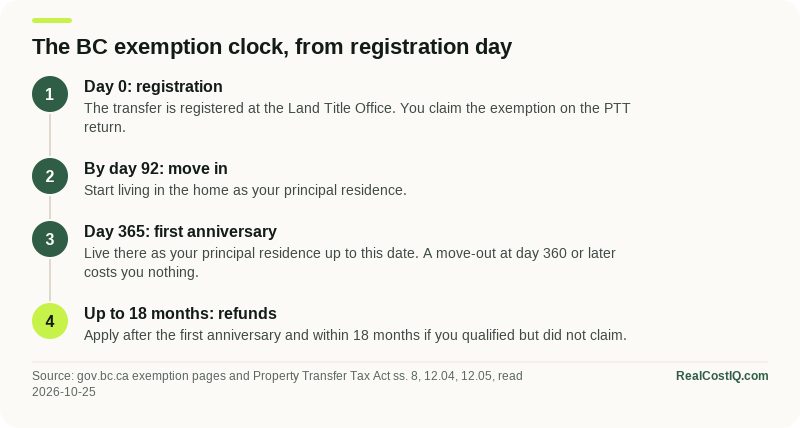
Practical points. The 92 days count from the registration date, not the possession date on the contract. Ask your lawyer for the registration date. If a job moves you away in month four, you have left before the first anniversary. Plan for that before you register.
What you repay if you leave early
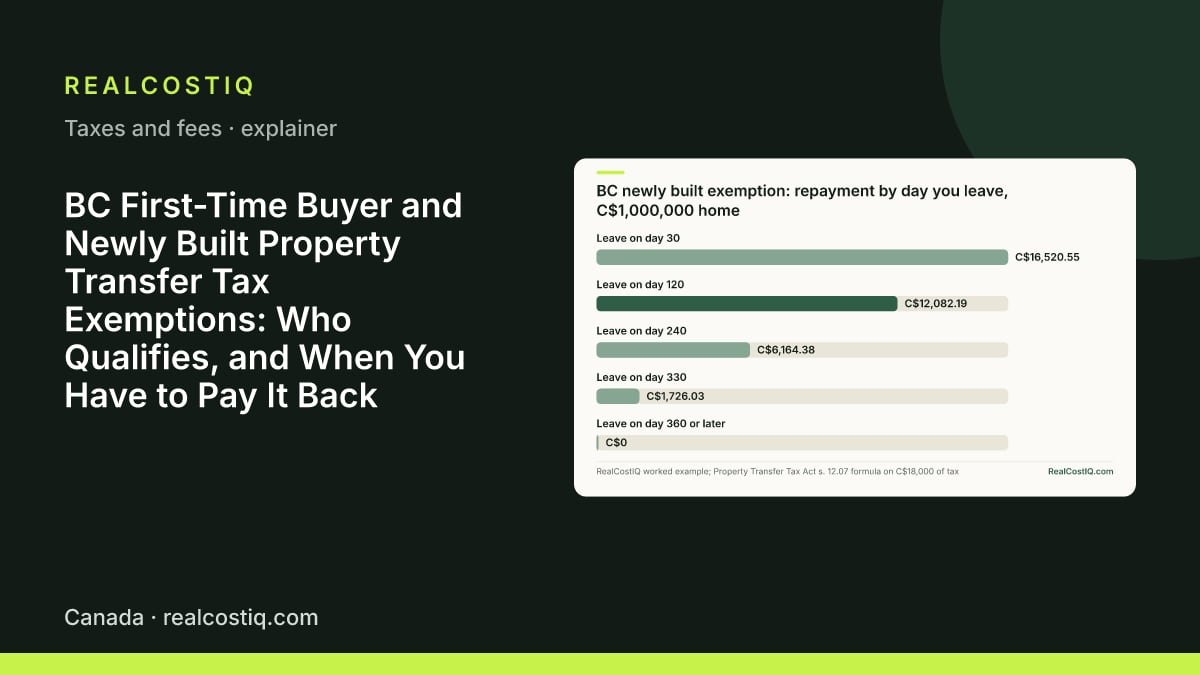
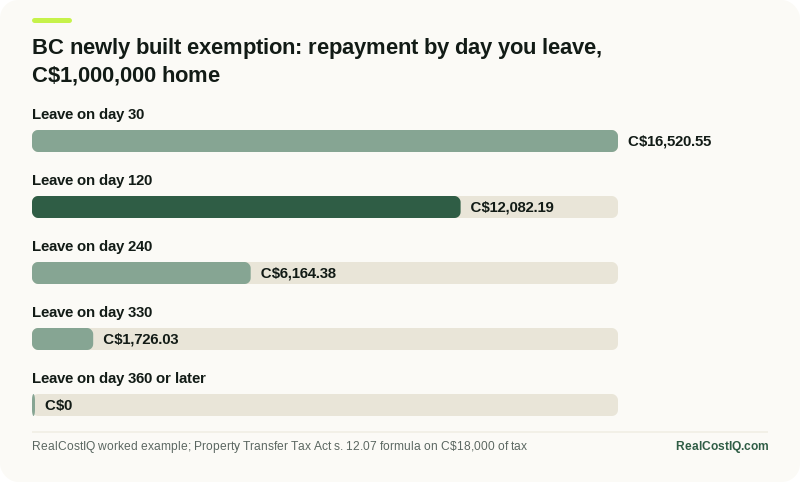
Section 12.07 of the Act covers newly built homes. If the only failure is that you stop living there before the first anniversary, liability begins on the day you stop. The tax owed is what would have been payable without the exemption. The Act then reduces it. If you stop on day 360 or later after registration, the reduction is 100% and you owe nothing. If you stop earlier, the amount is multiplied by 1 minus n over 365, where n is the number of days from registration to the day you stopped.
Here is a worked example. You buy a new condo for C$1,000,000, which is fully exempt. Tax before exemption is 1% of C$200,000 plus 2% of C$800,000. That is C$2,000 plus C$16,000, or C$18,000, the same figure the province uses in its own C$1,000,000 sample. You register and move in. Then life changes.
| You stop living there on day | Share still owed (1 − n/365) | You repay |
|---|---|---|
| 30 | 91.8% | C$16,520.55 |
| 92 | 74.8% | C$13,463.01 |
| 120 | 67.1% | C$12,082.19 |
| 180 | 50.7% | C$9,123.29 |
| 240 | 34.2% | C$6,164.38 |
| 300 | 17.8% | C$3,205.48 |
| 330 | 9.6% | C$1,726.03 |
| 360 or later | 0% | C$0 |
Our arithmetic from the Act's formula on C$18,000 of tax before exemption. Interest or penalties that the PTT office may add are not modelled. The Act's s. 12.08 keeps the exemption if the only failure is a death, or a transfer under a written separation agreement or a Family Law Act court order, before the first anniversary.
The sliding scale is only for someone who moved in on time and then left before the first anniversary. If you never move in within 92 days, there is no day count to credit you. Under section 9(2) for first-time buyers and section 12.07(3) for new homes, you repay the tax you would have paid without the exemption. On the C$1,000,000 example that is the full C$18,000.
For first-time buyers, the Act's section 9 follows a similar shape. The transferee who fails or stops complying with the move-in duty must pay the tax, and a reduction by days applies when the failure comes before the first anniversary, reaching 100% at 360 days. We read that section, but we did not work out a dollar example for it. The first-time buyer exemption is capped at C$8,000. The wording of the amount owed on a partial exemption is easy to misread. Call the PTT office on 1-888-841-0090 for the exact figure before you act. The government page says to contact them if you do not move in on time or move out early. It also says you may keep part of the exemption, based on the days you stayed.
Renting early and other trouble spots
Renting the whole home out in year one is, in the Act's words, a failure to inhabit it as your principal residence. We did not find a separate rental clause in the first-time buyer sections or in the newly built sections that we read. The rental rules in those sections of the Act belong to a different, purpose-built rental exemption. So the test is whether you lived there. A tenant in the whole home means you did not. Letting a room in a home where you also live is a different question. The pages do not address it. Ask before you rent.
- Never moving in. If you buy to rent from day one, you do not meet the move-in rule. Do not claim either exemption.
- Buying and flipping within the year. A sale before the first anniversary ends your occupancy. The clock above applies.
- A job transfer or divorce. A move-out is a failure unless the Act's exceptions apply. A transfer under a written separation agreement or a Family Law Act court order is one of the two exceptions. Death is the other.
- Becoming a permanent resident late. If you become a citizen or permanent resident within 12 months of registration, you may apply for a refund. It is a refund route, not a way to claim on day one.
- Large lots. A lot above 0.5 hectares, or a second building, gives a partial exemption. The formula uses the share of the value that qualifies.
Spouses, co-buyers and shares
The first-time buyer test in section 4 of the Act is about the individual. It does not refer to a spouse. The government pages do not set a spouse test for the first-time buyer exemption. So a spouse who owned a home before does not, on the text we read, end your own claim if you never held an interest. That is a reading of the Act, not a ruling. Ask your lawyer to confirm it for your facts.
Where a spouse or partner buys with you, their own test applies to their share. The province's first-time buyer amounts page gives a joint-tenant example, which is how many couples hold title. Two joint tenants buy a C$835,000 home and only one qualifies. Tax before exemption is C$14,700. The C$8,000 exemption is cut to C$4,000, so C$10,700 is payable. The government page says that if some purchasers do not qualify, only the qualifying buyers' percentage of the interest is exempt. In the province's own example, a C$700,000 purchase has tax of C$12,000. If one of two equal co-buyers qualifies, the exemption is C$4,000 and the tax payable is C$8,000. The same page shows C$850,000 with a partly eligible buyer, where the exemption is C$1,600 and tax payable is C$13,400.
So if one partner owned before, only the other partner's share is exempt when both go on title. Who goes on title is a decision for your lawyer and your lender, and it should be made before you register. Your mortgage approval is a separate matter from the tax test.
Putting the repayment risk into your plan
The exemption cuts your closing bill on day one. The repayment risk is a debt that may come later. Treat it like a deductible. On a C$1,000,000 new condo the early-exit bill is up to C$18,000 in the first days and falls over the year. On a first-time buyer purchase at C$600,000, tax before exemption is C$10,000 and the exemption is C$8,000, so you pay C$2,000 on registration. Under section 9(2) of the Act, the tax owed on a failure is the tax as if there were no exemption, which is C$10,000, so confirm the exact repayment with the PTT office before you plan around it. In both cases, a sale or a move in the first year changes the math. Add it to the cost of selling or moving.
Before you register, run through this list.
- Confirm your own tests: citizenship or permanent residence, one year in BC or two returns, and the never-owned rule.
- Ask your lawyer for the registration date and mark day 92 and day 360 on your calendar.
- Make a plan for the first year. If you may move for work, or sell, price in the repayment from the table above.
- Keep records that show you lived there: your address on your licence, bills and mail.
- If you qualified but did not claim, mark the 18-month deadline for a refund.
- Use the Canada land transfer tax calculator to see how BC compares with other provinces, and the first-time buyer total cost calculator to place the exemption inside your whole cost to buy.
That list is general. The Act and the PTT office decide your case. The dates and amounts above were read on 2026-10-25. Rates and thresholds can change at a budget, so check the government pages again on the day you sign.