You own a home. You want a bigger one. The new home closes on one date and the old home closes on another. That gap is the whole problem. You have three ways to deal with it. You can sell first and rent for a while. You can buy first and borrow the down payment with a bridge loan. Or you can buy first with no firm buyer for your old home. This post puts a price on each one, using one example, and shows which risk is the biggest.
The example move-up
We use round numbers. All of them are assumptions made for this post. They are not quotes. You can swap in your own figures later with the bridge loan calculator, which handles the day-by-day interest. We do not repeat its worked example here. This post is about the choice, not the arithmetic.
| Item | Amount | Where it comes from |
|---|---|---|
| Your old home sells for | C$700,000 | Assumption |
| Mortgage left on the old home | C$300,000 | Assumption: 4.50% rate, 20 years of amortization left |
| Selling costs (commission, tax, legal, discharge) | C$35,000 | Assumption, about 5% of the price |
| Cash you get after the sale | C$365,000 | C$700,000 less C$300,000 less C$35,000 |
| New home price | C$950,000 | Assumption |
| Down payment on the new home (20%) | C$190,000 | 20% of C$950,000 |
| New mortgage | C$760,000 | C$950,000 less C$190,000 |
Twenty per cent down means the new mortgage is not insured. Below 20% down you would also pay a Canada Mortgage and Housing Corporation (CMHC) premium. The selling-cost figure is a round assumption, not a published rate. No regulator sets a commission rate.
Land transfer tax on the new home is extra and is not in these figures. Check it with a land transfer tax calculator for your province. Notice one thing. After the sale you will have C$365,000. The down payment is C$190,000. So the money exists. The problem is only timing. If the new home closes first, the C$365,000 is still locked inside a sale that has not closed.
Plan A: sell first, then rent
This is the plain way. You list the old home. You close the sale. You rent a place until the new home closes. You never owe a bridge loan. You never own two homes. And you know exactly how much cash you have before you make an offer on the new one. In a market where sellers will take conditions, that certainty is a real strength.
It has costs too. Rent is the big one. You also move twice, once into the rental and once into the new home. You may rent storage. And you buy later, so you may lose the home you wanted. We priced the gap at 60 days with these assumed numbers.
| Cost | Amount |
|---|---|
| Rent, two months at C$2,800 | C$5,600 |
| Extra move | C$1,800 |
| Storage for two months | C$600 |
| Total | C$8,000 |
All three lines are assumptions. Rents, mover prices and storage vary a lot by city. Replace them with local quotes. There is no bridge loan, no second mortgage and no price risk on the old home.
Plan B: buy first, with a bridge loan on a firm sale
Here you sell your old home on your own terms, but you do it before you buy. You get a firm buyer first. Firm means the buyer has removed every condition: financing, inspection and anything else. (Our post on conditional and firm offers explains how that works in four provinces.) Then you buy the new home with a closing date that comes before your sale closes. The bridge loan lends you the C$190,000 down payment for the days in between.
What the lenders say
We opened the bridge pages of three Canadian sources on 2026-10-20. They agree on the main rule and differ on the details.
| Source | Sale agreement on the old home | Typical length | Other points |
|---|---|---|---|
| Royal Bank of Canada (RBC) | A firm sale agreement must be in place | Typically six months; terms run from 90 days to 12 months or longer | The rate is typically higher than conventional financing. The page gives no fee. |
| TD Canada Trust | A copy of the sale agreement and the purchase agreement | Typically up to 90 days | You must be approved for a TD mortgage or a TD Home Equity FlexLine on the new home. The rate is similar to an open-rate mortgage. The loan is reduced by estimated closing costs. |
| nesto (a Canadian mortgage lender) | A completed and signed sale agreement | Up to about 90 days; monthly interest is due if it runs past 90 days or the sale fails | About 8% fixed, or prime plus 2% to 5% variable. Up to 90% of net sale proceeds, and the lender may want 10% equity left after repayment. |
Prime is the benchmark rate that banks use to price variable loans. These pages describe typical terms. Your lender may differ. Ask for its terms in writing. Wahi, a Canadian brokerage, puts the usual bridge length at 30 to 120 days.
Three lessons come out of that table. First, a bank bridge needs a sale agreement for your old home. A listing is not enough. Second, the loan is short, usually 90 days or less at the big banks. Third, a bank often wants your new mortgage too. TD says you must be approved for its mortgage or credit line on the new home. So you may lose the freedom to shop the new mortgage to every lender.
What it costs in our example
We assume a bridge rate of 6.50%. That is prime near 4.45% plus about 2 points. The 4.45% figure was the major-bank prime rate our bridge loan calculator used when this post was written, set against a Bank of Canada policy rate of 2.25%, which the Bank held on 2026-09-02. Banks raised prime to 4.70% effective October 29, 2026, after the Bank of Canada's October 28 increase, so the calculator's default bridge rate is now higher. The rate is an assumption. It sits inside the prime plus 2% to 5% range that nesto describes. We also add a C$450 lender fee and a C$250 legal fee. Those two are the default figures on the calculator page.
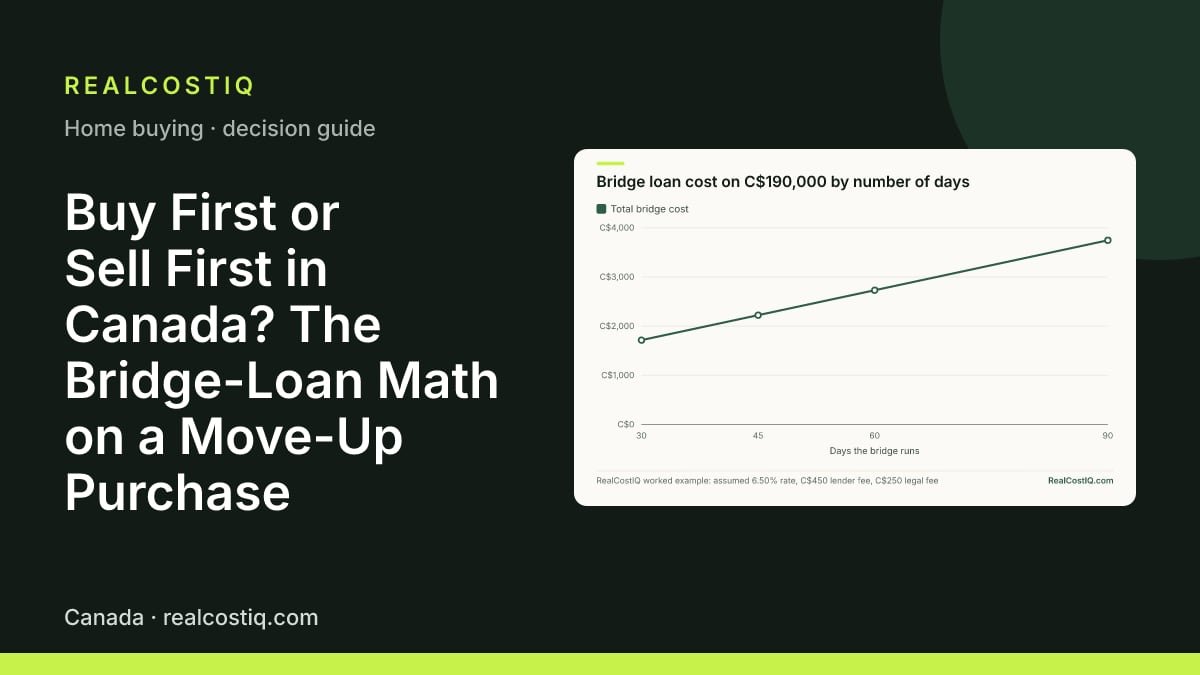
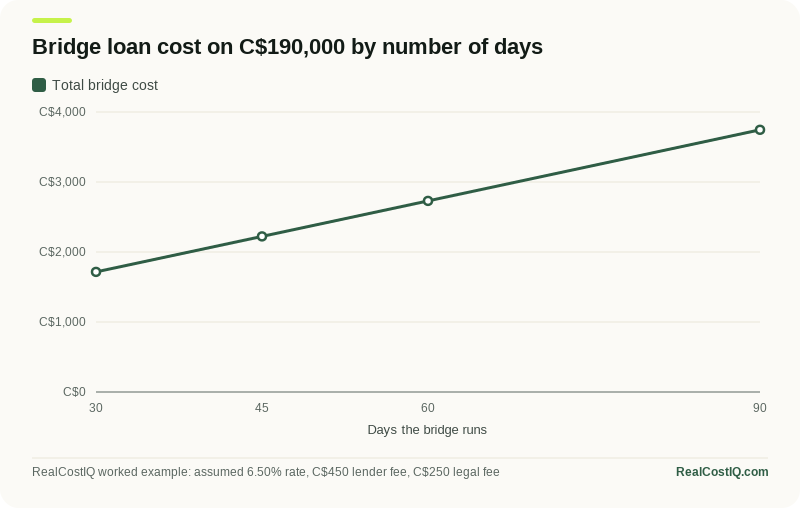
Interest on a bridge loan builds up day by day. On C$190,000 at 6.50% it is about C$33.84 a day. The table shows the full cost for four bridge lengths.
| Days the bridge runs | Interest | Fees (C$450 + C$250) | Total bridge cost |
|---|---|---|---|
| 30 days | C$1,015 | C$700 | C$1,715 |
| 45 days | C$1,523 | C$700 | C$2,223 |
| 60 days | C$2,030 | C$700 | C$2,730 |
| 90 days | C$3,045 | C$700 | C$3,745 |
Interest = C$190,000 x 6.50% / 365 x days, rounded to the dollar. This is simple daily interest on the bridged amount and nothing else.
A bridge loan is not the only cost of buying first. You also own two homes for a while. For our example we assume the old home costs C$2,015 a month to hold. That is about C$1,115 of mortgage interest on C$300,000 plus C$900 for property tax, heat, power and insurance. The C$900 is an assumption. Over 1.5 months that is C$3,023. Over three months it is C$6,045. Add the two parts together and a 45-day overlap costs C$5,246. A 90-day overlap costs C$9,790.
Plan C: buy first when the old home has no firm buyer
Maybe you want to buy now, but your old home is still on the market. A bank bridge loan is usually closed to you. RBC requires a firm sale, and TD asks for a copy of the sale agreement. You then have other routes, and each has a catch.
- A home equity line of credit (HELOC). This is a credit line secured on your old home. WealthNorth, a Canadian mortgage brokerage, says it must be set up before you need it and that it is often cheaper than a bridge. You can only borrow what you have been approved for.
- A private bridge loan. WealthNorth says private lenders do not need a firm sale. It also says they cost more: 10% to 18% a year, a lender fee of 1% to 2% of the loan, and a broker fee near 1%. These are broker-page figures, not quotes.
- A conditional offer on the new home. You make your purchase depend on selling the old one. This is the safest in a pure money sense. WealthNorth notes that sellers often turn these down.
- Savings. If you hold the cash, you need no loan at all.
For Plan C we assume a HELOC at 5.45%, which is prime plus one point, on the C$190,000. That is an assumption, since a HELOC rate is set by your lender. Over 90 days it costs C$28.37 a day, or C$2,553. Add C$6,045 to hold two homes for three months and the total is C$8,598. We chose 90 days because with no buyer lined up you cannot say when the old home will sell. It could be 30 days or 200.
The three plans side by side
| Plan | What you pay for | Cost | Main risk |
|---|---|---|---|
| A: sell first, rent 60 days | Rent, an extra move, storage | C$8,000 | You may lose the new home while you wait |
| B: buy first, firm sale, 45-day overlap | Bridge loan plus two homes | C$5,246 | Your buyer fails to close |
| B: buy first, firm sale, 90-day overlap | Bridge loan plus two homes | C$9,790 | Your buyer fails to close |
| C: buy first, no firm sale, 90 days | HELOC interest plus two homes | C$8,598 | The old home sells for less, or later |
Every cost line except the bridge-loan formula is an assumption. Run your own numbers. The order of the plans matters more than the exact dollars.
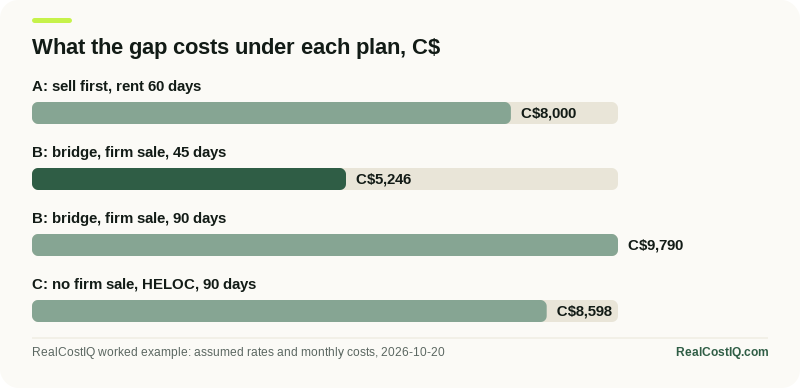
Read the table and a surprise appears. The dollars are close. A bridge loan looks scary, but its interest is the smallest line in Plan B. The two-home carrying cost is bigger. And the choice between plans depends much less on these costs than on what could go wrong.
The risk that costs more than the interest: your sale price
In Plan A you know your sale price before you buy. In Plan B you know it too, because the sale is firm. In Plan C you do not. You bought on a guess. If the old home sells for 5% less than C$700,000, you lose C$35,000. That is more than any figure in the table above. One percent is C$7,000.
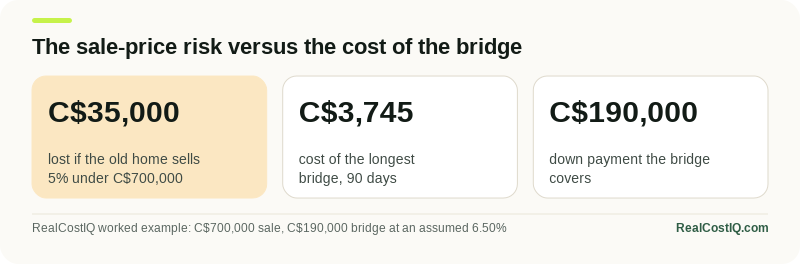
A lower price also changes the cash you have left. In our example you would still have more than the C$190,000 you need. But a thinner margin matters if the new mortgage payment is a stretch. It also matters if the lender wants 10% of equity left, as nesto says some do.
A firm sale takes this risk away, for the most part. It does not take away the risk that the buyer cannot close. If that happens, the bridge loan is still yours to repay. WealthNorth and nesto describe what follows: you may carry two mortgages while you find a new buyer, and the bridge may fall due or start charging monthly interest before your sale closes. The loan is only as safe as the contract behind it.
Will the bank let you carry two homes?
Cost is one thing. Approval is another. When you buy first, the lender may count the payment on the old mortgage as well as the new one. WealthNorth says you must qualify for both. A firm sale can change that. The lender then knows the old mortgage is about to be paid off.
Here is the scale. At an assumed 4.50% and a 25-year amortization, the C$760,000 new mortgage costs about C$4,206 a month. Canadian fixed-rate mortgages compound twice a year, which is why a Canadian payment differs from a US payment at the same rate. The Office of the Superintendent of Financial Institutions (OSFI) sets the minimum qualifying rate for uninsured mortgages at the greater of your contract rate plus 2 points, or 5.25%. Its page was last changed on 2026-01-29. Here that rate is 6.50%, and the payment at 6.50% is about C$5,091. The old mortgage adds C$1,891 a month. So a lender that counts both could test you against C$6,982 a month, before property tax and heat.
That is the number to check before you offer. It is a test payment, not what you pay. You would actually pay C$4,206 plus C$1,891 for as long as you own both. If you are close to the limit, Plan A is the safe choice.
How to choose
- Sell first if your old home is likely to sell fast, you can live with one extra move, or the numbers above leave you little room. It is the plan with the fewest ways to go wrong.
- Buy first with a bridge if you have found a home you do not want to lose and you can get a firm sale at a price you accept. Set the closing dates close together. Every day of overlap adds interest and carrying cost.
- Buy first with no firm sale only if you can take a lower sale price. That means a cushion in cash, a HELOC already approved, and an income that carries both homes. If any of those is missing, wait.
- Try a long closing on the old home or a short one on the new. Dates are negotiable. A seller who wants a quick close may agree to a date that cuts your overlap to a few days.
What to ask your lender before you decide
- Does the bridge need a firm sale, or will you lend against a listing?
- What is the longest term, and what happens on day 91?
- What are the rate, the admin fee and the legal fee, in writing?
- Must the new mortgage be with you?
- How much of my net sale proceeds will you lend, and how much equity must stay?
- Will you count the old mortgage payment when you approve the new mortgage?
- If my buyer does not close, what are my options?
If you also plan to pay off the old mortgage early to free the equity, that can add a penalty. See our mortgage penalty calculator before you commit. The full list of costs a seller meets, from commission to the discharge fee, is in our post on the cost of selling a home in Canada.
What this post did not read
- We did not find a published bridge fee at RBC or TD. The fees in our example are the defaults on our calculator page, which cite a Canadian mortgage site.
- We did not open the bridge pages for Scotiabank, BMO or CIBC. Their terms may differ from the three we show.
- We did not confirm any recent forum thread by opening it. RedFlagDeals now sends automated readers to a paid gateway, so we could not read the threads.
- Every rent, moving, storage, carrying and selling-cost figure is an assumption. They are there to show how the plans compare, not what you will pay.