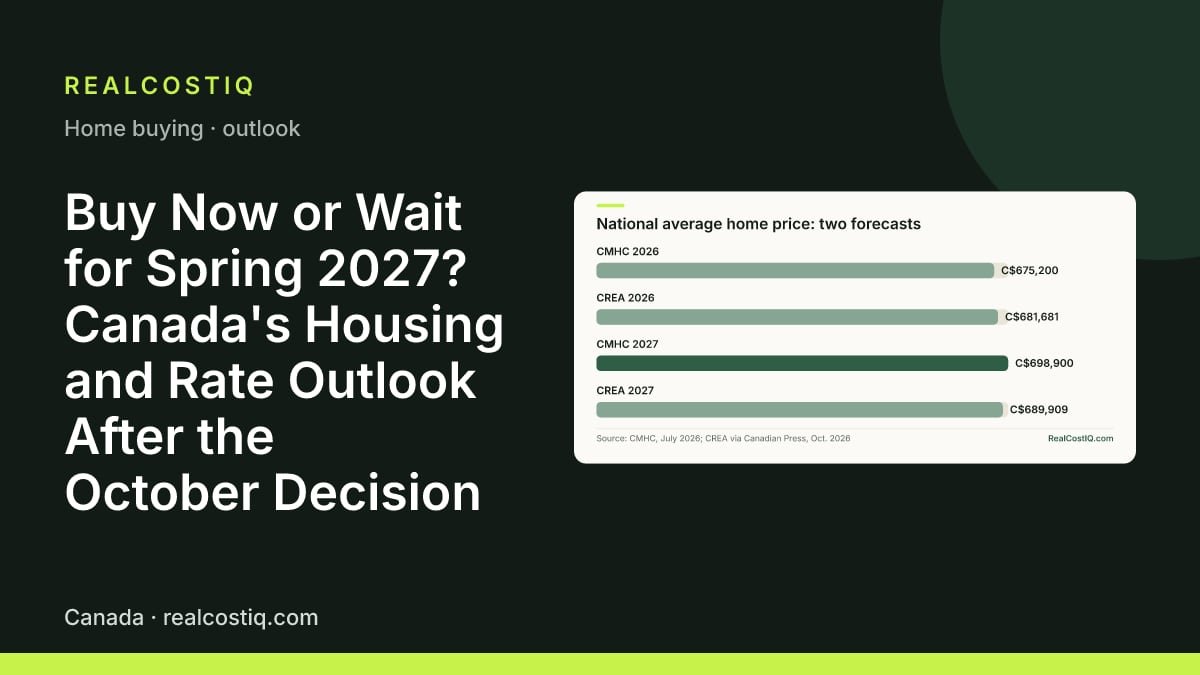
On October 28, 2026 the Bank of Canada raised its policy rate by a quarter point to 2.50%. Many people who were thinking about buying now ask a fair question. Should I go ahead, or should I wait for spring? This post does not tell you which. It shows what the main sources expect, what waiting costs, and what would have to happen for waiting to pay off.
We use Canadian dollars (CAD) and Canadian mortgage rules throughout. We read the Bank of Canada, CMHC, the Canadian Real Estate Association (CREA), OSFI and RBC. We already wrote about what the rate hike does to a payment in our post on the Bank of Canada's October 28 decision and about choosing a rate type in our fixed or variable post. Here we look at the timing question only.
In plain English
- Rates are the bigger risk right now. The Bank of Canada raised its rate on October 28 and said there could be a need to raise it further. Its next decision is December 9, 2026.
- Prices are flat to soft. CREA's benchmark price index was down 3.4% from a year earlier in September. CMHC cut its 2026 forecast in July and expects only a small rise in 2027.
- The forecasts disagree. For 2027, CMHC sees a 3.5% rise in the national average price. CREA sees 1.2%. Treat both as guesses.
- Waiting has a price. You pay rent, you do not build equity, and a rate rise lifts your payment. Waiting has a benefit too: more savings, and maybe a lower price.
- The stress test sets your limit. You must qualify at your rate plus 2 percentage points, or 5.25%, whichever is higher. When rates rise, the amount you can borrow falls.
What changed on October 28
The Bank of Canada raised its overnight rate target by 25 basis points to 2.5% on October 28, 2026, and said there could be a need to increase the policy rate further. Its next decision is December 9, 2026. The decision and the payment paths are in our post on the Bank of Canada's October 28 decision, so we do not repeat them here.
On housing, the Monetary Policy Report says activity remains weak. It says some consumers reported that trade uncertainty could lead them to postpone major purchases. It also says inflation in shelter services should rise from a little over 1% at the end of 2026 to about 2% in 2027, and that rising borrowing costs add pressure to housing-related expenses.
Fixed mortgage rates follow bond yields more than the policy rate. The Bank of Canada shows the five-year Government of Canada benchmark yield at 3.62% on October 28. RBC's page, which we read on October 29, shows a special offer 5-year fixed rate of 5.14% and a 5-year variable rate of 4.40% (prime minus 0.30%), with RBC prime at 4.70%. Those are one lender's advertised rates on one day. Your own quote will differ.
What the forecasters expect
Two groups publish national forecasts that most lenders and agents quote. CMHC is the federal housing agency. CREA is the national association of real estate boards. They use different methods and dates.
| Measure | 2025 actual | 2026 | 2027 | 2028 |
|---|---|---|---|---|
| CMHC: average MLS price | C$679,543 | C$675,200 | C$698,900 | C$717,300 |
| CMHC: MLS sales | 470,314 | 457,200 | 472,900 | 485,500 |
| CMHC: 5-year fixed mortgage rate | 5.1% | 5.2% | 5.4% | 5.5% |
| CREA: average price | n/a | C$681,681 | C$689,909 | n/a |
| CREA: sales | n/a | 444,530 | 464,235 | n/a |
CMHC: Summer 2026 Housing Market Outlook, baseline scenario, data as of June 23, 2026. CREA figures as reported by The Canadian Press on October 16, 2026. 2026 and later figures are forecasts, not actual results. 'n/a' means we did not read a figure.
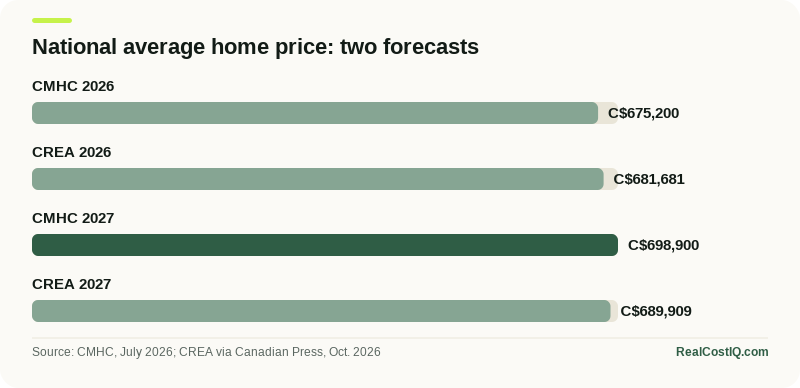
A few points stand out. CMHC cut its view in July. It had expected sales and prices to rise in 2026, and now says activity has been weaker than expected. It blames slower population growth, economic uncertainty, high mortgage rates and slow income growth. CMHC adds that better affordability alone has not brought many buyers back. CREA has cut its sales forecast three times this year.
CMHC's mortgage rate assumption also matters. It expects the 5-year fixed rate to average 5.2% in 2026 and 5.4% in 2027. That forecast was made before the October rate hike. If the Bank of Canada raises again, fixed rates could end up higher. If bond yields fall, they could end up lower. Neither group can know.
Prices are local. CMHC's July outlook has Toronto's average price at C$1,067,846 in 2025, falling to C$1,020,000 in 2026 and rising to C$1,050,000 in 2027. For Vancouver it has C$1,189,251 in 2025 and C$1,160,000 in 2026. For Calgary it has C$644,091 in 2025 and C$650,000 in 2026. A national average hides all of that. If you shop in one city, use that city's trend, not the national one.
One more point from the CREA report. The Canadian Press quotes a broker who says many buyers moved in summer or early fall to lock in rates, leaving a much shorter fall market. It also says sellers are in limbo and may wait until next year. That is one person's view in a news story, not a forecast. It does suggest that spring could bring more listings, but we found no source for how prices will behave.
What waiting costs: a C$600,000 example
Let us make the question concrete. A first-time buyer wants a C$600,000 home with 10% down, which is C$60,000. CMHC's minimum is 5% of the first C$500,000 plus 10% of the rest, or C$35,000, so 10% is above the minimum. At 10% down the CMHC premium is 3.10%, which CMHC adds to the loan. The loan is C$540,000 plus a C$16,740 premium, or C$556,740. We use a 25-year amortization and a 5.14% rate, with semi-annual compounding as Canadian fixed-rate mortgages do. The rate is an example from RBC's page, not an offer.
At those terms the payment is C$3,282.54 a month. Now suppose you wait until spring and two things move: the price and the rate. We show a grid. The rows are the price. The columns are the rate. We hold the down payment at 10% of the price in every cell.
| Price in spring | Rate falls to 4.89% | Rate stays 5.14% | Rate rises to 5.40% |
|---|---|---|---|
| C$579,600 (down 3.4%) | C$3,094.34 | C$3,170.93 | C$3,251.51 |
| C$600,000 (flat) | C$3,203.25 | C$3,282.54 | C$3,365.96 |
| C$621,000 (up 3.5%) | C$3,315.37 | C$3,397.43 | C$3,483.76 |
Our calculation. 3.4% is the fall in CREA's benchmark price index from September 2025 to September 2026. 3.5% is CMHC's forecast rise in the national average price for 2027. 5.40% is CMHC's 2027 forecast for the 5-year fixed rate. 4.89% is a hypothetical 0.25-point cut. These are scenarios, not forecasts.
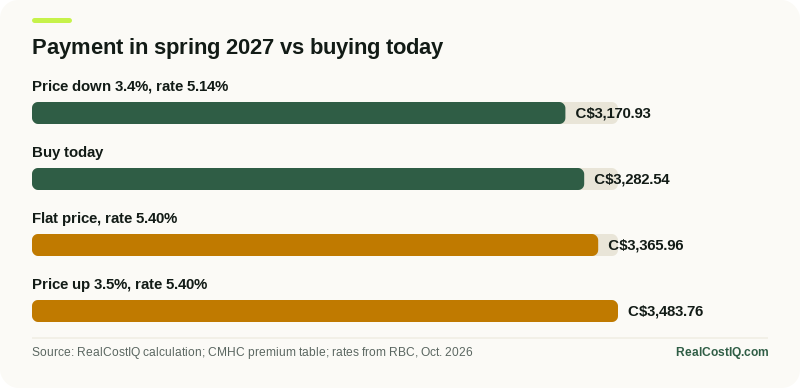
Read the middle column first. If the rate stays where it is, a 3.4% price fall saves C$111.61 a month, and a 3.5% rise costs C$114.89 a month. Now read the flat price row. A rate rise to 5.40% adds C$83.42 a month. The corner cells show the two risks stacking. Rising price and rising rate together add C$200.22 a month (C$3,483.76 less C$3,282.54).
How much must the price fall to cancel a rate rise from 5.14% to 5.40%? We solved it. A price near C$585,131, which is 2.48% lower than C$600,000, gives the same C$3,282.54 payment at 5.40%. In the other direction, if the rate fell to 4.89%, the price could rise to about C$614,851 (2.48% higher) and your payment would stay the same. So a 0.25-point rate move is worth about 2.5% of the price on this loan.
The grid leaves out your savings. If you save C$1,000 a month while you wait, six months adds C$6,000 to your down payment. Our mortgage affordability calculator shows how a bigger down payment changes what you can borrow. The grid also leaves out rent. We do not know your rent. Add it up for yourself. A tenant pays rent and builds no equity. An owner pays interest and also pays property tax, insurance and repairs. The right comparison is in our rent vs buy calculator.
For scale, here is what six months of ownership looks like on this loan. Payments total C$19,695. Of that, C$14,098 is interest and C$5,597 reduces what you owe. The interest is a cost, like rent. The C$5,597 is not. It is the part of waiting that you give up if you wait six months.
The stress test sets what you can borrow
OSFI's page, last updated January 29, 2026, says the minimum qualifying rate is the greater of your contract rate plus 2% or 5.25%. CMHC's page says insured mortgages use the same rule, and limits your housing costs to 39% of gross income and your total debts to 44%. Housing costs count principal and interest, property tax, heat and half of any condo fees.
So when the rate you are offered rises, the rate you must pass also rises. At 5.14%, you are tested at 7.14%. At 5.40%, you are tested at 7.40%. Take our C$600,000 home. Add C$400 a month for property tax and C$150 for heat. Those are assumptions, not quotes. The income the lender needs works out to about C$138,392 at 5.14% and C$141,168 at 5.40%. A rate rise of 0.26 points means you need about C$2,776 more income to qualify for the same house.
That matters most if you are close to your limit. If your pay will rise by spring, waiting could help you qualify. If it will not, a higher rate can push you below the price you want. Check your limit now with a lender, and again if rates move.
Many lenders also offer a rate hold on a pre-approval. If you hold a rate, you can shop for a home for a set period, and your rate cannot rise while the hold lasts. Ask your lender how long it lasts and whether it is binding. A rate hold lets you separate two questions. You can lock the rate risk and still take your time on price.
Five questions that decide it
- Is the payment safe at a higher rate? Test your budget at the stress-test rate. If it only works at today's rate, waiting for more savings may be wise.
- How soon does your lease end? If you face a rent rise or must move, the cost of staying a renter is real. If your lease runs to summer, you have more room.
- Is your income likely to rise? A raise, a second income or a clean credit record by spring can lift the amount you can borrow.
- Is your down payment close to a CMHC line? Moving from 5.83% down to 10% down cut the premium rate from 4.00% to 3.10% in our FHSA and HBP post. Saving a little more can lower the premium rate.
- What is the local market doing? National figures hide big gaps. Look at sales, listings and price trends in your city and in the type of home you want.
Mistakes to avoid
- Waiting for a signal that does not come. Forecasts change. CMHC changed its view in July. CREA has changed its view three times this year.
- Treating a rate forecast as a promise. The Bank of Canada said it "could" need to raise again. That is not a plan.
- Ignoring the stress test. A rate rise that looks small can cost you the home you were approved for.
- Comparing price only. A price fall of about 2.5% is wiped out by a quarter-point rate rise on this loan, as the grid shows.
- Stretching to beat a deadline. A rushed purchase above your budget is worse than waiting.
- Using the national average for a local choice. Toronto, Vancouver and Calgary are on different paths in CMHC's outlook.
When your five-year term ends, the same question comes up again at renewal. A higher rate at that point lifts your payment again, so think about your long run as well.
What this post did not read
We did not read CREA's own release text. We used the Canadian Press report of it, and CREA's news page for the headline and date. We did not read the full Monetary Policy Report section on housing beyond the passages we quote. We did not find a source that says how prices behave in spring, so we make no claim about it. We did not read a forum thread from the last 12 months. Reddit would not load for us. The C$600,000 home, the C$400 property tax and the C$150 heat cost are assumptions. This post is general information, not advice about your own purchase. A mortgage broker or lender can price your case.