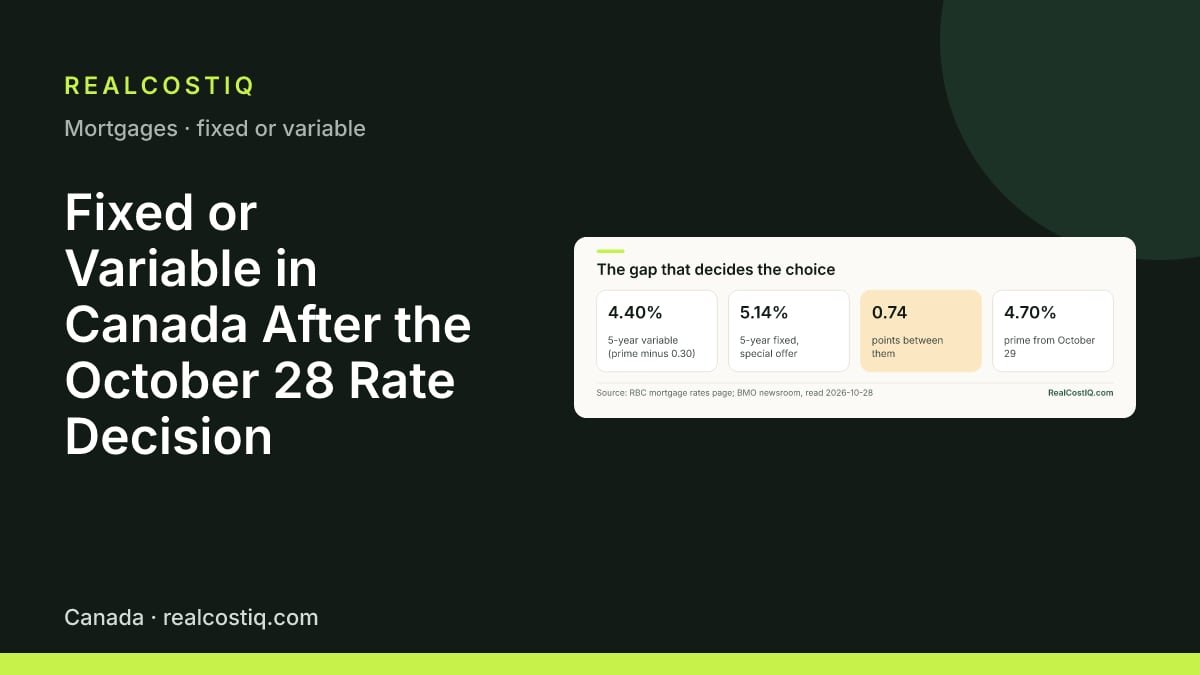
The Bank of Canada raised its policy rate on October 28, 2026. For anyone choosing between a fixed and a variable mortgage, the question now has a sharper edge. If the Bank is raising rates, is a variable mortgage a bad bet?
The answer depends on one number: how far prime has to rise before a variable mortgage costs more than a fixed one. This post works that number out from rates posted on October 28, 2026. It does the sums on two mortgages. The first is C$600,000, which fits a C$800,000 home in Ontario with 25% down. The second is C$750,000, which fits a C$1,000,000 home in British Columbia with 25% down. These are examples, not provincial averages. All amounts are Canadian dollars (CAD).
This is general information, not mortgage advice. Rates change daily, and your own lender's offer is the number that counts.
What changed on October 28
The Bank of Canada raised its overnight rate target by 0.25 percentage points, to 2.5%. The Bank Rate is now 2.75%. In its statement, the Bank said inflation is higher and more persistent than it projected in July, with high oil prices feeding into costs. It said there could be a need to increase the policy rate further, and that it would proceed carefully. The next announcement is on December 9, 2026.
Banks followed with prime. BMO's release on October 28 says its prime rate moves from 4.45% to 4.70%, effective October 29. RBC's mortgage page, read the same day, shows a prime rate of 4.700%. Variable mortgages are priced as prime plus or minus a set amount, so every variable rate moved up by 0.25 points.
The overnight rate does not set fixed rates directly. They follow bond markets. The Bank of Canada's table shows the Government of Canada 5-year bond yield at 3.57% on October 27, 2026. A 5-year fixed mortgage rate is set above that yield, and the lender's margin is what you pay for the lender taking the risk that rates rise.
So the hike matters for this choice in two ways. First, it raises the starting rate on every variable mortgage. Second, it tells you something about the path. The Bank said it might raise again. It did not say it would.
The rates in front of you on October 28
A fair comparison uses the same lender, the same day and the same kind of mortgage. RBC's mortgage page, read on October 28, 2026, gives us that. We use the rates for a mortgage with a 25-year amortization or less and a 5-year term, with a down payment of at least 20%. The page shows no "as of" date, so treat these as the rates on the day we read it.
| Type | Rate | How it is built |
|---|---|---|
| Fixed, special offer | 5.14% | A special rate for new mortgages and switches |
| Fixed, posted rate | 6.19% | The list price that few buyers pay |
| Variable, special offer | 4.40% | Prime (4.70%) minus 0.30 |
| Variable, posted rate | 4.70% | Prime plus 0.00 |
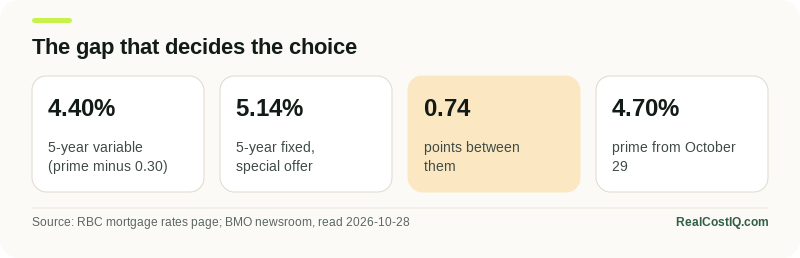
| Gap, fixed special minus variable special | 0.74 points | What certainty costs at the start |
Source: RBC mortgage rates page, read 2026-10-28. The 5-year fixed posted rate also appears in the Bank of Canada's weekly table of posted rates at 6.19%, unchanged since October 7, 2026.
Two things stand out. First, the special rates sit well below the posted ones. A buyer who quotes the posted fixed rate, 6.19%, is quoting a price almost nobody pays. Second, the gap between the special fixed rate and the special variable rate is 0.74 points. That gap is the key number in the rest of this post.
A second look at the market shows a similar gap. The comparison site Ratehub.ca lists its lowest 5-year rates on a page stamped October 29, 2026. For insured (high-ratio) mortgages, the lowest fixed rate was 4.44%, from a lender the site does not name. The lowest variable rate was 3.69%, from Meridian Credit Union, at prime minus 1.01. The gap is 0.75 points. Two different data sources, both under 1 point, both about three quarter-point moves.
How far prime has to rise: the break-even
Here is the idea in plain terms. Over a five-year term, a variable mortgage costs the same as a fixed one when its rate, averaged over the five years, equals the fixed rate. The fixed rate is 5.14%. The variable rate starts at 4.40%. So the variable rate has to average 0.74 points higher than today, which means prime has to average about 5.44% over the term, up from 4.70%.
Three more quarter-point moves are 0.75 points. So a rough rule is: if the Bank adds three more quarter-point hikes soon and leaves them in place for the whole term, the two mortgages cost about the same. Fewer than that, and variable costs less. More than that, and fixed costs less. If the hikes come slowly, or are later cut, the average is lower and the break-even is further away.
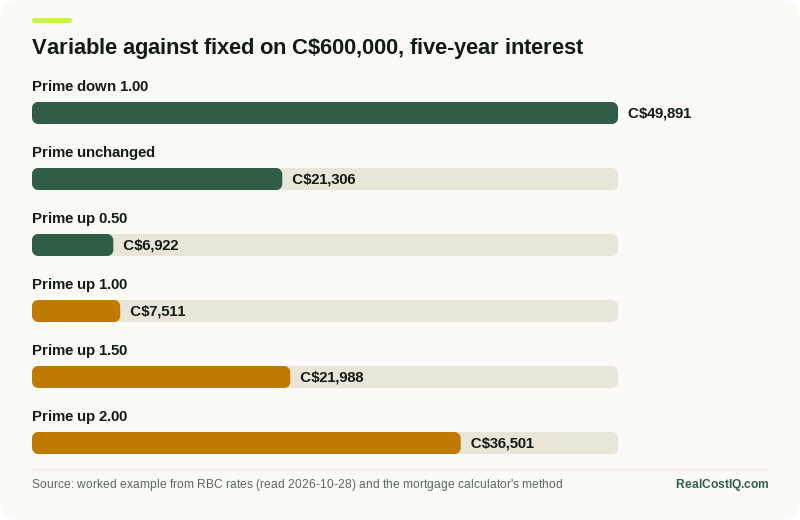
To make that concrete, we ran the numbers on the Ontario example: a C$600,000 mortgage, 25-year amortization, a 5-year term. We used the same Canadian interest method as the mortgage calculator. Under section 6 of the Interest Act, a mortgage rate must be calculated yearly or half-yearly, not in advance, and the calculator compounds half-yearly. The variable mortgage has an adjustable payment, so the payment is recalculated when the rate changes and the amortization stays at 25 years. Each row below assumes prime moves by the amount shown on day one and stays there for five years.
| Prime change on day one, held 5 years | Variable rate | First monthly payment | Interest paid in 5 years | Compared with fixed |
|---|---|---|---|---|
| Fixed at 5.14% | 5.14% | C$3,537.60 | C$144,462 | Baseline |
| Down 1.00 | 3.40% | C$2,964.04 | C$94,571 | C$49,891 less |
| Down 0.50 | 3.90% | C$3,123.68 | C$108,831 | C$35,632 less |
| No change | 4.40% | C$3,287.56 | C$123,156 | C$21,306 less |
| Up 0.50 | 4.90% | C$3,455.55 | C$137,540 | C$6,922 less |
| Up 1.00 | 5.40% | C$3,627.50 | C$151,974 | C$7,511 more |
| Up 1.50 | 5.90% | C$3,803.25 | C$166,451 | C$21,988 more |
| Up 2.00 | 6.40% | C$3,982.64 | C$180,964 | C$36,501 more |
Worked example using the same method as the mortgage calculator: semi-annual compounding, monthly payments, 25-year amortization, adjustable payment on the variable. The fixed payment does not change. Rates from the RBC page, read 2026-10-28. Interest is the interest paid in the 60 months of the term, not the lifetime total.
Read the "No change" row first. If prime stays at 4.70% for five years, the variable mortgage saves C$21,306 in interest, and the first payment is C$250.04 a month lower. That is the benefit of the starting gap. Then read down. Prime needs to rise by about 0.74 points, so the row between "Up 0.50" and "Up 1.00," before variable costs more than fixed. At "Up 1.00," variable costs C$7,511 more.
Notice also how lopsided the table is. A fall of 1 point saves C$49,891 against fixed. A rise of 1 point costs C$7,511. The cost of the bet is small on the way up, and the reward is large on the way down. That is because the variable mortgage begins with a head start of 0.74 points. The picture changes if the head start is smaller, which is why you must check the actual gap on your own offers.
A British Columbia example: C$750,000
A bigger mortgage magnifies both sides. We ran the same test on C$750,000, which is a C$1,000,000 home with 25% down, using the same RBC rates and a 25-year amortization. The break-even does not change, because the rate gap is what sets it. The dollars do.
| Prime change on day one, held 5 years | First monthly payment | Interest paid in 5 years | Compared with fixed |
|---|---|---|---|
| Fixed at 5.14% | C$4,422.00 | C$180,578 | Baseline |
| Down 0.50 | C$3,904.60 | C$136,038 | C$44,540 less |
| No change | C$4,109.45 | C$153,945 | C$26,633 less |
| Up 0.50 | C$4,319.44 | C$171,925 | C$8,653 less |
| Up 1.00 | C$4,534.37 | C$189,967 | C$9,389 more |
| Up 1.50 | C$4,754.06 | C$208,063 | C$27,485 more |
Same method and rates as the table above. Province does not change the rate a national lender posts; the larger loan is what changes the dollars. The land transfer tax and closing costs differ by province and are not part of this comparison.
On the larger loan, a rise of 1 point makes the payment C$112.37 higher than the fixed payment, even though variable began C$312.55 lower. The numbers show the shape of the risk: variable begins ahead, and loses its lead as prime climbs. In British Columbia and Ontario alike, what matters is whether you could carry the payment if the lead disappears.
Rates do not differ by province for a national lender, but the cost of buying does. Land transfer tax is a separate cash cost at closing, and if you are short on closing cash, a cheaper starting payment can look more tempting than it should. Keep the two decisions apart. This post does not model closing costs.
The path matters: payment, not just total cost
The tables above hold prime flat after day one. Real life is a staircase. To see what a staircase does, we ran a path in which prime rises 0.25 points at month 3, again at month 9, month 15 and month 21, then stays flat. That is four more hikes spread over about two years, finishing at 1.00 above today's prime.
On the C$600,000 mortgage, the variable payment starts at C$3,287.56 and ends at C$3,617.58 by month 21. Over five years the variable mortgage costs C$146,299 in interest, which is C$1,836 more than the fixed mortgage. That is almost a tie on total cost. But the monthly payment ends C$79.98 above the fixed payment of C$3,537.60, and it rose by C$330.02 in under two years.
On the C$750,000 mortgage, the same staircase takes the payment from C$4,109.45 to C$4,521.97. Interest over five years is C$182,873, or C$2,295 more than fixed.
This is the real lesson of the staircase. Even when variable nearly ties fixed on total cost, you live through the payment rising, and a household budget feels payments, not totals. The question to ask is not only "Which costs less?" but "Can I pay C$330 more a month, with no notice, in two years?" If the honest answer is no, the 0.74 points you save today is a price you are paying for a risk you cannot carry.
What the stress test does to your choice
If your mortgage is uninsured (a down payment of 20% or more) and comes from a federally regulated lender, you must qualify at a higher rate than the one you will pay. OSFI's rule, on a page last modified January 29, 2026, is that the minimum qualifying rate is the greater of the contract rate plus 2 percentage points or 5.25%. OSFI reviews it at least once a year.
That rule makes the choice matter before you sign. On the RBC rates above, the fixed mortgage qualifies at 7.14% (5.14% plus 2). The variable qualifies at 6.40% (4.40% plus 2). On a C$600,000 mortgage with a 25-year amortization, the payment used to qualify is C$4,254.48 for the fixed and C$3,982.64 for the variable. That is C$271.84 a month less for the variable.
If your income only just clears the limit, that lower qualifying payment can allow a mortgage about 6.8% larger. On C$600,000 that would be a gap of roughly C$41,000 in borrowing power. This is only a rough guide, because lenders also look at your other debts, your heating and tax costs, and their own rules. But it means that for some buyers the variable rate is not just cheaper: it is the only way to qualify for the home. If that is you, the right question is whether the home is affordable at the higher rate, not whether variable is smart.
The mortgage calculator lets you test your own price, down payment and rate against your income. Run it at the stressed rate, not just the contract rate.
If you need to get out before five years
A five-year term is the usual choice in Canada, but many people do not stay in a home for five years. Selling, refinancing or switching lenders before the term ends can trigger a prepayment penalty. The Financial Consumer Agency of Canada says breaking a closed mortgage normally means a penalty that can cost thousands of dollars.
How the penalty works differs by type. TD, in an article from August 2020, says that for a variable-rate closed mortgage the charge is three months of interest. For a fixed-rate closed mortgage it is the higher of three months of interest or the interest rate differential, or IRD. Lenders word this differently, and the article is old, so read your own contract. But the shape is common: a variable penalty is usually modest and easy to predict, and a fixed penalty can be much larger if rates have fallen since you signed.
As a rough guide, three months of interest on C$600,000 at 4.40% is about C$6,600 (the balance times the rate, divided by four). That is only an estimate and ignores compounding. A fixed-rate penalty can be higher or lower, depending on how far rates have moved and how long is left in the term.
This gives variable one more point in its favour for people who may move: the penalty is usually the smaller, more predictable one. It gives fixed one point for people who may not move: the payment never changes. If you might sell in two or three years, weigh that. If you are certain you will keep the home to the end of the term, the penalty is not part of your decision.
When the term ends you face the same choice again. The mortgage renewal calculator shows what a new rate does to your payment at renewal. A 5-year term renewing into a higher rate is the other side of this decision, and it is the one that catches people who chose fixed in a low-rate year.
Five questions that decide it
There is no right answer for everyone. These five questions turn the numbers above into a choice for you.
- Could I pay about C$330 a month more on a C$600,000 mortgage, or about C$410 more on C$750,000, without cutting anything essential? If no, lean fixed.
- Is my income only just enough to qualify? If yes, the variable's lower qualifying payment may decide it, but only if the home is still affordable at a higher rate.
- Might I sell, refinance or move within three years? If yes, the smaller and clearer variable penalty is worth weighing.
- How big is the gap on my own offers? At 0.74 points, a rise of about three quarter-point hikes, held, erases it. At 0.40 points, two hikes erase it. At 1.00 points, four.
- Do I have savings that could pay down the loan if payments jump? A cash buffer makes variable safer.
Notice that none of these questions is "Where will rates go?" Nobody knows. The Bank of Canada itself said only that there could be a need to raise the rate again. A good choice is one you can live with if the forecast is wrong in either direction.
Mistakes to avoid after a rate hike
- Comparing posted rates. The 5-year fixed posted rate of 6.19% is not what most buyers pay. Compare special offers, and compare them on the same day.
- Comparing a variable rate with last month's fixed rate. Fixed rates follow bond yields and can move any day. A quote from three weeks ago is not a quote.
- Treating a hike as a reason to rush into fixed. The hike is already in prime and in today's variable rates. If you lock in fixed now, you pay the 0.74-point premium for protection from future moves, not from the one that already happened.
- Forgetting the next date. The Bank's next announcement is December 9, 2026. Variable rates can move that day. Fixed rates can move before it.
- Judging by the first payment. A variable mortgage begins C$250.04 a month lower on C$600,000. The staircase example shows how fast that lead can shrink.
- Skipping the pre-approval hold. If you are shopping for a home, a rate hold lets you keep today's rate while you search. Ask how long it lasts and whether it applies to both fixed and variable.
What this post did not read
- The rate pages of TD, CIBC, BMO, National Bank and Scotiabank did not return usable rates on October 28, as the callout above explains. Only RBC's page and Ratehub's list supply lender rates.
- The Ratehub page is stamped October 29, 2026, 4:20 a.m., which is later than the day we read it. We believe this is a time-zone difference, and we cite the rates as the page showed them.
- RBC's page carries no "as of" date. The posted fixed rate of 6.19% matches the Bank of Canada's weekly figure, which supports that the page was current.
- The penalty description comes from a 2020 TD article and from the Financial Consumer Agency of Canada. We did not read a current penalty clause from a lender contract.
- Insured (high-ratio) mortgages with less than 20% down. RBC's page lists lower rates for them, but we did not model them. They carry CMHC or other insurance premiums that the examples here leave out.
- A forum thread from the last 12 months. The Reddit site was not reachable and no thread was confirmed, so none is quoted.