Search for HELOC rates and you will find lists of numbers that look like quotes. Most are not. A home equity line of credit (HELOC) in Canada does not carry a fixed rate. It carries a formula: the lender's prime rate plus a spread. Prime moves when the Bank of Canada moves. The spread is set by the lender, and for most big banks it is not printed on the product page. This post shows what each bank actually publishes, what a spread costs in dollars on C$100,000, and what else you pay to open the line.
Prime today and why it is 4.70%
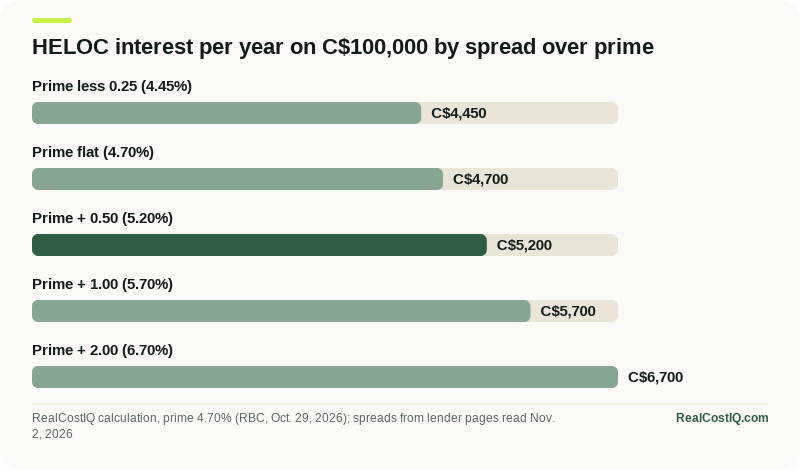
The Bank of Canada raised its target for the overnight rate by 0.25 points to 2.50% on October 28, 2026. Its key interest rate page says a change takes effect the day after the announcement, so the rise took effect October 29. The next announcement on its 2026 schedule is December 9, 2026. Banks follow with their own prime rates. RBC's Homeline Plan page states: prime rate as of October 29, 2026 is 4.700%. ATB's rates page also lists ATB prime at 4.70%, though it prints no date. The gap between the policy rate and prime is 2.20 points (4.70% less 2.50%), which is our arithmetic, not a bank statement.
Before the move, prime was 4.45%, the figure used in our earlier post on refinancing versus a HELOC. Every figure in this post uses 4.70%. If you read an older table that shows a HELOC at prime plus 0.50% as 4.95%, it predates the October 29 move. For the policy move itself and what it did to fixed and variable payments, see our fixed versus variable post.
What each bank actually prints
We opened the product or rate page of five lenders on November 2, 2026. We wanted one number: the spread over prime. Only one bank prints it. The others print the structure and leave the spread to the quote. That is itself the finding. When a bank writes only prime plus an adjustment factor, the spread is negotiable, and you can only learn it by asking.
| Lender | Rate wording on the page | Spread printed? | Limit wording |
|---|---|---|---|
| RBC (Homeline Plan) | Line of credit rate is based on RBC prime + 0.500%; prime 4.700% as of Oct. 29, 2026 | Yes: +0.50 | Not on the rate page |
| TD (FlexLine) | Revolving portion is variable, based on the TD Prime Rate | No | Up to 80% of home value with a term portion; down payment of 20% or more to buy |
| Scotiabank (STEP) | No rate or prime stated on the page | No | Up to 80% initially, including up to 65% for line of credit products |
| CIBC (Home Power Plan) | Introductory rate equal to CIBC prime until Dec. 6, 2027; ongoing rate is in the agreement | No (intro is +0.00) | Not on the rate page |
| ATB (HELOC) | Variable, based on ATB's prime rate; ATB prime listed at 4.70% | No | Up to 65%, based on approved credit and any existing mortgage |
Each row is the lender's own page, not an aggregator. We did not open BMO's page: it timed out on every attempt on November 2, so BMO is not in the table. A promotion or a professional rate can differ from the standard rate.
Two more numbers help frame the range. CIBC's page for physicians lists a Home Power Plan line of credit preferred rate of CIBC prime less 0.25%, on lines up to C$1,000,000, tied to its Full Service Physician Package. So a spread can be negative for a profession a bank wants as a client. And CIBC's introductory offer is prime flat, with an end date of December 6, 2027. The page does not say what the ongoing rate is after that date. It says only that your agreement sets it. That is the part to ask about before you sign.
The Financial Consumer Agency of Canada (FCAC) gives an example of the structure: most HELOCs have a variable rate, often set as prime plus a margin, for example prime + 1%. Your lender can change the rate. For a federally regulated bank it must tell you in writing within 30 days. So the right way to think about a HELOC rate is a range. From the pages above, the range runs from prime less 0.25 to prime plus 0.50 for advertised or professional rates. The FCAC example of prime plus 1 point is a reminder that an ordinary borrower may be quoted more.
What a spread costs on C$100,000
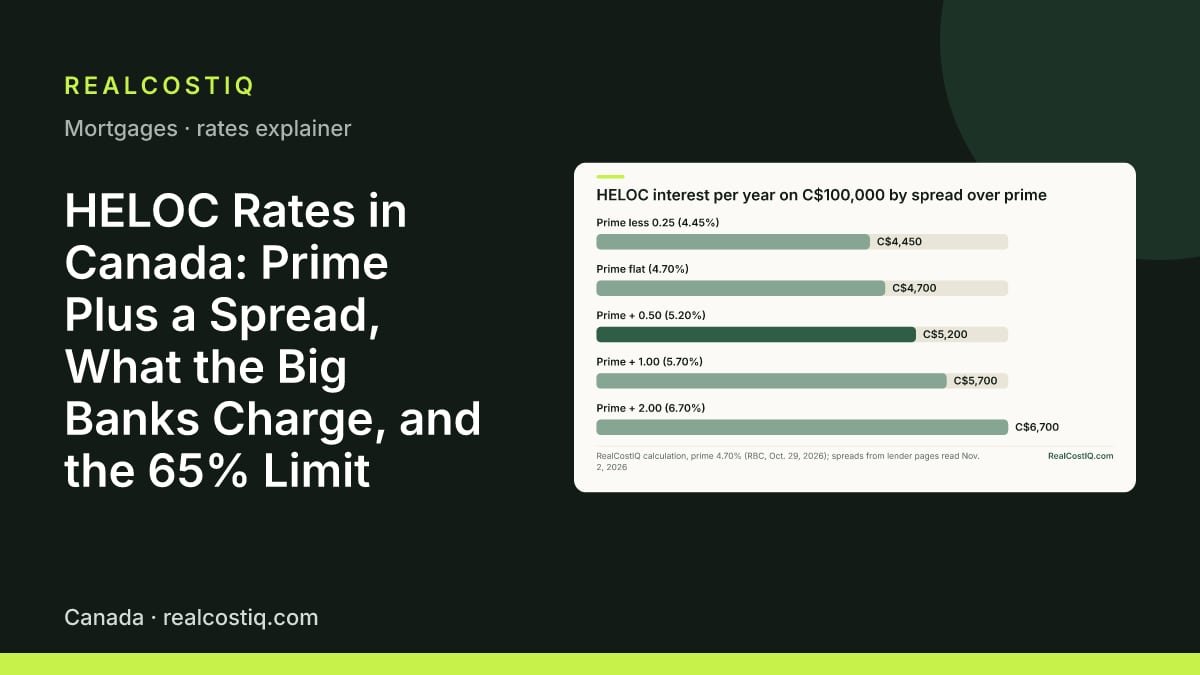
A spread sounds small. A quarter of a point does not feel like money. It is, because it repeats every month for as long as the balance sits there. The table prices C$100,000 drawn at five spreads over today's 4.70% prime. The cost is simple interest: the annual rate times the balance, then divided by 12 for the monthly figure. This is the same method as our HELOC calculator uses for the interest-only payment.
| Spread over prime | Rate | Interest per year | Interest per month | Same rate on C$50,000 per year |
|---|---|---|---|---|
| Prime less 0.25 (CIBC physician rate) | 4.45% | C$4,450 | C$370.83 | C$2,225 |
| Prime flat (CIBC introductory) | 4.70% | C$4,700 | C$391.67 | C$2,350 |
| Prime + 0.50 (RBC printed) | 5.20% | C$5,200 | C$433.33 | C$2,600 |
| Prime + 1.00 (FCAC example) | 5.70% | C$5,700 | C$475.00 | C$2,850 |
| Prime + 2.00 (illustrative high quote) | 6.70% | C$6,700 | C$558.33 | C$3,350 |
Computed by RealCostIQ on 2026-11-02 as balance x rate (and /12 for the month). Real statements usually charge interest on the daily balance, so a 31-day month costs slightly more than a 28-day one. Your agreement states the method.
Read down the annual column. Each step of 0.25 points is C$250 a year on C$100,000, or about C$20.83 a month. The gap between the RBC-style spread and the FCAC example is half a point: C$500 a year. Hold that for five years and it is C$2,500 of interest, from one line in a quote. The gap between the lowest and highest row is C$2,250 a year (C$6,700 less C$4,450). That is why it is worth asking two banks for the spread in writing, and why a broker who shops lines is not a luxury for a large balance.
When prime moves, so does your bill
A variable rate carries a second risk beyond the spread. The October 28 move added 0.25 points to prime. On C$100,000 drawn, that is C$250 more a year. If the Bank of Canada raised its rate by a full point over a year or two, a line priced at prime plus 0.50 would go from 5.20% to 6.20%, and the yearly interest on C$100,000 would go from C$5,200 to C$6,200. We are not forecasting a rise. We are showing the size of the exposure. A line you plan to repay in a year feels it little. A line you keep for a decade feels it a lot.
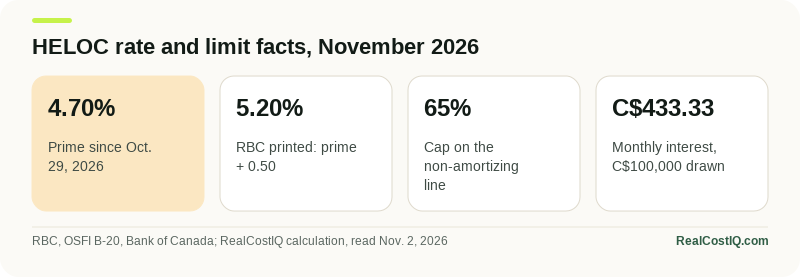
There is a simple test. Ask what happens to your budget if the rate is 2 points higher than today. At prime plus 0.50 plus 2 points, the rate is 7.20%, and the interest on C$100,000 is C$600 a month. If that number breaks your budget, the balance is too large for a floating-rate, interest-only product. That 7.20% is also the figure a bank may use to qualify you, as the next section explains.
The 65% limit and the 80% ceiling
Our post on refinancing at 80% loan-to-value explains the 65% and 80% limits in full, so we keep this short. The Office of the Superintendent of Financial Institutions (OSFI) says in Guideline B-20 that the non-amortizing part of a HELOC should stay at or below 65% of the home's value, and a footnote says any credit above that level should be amortized. B-20 also tells lenders to review the authorized amount of a HELOC after a material fall in the home's value. Put plainly: a bank can shrink your limit if prices fall, and the guideline expects it to look.
The lender pages show how that looks in practice. ATB says its HELOC goes up to 65%, based on approved credit and any existing mortgage. Scotiabank's STEP says you can initially borrow up to 80% of your home's value, including up to 65% for line of credit products, and that the global limit falls monthly over 25 years toward 65% of the value. TD says a FlexLine with a term portion can reach 80% of value. So the line itself is capped at 65%, and a mortgage next to it can take the total to 80%.
Standalone versus readvanceable
FCAC says you need more than 35% equity for a standalone HELOC, or 20% for a HELOC combined with a mortgage. That is the difference in one line. A standalone line sits behind your existing mortgage and you apply for it as a new credit product. A readvanceable plan, such as the Scotiabank STEP, bundles a mortgage and a line. As you pay the mortgage down, room opens in the line. Scotiabank says you can set up STEP at the time of your mortgage with no additional fee. A standalone line does not carry that bundle, so the fees below matter more.
Qualifying: the stress test and a revolving line
FCAC says banks also require a stress test for a HELOC. OSFI's page on the minimum qualifying rate says that for uninsured mortgages the rate is the greater of the contract rate plus 2%, or 5.25%. The page was last modified January 29, 2026, and OSFI reviews the buffer and the floor at least once a year. With prime at 4.70%, a line at prime plus 0.50 is 5.20%. Add 2 and you get 7.20%, well over the 5.25% floor. So the floor binds only when the contract rate is below 3.25%. At today's prime it does not.
How a bank turns that into a monthly number for a revolving line is its own business. OSFI's B-20 page does not give a HELOC-specific formula for the qualifying payment. One common way is to test the drawn balance or the full limit at the qualifying rate. We did not find a bank page that states which, so treat the next sentence as an illustration and not a rule. If a lender tested C$100,000 at 7.20%, interest only, the payment in its ratios would be C$600.00 a month, against C$433.33 at the contract rate. Ask your lender whether it tests the limit or the balance. A big limit can reduce what else you can borrow, even if you never draw it.
Interest only is a choice, not a deal
The payment on a HELOC can be interest only. FCAC says your lender may require only interest, or interest plus some principal, and warns that if you pay only the interest you will not pay off the loan. The table compares C$100,000 at 5.20% two ways. The first is interest only. The second is a 25-year amortizing loan, priced with the Canadian rule that fixed mortgage interest compounds twice a year. A line does not compound that way, and the 5.20% here is used only to compare the shape of the two payments. A real amortizing loan would carry its own rate.
| Payment style | Monthly payment | Interest in year one | Principal repaid in year one |
|---|---|---|---|
| Interest only (HELOC minimum) | C$433.33 | C$5,200 | C$0 |
| Amortizing over 25 years (semi-annual compounding) | C$593.04 | C$5,097 | C$2,019 |
| Difference | C$159.71 | C$103 less | C$2,019 more |
Computed by RealCostIQ on 2026-11-02. The amortizing line uses (1 + rate/2)^(1/6) as the monthly factor, the Canadian convention for fixed mortgages. The interest-only line uses balance x rate. Rounded to the dollar.
The extra C$159.71 a month buys C$2,019 of principal in the first year, and the balance falls. The interest-only payment buys nothing but time. For a short bridge or a project you will repay from a known source, interest only is fine. For a balance you do not have a plan to repay, it is the slow way to stay in debt. If you want to see how a draw changes with your own numbers, use our home equity calculator to see how much room you have, then the HELOC calculator for the payment.
What it costs to open the line
FCAC lists the costs to expect on a HELOC: appraisal, legal, title search, administration and monthly fees, and cancellation and discharge fees if you close or transfer the line. None of the five bank pages we read states a legal fee in dollars. ATB comes closest. It says appraisals typically start at C$275 and that Land Titles registration and legal fees may apply. It also says set-up fees may apply and can affect the APR, and it prints no amount.
Alberta: the registration fee is public
Alberta has no land transfer tax, but registering a mortgage or charge still carries a Land Titles fee. The Government of Alberta's Land Titles and Surveys common documents fee schedule, updated effective October 1, 2026, lists a mortgage (form MOR-1) at C$50 plus C$5 for each C$5,000 of the principal amount. Alberta's registration levy page says the C$5 rate has applied to submissions since October 20, 2024. The schedule does not say how a lender registers a revolving line, so the table assumes the charge is registered for the credit limit. Your lawyer or the bank will tell you the amount registered.
| Amount registered | Calculation | Land Titles fee |
|---|---|---|
| C$50,000 | C$50 + (10 x C$5) | C$100 |
| C$100,000 | C$50 + (20 x C$5) | C$150 |
| C$250,000 | C$50 + (50 x C$5) | C$300 |
| C$390,000 (65% of a C$600,000 home) | C$50 + (78 x C$5) | C$440 |
Computed by RealCostIQ from the Government of Alberta fee schedule. Legal fees, the appraisal and any lender set-up fee are extra. We did not find a published Alberta legal fee for a HELOC charge.
Take an Alberta homeowner with a C$100,000 line. The registration fee is C$150. An ATB-style appraisal starts at C$275. That is C$425 before legal fees and any lender set-up fee, which are not published. Against C$5,200 a year of interest at prime plus 0.50, the set-up cost is small. It would matter if you open a line for a one-month bridge. For a line you keep, the spread is the larger number by far. The same HELOC in another province has a different registration cost, so do not carry the Alberta figure across a provincial border.
A note on the Alberta search
People search for HELOC rates in Alberta as if the province set the rate. It does not. Prime is national, and a bank's spread is set by the bank. What changes by province is the cost to register the charge and the legal fee. ATB is Alberta's own bank, and it prices a HELOC off its own prime, which on its rates page matches the 4.70% that RBC states. If you are in Alberta, you can compare ATB with the national banks on exactly the same basis: the spread and the fees.
Questions to ask before you sign
- What is the spread over prime today, in writing, and is it fixed for the life of the line or can you change it?
- Is the rate a promotion? If so, what does it become when the promotion ends?
- Is this a standalone line or part of a readvanceable plan, and how does the limit change as I pay my mortgage down?
- What amount will be registered against the home, and what are the legal, appraisal and registration costs?
- Does the bank count the limit or the balance when it judges my other borrowing?
- Are there annual, monthly or access fees, and what does it cost to close the line?
- What happens to the limit if my home's value falls?
The first question does the most work. A bank that writes the number down is a bank you can compare. A bank that says the rate depends is a bank you have to press. Ask at least two lenders, including one outside the big banks, and ask for the spread itself, not just today's rate. Today's rate moves with prime. The spread is the part you are negotiating.
What this post did not read
- BMO's HELOC page timed out on every attempt on November 2, so BMO's spread is not stated here.
- Scotiabank, TD and CIBC print no spread on the pages we opened. Their actual quotes may be higher or lower than anything in the tables.
- We did not find a published rule on whether banks count a HELOC's limit or balance in debt ratios, so the qualifying section is an illustration.
- We did not find a bank page that states a legal fee in dollars for a HELOC charge in any province.
- Aggregator rate lists were not used as a rate source.