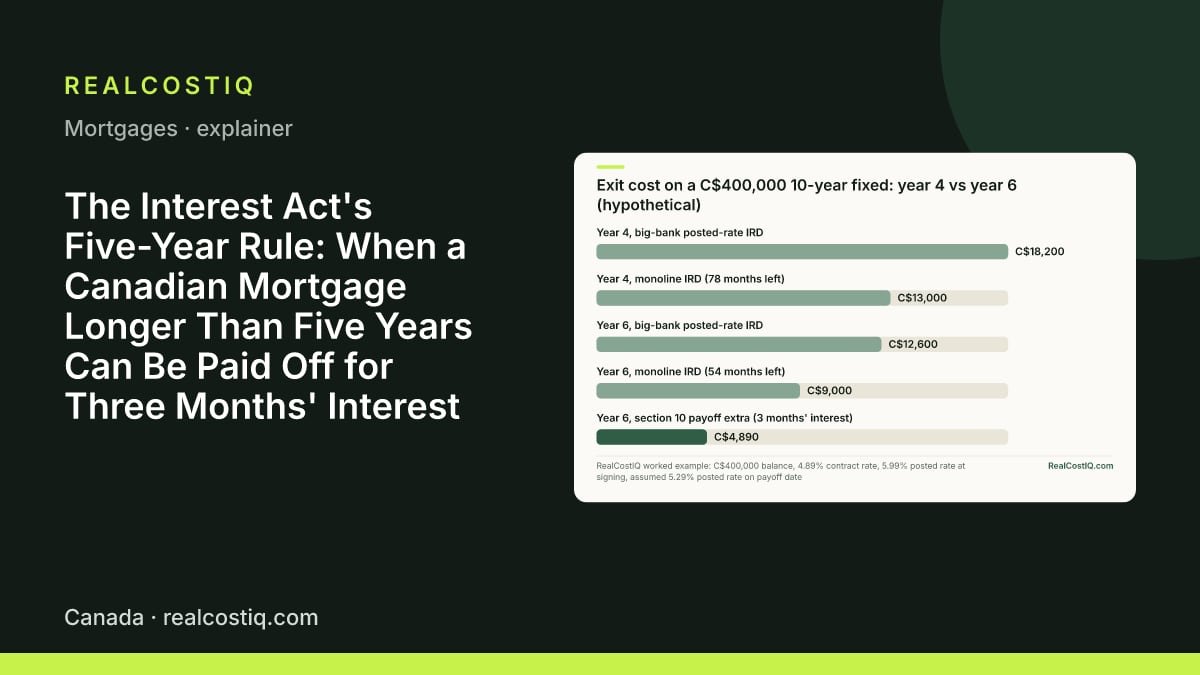
Most Canadian mortgage borrowers first hear the word penalty at their first renewal talk. They assume the number is whatever the lender's contract says. For one slice of the market, a federal law puts a ceiling on that number. Section 10 of the Interest Act is a short provision last amended in 2008. It says that when a mortgage is not payable until more than five years after its date, the borrower can pay it off after the five years. The borrower pays what is owing plus three months of further interest. Nothing more in interest can be charged. That is the whole rule. It matters most to borrowers who took a 7- or 10-year fixed term (one where the rate is locked in). It turns the second half of a long term into a different cost problem from the first half.
This post sets out what the section says and who it excludes. It also shows how the rule differs from the usual comparison of three months' interest against the interest rate differential. The site's mortgage penalty calculator explains that comparison for ordinary closed mortgages. Last, it shows what a gap of several thousand dollars looks like in a hypothetical 10-year mortgage. It does not explain how fixed-rate mortgages compound. That is covered on the Canadian mortgage comparison calculator page and in the compare-offers post. It also gives no view on which term to choose. All dollar amounts are Canadian dollars (CAD). We read the statute text on the Department of Justice's Justice Laws website on 2026-10-11. The Act is shown there as current to 2026-09-21 and last amended on 2008-06-18. This is information, not legal advice. Whether section 10 applies to your mortgage depends on the exact wording and dates in your own mortgage documents. A real estate lawyer is the right person to read them.
What section 10 says, element by element
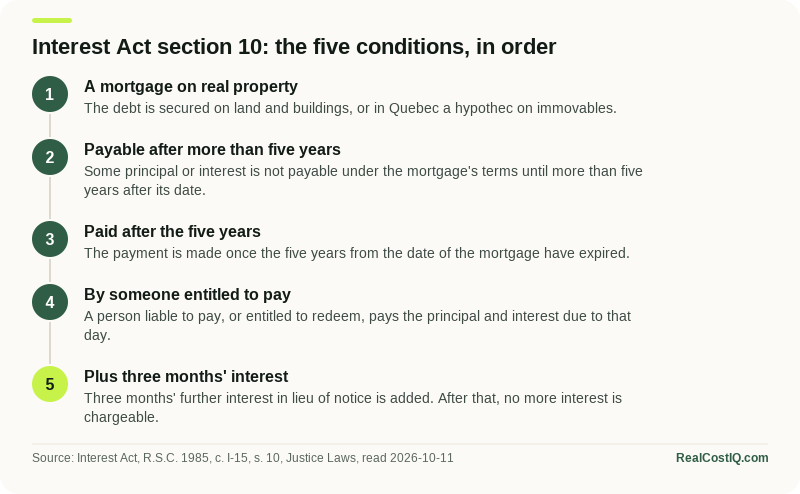
Subsection 10(1) of the Interest Act can be broken into five conditions. All five must be met. Each one narrows the rule, so the order matters.
- The debt is secured by a mortgage on real property, or in Quebec a hypothec on immovables. Real property means land and buildings. The Act uses both terms in the same sentence, so the rule is federal and applies across the provinces.
- Some or all of the principal money or interest is not payable under the terms of the mortgage until a time more than five years after the date of the mortgage. Principal is the amount borrowed.
- The payment is made after the expiration of the five years.
- The payer is a person liable to pay, or entitled to pay in order to redeem the mortgage. The payer tenders (offers) or pays to the person entitled to receive the money the amount due for principal and interest to the time of payment. That amount is calculated under sections 6 to 9 of the Act.
- The payer adds three months further interest in lieu of notice. When that is paid, no further interest is chargeable, payable or recoverable on the principal money or interest due under the mortgage at any time after the payment.
Two phrases do most of the work. The first is "more than five years after the date of the mortgage". It tests when the money is payable under the mortgage's terms. It does not test how long the borrower intends to keep the loan. The second is "three months further interest in lieu of notice". The statute describes the extra three months as a substitute for notice. That is why it reads as a ceiling on the cost of leaving. The borrower owes the interest to date, plus three months. After the payment, the lender cannot charge further interest. Sections 6 to 9 set how the payoff amount is calculated. They are the neighbouring rules on how interest on a mortgage must be stated, and what can be charged on arrears (late payments). Section 6 applies to mortgages on blended-payment, sinking-fund or similar plans. It requires a statement of the principal and the rate of interest chargeable, calculated yearly or half-yearly, not in advance. Without that statement, no interest is recoverable on the advance. The comparison-calculator page covers it, so it is a pointer here and not a topic.
Who is outside the rule
Subsection 10(2) removes two groups. Paragraph (a) excludes any mortgage on real property, or hypothec on immovables, given by a joint stock company or any other corporation. It also excludes any debenture (a type of company bond) issued by one that is secured by a mortgage. Paragraph (b) excludes a prescribed mortgage given by a prescribed entity. Prescribed means named in the regulations. Subsection 10(3) lets the Governor in Council (the federal cabinet) make regulations for paragraph (b). The Prescribed Entities and Classes of Mortgages and Hypothecs Regulations (SOR/2011-230), current to 2026-09-21, do so.
Under those regulations, the prescribed entities are partnerships, trusts settled for business or commercial purposes, and certain unlimited liability companies. These are unlimited liability corporations as defined in Alberta's Business Corporations Act, unlimited liability companies as defined in British Columbia's Business Corporations Act, and unlimited companies as defined in Nova Scotia's Companies Act. The prescribed class of mortgages is those issued after January 1, 2012. According to the page we read, the regulations came into force on that date and were last amended in 2012.
| Borrower | Within s. 10? | Why |
|---|---|---|
| An individual on a mortgage payable more than five years after its date | Yes, once the five years have expired | Not a corporation or prescribed entity; meets the more-than-five-years test |
| An individual on a standard 5-year term | Not on its face | Principal is payable at the end of the term, which is five years and not more than five years after the date (our reading; confirm with a lawyer) |
| A corporation (joint stock company or any other corporation) | No | Excluded by paragraph 10(2)(a) |
| A partnership or a business or commercial trust, on a mortgage issued after January 1, 2012 | No | Prescribed under SOR/2011-230 for paragraph 10(2)(b) |
| A partnership or business trust, on a mortgage issued on or before January 1, 2012 | Not excluded by the regulations | The prescribed class covers only mortgages issued after that date |
| An Alberta ULC, a British Columbia ULC or a Nova Scotia unlimited company | No | These are corporations or companies, so paragraph 10(2)(a) already excludes them at any date; SOR/2011-230 also names them as prescribed entities for mortgages issued after January 1, 2012 |
The first two rows assume the borrower is a natural person holding the mortgage in their own name. Holding a rental property inside a corporation, a partnership or a business trust changes the answer for that property.
This is the part that most often surprises investors. A homeowner who borrows personally on a 10-year fixed mortgage is inside the section. The same person borrowing through a numbered company to buy a rental is outside paragraph (a), by the plain words of the text. A couple who hold a rental through a partnership or a business trust are outside under the regulations when the mortgage was issued after 1 January 2012. The section protects individuals. By implication, it leaves commercial borrowing to the contract.
Which mortgages are payable after more than five years
Canadian mortgages have two clocks. The term is how long the contract and its interest rate last. The amortization period is how long repayment would take in full. The Financial Consumer Agency of Canada's page on terms and amortization is dated 2025-10-15. It describes the term as the length of time your mortgage contract is in effect, running from a few months to five years or more. It describes the amortization as the total time to repay. It adds that most Canadian mortgage holders have a short-term mortgage of five years or less. Long-term mortgages run longer than five years. At renewal you either pay the balance or renew. Most borrowers need several terms to finish repaying.
Section 10 looks at when principal and interest are payable under the mortgage's terms. The term is the point at which the balance falls due. A 25-year amortization does not make a 5-year-term mortgage payable after 25 years in any practical sense. The lender expects to be repaid or to renew at the fifth anniversary. On the plain reading, a standard 5-year term mortgage is payable at five years, not more than five years. It does not meet the second condition. A 7-year or 10-year term does. We are not aware of anything on the pages we read that addresses how a court would treat the amortization wording in a 5-year-term contract. A borrower who thinks section 10 helps them should have a lawyer read the mortgage charge and the commitment letter. Do not rely on this post. (The mortgage charge is the document that registers the loan against the property. The commitment letter is the lender's offer.)
The Bank of Canada's selected bond yields table helps explain why long terms exist at all. We read it for dates up to 2026-10-08. On 2026-10-08 the Government of Canada benchmark 5-year yield was 3.60%. The 7-year yield was 3.69% and the 10-year yield was 3.93%. The average yield on marketable bonds of 3 to 5 years was 3.54%. A bond yield is the return investors get on a government bond. These are bond yields, not mortgage rates, and lenders add their own spread. They are shown here only to make a point. A longer term is priced off a different part of the curve. The size of a rate differential depends on where that curve is on the day you leave.
How it differs from the ordinary penalty comparison
The Financial Consumer Agency of Canada describes the typical penalty as the higher of two amounts. One is three months' interest on the amount still owed. The other is the interest rate differential (IRD). Its page on prepayment penalties is dated 2025-10-15. It says the lender usually works out the IRD by comparing the interest left on your term at your rate with the interest at a current rate for a similar term. For the first, the lender uses either the posted rate at signing or your contract rate. For the second, it uses the current posted rate, or that rate less your original discount. The page says the lender will usually use the IRD calculation if your contract rate is higher than the current rate and you signed less than 5 years ago. The agency's terms page adds that long-term mortgages may carry a substantial penalty if you sell within the first 5 years of the term. Both statements line up with the structure of section 10. The statute concerns the period after year five. The penalty risk the agency describes sits mostly in the period before it.
So there are two regimes in the life of one long mortgage. Before the fifth anniversary, the exit cost is whatever the contract provides. That is typically the higher of three months' interest and the IRD. The IRD can be several times larger than three months' interest when rates have fallen since you signed. After the fifth anniversary, on a mortgage that qualifies, the statute describes a payment of the interest to date plus three months' further interest. No more interest is chargeable afterwards. The comparison of three months against the IRD on the mortgage penalty calculator page is the right model for the first regime. It is a different calculation from the second.
The agency's break-a-mortgage page is also dated 2025-10-15. It is a useful reminder of what else sits beside the penalty. An open mortgage can be broken without a prepayment penalty. A closed mortgage normally carries one that can run to thousands of dollars. Breaking can also add administration, appraisal, reinvestment and discharge fees. You may also have to repay any cash back you received. Section 10 speaks about interest. We found nothing in its text that removes those other charges. Budget for them separately and ask the lender to list them in the payout statement.
A worked comparison: a 10-year fixed mortgage paid off in year 4 and in year 6
To see what the rule is worth, take a hypothetical borrower. All of these inputs are invented for illustration and are not a quote from any lender.
- Outstanding balance: C$400,000 at the date of payoff. It is held the same at both dates so the difference isolates the rule rather than the amortization.
- A 10-year fixed-rate mortgage in the borrower's own name, contract rate 4.89%.
- The calculator's inputs for the IRD: a big bank posted rate of 5.99% at signing, which leaves a 1.10-point discount. We assume the posted rate for the matching term is 5.29% on the payoff date. That is an assumption, not a forecast.
- Payoff A: at the end of month 42, in year 4, with 78 months remaining. Payoff B: at the end of month 66, in year 6, with 54 months remaining.
We ran these inputs through the same engine that powers the mortgage penalty calculator. It works out three months' interest as the balance times the annual rate, divided by 12, times 3, the simple method the Financial Consumer Agency of Canada (FCAC) describes. For these inputs that is C$400,000 × 4.89% ÷ 12 × 3 = C$4,890. A lender's exact figure can land a little either side, depending on its own day count. For a big bank, the engine uses the posted-rate method. The comparison rate is the posted rate today minus your original discount. Here that is 5.29% less 1.10 points, or 4.19%. Your rate of 4.89% is 0.70 points above that, so the rate differential is 0.70 points. The IRD is the balance times 0.70% times the years left. That is C$18,200 with 78 months left and C$12,600 with 54 months left. These figures depend heavily on the posted rate you assume. The Bank of Canada's weekly average posted rates for chartered banks on 2026-10-21 were 6.05% for a 3-year and 6.19% for a 5-year conventional mortgage (read 2026-10-25). If today's posted rate were 6.05%, the comparison rate would be 4.95%, above your 4.89%, so the IRD would be C$0. Three months' interest of C$4,890 would then apply. For a monoline lender (one that only does mortgages) it assumes a current comparable rate 0.50 points below the contract rate. Neither is a forecast. A real IRD depends on the lender's own posted-rate table on the day.
| Scenario | Contract-style penalty (greater of 3 months and IRD) | Section 10 payoff extra (3 months) | Gap |
|---|---|---|---|
| Year 4, big-bank posted-rate IRD (78 months left) | C$18,200 | Not available: five years have not expired | Not applicable |
| Year 4, monoline IRD (78 months left) | C$13,000 | Not available: five years have not expired | Not applicable |
| Year 6, big-bank posted-rate IRD (54 months left) | C$12,600 | C$4,890 | C$7,710 lower |
| Year 6, monoline IRD (54 months left) | C$9,000 | C$4,890 | C$4,110 lower |
Our arithmetic with the site's penalty engine at the stated inputs. Whether a lender's contract matches the statute is a question for the lender and a lawyer; the table shows what the statute describes against a contract-style IRD, not what any lender has agreed to charge.
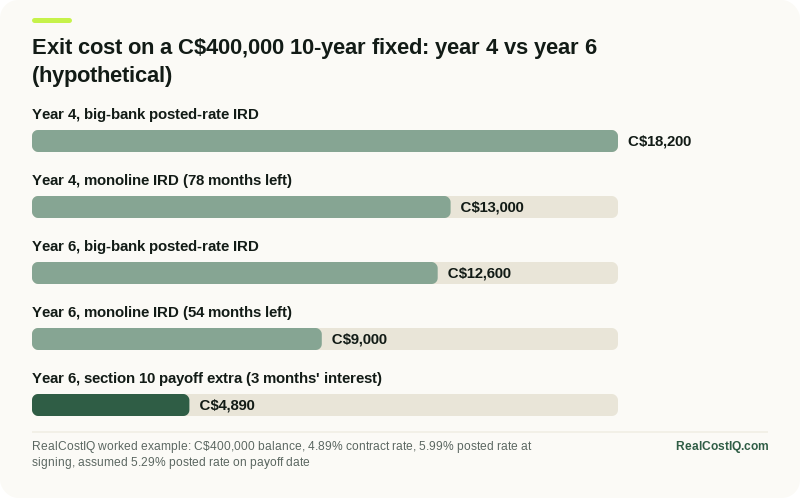
Read the table in two steps. First, the contract-style figure falls from C$18,200 to C$12,600 between years 4 and 6 on the big-bank method. The reason is simply that 24 fewer months remain to be multiplied by the rate differential. That reduction is real but modest. Second, once the five years have expired, the statute offers a different measure. It does not depend on the remaining term or on a rate differential at all. For a borrower in the year-6 row, it is C$7,710 below the big-bank IRD and C$4,110 below the monoline IRD. The longer the remaining term and the larger the differential, the bigger that gap. With a differential near zero, the three-months figure is already the larger number and the section changes nothing. Section 10 is a ceiling, not a discount. It is worth the most exactly when a contract-style IRD would otherwise be large.
Notice also what the table leaves out. It does not include an administration or discharge fee. It does not include any repayment of cash back, or the time value of paying off earlier. It compares only the interest-based exit amounts. That is the part section 10 speaks to.
What lenders must tell you about prepayment
Federally regulated banks must give borrowers an information box. The Financial Consumer Protection Framework Regulations (SOR/2021-181) say what goes in it. They are current to 2026-09-21 and were last amended on 2026-03-12. For a fixed-interest loan for a fixed amount, section 38 lists several items. Among them are the length of the term, and the amortization period if different. Another is a brief description of the conditions under which the borrower may repay a greater portion than required in a given period without a prepayment penalty. A third is the amount of the prepayment penalty charges, if any, with a brief explanation of how they are calculated. Section 39 does the same for a variable-rate loan. The information box is the first place to look for the lender's own description of its penalty. It is the right document to hold next to section 10 if you have a 7- or 10-year term.
Those regulations apply to federally regulated banks under the Bank Act. Credit unions and other provincially regulated lenders follow provincial rules that this post did not read. The Interest Act is federal, though. It applies to a mortgage on real property whoever the lender is. The older Cost of Borrowing (Banks) Regulations (SOR/2001-101) were replaced by these disclosure rules. They show as repealed on Justice Laws in the page we read. That is a reminder to cite the current text when you quote a bank's duties.
Suppose the information box or the mortgage contract describes a penalty after year five that is larger than the interest to date plus three months. Ask the lender to explain in writing how its clause fits section 10. The reason to ask is not to pick a fight. The answer may differ by borrower type, by date of the mortgage, or by whether a renewal restarted the clock. Those are exactly the facts a lender can state and this post cannot.
A practical sequence if you hold a mortgage payable after more than five years
- Find the date of the mortgage and the term in the mortgage charge and commitment letter. Mark the fifth anniversary of that date in a calendar.
- Confirm who the borrower is on the charge: you personally, or a corporation, partnership or trust. Section 10 does not reach the latter groups, by its text and SOR/2011-230.
- Check whether the term was renewed, extended, or blended. We could not find anything that settles whether a renewal or a blend-and-extend restarts the five years, so ask the lender.
- Ask in writing for two payout statements: one for payoff today and one for payoff on the first business day after the fifth anniversary. Ask the lender to list interest, penalty, administration and discharge charges one by one.
- Run both figures through the mortgage penalty calculator. For a renewal comparison, use the mortgage renewal calculator to see the effect of a new rate on the monthly payment.
- Have a real estate lawyer read the section against the contract before you send the payoff. A mistake here is a few thousand dollars in either direction.
None of this tells you whether to pay off, refinance or wait. A lower rate elsewhere, the cost of a new mortgage, the sale price of the home and the borrower's cash flow all matter. They are specific to the household, and the penalty is one input. What the section gives is a better-defined number for one slice of mortgages. It also gives a reason to look at the calendar before accepting a penalty quote on a long-term mortgage.
Common misreadings
- A 5-year fixed mortgage becomes cheap to break after year 5. On the plain wording it does not. There is no year 6 in that contract, because the term ends at five years. The rule needs a mortgage that is payable after more than five years.
- The rule is a discount on the IRD. It is a different measure, not a percentage off. Whether it is smaller than a contract IRD depends on the facts, as the worked table shows.
- Section 10 applies to any mortgage held for more than five years. The text turns on when the money is payable under the mortgage's terms. It does not turn on how long you have held the mortgage.
- It applies to every borrower. Corporations are outside at any date. Partnerships and business trusts are outside on mortgages issued after 1 January 2012. Certain unlimited liability entities are outside as corporations or as prescribed entities.
- It removes all fees. The text speaks of interest. It does not mention administration, appraisal, reinvestment or discharge charges.
- It must apply because a website or a broker says so. Whether it applies to you depends on your documents and your borrower type. The Financial Consumer Agency pages we read do not mention the Act at all. A plain-language summary is no substitute for the statute and a lawyer.
What we read, and what we did not
We read the Interest Act on Justice Laws (current to 2026-09-21; page modified 2026-09-28). We also read the Prescribed Entities and Classes of Mortgages and Hypothecs Regulations, the Financial Consumer Protection Framework Regulations, and the Cost of Borrowing (Banks) Regulations page showing their repeal. We read three Financial Consumer Agency of Canada pages, on penalties, breaking a mortgage, and terms and amortization. We read the Bank of Canada's selected bond yields page. All of this was read on 2026-10-11. We did not read any court decision on section 10, any lender's mortgage terms, any provincial credit-union rules, or any guidance from the Department of Finance. The Financial Consumer Agency pages we read do not mention the Interest Act at all. So what follows from them is only what they state about typical penalties and terms. Statutes are amended and regulations are made. Check the Justice Laws page for the version in force on the day you act. Treat the worked example as an illustration of order of magnitude.