You have found a new house or condo in Ontario. The price looks fair next to a resale home. Then your lawyer sends the builder's statement of adjustments. It has lines you have never seen. Development charges. Tarion. Service connections. An HST adjustment. Which of these are yours to pay? And how do you stop a small line from turning into a large one?
This post answers that for Ontario. It reads four primary sources, all on 27 October 2026. They are the City of Toronto's development charge by-law, the City's water fee page, Tarion's fee table, and the Schedule B form that Ontario's new-home regulator posts for builders. It does not walk through the resale bill. For that, see our post on closing costs beyond land transfer tax. It also does not rework the HST rules for new homes. We have separate posts on the Ontario HST break and on Tarion's warranty.
What a new build adds to the bill
A resale and a new build share many closing lines. Both have a lawyer, a title search, land transfer tax and a statement of adjustments. Use the Ontario closing costs calculator for those shared lines. Land transfer tax is charged on both, and that calculator covers it. The table shows only what is different.
| Line | Who pays it first | Can it reach the buyer? | Where to check |
|---|---|---|---|
| HST on the price | Buyer, with a possible rebate | Yes, it is part of what you pay | Ontario HST break post; GST/HST rebate calculator |
| Tarion enrolment fee | Builder, who submits it to Tarion | Only if Schedule B lists it | Tarion fee table; Schedule B |
| Municipal development charge | The builder, as developer | Only if the agreement or Schedule B passes it on | Municipal by-law; your agreement |
| Education development charge | The builder, as developer | Only if the agreement or Schedule B passes it on | School board by-law; your agreement |
| Water, sewer and meter connections | The applicant, usually the builder | Only if Schedule B lists them | City fee page; Schedule B |
| Gas and hydro hookups | Builder or owner, by utility rules | Only if Schedule B lists them | Utility pages; Schedule B |
| Interim occupancy fee (condos) | Buyer | Often, on a condo before the building registers | Pre-construction deposit calculator; closing costs post |
“Reach the buyer” is a question about your contract, not a legal conclusion. Show your agreement to a real estate lawyer before you sign.
Schedule B: the list that limits the bill
Tarion is the Ontario warranty provider for new homes. Its guide to the Addendum says the builder must list in Schedule B the fees, charges or other costs it expects to add to your price. It also says that if a cost is not listed, “your builder cannot force you to cover it.” That one idea does most of the work in this post.
We read the New Freehold Home Addendum for a firm closing date, a form dated 24 August 2026 that Ontario's new-home regulator, the Home Construction Regulatory Authority (HCRA), has posted. Its Schedule B has two parts. Part I is for amounts with a fixed dollar value in the purchase agreement. Part II is for adjustments worked out later, under the terms of the agreement. The form still carries “Draft Note” lines in Schedule B. We could not confirm whether it is the version in force for agreements signed today. Check which version your builder uses. Condo forms are separate and we did not read them.
Section 8 of that form adds three rules. First, only items in Schedule B, or an amendment to it, can change your price or closing balance. Second, the builder cannot charge you back for money paid to a third party unless that money is really paid to the third party, before or after closing. If it does, it must readjust with you. Third, the rule does not stop you and the builder from agreeing who gets any rebate, refund or incentive from a government. That third rule matters for development charges, as we show below.
Part I is the safer place for a charge. A dollar figure in Part I is a known number. A charge in Part II is a formula or a promise to adjust. Wording such as “plus any increase in development charges” can mean a large number later. Ask your lawyer to move each item into Part I with a dollar figure, or to cap it.
Development charges: what Toronto's by-law says
Each municipality sets its own development charges. We read Toronto's. Other cities and regions set their own rates and rules. We did not read Peel, York, Halton, Ottawa or any other by-law, so nothing here is a rate for those places.
Toronto's rates come from Development Charges By-law 1137-2022. Council passed it on 15 August 2022. Rates were meant to rise each 1 May with a construction price index. The City's page, last changed 26 January 2026, says Council removed that rise for 2025 and 2026. Then Council passed By-law 1261-2026 on 30 July 2026. It takes the 2027, 2028 and 2029 rises off the schedule too. Its indexing clause now lists 1 May 2023, 1 May 2024, then 1 May 2030 and each 1 May after that. So, as the by-law reads today, the City's own charge does not step up by indexing before May 2030.
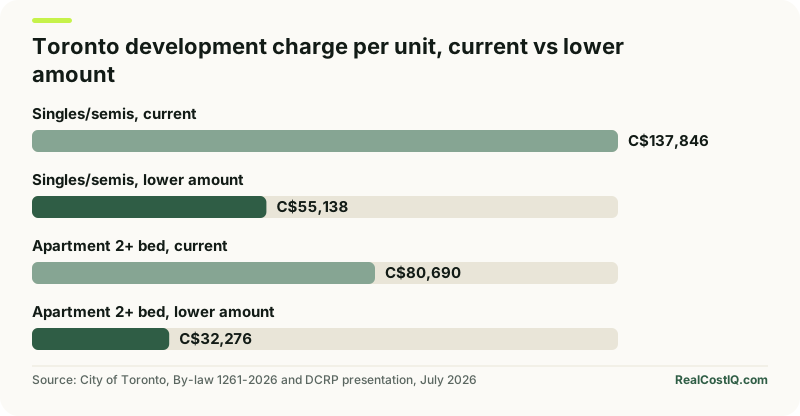
The same by-law adds time-limited lower amounts for homes. A City presentation dated 28 July 2026 explains why. It says Canada and Ontario are funding a Development Charge Reduction Program. It gives Toronto C$1.5 billion to allow cuts of 40% to 60%. The by-law applies the lower amounts only when a list of tests is met. The first building permit must be issued between 30 March 2026 and three years after the funding agreement takes effect. An above-grade permit must follow within set limits, and it must not be revoked before occupancy. The funding agreement must also be fully signed. The City's slides expected signing by 15 August 2026. We could not confirm that it was signed, so we cannot say the lower amounts are payable today.
| Unit type (non-rental) | Current rate | Lower amount | Cut | Difference per unit |
|---|---|---|---|---|
| Singles and semis | C$137,846 | C$55,138 | 60% | C$82,708 |
| Multiples, 2 or more bedrooms | C$113,938 | C$45,575 | 60% | C$68,363 |
| Apartments, 2 or more bedrooms | C$80,690 | C$32,276 | 60% | C$48,414 |
| Multiples, studio or 1 bedroom | C$57,153 | C$34,292 | 40% | C$22,861 |
| Apartments, studio or 1 bedroom | C$52,676 | C$31,606 | 40% | C$21,070 |
Current rates are from the City of Toronto presentation of 28 July 2026. Lower amounts are from Appendix D.1 of By-law 1261-2026 (Council vote 30 July 2026). The lower amounts apply only if the by-law's tests are met, as confirmed at occupancy. Rental units have their own table, not shown.
Two more details from the by-law matter to buyers. First, if a builder paid its charge early and the tests are not met at occupancy, the builder pays the difference then. Second, the by-law says the regular schedules, not the lower amounts, still decide the rate under Ontario's rate-freeze rule. Under that rule, a project's rate is locked when the site plan or zoning application is made. The province's page, updated 16 June 2026, says the rate stays frozen for 18 months after the application is approved.
The school board layer
Toronto also collects an education development charge for the Toronto Catholic District School Board. The City's page lists the rate per dwelling unit by year from 3 December 2023: C$3,293, C$3,593, C$3,893, C$4,193 and C$4,493. The page does not label any rate as current, and it was last changed 6 October 2025. Reading its schedule, the rate in force today is C$3,893 and it rises to C$4,193 on 3 December 2026. We read that from the schedule, so check the date of your building permit.
This is the lesson for a cap clause. The City's own charge is not due to rise before 2030, but the school board's charge is. A cap that says only “municipal development charges” might leave the school layer open. Name every layer: municipal, regional where one exists, education and any transit charge.
Three ways an agreement can handle development charges
Here is a plain-language view of three common choices. This is our reading of the Schedule B form, not legal advice. The size of the stakes comes from the table above: on one Toronto single-family unit, the gap between the current and lower amount is C$82,708.
| Clause style | What you pay | If the builder pays less | What to ask for |
|---|---|---|---|
| Price includes all development charges; no line in Schedule B | Nothing extra | The builder keeps the saving | Put “no development charge adjustment” in writing |
| Schedule B adds any increase after signing | Only increases | A cut is not an increase, so your price does not fall | A dollar cap on any increase, and the layers it covers |
| Schedule B adjusts for charges actually paid, above a stated base | The paid amount above the base | The adjustment may fall, if the base is set before the cut | A clause that says how a government reduction is shared |
Reading of the Addendum's Schedule B and section 8 as of the 24 August 2026 form. Section 8 says parties may agree how to allocate government rebates, refunds or incentives. Confirm every clause with your lawyer.
Look at the first row. It is the cleanest for you if the number is fixed in the price. The second row can still hurt. If you agreed to pay any increase and there is no cap, a rise in any layer lands on your bill. The third row is the one where wording matters most. It can send a saving to you, or it can leave it with the builder, depending on one sentence about rebates.
Do not assume the builder will share a reduction. Do not assume it will not. Ask. A builder who is passing no development charge to you has no reason to refuse to write “no adjustment” in Part I.
The Tarion enrolment fee
Every new home sold with Tarion's warranty is enrolled. The builder submits an enrolment fee to Tarion. Tarion's fee page, effective 1 September 2025, sets the fee by the estimated sale price before HST. It adds 13% HST because the fee is a taxable supply. The page showed no newer schedule and no change notice when we read it. A condo unit in a conversion project pays twice the listed fee.
| Estimated sale price before HST | Fee | HST at 13% | Total |
|---|---|---|---|
| Up to C$300,000 | C$585.00 | C$76.05 | C$661.05 |
| C$500,000.01 to C$550,000 | C$970.00 | C$126.10 | C$1,096.10 |
| C$550,000.01 to C$600,000 | C$1,075.00 | C$139.75 | C$1,214.75 |
| C$600,000.01 to C$650,000 | C$1,515.00 | C$196.95 | C$1,711.95 |
| C$750,000.01 to C$800,000 | C$1,740.00 | C$226.20 | C$1,966.20 |
| C$850,000.01 to C$900,000 | C$1,940.00 | C$252.20 | C$2,192.20 |
| C$950,000.01 to C$1,000,000 | C$2,075.00 | C$269.75 | C$2,344.75 |
| C$1,000,000.01 to C$1,250,000 | C$2,245.00 | C$291.85 | C$2,536.85 |
Source: Tarion enrolment fee table. The page shows overlapping ranges at C$1,500,000, which looks like a typing error, so we left that band out. A C$50 plus HST cancellation fee also appears on the page.

The table has a cliff. At C$600,000 the fee is C$1,075. At C$600,000.01 it is C$1,515. That is C$440 more, or C$497.20 with HST. On a fee this small it will not decide a purchase. But if a builder asks you to pay the fee, the band is one thing you can check against the price in your agreement. The band uses the price before HST.
The fee page is written for builders. It does not say who bears the fee as between builder and buyer. That is a Schedule B question. If the fee is on the list, it should show a dollar amount and match the band for your price. If it is not on the list, Tarion's own guide says the builder cannot force you to pay it.
Service connections and hookups
The City of Toronto's water fee page, last changed 5 May 2026, lists fees effective 1 January 2026. A new 19 mm residential water service and meter costs C$5,884.44. A new residential sanitary sewer connection in the road allowance costs C$14,718.78. A new storm sewer connection in the road allowance costs another C$14,718.78. Together that is C$35,322.00. The page says fees are reviewed each year and can change.
Those are fees the City charges the applicant for the work. On a new lot the builder is usually the applicant, but the page does not say that, and it does not say who passes the fee to whom. Whether a buyer sees any of it depends on your agreement. If a line like “water and sewer connection” appears in your statement of adjustments, find it in Schedule B. It should show a dollar figure that you can match to a City fee.
Gas works differently. Enbridge Gas's Ontario page says it installs the service line from the street to the house at no charge up to 20 metres. Depending on the area, an expansion surcharge may be required. It says a customer contribution may be required to extend service, and that it must be paid before the project starts. There is also a one-time account fee. The page lists no dollar amounts. It says a TSSA-registered heating contractor applies for the service. Hydro is a third utility. Toronto Hydro's guide to powering up a home was an image-only PDF that we could not read as text, so we give no hydro figure.
How big are these lines? A C$800,000 new house, Toronto, line by line
Here is a way to size each line. Take a new freehold house priced at C$800,000 before HST. Assume a Toronto location for the municipal lines. The numbers below are the sizes of the fees if each were billed to the buyer. Most of them are the builder's cost, and your agreement decides whether any reach you.
| Line | Amount | Share of C$800,000 |
|---|---|---|
| Tarion enrolment fee with HST (C$750,000.01 to C$800,000 band) | C$1,966.20 | 0.25% |
| Toronto water service and meter, sanitary sewer and storm sewer connections | C$35,322.00 | 4.4% |
| Toronto development charge, single-family unit at the current rate | C$137,846 | 17.2% |
| Toronto development charge, single-family unit at the lower amount | C$55,138 | 6.9% |
Amounts from Tarion (fee table, 1 September 2025), the City of Toronto (water fees, 1 January 2026) and By-law 1261-2026 and the City's July 2026 presentation. Education development charge (C$3,893 now) and HST on the price are not included. These are not a forecast of any buyer's bill.

The order of the bars tells you where to spend your time. The Tarion fee is tiny. The connections are larger. The development charge is by far the biggest. A cap that costs your lawyer ten minutes is worth far more than any other change you can ask for. You can model the pre-closing cash for condos in the pre-construction deposit calculator.
The HST adjustment in one paragraph
HST is the one new-build line that nearly every buyer meets. How it works on a new home, and which agreements qualify for the 2026–2027 Ontario break, is the job of our post on the Ontario new-home HST break. This post does not repeat it. Use the GST/HST rebate calculator to test your own price. The rule for this post is narrower. Whatever the HST outcome, it should show as a Schedule B item with a dollar amount, not as a hope.
A checklist before you sign
- Ask for the Addendum with Schedule B filled in before you sign, not after.
- Move every known charge into Part I with a dollar figure.
- For development charges, ask for “no adjustment” or a dollar cap. Name municipal, regional, education and transit layers one by one.
- Ask in writing who keeps any government reduction to those charges, and what happens if the reduction is paid or refused after closing.
- Match the Tarion fee in Schedule B to the band for your price before HST. If it is not listed, it is not yours to pay.
- Ask for each service connection by name and amount, and compare to the City's fee page for the year.
- Check the funding conditions in the builder's DC statement. In Toronto, the lower amounts depend on permit dates and a signed funding agreement.
- Have a lawyer read the agreement before you sign, or before any conditions period ends.
What this post did not read
- We did not confirm that Toronto and the federal and provincial governments have signed the funding agreement. Until they have, the lower development charge amounts are not payable under the by-law's own test.
- We read only Toronto's development charge by-law. Peel, York, Halton, Ottawa and others have their own, and we give no rates for them.
- The Addendum form we read is dated 24 August 2026 and still has draft notes. We did not read condo forms.
- We did not read Toronto Hydro's connection charges. The guide we found was an image-only PDF.
- We found no dollar amounts for Enbridge Gas fees on the page we read.
- The Tarion page is for builders. It does not say who bears the enrolment fee as between builder and buyer.
- The City's education charge page was last changed on 6 October 2025. We derived today's rate from its published schedule.
- Land transfer tax figures are not shown here. Use the closing costs calculator for that line.