Many buyers of new Ontario homes hear that the HST on a new home is gone for a year. That is close to true, but the rule has edges. HST is the Harmonized Sales Tax. In Ontario it is 13%: 5% federal and 8% provincial. On a new home built by a builder, the tax is charged on the price. For a C$900,000 home that is C$117,000. A rule that changes who pays that bill is worth reading closely.
This post answers the questions that decide who qualifies. What counts as the date? What if the contract was changed? What if it was assigned? What if you plan to rent the unit? It uses the Canada Revenue Agency (CRA) pages and the Ontario government page on the relief, read on 2026-10-25. It does not repeat how much you get on a given price. The GST/HST rebate calculator does that. All amounts are Canadian dollars (CAD). This is general information, not tax or legal advice. Confirm your case with your lawyer, your builder, or the CRA.
Is it in force? What the government pages show
This post only goes ahead if the relief is live, so that came first. Three government pages answer it. The CRA's Notice 346, Ontario Enhanced New Housing Rebate, is dated August 2026 and says it replaces the notice dated June 2026. The CRA page on how to apply for a home bought from a builder carries a 2026-09-25 date. It tells builders how to pay or credit the rebate and lists the forms. The Ontario government page on the Ontario New Home Affordability Payment was last updated on September 17, 2026. It says eligible buyers could save up to C$130,000. The CRA pages also say it is not yet possible to file this rebate electronically. They say updates are expected in fall 2026.
So the program is running now. Builders are told how to credit it, and buyers are told how to claim it. One caution. The pages I read describe how to claim. They do not print the text of the Ontario regulation or the federal regulation behind it. The e-Laws and Canada Gazette pages I tried did not load. So this post gives no section numbers. It relies on what the CRA and Ontario say in their own guidance.
How the relief is built matters for the rest of this post. It has two parts. The first is the Ontario Enhanced New Housing Rebate (ENHR). It covers the 8% provincial part of HST, up to C$80,000, and the CRA pays or credits it. The second is the Ontario New Home Affordability Payment (ONHAP). It covers the 5% federal part, up to C$50,000, and Ontario pays it. Together they can reach C$130,000. Nobody needs to file a separate ONHAP application, if the buyer agrees on the CRA form to share their information with Ontario.
The date that counts is the day you sign
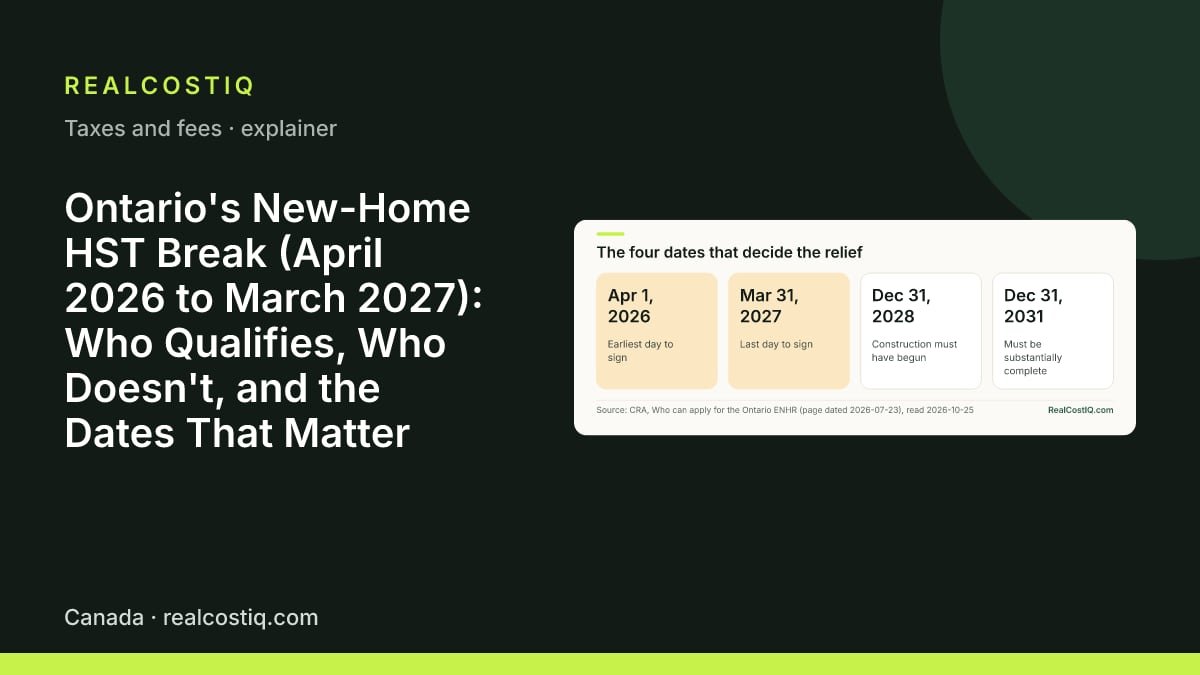
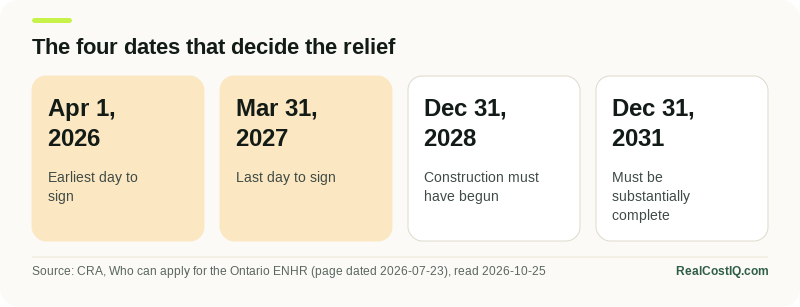
For a home bought from a builder, the CRA's test is the date of the agreement of purchase and sale. The agreement must be entered into on or after April 1, 2026 and on or before March 31, 2027. That is the date the contract was signed, not the date you get the keys. A condo that closes in 2030 can still qualify if the contract was signed in the window. A house that closes next month does not qualify if the contract was signed on March 31, 2026.
Closing can be far away, so there are outside dates. The CRA lists them for a house and land from the same builder. Construction or renovation must have begun on or before December 31, 2028. It must be substantially completed on or before December 31, 2031. Substantially completed means the home is generally 90% or more complete and can reasonably be lived in. Minor work left over does not stop that. The CRA's Notice 346 adds that the GST/HST must become payable by December 31, 2032. If your project could run late, ask your builder what the contract says about it.
| Type of purchase | Window | Other limits |
|---|---|---|
| House and land from a builder, or a condo unit | Agreement signed Apr 1, 2026 to Mar 31, 2027 | Construction begun by Dec 31, 2028; substantially complete by Dec 31, 2031; price under C$1,850,000 before HST |
| House on leased land from a builder | Agreement signed Apr 1, 2026 to Mar 31, 2027 | Same build dates; possession by Dec 31, 2032; market value under C$2,090,500; lease of 20 years or more, or with an option to buy |
| Share in a co-op housing corporation | Agreement signed Apr 1, 2026 to Mar 31, 2027 | Same build dates; share transferred by Dec 31, 2032; price under C$2,090,500 |
| Home you build or renovate yourself | Construction begins Apr 1, 2026 to Mar 31, 2027 | Substantially complete by Dec 31, 2029; market value under C$1,850,000 at completion |
Source: CRA, Who can apply for the Ontario ENHR (2026-07-23) and Notice 346 (2026-08-24). The CRA pages list more detail for each type.
For an owner-built home, the start date is the day excavation begins, not the day you buy the land or get a permit. The CRA gives an example. A person buys bare land on October 15, 2025 and gets a building permit on February 15, 2026. Excavation starts on June 1, 2026. Construction is treated as beginning on June 1, 2026, so the build is inside the window.
What the date is worth: a C$900,000 example
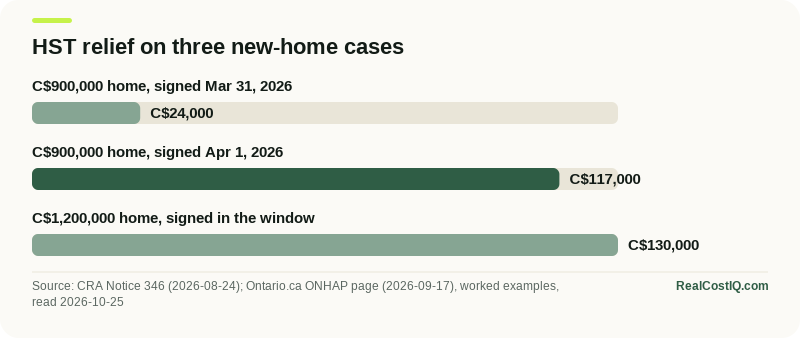
Here is a round-number example. A new condo costs C$900,000 before HST. The HST is 13%, or C$117,000. Of that, the 8% provincial part is C$72,000 and the 5% federal part is C$45,000. Say the buyer signs on April 1, 2026 and will live in the unit. Because the price is under C$1,000,000, the CRA says the ENHR is a full rebate of the 8% provincial HST, up to C$80,000. That is C$72,000. Ontario's ONHAP covers up to 100% of the 5% federal part, up to C$50,000. That is C$45,000. The two parts add to C$117,000, so the buyer pays no HST on the unit.
Now move the signing date back by one day, for a buyer who is not a first-time buyer. The buyer signs on March 31, 2026. The CRA says an agreement made before April 1, 2026 does not qualify for the ENHR. It may still qualify for the standard Ontario new housing rebate, which the CRA says is up to C$24,000. About C$93,000 of HST is left to pay. That is C$117,000 less C$24,000. One day on the calendar moved about C$93,000. A first-time buyer is in a different spot. The CRA says the Ontario first-time home buyers' rebate covers up to C$80,000 of the provincial part, on top of the federal first-time buyer rebate, so a first-time buyer who signed on March 31 could still get much or all of the HST back. Check both rebates before you rely on the date.
Price matters too. At C$1,200,000 before HST, the HST is C$156,000. The CRA says homes valued above C$1,000,000 and up to C$1,500,000 get a flat C$80,000 under the ENHR. Ontario's page says the ONHAP is a flat C$50,000 in that band. Relief is C$130,000, and C$26,000 of HST remains. The CRA says a home at C$1,850,000 or more gets no ENHR, only the standard Ontario new housing rebate of up to C$24,000. Between C$1,500,000 and C$1,850,000, the CRA and Ontario both print a partial rebate and give no formula. Use the rebate calculator for that band.
| Home value | ENHR (8% provincial part, from the CRA) | ONHAP (5% federal part, from Ontario) |
|---|---|---|
| Up to C$1,000,000 | 100% of the 8% paid, up to C$80,000 | Full relief of the federal part, up to C$50,000 |
| C$1,000,000 to C$1,500,000 | Flat C$80,000 | Flat C$50,000 |
| C$1,500,000 to under C$1,850,000 | Partial rebate; no formula printed | Partial relief; no formula printed |
| C$1,850,000 and over | None; the Ontario new housing rebate of up to C$24,000 only | None |
Source: CRA, What is the Ontario ENHR (2026-07-23); Ontario.ca ONHAP page (updated 2026-09-17). ONHAP is reduced by any federal GST/HST new housing rebate or first-time home buyers' rebate you are entitled to.
Changed, cancelled and re-signed agreements
Builders and buyers often amend contracts. Closing dates move. Extras get added. Units get swapped. The CRA has a rule for this. If an agreement made before April 1, 2026 is changed so that it counts as entered into on or after that date, it is treated as made before April 1, 2026. The buyer is not entitled to the ENHR. The buyer may still qualify for the Ontario new housing rebate or the Ontario first-time home buyers' rebate. So an amendment signed in May 2026 does not pull an older contract into the window.
A related rule covers cancelling and starting over. Say a pre-April 2026 agreement is terminated and a new one is signed on or after April 1. The CRA says the new agreement must be for bona fide purposes other than obtaining the ENHR. In plain words, there must be a real reason other than the rebate. Notice 346 adds a test. A new agreement is treated as made before April 2026 if it involves the same or related parties, is with the builder or a related builder of the complex, and is not mainly for other real purposes. If your builder offers to cancel and re-sign, ask your lawyer about this rule before you sign.
Assignments: both contracts must be in the window
An assignment is when the first buyer sells their unfinished contract to someone else before closing. The CRA is direct about the date test. Both the first agreement with the builder and the assignment agreement must be entered into between April 1, 2026 and March 31, 2027. So if the original buyer signed in February 2026 and you take over the contract in June 2026, you do not get the ENHR. Both dates have to fit.
Assignments also bring their own HST on the price the new buyer pays the old one. That is a separate tax from the builder's HST, and it is not covered here. The post on HST on an Ontario assignment sale explains it. If you are buying an assignment, ask for both signing dates in writing before you pay for the contract.
Investors, rentals and family: the home must be your home
The ENHR is for a main home. The CRA says you, or a relation, must be buying or building the home as a primary place of residence. It says the home cannot be used as a rental property. You or your relation must also be the first person to live in it after construction or a major renovation is substantially complete. A primary place of residence is where an individual lives on a permanent basis. A person can only have one. The CRA's Policy Statement P-228 sets this out.
A relation is wider than a parent or child. The CRA includes family by blood, marriage, common-law partnership or adoption. It also includes former spouses and former common-law partners. Under that wording, a parent can buy a unit for a child to live in, if the child is the first to occupy it as a main home. Check your case before you rely on it.
What about an investor who buys to rent? The ENHR is not for that case, because the CRA requires the home to be a primary residence. Notice 346 says a separate CRA notice on an enhanced rebate for new residential rental property is expected by October 2026. The page I read on 2026-10-25 still said so, and I did not find a rental notice. Ontario's ONHAP page names a separate rental rebate (the Enhanced New Residential Rental Property Rebate) as a route to the ONHAP, but the CRA had not published its details. So no rental amount is quoted here. If you plan to rent, treat any rental relief as unconfirmed until the CRA publishes it.
There is also a risk for a buyer who gets it wrong. If a builder pays or credits the rebate and knew, or should have known, that the buyer did not qualify, the builder and the buyer can both be liable to repay the CRA. That is called joint and several liability. It means the CRA can collect from either one. The practical point is to be honest on the form. The CRA says the buyer must confirm they have not already received the rebate, for example through the price, and must sign the forms in the builder's presence.
Renovations and owner-built homes
The relief also covers substantially renovated homes, but the bar is high. The CRA defines a substantial renovation as one where at least 90% of the building, or the part being renovated, is removed or replaced. It leaves out the foundation, the external walls, the interior supporting walls, the floors, the roof and the staircases from that count. After the work, the result must form part of a residential complex. A kitchen and bathroom update is far below that line. A gut job that keeps the shell may meet it.
A single-unit residential complex is generally up to two units, such as a duplex. The CRA says up to half a hectare of land is generally treated as reasonably necessary for the home. A residential condominium unit also qualifies. For an owner-built home, the market value at completion must be under C$1,850,000. The substantial completion date must be on or before December 31, 2029.
Who claims it, and in what order
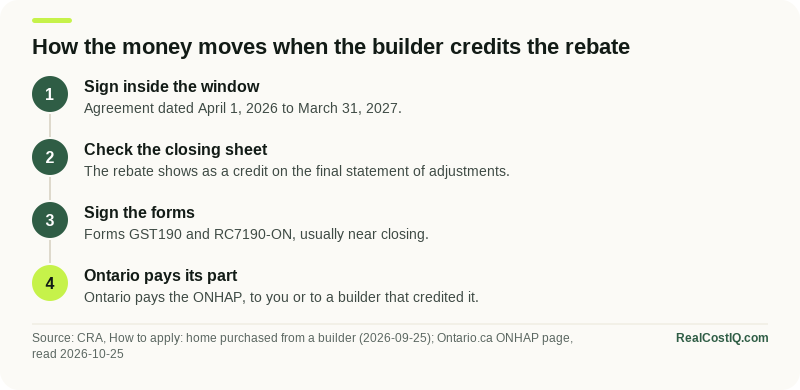
There are two ways to get the money. In the first, the builder pays or credits the rebates. The credit shows up on the final statement of adjustments, which is the closing sheet that shares costs between buyer and seller. The builder reports the sale on its GST/HST return and sends Form GST190 and Form RC7190-ON. The CRA asks the builder to include a copy of the statement of adjustments and the signed agreement with the application. The buyer signs the forms, usually near closing. Ontario pays the ONHAP to you, or to the builder if the builder credited it, and the builder cannot deduct it on its return.
In the second, the buyer pays the full HST and claims it back. The CRA says a buyer who applies directly generally has up to two years from the date ownership or possession was transferred. It also says electronic filing is not available for this rebate yet, so forms go by mail. The CRA says a buyer generally cannot file a separate application if the builder paid or credited the rebates, unless the builder did not pay or credit all of what the buyer is owed. A buyer who plans to apply directly needs cash for the full HST at closing. On the C$900,000 example, that is C$117,000. The pre-construction deposit calculator shows what falls due at final closing on a new condo.
The order of claims matters too. If you qualify for the federal first-time home buyers' rebate, you must claim it first for the 5% federal part. That federal rebate returns 100% of the GST, or the federal part of the HST, on a new home valued up to C$1,000,000, according to the CRA page dated 2026-06-16. The ONHAP payment is then reduced by that amount. Any federal tax not recovered through the first-time buyer rebate may be recovered through ONHAP, according to the CRA. For a first-time buyer on a C$900,000 home, the federal rebate and ONHAP overlap, and the total relief stays at the same C$117,000, by the rules as read here. Who pays the federal part changes, not the total.
Questions to ask your builder before you sign
- What is the date on the agreement, and on every amendment? Ask for a copy of each one.
- Does the agreement say the builder will credit the HST rebates on the final statement of adjustments, or will I pay the full HST and claim it back?
- If I am buying an assignment, what are the dates on the original agreement and on the assignment?
- What does the contract say if construction runs past the CRA's outside dates?
- Will the home be my main home, or a relative's? If I might rent it, have I asked a tax professional before I sign the forms?
- Is the price before HST under the limit for the band I expect, and is any extra, such as upgrades, counted in it?
What this post did not confirm
I did not read the text of the Ontario or federal regulations, because the e-Laws and Canada Gazette pages I tried did not load. I did not find the CRA's rental notice. I did not find a CRA formula for the C$1,500,000 to C$1,850,000 band. I also tried the RedFlagDeals threads on this topic. The site redirected to a paywalled copy, so I did not use them. Check the CRA's Notice 346 and the Ontario page for changes before you sign anything, and plan to re-read this topic before March 31, 2027, when the signing window closes.