Canadian forum threads often tell the same story. An owner bought a condo to rent out. The rent does not even cover the interest. Should they sell? The question is fair. But most posts answer it with feelings. This post answers it with one unit and every line of the math, in Canadian dollars (CAD).
In plain English
- Cash flow is the money left each month after the rent comes in and every bill is paid. If it is below zero, you top it up from your own pocket.
- We use one Toronto condo: C$600,000, one bedroom, 20% down (C$120,000), rented at the City of Toronto average of C$2,316 a month.
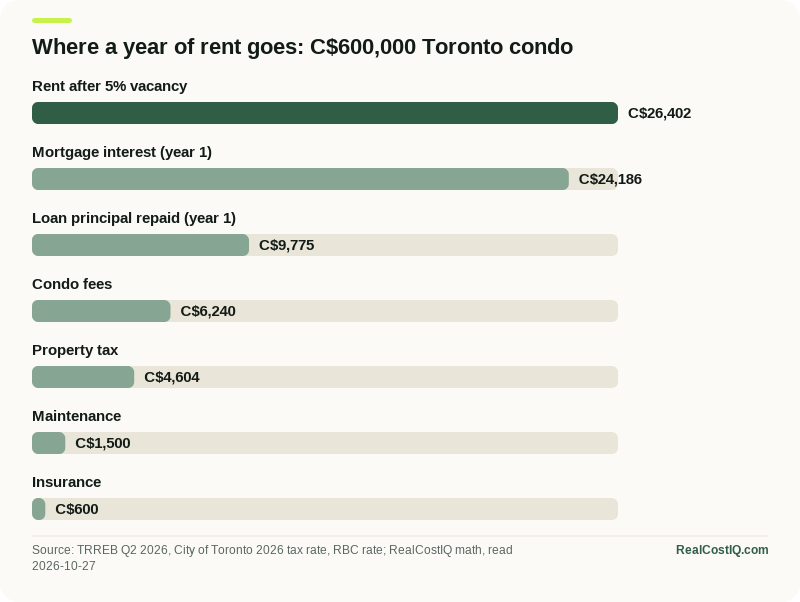
- Rent after vacancy is C$26,402 a year. The mortgage payment alone is C$33,961. Fees, tax and upkeep add C$12,944 more.
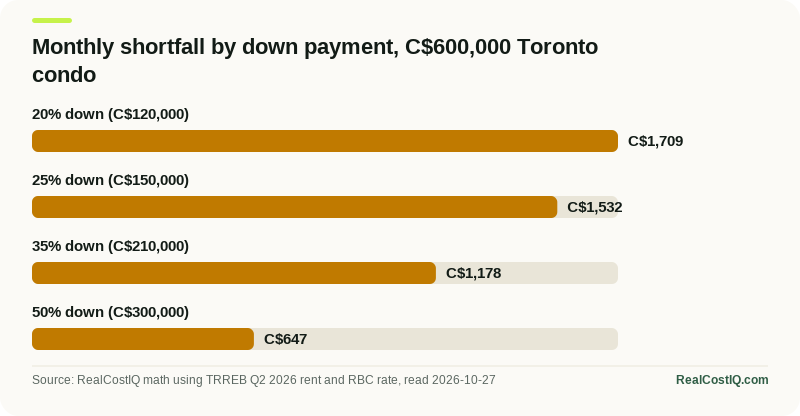
- The result is about minus C$20,502 a year, or minus C$1,709 a month.
- Part of each payment pays down the loan. That is not free equity. You still paid the cash. It only helps if the price holds.
- Even a big drop in the rate does not fix it. At a 3% rate, the shortfall is still about C$1,150 a month.
The unit and where each number comes from
Every input must be a number you can check. Here is the full list. Items marked as assumptions are ours, not market data. Change them on the rental property calculator if your unit differs.
| Input | Value | Where it comes from |
|---|---|---|
| Purchase price | C$600,000 | A round example. The Toronto Regional Real Estate Board (TRREB) says the average City of Toronto condo sold for C$667,916 in the second quarter of 2026. |
| Down payment | 20% (C$120,000) | CMHC's non-owner-occupied insurance product covers 2 to 4 units with at least 20% equity. A single condo is not listed there, so plan on 20% or more. |
| Rent | C$2,316 a month | TRREB Rental Market Report, Q2 2026: average City of Toronto one-bedroom apartment rent, from 8,847 leases. |
| Vacancy | 5% | The site calculator's national-average option. About 2.6 weeks empty a year. |
| Mortgage rate | 5.14% | RBC advertised 5-year fixed special. Not a quote. Landlord pricing can be higher. |
| Amortization | 25 years | A standard amortization for an uninsured mortgage. |
| Property tax | C$4,604 a year | The City of Toronto 2026 residential rate of 0.767311%, applied to the C$600,000 price. Real bills use assessed value. |
| Condo fee | C$520 a month | Assumption: 550 sq ft at C$0.95 a sq ft. One Toronto source gives C$0.80 to C$1.20 a sq ft. |
| Landlord insurance | C$600 a year | Assumption. Get a real quote. |
| Maintenance and repairs | 0.25% of price (C$1,500 a year) | Assumption. A condo corporation fixes the building. You fix the inside. |
| Management fee | None | Assumes you manage the unit yourself. |
Hypothetical. The condo fee, insurance and maintenance lines are assumptions, not averages. Property tax assumes the assessed value equals the price. Check the listing for the real tax bill and the real condo fee.
Two checks on the market numbers. First, rent. TRREB's report counted 15,388 apartment leases in the City of Toronto in the second quarter of 2026. For the GTA as a whole, the average one-bedroom rent was C$2,273, down 2.3% from C$2,326 a year earlier. Second, supply. The same report said renters had plenty of choice. Do not assume rents will jump to rescue the math.
Step by step: one year of cash flow
- Rent before vacancy. C$2,316 a month times 12 is C$27,792 a year.
- Subtract vacancy. At 5%, you lose C$1,390. Rent after vacancy is C$26,402.
- Add up the costs of owning. Condo fees C$6,240, property tax C$4,604, maintenance C$1,500 and insurance C$600 come to C$12,944.
- Net operating income. C$26,402 minus C$12,944 is C$13,459. This is what the unit earns before any mortgage.
- Find the mortgage. C$600,000 minus C$120,000 is C$480,000. At 5.14% over 25 years, with the twice-a-year compounding Canadian lenders use, the payment is C$2,830.08 a month, or C$33,961 a year.
- Cash flow. C$13,459 minus C$33,961 is minus C$20,502 a year. That is minus C$1,709 a month.
| Line | Per year (CAD) | Per month (CAD) |
|---|---|---|
| Rent before vacancy | C$27,792 | C$2,316 |
| Rent after 5% vacancy | C$26,402 | C$2,200 |
| Condo fees | -C$6,240 | -C$520 |
| Property tax | -C$4,604 | -C$384 |
| Maintenance (assumption) | -C$1,500 | -C$125 |
| Insurance (assumption) | -C$600 | -C$50 |
| Net operating income | C$13,459 | C$1,122 |
| Mortgage payment | -C$33,961 | -C$2,830 |
| Cash flow before tax | -C$20,502 | -C$1,709 |
Hypothetical. Mortgage payment C$2,830.08 a month on C$480,000, semi-annual compounding. Figures are rounded to whole dollars, so lines may differ by C$1. Income tax on the rent is not included.
The tenant's rent after vacancy, C$26,402, is a little more than the first year of mortgage interest, which is about C$24,186. So the owner who says the rent barely covers the interest is right. The trouble is that interest is not the only bill. The condo fee, the tax, the upkeep and the insurance are there whether or not the unit is rented.
Principal paydown is not cash flow
Here is the argument owners make. I am losing C$1,709 a month, but my tenant is paying down my loan. That is true. In the first year, about C$9,775 of the payments reduces the loan. The rest, about C$24,186, is interest.
But the C$9,775 is part of the C$33,961 you pay. It is not extra money from the tenant. The tenant's rent was already used up. The principal comes out of your pocket along with everything else. It is a form of saving. It only becomes cash if you sell, and only if the sale price holds.
Credit the principal and see what is left. Minus C$20,502 plus C$9,775 is minus C$10,728 a year. That is the true cost of holding the unit in year one. It is 1.8% of the C$600,000 price. So the condo has to rise in price by about C$10,728 a year just to leave you where you started, before the costs of selling.
Over five years the story is clear. If nothing changes, the cash you add is about C$102,512 (five times C$20,502). The loan falls by about C$54,235, from C$480,000 to about C$425,765. You paid in almost twice what you got back in loan reduction. And TRREB says the City of Toronto's average condo price in the second quarter was C$667,916 against C$717,403 a year earlier, a fall of about 6.9%. Price is not a given.
Be careful with this idea. We are not saying you will lose money. A condo can rise in price. We are saying that the rent does not fund the purchase. The purchase is funded by you, and the payoff comes only from the price.
The cash it takes to start
The down payment is not the only cash. You also pay land transfer tax. A landlord does not get the first-time buyer refunds, because those require you to live in the home.
- Ontario land transfer tax on C$600,000. The rates are 0.5% to C$55,000, 1.0% to C$250,000, 1.5% to C$400,000 and 2.0% above that, up to C$2,000,000 (Ontario, calculating land transfer tax, read 2026-10-27). That is C$275 plus C$1,950 plus C$2,250 plus C$4,000, or C$8,475.
- Toronto municipal land transfer tax. The City of Toronto uses the same brackets in this range (City of Toronto, MLTT rates, page modified 2026-04-07). That is another C$8,475.
- Total tax. C$16,950.
So the cash in is C$120,000 plus C$16,950, or C$136,950, before legal fees and other costs. The cash flow of minus C$20,502 on that cash is a return of about minus 15.0% a year. The rental property calculator estimates closing costs as 2.5% of the price, so it shows a slightly different return. Both say the same thing. To test your own unit's cash invested against its yearly cash flow, use the cash-on-cash return calculator.
Which input matters most? A sensitivity test
Change one input at a time and keep the rest as above. This shows what moves the answer.
| Change | Monthly cash flow (CAD) |
|---|---|
| Base case | -C$1,709 |
| Mortgage rate 6.19% (RBC posted rate) instead of 5.14% | -C$2,004 |
| Mortgage rate 4.00% | -C$1,403 |
| Mortgage rate 3.00% | -C$1,150 |
| Vacancy 2% instead of 5% | -C$1,639 |
| You pay an 8% management fee | -C$1,885 |
| Rent C$2,500 instead of C$2,316 | -C$1,534 |
| Rent C$3,000 instead of C$2,316 | -C$1,059 |
| Down payment 25% (C$150,000) | -C$1,532 |
| Down payment 35% (C$210,000) | -C$1,178 |
| Down payment 50% (C$300,000) | -C$647 |
Hypothetical. Each row changes one input and holds the rest at the base case. The rates 6.19% and 4.00% and 3.00% are tests, not forecasts. The 6.19% figure is the posted 5-year fixed rate on RBC's page and the Bank of Canada's weekly 5-year conventional rate for October 21, 2026.
Look at rent. A C$684 jump in rent, from C$2,316 to C$3,000, improves cash flow by only C$650 a month, because vacancy takes 5% of it. A fall in the mortgage rate of more than two points moves things by about C$560. No single reasonable change gets you to zero.
What about a bigger down payment? With 50% down (C$300,000), the shortfall falls to C$647 a month. Cash flow reaches about zero at roughly C$410,000 down, which is about 68% of the price. At that point the mortgage is C$190,000 and the payment is about C$1,120 a month. In other words, the unit pays for itself only when it has very little debt on it. At that size of cash investment, the return on that cash is tiny.
Cap rate versus the mortgage rate
The cap rate is the unit's net operating income divided by its price. Here it is C$13,459 divided by C$600,000, or 2.24%. The gross yield, which is yearly rent before costs divided by price, is 4.63%.
The mortgage rate is 5.14%. The unit earns 2.24% on its price, and the loan costs 5.14%. Whenever the cap rate is below the mortgage rate, each borrowed dollar costs more than it earns. This is called negative leverage. It is why a bigger loan makes the cash flow worse, not better. The cap rate calculator lets you test your own unit. The rental yield by city page shows how other markets compare, so you can see where yield and price are closer together.
It also explains the sensitivity table. Lowering the rate to 3% still leaves a gap, because a 2.24% cap rate is below even 3%.
Could the market change the answer?
Maybe, and these are the figures to watch. They come from published reports, not forecasts.
- Rents. TRREB's report said average condo rents were below last year across all bedroom types. The report said conditions could gradually tighten if transactions keep growing faster than listings.
- Vacancy. CMHC's 2025 rental report lists a rented condo apartment vacancy rate of 1.0% in the Greater Toronto Area, so a unit that is priced right can stay occupied. Our 5% is a cautious input. Vacancy does not fix a structural gap, though.
- Rates. The Bank of Canada's policy rate is 2.25% and its next decision is October 28, 2026. Mortgage rates for a five-year fixed term are still near 5% to 6%. Both RBC's special and its posted rate are on its page, read today.
- Prices. The City of Toronto condo average fell from C$717,403 to C$667,916 between the second quarters of 2025 and 2026. TRREB's September 2026 report put the City of Toronto condo average at C$640,248, down 6.1% from a year earlier. A lower price helps the cap rate. It also means less equity for owners who bought earlier.
A buyer today at C$600,000 is buying below the C$667,916 second-quarter average. Even so, the math above holds. It is the structure that fails, not the price.
What the owner-occupier post covers, and what this one does not
If you plan to live in a Toronto condo instead of renting it out, a different set of rules applies: a smaller down payment is allowed, and first-time buyer refunds are available. Our post on renting versus buying in Toronto covers that case.
This post stops at cash flow before income tax. Rental income is taxable and some costs are deductible. That is a tax question, and you should ask an accountant. We did not model it. We also did not model condo special assessments, rent increases, a vacancy that lasts months, or a sale.
If you already own one: keep, sell or add cash
Many readers do not face a buy decision. They already own a unit and are paying the gap each month. The math above gives you three questions to ask.
- What is my real monthly gap? Use your own rent, fee, tax and mortgage payment. If you pay C$1,709 a month, that is C$20,502 a year of your own cash.
- What is my gap after principal? Take the part of each payment that reduces the loan and subtract it. In our example that leaves about C$10,728 a year. This is the amount the price must rise each year for you to break even before selling costs.
- What happens at renewal? If your term ends soon, ask your lender for a renewal quote and re-run the numbers at that rate. Our test at 6.19% added about C$295 a month to the gap.
If the answers show a gap you can carry for years, and you believe in the price, keeping the unit is a choice. If the gap strains your budget, a larger down payment cuts it, but it takes cash. Paying down C$90,000 more on the loan, which moves a 25% down payment to a 40% one, would shrink the gap only to about C$1,000 a month. Selling is a third option. A sale has costs of its own, such as agent fees and legal fees. Get a quote for them before you decide.
Five checks before you buy or keep a rental condo
- Use real rent. Look at leases in the same building, not asking prices. The TRREB average is a guide, not a promise.
- Ask for the condo fee and the status certificate. Fees rise, and special assessments can add a bill. Read the building's reserve fund report.
- Compare the cap rate to your mortgage rate. If the cap rate is lower, the loan is costing more than the unit earns.
- Count the cash twice. Include down payment, land transfer tax in both layers where they apply, and legal fees.
- Credit principal separately. Treat loan reduction as saving that is locked in the unit. Do not call it income.