Your parents want to help you buy. That help can take three forms. They can give you money. They can sign your mortgage with you. Or they can go on the title of the home, which makes them an owner. Each route does a different job and has a different cost. This post prices all three on one example, in Canadian dollars (CAD, shown as C$), and shows what lenders and CMHC say they need. It does not give tax advice. If a parent is selling investments to fund a gift, or the home will not be your only property, talk to an accountant before you act.
Two nearby guides cover pieces of this. Buying a first home as a newcomer covers building a down payment from scratch. The 20% down or pay CMHC break-even works the question of whether to put down more. Here the question is different: what does it cost the family to give the money, and in what form?
The example purchase
These are assumptions, not quotes. A first-time buyer is buying a C$700,000 home in Ottawa, Ontario. We use a city without a municipal land transfer tax so that the provincial figures stand alone. In Toronto, a second municipal tax applies and changes the sums. The buyer has saved C$70,000, which is 10% of the price. We assume a 4.59% five-year fixed rate and a 25-year amortization for the payment figures. Those are examples, not offers. Fixed-rate mortgages in Canada compound twice a year, and we price them that way, as our mortgage calculator does.
Route 1: a gift, and what the lender needs
Who can give
CMHC's mortgage loan insurance FAQ lists a non-repayable gift from immediate family among the accepted sources of a down payment. TD adds detail: for a high-ratio mortgage, which is a mortgage with less than 20% down, a gifted down payment can only come from an immediate family member related by blood, marriage or common law, or adoption. For a standard mortgage of 80% of the price or less, TD says a gift could come from a wider group of relatives. A friend or an aunt who does not fit the lender's definition may be accepted at 20% down and refused at 10%. Check the donor against your lender's definition before the money moves.
What the gift letter says
Every lender we read asks for a signed letter. TD says the giver must state that the money is a gift, not a loan, and that it does not need to be repaid, with the date, the amount and the giver's relationship to you. National Bank describes the same contents and says notarization is optional. CIBC asks for a gift letter from the donor confirming the amount and that there are no repayment terms. RBC says an RBC advisor can provide the letter and notes, as an advantage over a loan, that a gift is not counted against your capacity to carry the mortgage.
The flip side is easy to miss. A gift helps you with the down payment. It does not raise your income for the stress test or the debt-service ratios. If the issue is that you cannot qualify for the monthly payment, a gift does not fix that. A co-borrower can. The stress test guide explains the ratios.
Proving the money is yours to use
CIBC asks for a savings or investment statement from the past 90 days as evidence of your down payment, and a gift letter if part of it is a gift. Lenders also want to see the money arrive in your account before closing. The practical steps are to move the gift into your own account early, keep the bank record, and keep the letter with it. Do not wait for the week of closing, because a transfer from another bank can take days and a lender may ask questions about a large deposit that appears late.
A gift versus a loan
If your parents expect the money back, it is a loan, and it should not be written up as a gift. TD's guide for parents says that if you want the money repaid, a private loan or private mortgage with a written agreement drawn up by a lawyer is the way to do it. The agreement should cover the amount, the interest rate, the monthly payment and the amortization. CMHC's list of sources treats a gift as non-repayable. Signing a gift letter and then repaying the money is a misstatement to the lender.
What a gift is worth to you: the insurance premium
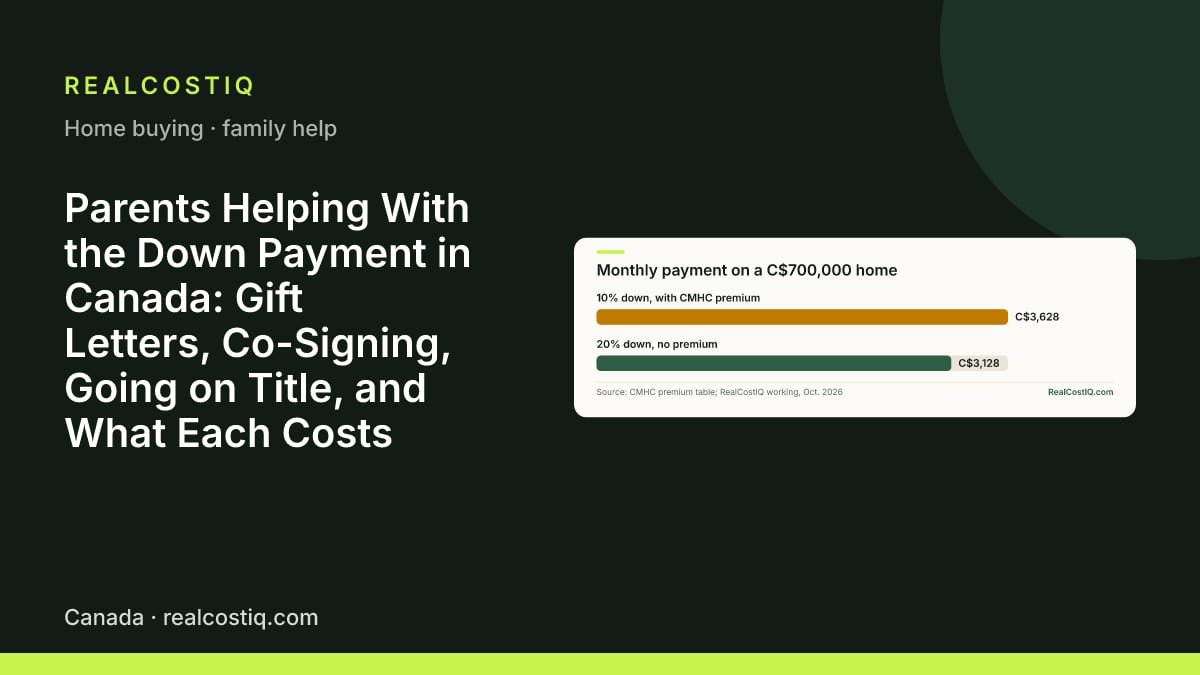
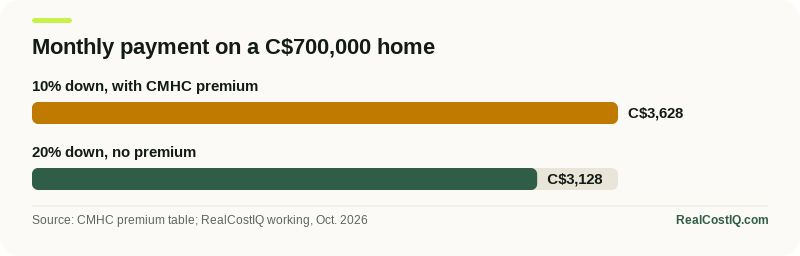
Here is what a larger gift can buy. With C$70,000 down on C$700,000, you borrow C$630,000. That is 90% of the price, so the CMHC premium on the total loan is 3.10% (CMHC premium table, read 2026-10-28), or C$19,530. It is usually added to the mortgage. The loan becomes C$649,530, and the payment on our assumed terms is about C$3,628 a month.
Now suppose your parents gift another C$70,000. You put down C$140,000, which is 20%. You borrow C$560,000, and there is no default insurance to pay. The payment is about C$3,128 a month. That is C$500 a month lower, and you avoid the C$19,530 premium. The gift also cuts the loan by C$89,530, because the premium disappears with it. The minimum down payment on C$700,000 is C$45,000, calculated as 5% of the first C$500,000 plus 10% of the rest, per CMHC. So your own C$70,000 already clears the minimum. The extra gift is a choice, not a requirement.
| Down payment | Insured loan | CMHC premium | Monthly payment | |
|---|---|---|---|---|
| Buyer's own savings only | C$70,000 (10%) | C$649,530 | C$19,530 | C$3,628 |
| With a C$70,000 parental gift | C$140,000 (20%) | C$560,000 | None | C$3,128 |
Premium rate from CMHC's homeowner premium table (85.01% to 90% loan-to-value: 3.10%), read 2026-10-28. Payments are our working at an assumed 4.59% with semi-annual compounding. Rates are examples, not offers. A 30-year amortization would add a surcharge; we use 25 years.
Whether the C$70,000 is better in your bank or in the home is the question the CMHC insurance calculator and the down payment savings calculator help with. A gift also does not have to be all or nothing. A smaller gift that moves you to the 15% band cuts the premium rate to 2.80% (loan of C$595,000, premium C$16,660), which still saves money.
Route 2: co-signing, or becoming a co-borrower
Sometimes the problem is income, not savings. A parent can sign the mortgage with you. RBC says co-borrowing can help with the ability to get approved, and that the co-borrower is responsible for the loan the same way as for their own. It also warns that the co-borrower's credit history appears on the loan. RBC says all applicants' names will appear on the property's title, which is one reason lenders treat a co-borrower as an owner. National Bank describes the line more finely. It says a parent can co-sign as a joint borrower when the down payment is 20% or more on a conventional mortgage. If the down payment is below 20% and mortgage insurance is required, it says the parent's only option is to become a co-owner. If the child defaults, National Bank says, the lender can pursue the parent for all or part of the debt.
These rules are lender-specific. National Bank is a Quebec-based lender, and what it says about its own mortgages may not match RBC's, TD's or a credit union's. Ask your lender in plain words: can my parent be on the loan without being on title, and if I put less than 20% down, is that still allowed? The answer decides which routes are open to you.
What does it cost? The immediate cost is zero in fees. The real cost is risk and capacity. A parent who co-signs takes on a debt that appears on their own credit file, and it may reduce what they can borrow for themselves. If the mortgage payment is missed, both are liable. Both lenders we read said as much. Consider what happens if the child's job changes or the marriage breaks down. Both TD and National Bank point out that if a couple separates, the home's equity is generally divided equally, which includes the money your parents gave unless something is written down to protect it. Both suggest speaking to a lawyer or notary about protecting the gift.
Route 3: going on title, and what it does to land transfer tax
At purchase: the first-time buyer refund shrinks
Putting a parent on title at purchase is where a family can lose money without noticing. Ontario's land transfer tax on a C$700,000 purchase is C$10,475 on the provincial schedule: 0.5% on the first C$55,000, 1% up to C$250,000, 1.5% up to C$400,000, and 2% above that (Ontario Ministry of Finance, read 2026-10-28). Use the land transfer tax calculator for your own price and for the municipal layer in Toronto.
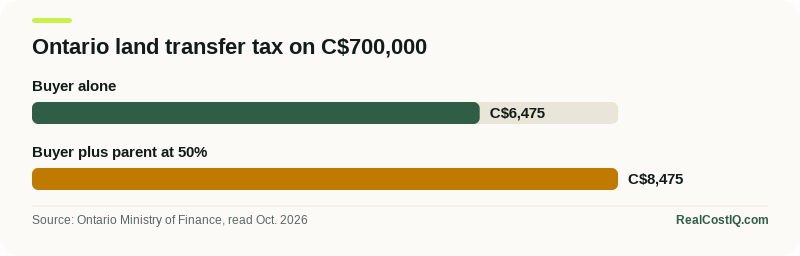
A first-time buyer in Ontario can claim a refund of up to C$4,000. The conditions, per the Ministry: you are at least 18, you move in within nine months of the transfer, you have never owned a home anywhere in the world, you are a Canadian citizen or permanent resident, and you apply within 18 months of registration. Now the key rule. If one or more purchasers is not a first-time buyer, the refund is proportionate to the interest acquired by those who qualify. The Ministry's own example is a parent who is not a first-time buyer and a child who is, each holding 50%. The child can claim 50% of the maximum, which is C$2,000.
| Title | Tax before refund | First-time buyer refund | Net tax |
|---|---|---|---|
| Buyer alone (first-time buyer) | C$10,475 | C$4,000 | C$6,475 |
| Buyer and parent, 50/50 (parent owned a home before) | C$10,475 | C$2,000 | C$8,475 |
Rates and refund from the Ontario Ministry of Finance land transfer tax pages, read 2026-10-28. The proportionate-refund rule and the 50/50 example are from the Ministry's first-time homebuyer refund page. Toronto adds a municipal land transfer tax on top.
So adding a parent as a 50% owner costs the family C$2,000 in land transfer tax relief on this purchase. That is the cheapest part of the cost of going on title, because the parent also takes on every duty of an owner. RBC lists the shared liability. National Bank says the parent covers a share of the mortgage payments, school taxes and municipal taxes. The parent's name is on the title, and the home can affect the parent's own finances when sold. National Bank says owning two residences can affect taxes at sale. We leave that to an accountant.
Adding a parent after closing
Families sometimes buy alone and add a parent later, for example when the mortgage was easier to get that way. Ontario's guidance is less clear here, and we could not confirm a figure. What the Ministry's practitioner guide does say is useful. The nominal-consideration statement applies only where there is no consideration of any kind, or less than C$200. Consideration includes the value of any liability the person receiving the interest takes on. And the guide says there is no exemption for a gift on land that has an existing encumbrance, such as a mortgage. A mortgaged home that a parent joins by taking on part of the loan therefore looks like a transfer with consideration. If the Ministry applied the tax to the value of a 50% interest, C$350,000, the provincial tax would be C$3,725 by the same schedule. That is an illustration, not a finding. Ask the lawyer to confirm the tax and the registration cost before you sign, and compare it with the cost of adding the parent at purchase. The family-transfer exemptions the Ministry lists, such as the spousal exemption and the farmland exemptions, do not cover a parent joining a child's house.
A parent on title for a few months, then off
The Ministry's practitioner guide covers a parent who is on title only as a trustee for the child, and says trust documents are needed to support a first-time buyer refund. This is a narrow path and not something to improvise. If a parent is on title only to help with qualification, ask a lawyer to document it at the start. Ask the lender, too, since a lender may not agree to a trust arrangement at all.
The three routes side by side
| Route | What it fixes | Direct cost | Main risk |
|---|---|---|---|
| Gift | Down payment shortfall; can remove the CMHC premium (C$19,530 in our example) | The money itself; no fee for the letter | Equity is shared if the child separates, unless protected in writing |
| Co-signer or co-borrower | Income shortfall; helps approval | No fee; reduces the parent's own borrowing room | Parent is liable for the debt; lender can pursue them |
| Parent on title | Lender requires an owner on insured loans (at some lenders) | Up to C$2,000 less land transfer tax relief at a 50% share | Parent shares ownership, liability and possible tax at sale |
Sources: CMHC, TD, RBC, National Bank, CIBC and Ontario Ministry of Finance pages, read 2026-10-28. Lender rules differ; confirm yours.
Many families combine routes. A parent gifts C$50,000 and co-signs. Or a parent gifts the full amount and stays off the loan. The cleanest option is usually a gift with no one else on the mortgage, because it keeps liability with the buyer. But if the buyer cannot qualify on income alone, the choice is not free.
A checklist before the money moves
- Ask the lender which relatives it accepts as donors at your down payment size, and in what form it wants the letter.
- Put the gift into your own account early and keep the statement. Lenders look back about 90 days at CIBC.
- Decide whether the money is a gift or a loan, and write it down that way. If you want it back, use a lawyer and a loan agreement.
- If a parent will be on the mortgage, ask whether they must also be on title, and price the loss of first-time buyer relief before you agree.
- Ask your lawyer how to protect the gift if the relationship ends, and what a land transfer tax filing with a co-owner will look like.
- Run your own numbers in the land transfer tax calculator and the CMHC insurance calculator.
The figures here are for one Ontario purchase. Other provinces have different land transfer taxes, different first-time buyer relief and in some cases none, and Quebec's welcome tax works differently. Use the province's own rules for your case. And keep in mind the dates: we read every lender and government page on 2026-10-28, and any of them can change.