Take a home worth C$700,000 with C$400,000 still owing. A lender will usually lend up to 80% of the home's value on a refinance. Eighty percent of C$700,000 is C$560,000. Subtract the C$400,000 you owe and C$160,000 is the most you could take out before costs. This post prices that move: what you pay to get the money, what a lower rate saves, and how many months it takes to come out ahead.
The worked example: how much room does the 80% line leave
The inputs: a home value of C$700,000, a mortgage balance of C$400,000, and a borrowing limit of 80%. The value is an assumption. A lender will order its own appraisal, and that number is the one that counts. So the first thing to see is how much the appraisal moves your room.
| Appraised value | 80% limit | Mortgage today | Most you could add |
|---|---|---|---|
| C$650,000 | C$520,000 | C$400,000 | C$120,000 |
| C$700,000 | C$560,000 | C$400,000 | C$160,000 |
| C$750,000 | C$600,000 | C$400,000 | C$200,000 |
Arithmetic on the 80% limit. It is a ceiling before costs, not an offer. A C$50,000 swing in the appraisal moves your room by C$40,000. Values are assumptions chosen for the example.
The size of the gap between the first and last row is the point. A refinance is only as big as the appraisal allows. If you plan around C$160,000 and the appraiser says C$650,000, you have C$120,000. Do not sign a contract with a contractor, a seller or a school until the lender confirms the number.
Our home equity calculator shows how fast your equity grows as you pay down the loan and the home's value changes. Our HELOC calculator covers the 65% and 80% limits on a home equity line. Those pages own those rules, so this post only uses them.
Where the 80% limit comes from
The Financial Consumer Agency of Canada (FCAC) says you may usually borrow up to 80% of your home's value against its equity. For a second mortgage, it gives the limit as 80% of the appraised value of the home, minus the balance of your mortgage. For a home equity line of credit (HELOC), it says you may borrow up to 65% of the home's value. It also says you may have to pay a new mortgage loan insurance premium and lists appraisal, title search, title insurance and legal fees among the costs.
Now the federal rules. The Office of the Superintendent of Financial Institutions (OSFI) sets the rules for banks in its Guideline B-20. It says a non-amortizing HELOC should stay at or below a 65% loan-to-value (LTV) ratio. It says mortgages for purchase, renovation or improvement must be insured if their LTV is above 80%. It says the LTV should be recalculated on any refinancing. And it says the qualifying rate for all uninsured mortgages should be the greater of the contract rate plus a buffer, or a floor rate.
We want to be exact about what we read. B-20 does not contain a sentence that says "a refinance may not exceed 80%." The 80% figure comes from putting the pieces together. Above 80% a mortgage has to be insured. The Canada Mortgage and Housing Corporation (CMHC) refinance product that exists today is built for building secondary suites. Its page says additional financing must only be used for the construction and that equity take-out is not permitted. So if you want to take out cash, we found no insured route above 80%. Our rule of thumb is the FCAC's: usually 80%. Your lender may set a lower limit.
That CMHC product has its own limit of 90% loan-to-value on the lending value (the lesser of the as-improved value and the as-is value plus the cost of the work), and it only applies to a suite. We cover it in our post on refinancing to add a secondary suite. It is not a general cash-out tool, and you should not plan around it for a kitchen, a debt payoff or a vacation.
The costs, line by line
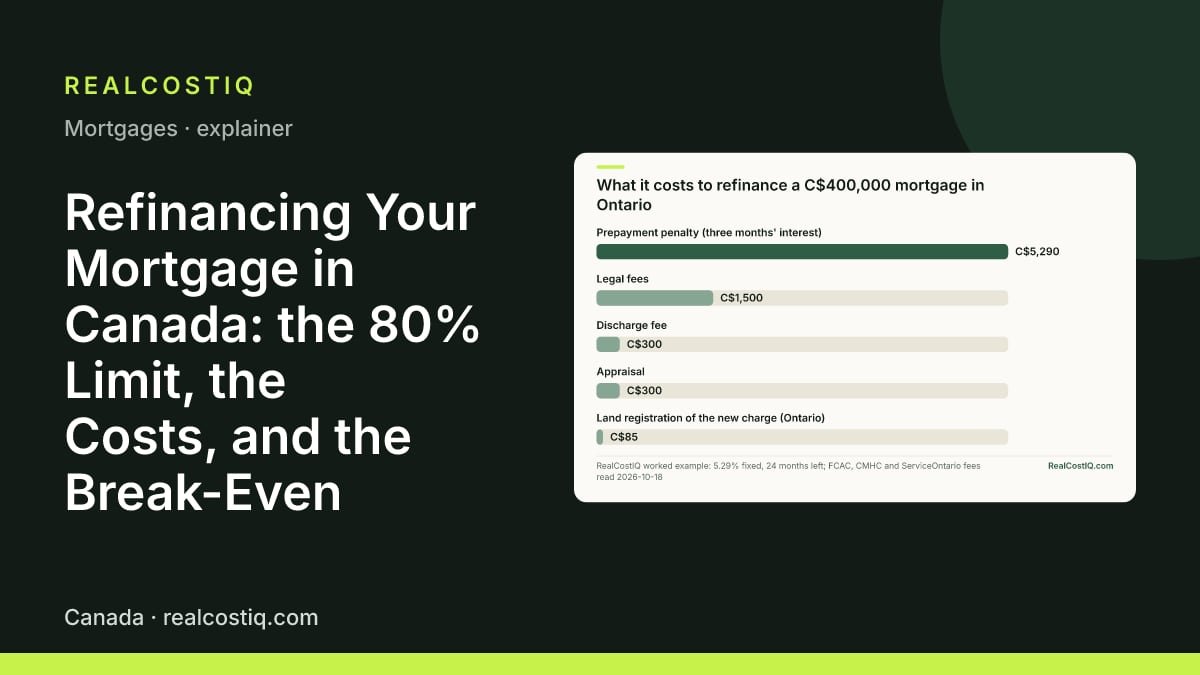
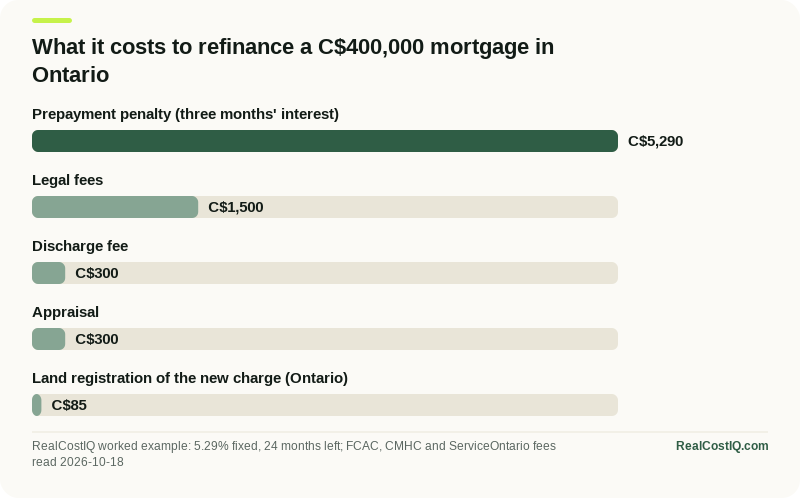
Here is the cost table for our example. The inputs: C$400,000 balance, a fixed-rate mortgage with a contract rate of 5.29% and 24 months left in the term. Both rates in this post are illustrative. They are not quotes. We chose them for the example.
| Cost | Amount | Where the figure comes from |
|---|---|---|
| Prepayment penalty | C$5,290 | The site's penalty engine, three months of interest on C$400,000 at 5.29% |
| Legal fees | C$1,500 | Assumption inside the FCAC range of C$400 to C$2,500 for a lawyer, notary or commissioner |
| Discharge fee | C$300 | Assumption inside the FCAC range of nothing up to about C$400 where no cap applies |
| Appraisal | C$300 | Assumption at the midpoint of CMHC's C$250 to C$350 range |
| Land registration of the new charge (Ontario) | C$85 | ServiceOntario fee schedule effective 2025-11-03, instrument in electronic format, with HST. From 2026-11-02 it is C$86.42 (Bulletin 2026-04), C$1.42 more |
| Total | C$7,475 | Sum of the rows |
Penalty computed with the site's mortgage penalty engine at a fixed rate, a monoline lender, C$400,000 balance, 5.29% contract rate and 24 months remaining. Fee ranges read 2026-10-18. Where a row says assumption, we picked a value inside the published range; your lender and lawyer will quote the real one.
The penalty is the line to check first
If you leave a closed mortgage early, you normally pay a prepayment penalty, says the FCAC. Its page on reducing prepayment penalties says the penalty will usually be the higher of three months' interest on what you still owe or the interest rate differential (IRD). Our engine gives C$5,290 for the three-month rule. Its own simplified IRD for this input is C$4,000, which is lower, so the three-month figure wins here. Do not rely on that. A real IRD depends on the lender's own comparison rate, and some lenders use posted rates, which are higher than the rates people actually get. The Bank of Canada's weekly series for banks' posted 5-year conventional mortgage rate read 6.19% on 2026-10-14. Use the mortgage penalty calculator and then ask your lender for the written number. We do not work out an IRD here.
A variable-rate mortgage is simpler. The engine uses three months of interest for a variable rate, which is C$5,290 here as well. The one case with no penalty is the renewal date itself. If the term ends in a few months, waiting may be cheaper than leaving now.
The smaller costs
The FCAC says professional fees for discharging a mortgage typically run from C$400 to C$2,500. It says some provinces regulate the maximum discharge fee, and where no cap applies the lender sets it, typically from nothing up to C$400. Federally regulated lenders must disclose the discharge fee in your mortgage contract. A refinance also needs a new charge on title, and a lawyer or notary registers it. CMHC puts a bank-ordered appraisal at C$250 to C$350 on a page with no date.
Province matters for registration. In Ontario, the ServiceOntario schedule effective 2025-11-03 listed the fee to register an instrument in electronic format at C$85.00 in total, made up of a C$71.55 statutory fee, a C$11.90 e-registration fee and C$1.55 HST. Bulletin 2026-04 raised it to C$86.42 from November 2, 2026 (C$72.75 statutory, C$12.10 e-registration and C$1.57 HST), so a refinance registered now costs C$1.42 more than our example. That is the government fee only, not the lawyer's. We read no registration fee for any other province for this post, so we give no number for them. Quebec uses notaries, and its costs are different. Ask your own lawyer or notary for the all-in figure.
Break-even on a lower rate: the short version
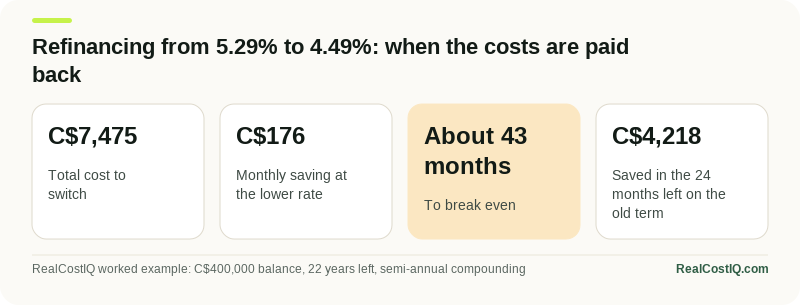
If your only goal is a lower rate, run the break-even before you refinance. On a C$400,000 balance with 22 years left, moving from an illustrative 5.29% to 4.49% saves C$176 a month. Total costs of C$7,475 take about 43 months to recover. Only C$4,218 is saved in the 24 months left on the old term. The refinance pays back after the old term would have ended, so it wins only if you expect higher rates at renewal. Illustrative rates, not quotes.
Our post on breaking a mortgage early for a lower rate, blend-and-extend and the break-even works the rate-only case in full, including the blend-and-extend alternative. This post stays on the equity side: how much you can take out, and what that costs.
Break-even on taking out C$160,000
Now the other reason to refinance: you want the cash. Say you want the full C$160,000 for a renovation (the home renovation cost calculator can size it) or to consolidate debts. You can refinance the whole mortgage to C$560,000 at the new rate. Or you can leave the old mortgage alone and borrow the C$160,000 on a home equity line. Both cost interest. The question is which costs more in the first year, and what the move costs up front.
The inputs for path B: a HELOC at prime plus 0.50%. The Bank of Canada's weekly prime series read 4.45% on 2026-10-14, so we use 4.95%. The plus 0.50% is an assumption and your HELOC rate will differ. The line is interest-only. The site's HELOC engine confirms that, at a C$700,000 value and a C$400,000 mortgage, up to C$160,000 is available, which puts the combined loan at exactly 80%. Interest-only on C$160,000 at 4.95% is C$660 a month, or C$7,920 a year.
| Path A: refinance to C$560,000 | Path B: keep the mortgage, add a HELOC | |
|---|---|---|
| Mortgage rate (illustrative) | 4.49% on C$560,000 | 5.29% on C$400,000 |
| HELOC | none | C$160,000 at 4.95%, interest only |
| Year-one interest on the mortgage | C$24,601 | C$20,694 |
| Year-one interest on the HELOC | none | C$7,920 |
| Total year-one interest | C$24,601 | C$28,614 |
| One-time costs | C$7,475 | not priced here |
Path A uses a 22-year amortization at 4.49%, C$3,330 a month. Path B's mortgage payment stays C$2,554 and the HELOC adds C$660 of interest a month. Interest is for the first 12 months. A HELOC rate floats with prime, and the table does not price the cost of setting up a HELOC.
On interest alone, path A is C$4,013 a year cheaper. Divide the C$7,475 cost by that and you get a break-even of about 22 months. But look at what path A did. It also lowered the rate on the existing C$400,000, from 5.29% to 4.49%. Part of the C$4,013 is the lower rate, not the cash. Path A also puts the C$160,000 on the same amortization, which means your payment rises to C$3,330 a month. Path B leaves C$160,000 on interest-only, which is cheaper each month but never pays it down.
So the decision is not only about cost. It is about whether you will actually repay the C$160,000. A refinance forces repayment on a schedule. An interest-only line does not. If you would pay it back anyway, a line of credit may be the cleaner choice. If you would not, the refinance is the stricter one.
Will you qualify? The stress test on a refinance
A refinance is a new loan, and for uninsured loans OSFI says the qualifying rate is the greater of the contract rate plus 2% or 5.25%. Its qualifying rate page, last modified 2026-01-29, gives that formula. At our new rate of 4.49%, the qualifying rate is 6.49%.
Here is what that does to the income you need. At 6.49%, a C$560,000 mortgage over 25 years has a payment of C$3,748 a month. If a lender used a 39% gross debt service limit, the common CMHC benchmark for insured loans, and counted the mortgage payment alone, you would need about C$115,311 of household income. That is a floor. Property tax and heating are counted too, so the real number is higher. For the C$400,000 rate-switch case on 22 years, the same arithmetic gives about C$87,034.
Two points follow. First, the stress test is why a refinance that looks cheap on your current payment can fail at the lender. It is not your payment that is tested but the higher qualifying payment. Second, taking cash out raises the qualifying bar more than a plain rate switch does, because the loan is bigger and the amortization restarts. If you are near the limit, a smaller cash-out may qualify where the full C$160,000 does not. Lenders set their own debt-service limits for uninsured loans, so this is a way to estimate, not a rule.
Other ways to get at the money
- A home equity line of credit. The FCAC says up to 65% of the home's value. It costs set-up fees and floats with prime, as the table above shows.
- A second mortgage. The FCAC gives the limit as 80% of the appraised value minus your mortgage balance. We did not read a rate for it.
- Blend and extend. The FCAC says lenders may let you extend your term before it ends, blending your old rate and the new term's rate, and the lender must tell you how it calculates the new rate. Ask for the blended rate in writing.
- Wait for the renewal. At the renewal date there is no penalty to leave. If you can wait, you save the C$5,290 in our example.
- Borrow less. A smaller amount means a smaller qualifying payment and, often, an easier file.
What to ask before you refinance
- What is the penalty to leave my current mortgage today? Please give me the dollar figure and the method in writing.
- Will the lender order an appraisal, who pays for it, and what value will it use?
- What is the highest amount you will lend against my home, and is it 80% or lower?
- What will the qualifying rate be, and what income do you count?
- What are the legal fees, the discharge fee and the registration fee, in total?
- Will you cover some of the costs if I move the mortgage to you?
- How long is the new term, and what is the new penalty if I leave it early?
- What will happen to my amortization? Does it restart?
Then run your own numbers. Put your balance, your two rates and every cost in the table in this post. Divide the total cost by the monthly saving. Compare that number of months to the time left in your term, and to how long you expect to stay in the home. If the answer is longer than either, the refinance may not pay off.
What this post did not read
We read the FCAC pages on borrowing against home equity and on mortgage discharge, the FCAC page on breaking a mortgage contract, OSFI's Guideline B-20 and qualifying rate page, CMHC's refinance page and its cost page, the Appraisal Institute of Canada's page for property owners, the Ontario land registration fee schedule and two Bank of Canada series, all on 2026-10-18.
We did not read any lender's own refinance policy, and we did not read private insurers' rules. We did not find a published federal sentence capping refinances at 80%, so we said how we reached that figure. We read land registration fees for Ontario only. Other provinces, and Quebec's notarial costs, differ and are not priced here. The rates in the tables are illustrative assumptions, and the legal, discharge and appraisal rows are assumptions inside published ranges. The penalty engine uses a simplified IRD, so a real penalty may be higher. This is general information and not advice on your mortgage.