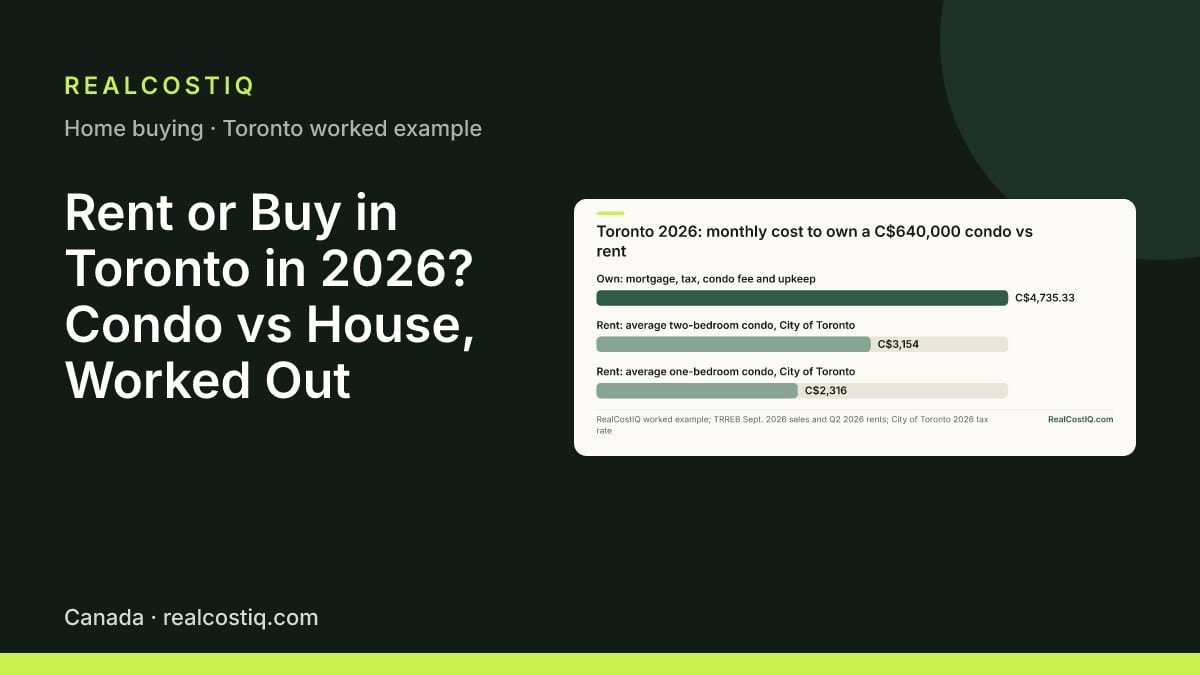
Renting costs less each month in Toronto. That part is easy to see. The harder question is what happens to the money over ten or fifteen years. A buyer builds equity, which is the part of the home you own free and clear. A renter keeps the cash that a buyer would have spent on the down payment, closing costs and extra monthly costs, and can invest it. This post works through both sides with Toronto numbers, all in Canadian dollars (CAD).
In plain English
- Renting is cheaper per month in Toronto. A C$640,000 condo costs about C$4,735 a month to own. A comparable two-bedroom condo rents for about C$3,154.
- Owning only pays off if the home gains value and you stay long enough. In our base case, buying the condo catches up to renting after about 11 years.
- Against a one-bedroom rent of about C$2,316, buying did not catch up within 15 years.
- A C$1.56 million detached house needs 20% down (C$312,000) and a C$55,350 land transfer tax. It did not catch up within 15 years against the rent we could source.
- The answer changes a lot with three guesses: how fast the home rises in value, what your saved cash earns, and how long you stay. This post shows all three.
What we compare, and what we do not
The word break-even means the year when the buyer's total wealth first passes the renter's. Total wealth for a buyer is the home's value minus the mortgage still owed. Total wealth for a renter is the invested savings. Each side keeps a running total, and break-even is the first year the buyer is ahead.
Opportunity cost is the money you give up by choosing one path. When you put C$39,000 into a down payment, you can no longer invest it. That lost growth is the opportunity cost of buying. The mirror image is the rent you pay: it is gone, and you build no equity from it. A fair comparison counts both.
We use the engine behind this site's rent vs buy calculator, at named inputs. It uses Canadian mortgage math, including semi-annual compounding. That means a Canadian fixed rate is compounded twice a year, which gives a slightly lower payment than the US method of dividing the rate by 12. It also adds the Ontario and Toronto land transfer taxes and the CMHC insurance premium. CMHC is the Canada Mortgage and Housing Corporation, a federal Crown corporation that insures mortgages when the down payment is under 20%.
This post does not cover other cities. For Vancouver, with strata fees and BC property transfer tax, see our Vancouver rent vs buy post. It also does not tell you what to do. Your income, job, family plans and risk comfort matter more than any average.
Worked example 1: a C$640,000 condo
The Toronto Regional Real Estate Board (TRREB) reported that condo apartments in the City of Toronto sold for an average of C$640,248 in September 2026. We round to C$640,000. Here is how the buying side adds up, step by step.
- Minimum down payment. The Financial Consumer Agency of Canada (FCAC) says homes between C$500,000 and C$1.5 million need 5% of the first C$500,000 plus 10% of the rest. That is C$25,000 plus C$14,000, or C$39,000.
- Loan before insurance. C$640,000 minus C$39,000 is C$601,000. The loan is 93.9% of the price.
- CMHC premium. CMHC's table sets 4.00% for a loan between 90.01% and 95% of the price. 4.00% of C$601,000 is C$24,040. We add it to the loan, so the total mortgage is C$625,040.
- Rate and time. We use an example rate of 4.50% and a 25-year amortization. Amortization is the full time you take to repay the loan. It is not the same as the term, which is the length of one contract, often five years. The rate is an illustration, not a quote.
- Monthly payment. About C$3,459 for principal and interest. Principal is the money you borrowed. Interest is the cost of borrowing it.
Next come the costs that renters do not pay. Toronto's total residential property tax rate for 2026 is 0.767311%, according to the City of Toronto. On a C$640,000 home that is about C$4,911 a year, or C$409 a month. This is a simple stand-in, because the City taxes the assessed value of the home, and that can differ from the price you paid.
We add C$600 a month for condo fees. That is a placeholder, not an average. Fees vary a lot by building, so test your own. We also add C$267 a month for upkeep, which is 0.5% of the price a year. The condo corporation handles the building, so we use half of the 1% the engine uses for a house.
| Item | Amount (CAD per month) |
|---|---|
| Mortgage principal and interest (C$625,040 loan) | C$3,459.43 |
| Toronto property tax (0.767311% of price, 2026 rate) | C$409.23 |
| Condo fee (placeholder) | C$600.00 |
| Upkeep (0.5% of price a year) | C$266.67 |
| Total to own | C$4,735.33 |
| Average two-bedroom condo rent, City of Toronto | C$3,154.00 |
| Owning costs more by | C$1,581.33 |
Hypothetical. Mortgage payment from the site's engine with semi-annual compounding. Property tax rate: City of Toronto, 2026 residential total rate, read 2026-10-15. Rent: TRREB Rental Market Report, Q2 2026, City of Toronto condo apartment leases. Home insurance and utilities are not included on either side.
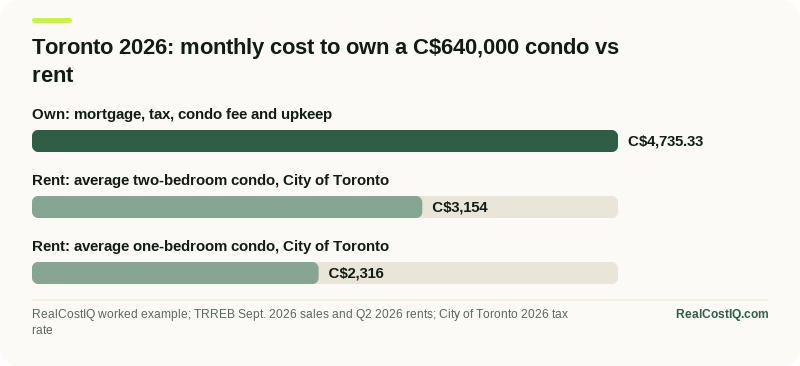
Which rent is the fair comparison? TRREB's Q2 2026 report gives the City of Toronto average for condo apartments leased through its system: C$2,316 for one bedroom, C$3,154 for two bedrooms and C$3,882 for three. The C$640,000 average sale price covers a mix of unit sizes, so we run two cases. A two-bedroom rent is the closer match to a C$640,000 purchase. A one-bedroom rent shows the low end.
The cash you need on day one
Buying also takes cash at closing. This matters because the renter keeps that cash. The big item is land transfer tax. Land transfer tax is a one-time tax on the purchase price, paid when the home changes hands. In Toronto you pay two of them: one to the province and one to the City.
Ontario charges 0.5% on the first C$55,000, 1.0% up to C$250,000, 1.5% up to C$400,000 and 2.0% up to C$2 million, per the Ontario government page. The City of Toronto's Municipal Land Transfer Tax uses the same brackets up to C$2 million, per the City's rate page. Both were read on October 15, 2026. On C$640,000 each tax is C$9,275, so the total is C$18,550.
| Item | Amount (CAD) |
|---|---|
| Down payment (minimum) | C$39,000 |
| Ontario land transfer tax | C$9,275 |
| Toronto Municipal Land Transfer Tax | C$9,275 |
| Legal, inspection and other closing costs (engine allowance) | C$4,000 |
| Ontario sales tax on the CMHC premium (8% of C$24,040) | C$1,923 |
| Total cash at closing | C$63,473 |
Hypothetical. Land transfer tax from the site's land transfer tax engine. The C$4,000 allowance is the engine's round number, not a quote. CMHC says Ontario charges sales tax on the premium and that it cannot be added to the loan; the 8% rate is the one the site's CMHC calculator uses and was not re-read today.
A first-time buyer pays less. The City of Toronto says its rebate is up to C$4,475. Ontario's page says the maximum refund is C$4,000, and that no land transfer tax is payable on the first C$368,000 of an eligible home. Together that cuts the C$18,550 to C$10,075. Both rebates need you to have never owned a home anywhere in the world and to live in the home within nine months. Our break-even year for the C$640,000 condo moves from 11 to 10 with the rebates. You can test your own case in the land transfer tax calculator.
What happens over the years
Now we run the two paths forward. We make three guesses and say so. Rent rises 3% a year. The condo gains 2% a year in value. Savings that the renter invests earn 5% a year. None of these is a forecast. TRREB says the average Toronto-area price was down 5.1% from a year earlier in September 2026, and the MLS Home Price Index was down 4.7%. So 2% growth already assumes a recovery.
The renter starts with the cash a buyer would have used and then invests the monthly gap. In the base case that gap is C$1,581 a month and it shrinks as rent rises. The buyer's wealth grows as the mortgage balance falls and the home gains value.
| Year | Buyer: home value minus mortgage and selling costs | Renter, 2-bedroom (C$3,154) | Renter, 1-bedroom (C$2,316) |
|---|---|---|---|
| 1 | C$1,906 | C$86,137 | C$96,427 |
| 5 | C$115,026 | C$176,408 | C$236,742 |
| 10 | C$279,701 | C$285,175 | C$432,550 |
| 15 | C$475,344 | C$382,834 | C$653,053 |
| Break-even year | - | 11 | None within 15 years |
Hypothetical, from the site's rent vs buy engine: 4.50% rate, 25-year amortization, minimum down, Ontario and Toronto land transfer tax, no first-time rebate. The tool counts the CMHC premium once, in the buyer's mortgage, and starts the renter with only the cash a buyer pays at closing (C$63,473 here, including the Ontario sales tax on the premium). It takes selling costs off the buyer's wealth in every year, as if the home were sold that year: by default 5% commission plus HST on it plus C$2,900 for legal and discharge fees, which is C$46,979 on the C$780,156 sale in year 10. You can set both to zero. Neither side pays tax on investment gains here.
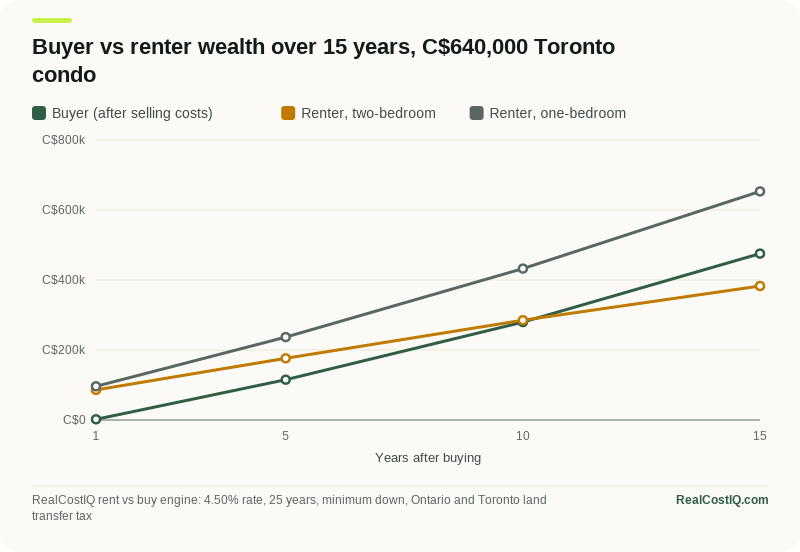
Read the table slowly. After one year the buyer is far behind, because closing costs and the CMHC premium are gone. After five years the buyer has closed some of the gap, but the renter is still ahead. Only in year eleven does the buyer pass the two-bedroom renter, and the lead is thin: C$316,159 against C$305,863. Against the one-bedroom renter, who saves more every month, the buyer never catches up in 15 years.
How much the answer moves
A break-even year is only as good as its guesses. Here is the same C$640,000 condo against the C$3,154 two-bedroom rent, with different price growth and different returns on the renter's savings.
| Condo price growth per year | Renter earns 3% | Renter earns 5% | Renter earns 7% |
|---|---|---|---|
| 0% (flat prices) | None in 15 years | None in 15 years | None in 15 years |
| 2% | Year 9 | Year 11 | None in 15 years |
| 4% | Year 5 | Year 5 | Year 6 |
Hypothetical, same engine and inputs as the table above. 'None in 15 years' means the renter's total stayed ahead through year 15.
The pattern is clear. If Toronto condo prices stay flat, buying does not catch up. If they rise 4% a year, buying wins quickly, in about five to six years. The middle case is the hard one, and it is where most of us sit when we say we do not know. Two percent growth makes the answer depend on the return on the renter's savings.
A second way to see it is the break-even rent. That is the monthly rent at which the buyer and the renter finish level after ten years. If the real rent is above that number, buying is ahead. If it is below, renting is ahead.
| Condo price growth per year | Renter earns 3% | Renter earns 5% | Renter earns 7% |
|---|---|---|---|
| 2% | C$2,941 | C$3,185 | C$3,421 |
| 4% | C$1,949 | C$2,288 | C$2,613 |
Hypothetical, same engine and inputs. Compare with TRREB's Q2 2026 City of Toronto condo rents: C$2,316 for one bedroom and C$3,154 for two bedrooms.
At 2% growth and a 5% return, the break-even rent is C$3,185. The real two-bedroom rent of C$3,154 sits just below it, which is why the base case lands just after year ten, in year eleven. A one-bedroom rent of C$2,316 is well below it, so renting wins that comparison. At 4% growth, the break-even rent falls to C$2,288, and both real rents are above it.
Worked example 2: a C$1.56 million detached house
TRREB reported an average City of Toronto detached sale price of C$1,562,966 for September 2026. We round to C$1,560,000. This case is different in four ways.
- The down payment is 20%. FCAC says homes at C$1.5 million or more need 20% down. That is C$312,000. CMHC's page says the price must be below C$1.5 million to be insured, so there is no CMHC premium and no insurance choice here.
- The loan is C$1,248,000. At 4.50% over 25 years, the payment is about C$6,907 a month.
- Land transfer tax is C$55,350. Ontario's tax is C$27,675 and Toronto's is the same. The higher Toronto rates the City approved for homes over C$3 million took effect on April 1, 2026, and do not touch a C$1.56 million home.
- Upkeep is higher. We use 1% of the price a year, or C$1,300 a month. Property tax at 0.767311% is C$997.50 a month.
Total monthly cost to own is about C$9,205. What does a renter pay for a comparable house? We could not find a published Toronto detached-house rent for this month in the sources we read. TRREB's report has condo and townhouse rents but no detached-house rents. So we use the three-bedroom condo rent of C$3,882 as a low comparison. A rented house would likely cost more, which helps the buyer. We also show the rent a house would need to charge for buying to break even.
| Item | Result |
|---|---|
| Cash needed to close (down payment plus land transfer tax, before other costs) | C$367,350 |
| Monthly cost to own | C$9,204.85 |
| Comparison rent (three-bedroom Toronto condo) | C$3,882 |
| Buyer wealth, year 10 | C$885,845 |
| Renter wealth, year 10 | C$1,358,259 |
| Buyer wealth, year 15 | C$1,310,253 |
| Renter wealth, year 15 | C$1,993,499 |
| Break-even year | None within 15 years |
Hypothetical, from the site's rent vs buy engine at the stated inputs. The renter invests the monthly gap, about C$5,323 at the start. Selling costs are subtracted from the buyer (C$121,525 in year 15).
The renter wins here because a house takes a lot more cash every month, and a renter who invests it at 5% builds a large pile. The buyer needs more price growth. At 4% a year and a 5% return, the same engine finds a break-even only in year 16. At 4% and 7%, it finds none within 25 years. At 6% a year, it finds year 5 or 6.
The break-even rent is the cleaner test. After ten years at 2% growth and a 5% return, a house would need to rent for about C$6,568 a month for buying to break even. At 4% growth the number drops to about C$4,382. If you can rent a similar house for more than those numbers, buying looks better. If you cannot, it does not.
Why the interest rate matters less than you think
The Bank of Canada held its target for the overnight rate at 2.25% at its September 2, 2026 decision, and the next announcement is October 28, 2026. Prime was 4.45%. The five-year posted mortgage rate the Bank publishes for the big banks was 6.19% on October 14, 2026. Posted rates are the banks' list prices. Most buyers negotiate well below them, which is why we use 4.50% as an example. Check a lender's current offer, and treat our rate as an illustration only.
Also remember the term. A five-year term means the rate is fixed for five years, not 25. At renewal you may face a higher or lower rate. This is a risk the engine cannot price. If you want to see what a higher renewal rate does, the mortgage calculator shows the payment at any rate. For a plain walk through a Canadian payment, see the post on the mortgage payment on a C$600,000 home.
Qualifying is a separate hurdle. The Office of the Superintendent of Financial Institutions (OSFI) sets a stress test for federally regulated lenders. You must show you can pay at the greater of your contract rate plus 2 points or 5.25%. A lender checks this before you can borrow, and it can cap how much home you can buy even when the monthly cost looks fine.
What would change the answer for you
- How long you will stay. Closing costs and the CMHC premium are paid once. Spread over three years they are heavy. Spread over fifteen they are not.
- Condo fees and special assessments. The C$600 fee is a placeholder. A building with high fees or a large repair bill can add thousands. Review the building's reserve fund before you buy.
- Your down payment. More than the minimum lowers the CMHC premium rate, and at 20% there is none. A bigger down payment also leaves less to invest as a renter.
- Whether you would really invest the gap. The model assumes the renter saves every dollar. Many people do not. A mortgage makes saving automatic.
- Rent growth. We use 3% a year, which is a guess. Test a lower and a higher number.
- Selling costs. The tool takes off a 5% commission, HST on it and C$2,900 of legal and discharge fees. Use your own numbers, and add any mortgage penalty yourself.
- First-time buyer rebates. Rebates of up to C$8,475 shift break-even earlier by a year in our condo case.
A short checklist before you decide
- Pick the home you would really buy and the rental you would really choose. Compare like with like.
- Get a current rate from a lender or broker and use it in the calculator, along with your own down payment.
- Add your building's real condo fee, or a house's real property tax and upkeep.
- Run the calculator with flat prices, 2% growth and 4% growth. If buying only wins in the best case, you are betting on prices.
- Check how long you expect to stay. If it is under five years, renting came out ahead in every case here.
- Check that you can qualify under the stress test, and that you keep an emergency fund after closing.
The numbers in this post are a snapshot. They reflect TRREB's September 2026 sales, its Q2 2026 rents, the City of Toronto's 2026 property tax rate, and land transfer tax rates read on October 15, 2026. Rates, rents and prices all move. Re-run the numbers with the rent vs buy calculator when you are close to a decision.