A lot of Ontario owners are asking the same question. If I sell here and buy a similar house in Calgary, what changes? Most posts answer with house prices and stop. The bill is bigger than that. The price changes. The tax you pay at closing changes. The way your yearly property tax is worked out changes too. And your mortgage has rules that follow you across the border. This post takes one example, a detached house in the City of Toronto against a detached house in the City of Calgary, and walks through each line. It covers housing costs only. Income tax and jobs are outside this site.
The two houses and the price gap
We use each board's own price index so the two numbers mean the same thing. A benchmark price is the price of a typical home of that type, adjusted so that the mix of homes sold in a month does not skew it. It is a better yardstick than an average, which jumps around when a few large houses sell. The Toronto Regional Real Estate Board's (TRREB) Market Watch for September 2026, released October 6, 2026, puts the MLS Home Price Index benchmark for a single-family detached home in the City of Toronto at C$1,417,600, down 4.48% from a year earlier. The Calgary Real Estate Board's (CREB) September 2026 package lists the City of Calgary detached benchmark at C$739,400, down 0.95%.
| City of Toronto (TRREB) | City of Calgary (CREB) | Gap | |
|---|---|---|---|
| Detached benchmark price | C$1,417,600 | C$739,400 | C$678,200 lower in Calgary |
| Change from September 2025 | -4.48% | -0.95% | |
| Share of the Toronto price | 100% | 52.2% | 47.8% lower |
| 20% down payment | C$283,520 | C$147,880 | C$135,640 less |
| Mortgage at 80% of price | C$1,134,080 | C$591,520 | C$542,560 less |
Benchmarks are from TRREB's Market Watch (Sept. 2026) and CREB's Sept. 2026 monthly package. The gap and the shares are RealCostIQ arithmetic. A benchmark is not your house: a Toronto detached house in Scarborough and one in the Annex are far apart, and so are two in Calgary. Treat these as the typical home of each type.
TRREB also reports what detached houses actually sold for in the City of Toronto in September 2026: an average of C$1,562,966 on 640 sales and a median of C$1,200,000. The average is above the benchmark and the median is below it. That spread tells you the Toronto detached market is wide. A typical sale is closer to C$1.2 million than to C$1.56 million. Use your own house's comparable sales, not any single number here.
CREB's release says Calgary detached prices were one per cent lower than a year earlier and detached sales reached 896 units. TRREB reports that the GTA's composite benchmark fell 4.7% over the year. So the seller in Toronto is selling into a falling market, and the buyer in Calgary is buying into a flat one. We do not forecast either. It only means the C$678,200 gap is smaller than it was a year ago, because Toronto fell by more.
The closing bill: two taxes against one fee
Buying in Toronto
Ontario's land transfer tax on residential property is 0.5% on the first C$55,000, 1.0% from C$55,000 to C$250,000, 1.5% from C$250,000 to C$400,000, and 2.0% above C$400,000. The Ontario Ministry of Finance page works a C$400,000 example to C$4,475. On a C$1,417,600 house, the tax is C$275 + C$1,950 + C$2,250 + (2.0% x C$1,017,600, which is C$20,352) = C$24,827. The City of Toronto adds its own municipal land transfer tax. The city's page lists rates that took effect April 1, 2026. For a house up to C$2,000,000 they match the provincial brackets: the same 0.5%, 1.0%, 1.5% and 2.0%. So the Toronto tax is also C$24,827. Together the two taxes are C$49,654.
Our Toronto land transfer tax post explains the two-tax system and the first-time buyer rebates, which this example does not assume. The point here is the size. The two taxes on a Toronto purchase at the benchmark price are a bit over C$49,000. That is cash, due on closing, and it cannot be rolled into the mortgage.
Buying in Calgary
We found no Alberta land transfer tax. The Government of Alberta's fee pages list Land Titles registration fees only. The Land Titles and Surveys common documents fee schedule, updated effective October 1, 2026, lists a transfer of land at C$50 plus C$5 for each C$5,000 of the value of the land, and a mortgage at C$50 plus C$5 for each C$5,000 of the principal amount. The government's registration page says the C$5 rate has applied to submissions received on or after October 20, 2024. At the C$739,400 benchmark, the transfer fee is C$50 + (C$739,400 / C$5,000 x C$5) = C$789.40, or about C$790. The schedule does not say how a partial C$5,000 block is rounded. Our Alberta closing costs calculator charges every started block in full, which gives C$790 for the transfer and C$645 for the mortgage, C$1,435 in total. That is C$4 more than the pro-rated figures used below. A mortgage of C$591,520 registers at about C$641.52 by the same formula.
| Charge | Toronto, C$1,417,600 | Calgary, C$739,400 |
|---|---|---|
| Ontario land transfer tax | C$24,827 | none |
| Toronto municipal land transfer tax | C$24,827 | none |
| Alberta Land Titles transfer fee | none | about C$789.40 |
| Alberta Land Titles mortgage fee (C$591,520) | none | about C$641.52 |
| Total of these charges | C$49,654 | about C$1,431 |
| Difference | about C$48,223 less |
Computed by RealCostIQ on 2026-11-02 from the Ontario Ministry of Finance brackets, the City of Toronto MLTT table (effective April 1, 2026) and the Alberta Land Titles fee schedule (effective Oct. 1, 2026). Ontario's own mortgage registration charge, legal fees, title insurance and adjustments are extra in both provinces and are not in this table.
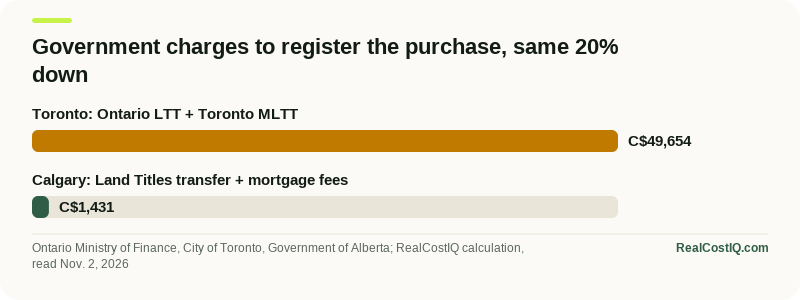
Do not read that as a C$48,000 saving that appears for free. Part of it is the price difference. A cheaper house pays less transfer tax under any system. If the same two Toronto taxes applied to a C$739,400 house, each would be C$275 + C$1,950 + C$2,250 + (2.0% x C$339,400, which is C$6,788) = C$11,263, or C$22,526 for the pair. So about C$27,128 of the C$48,223 gap (C$49,654 less C$22,526) comes from buying a house that costs less. The other C$21,095 (C$22,526 less about C$1,431) comes from the absence of the taxes. Both parts are real money. The first is the cost of the house you chose. The second is the province you chose.
Closing costs are more than transfer tax. Lawyer fees, title insurance, adjustments and disbursements show up in both provinces. Our post on closing costs beyond land transfer tax lists them, and our Alberta closing costs calculator and Ontario closing costs calculator price each side for your own number.
Property tax: why the rate is the wrong comparison
The City of Toronto's 2026 residential tax rate is 0.767311%. That is a city rate of 0.605295%, an education rate of 0.153000% and a City Building Fund rate of 0.009016%. The city's own example multiplies an assessed value of C$692,140 by that rate to get C$5,311. The City of Calgary's 2026 residential rate is 0.0038906 for the city plus 0.0027593 for the province, a total of 0.0066499, or 0.66499%. Its example is a median single-detached assessment of C$706,000, which gives C$2,746.76 for the city, C$1,948.06 for the province and C$4,694.82 in total.
| Toronto | Calgary | |
|---|---|---|
| Total residential rate | 0.767311% | 0.66499% |
| Example assessed value used by the city | C$692,140 | C$706,000 (median single-detached) |
| Tax on the example | C$5,311 | C$4,694.82 |
| Share that goes to the province or education | 0.153000% education rate | C$1,948.06, about 42% |
From toronto.ca (rates page, last modified May 11, 2026) and calgary.ca (2026 rate calculation and tax change pages). The two examples are each city's own illustration, not equivalent houses. Toronto's example is not a detached house at the benchmark.
Look at the two assessed values. Toronto's example is C$692,140. The Toronto detached benchmark is C$1,417,600. Those are very different numbers, and the reason is that Ontario property tax is charged on an assessed value, not on what the house would sell for today. We did not find a page that states Toronto's valuation date in the sources we read, so check your assessment notice for the date it uses. Calgary's example, a median single-detached assessment of C$706,000, sits close to the C$739,400 detached benchmark, which suggests its assessments track the market.
So the lesson is simple. If you multiply a Calgary price by Calgary's rate, you get a number close to the real bill. If you multiply a Toronto sale price by Toronto's rate, you get a number far above the bill you were paying. At C$1,417,600 times 0.767311%, the answer would be C$10,877. Nobody should read that as their Toronto bill. Look at your own MPAC assessment and your own tax bill. Then compare it with a Calgary bill built from the city's property tax calculator for a house of the same size.
There is a trend to watch as well. Calgary's page says the typical single-family home's municipal tax rose about C$49 a year (1.8%) in 2026, while the provincial education portion rose about C$338 a year (21%). The city collects the provincial share for the Government of Alberta. If you move to Calgary expecting a flat bill, know that the provincial piece moved sharply this year. Use our property tax calculator for the comparison with your own inputs.
The mortgage: what changes and what travels with you
Canadian mortgage rules are national. A term, the length of your rate deal, is usually five years. The amortization is the time to pay the loan off, commonly 25 years. Fixed-rate Canadian mortgages compound twice a year. None of that changes between Ontario and Alberta. What changes is the size of the loan. Here is the same 80% loan-to-value purchase at both prices. The 5.00% rate is an assumption for the example, not a quote. The stress-test rate is the contract rate plus 2%, 7.00%, because the Office of the Superintendent of Financial Institutions (OSFI) sets the minimum qualifying rate for uninsured mortgages at the greater of the contract rate plus 2% or 5.25%.
| Toronto, C$1,134,080 loan | Calgary, C$591,520 loan | |
|---|---|---|
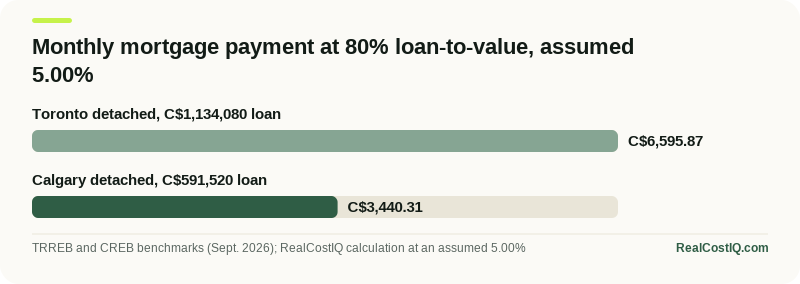
| Payment at an assumed 5.00% | C$6,595.87 | C$3,440.31 |
| Payment at the 7.00% qualifying rate | C$7,943.27 | C$4,143.10 |
| Difference at 5.00% | C$3,155.56 less a month |
Computed by RealCostIQ on 2026-11-02 with the Canadian convention (1 + rate/2)^(1/6) for the monthly factor. The 5.00% rate is assumed. A lender will use your actual rate, income and debts.
With 20% down there is no default insurance to pay. CMHC premiums apply when the down payment is below 20%, and they are not a factor in this example. If you are selling a house with equity, the sale probably covers the whole Calgary down payment and then some. Check what is left. The Toronto sale may leave you well above 20% on the Calgary purchase, and a smaller mortgage lowers the payment further.
Your existing Ontario mortgage
Selling in the middle of a term usually means a penalty, or a port. Some lenders let you port a mortgage to a new property, which keeps the rate. Whether that works for a smaller Calgary loan depends on your lender, and a port that lowers the balance can trigger a penalty on the part you do not carry. Our post on porting your mortgage covers port, break or blend, and the mortgage penalty calculator estimates what a break would cost before you list. Start that conversation with your lender before you sign a listing agreement.
The selling side
The Toronto seller does not pay land transfer tax. The seller pays the real estate commission, the legal fees and the cost to discharge the mortgage. Those are covered in our post on the cost to sell a home in Canada, and they are no different because you are moving to Alberta. We did not find a province-specific rule that changes them for a seller who leaves Ontario. What does change is timing. Two closings, one in Ontario and one in Alberta, rarely land on the same day. If you buy first, you carry two homes. If you sell first, you may rent in between. Our post on buying first or selling first works the bridge-loan math.
What the comparison leaves out
- Income and income tax. Jobs, pay and tax are outside this site. A cheaper house is only cheaper if the paycheque goes with you.
- Insurance. Home insurance is priced by province and by peril. Our post on home insurance premiums by province covers what drives it. We put no premium figure on the two houses here.
- Utilities, heating and winter. We did not read a source that compares them for matched houses, so we do not compare them.
- The house is not the benchmark. A move often changes the neighbourhood, the lot and the size, not just the city. The numbers above are the typical detached home, not a like-for-like swap of your own house.
- Other Ontario municipalities. Only the City of Toronto charges a municipal land transfer tax in our example. A buyer in another Ontario city pays the provincial tax only.
A short checklist before you list
- Get your latest MPAC assessment notice and last tax bill. Do not estimate Toronto tax from your sale price.
- Ask your lender in writing what a break, a port or a blend would cost on your mortgage and how long the quote holds.
- Price the Calgary purchase with the Alberta closing costs calculator, using the real price of the house you want, not the benchmark.
- Price the Ontario sale, including commission, legal and discharge costs, with the cost-to-sell post.
- Decide the order. Buy first and carry two homes, sell first and rent, or use a bridge loan.
- Check how much of the Calgary price you can cover from the sale, and what a 20% down payment leaves.
After those six steps the comparison becomes your own and not a benchmark's. The benchmark tells you the size of the move. Your own numbers tell you whether it works.
What this post did not read
- We did not find the dollar figure for Calgary's detached benchmark in CREB's media release text. It is in the monthly package PDF, which we used.
- We did not find a page that states the valuation date Toronto uses for assessments. Check your own notice.
- We did not read a comparison of utilities, insurance premiums or moving costs for matched houses, so none is given.
- We did not read a current Ontario Land Registry fee schedule, so Ontario's registration charges beyond the two land transfer taxes are not in the table.
- We did not find a RedFlagDeals or Reddit thread dated 2025 or 2026 on this question that an automated reader could open.