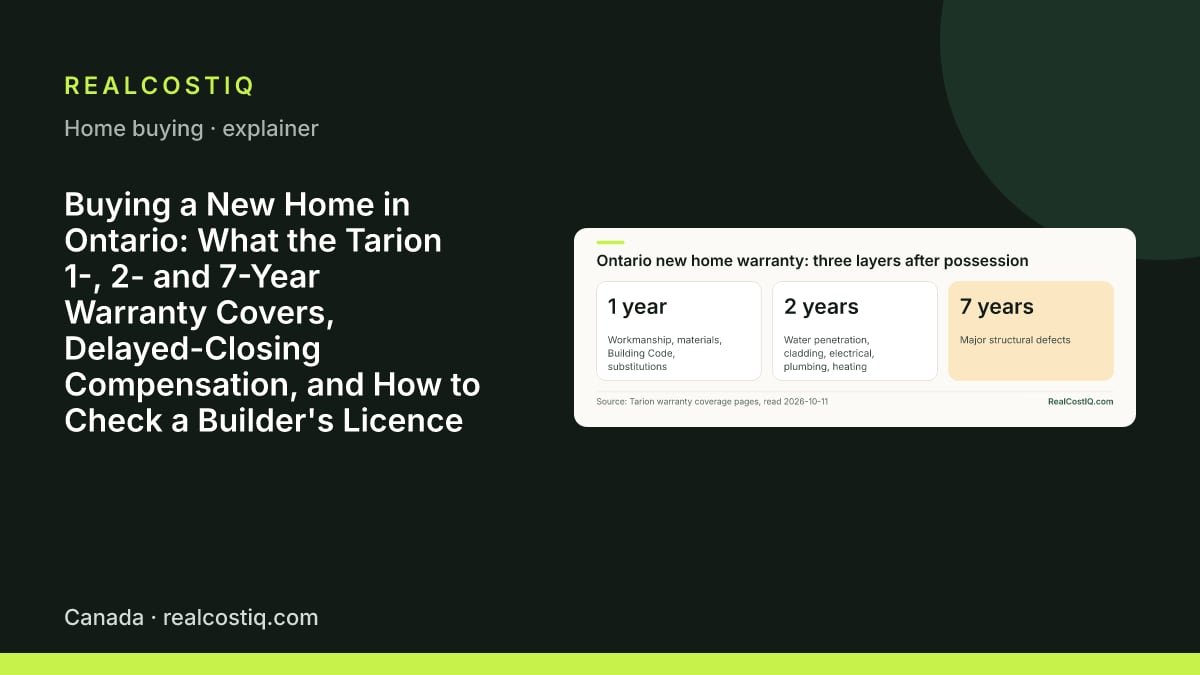
A newly built home in Ontario does not come with a promise from the salesperson alone. By law, the builder gives a warranty, and Tarion stands behind it. A warranty is a written promise to fix certain problems. The warranty has two halves that work very differently. One half is money protection before you take possession, which means before you get the keys. It covers deposits, a late closing or move-in date, and cancellations. The other half protects you from construction defects after you take possession. It has three layers: one year, two years and seven years. Most buyers meet the first half as a clause in a thick agreement. They meet the second half as a stack of forms with deadlines they did not know about.
This post explains the second half in full. Then it covers the late-closing half in the detail a buyer needs to price a slipped closing date. Then it shows how to check that the builder is licensed before you sign. It does not repeat deposit protection. That has its own section on the pre-construction deposit calculator. It also does not cover the HST treatment of assignment sales. HST is the harmonized sales tax. An assignment sale is when a buyer sells their purchase agreement before the home is finished. That topic is in the assignment-sale post. All dollar figures are Canadian dollars (CAD), exactly as Tarion states them, on pages read on 2026-10-11. The worked examples are our own arithmetic at named inputs, and we label them as hypothetical. We tried to read the Act itself (ontario.ca e-Laws) today, but it returned an empty script shell. So every statement below rests on the published pages of Tarion and the Home Construction Regulatory Authority, not on the statute text. This is information, not legal advice. A dispute over a claim is a job for a real estate lawyer.
Who provides the warranty, and who stands behind it
Tarion's own summary is simple. By law, every new home built in Ontario comes with a warranty from the builder. Tarion's job is to make sure buyers get the coverage they are entitled to. In practice there are two steps. The builder is the warranty provider. The builder must resolve a warranty problem directly with the homeowner. If the builder fails to fix it, or says it is not covered, you can make a claim to Tarion. Tarion then assesses the claim. If the item is under warranty, Tarion makes sure it is resolved.
Eligibility depends on a licence. Tarion says a new home is eligible if the builder or vendor holds a licence from the Home Construction Regulatory Authority (HCRA). A vendor is the seller of the home. The home must also meet four criteria in the Act. There must be a home, a vendor, a builder and an owner, each as defined on the HCRA website. Coverage begins when you sign the agreement of purchase and sale. It lasts up to seven years, even if the home is sold. It protects owners of freehold homes, contract homes, condominium units and condominium conversions under seven years old. If you are unsure whether a home qualifies, Tarion publishes an address for that question: ismyhomecovered@tarion.com.
The warranty at a glance
| Layer | Runs from | What it covers | What it does not cover |
|---|---|---|---|
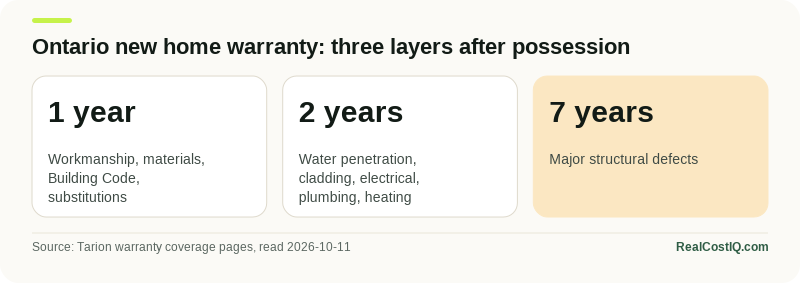
| One year | Date of possession (or the occupancy date for a condominium) | A home built in a workman-like manner and free of defects in material; Ontario Building Code violations; unauthorized substitutions; fitness for habitation | Items on the Act's exclusion list, appliance manufacturer defects, cosmetic out-of-the-box damage |
| Two years | Date of possession | Water penetration through the basement or foundation walls; defects that let water into the building envelope; detached, displaced or deteriorated exterior cladding; defects in the electrical, plumbing and heating delivery and distribution systems; Building Code violations affecting health and safety | Normal wear and tear, damage from owner maintenance failures, items on the exclusion list |
| Seven years | Date of possession; ends on the seventh anniversary | A major structural defect: a defect in work or materials that causes a structural load-bearing element to fail, or materially and adversely affects its ability to carry loads for its ordinary service life, or materially and adversely affects the use of a significant portion of the building | Elevating devices, heating and cooling appliances, dampness not arising from structural failure, owner or tenant acts, floods not caused by the builder, other statutory exclusions |
The seven-year wording above is Tarion's description for homes built after 30 June 2012. Tarion's pages are a summary, not the Act.
The one-year warranty: workmanship, Building Code and substitutions
The one-year warranty is the widest in subject matter and the shortest in time. Tarion says it requires four things. The home must be built in a workman-like manner, which means with proper skill, and be free from defects in material. It must not violate the Ontario Building Code, the province's set of construction rules. It must have no unauthorized substitutions. And it must be fit to live in. The clock starts on the date of possession, or the occupancy date for a condominium. The warranty stays with the home if it is sold.
Substitutions need their own paragraph. This is where purchase agreements and finished homes drift apart. A substitution means the builder uses a different item from the one you expected. Tarion separates two cases. In the first, the agreement lets you select an item, such as flooring from a decor centre. The builder cannot substitute without your written consent. If it does, you are entitled to the item you selected, subject to reasonableness. In the second, the agreement only specifies an item, such as a particular brand of window. The builder may substitute without consent. But it must use something of equal or better quality. Tarion judges this on cost, maintenance cost, performance and intended use. The usual remedy here is the difference in cost. Tarion also explains how selections work. The buyer makes selections within 30 days of the agreement unless agreed otherwise. If the builder cannot supply a selection, it must say so in writing. The buyer then has 7 days to choose again. Miss the 7 days and the builder may substitute options of equal or better quality. Claim unauthorized substitutions within the first year after possession.
Appliances cause a lot of confusion. Tarion explains that the Act does not treat household appliances as part of the home. Examples are refrigerators, stoves, and washers and dryers. So coverage is limited when the builder supplies them. Installation defects, including damage caused during installation, fall under the one-year warranty. They come from the builder's workmanship. Four things are not covered: a stove top scratched out of the box, a circuit-board failure, a different brand from the one in the agreement, and a missing appliance. Tarion says to take those to the builder or the manufacturer.
The two-year warranty: water and the systems behind the walls
The second layer is narrower, but it costs more when it fails. Tarion lists three kinds of protection. The first is against water coming through the basement or foundation walls. The second is against defects in work or materials that let water into the building envelope. The building envelope is the outer shell of the house, such as walls, roof and windows. The third is against defects that make exterior cladding come loose, shift or wear out. Cladding is the outer surface, such as brickwork, aluminum or vinyl siding. The layer also covers defects in work or materials in the electrical, plumbing and heating delivery and distribution systems. And it covers Building Code violations that affect health and safety. The period runs two years from the date of possession.
Read the wording on the systems with care. The two-year layer covers the delivery and distribution systems. These are the wiring, piping and ducting that carry power, water and heat through the house. It does not promise that every fixture or appliance at the end of those systems will work for two years. Tarion's two-year description does not list heating or cooling appliances. Its seven-year description expressly leaves them out of a structural claim. Those are furnaces, air conditioners, chillers and heat recovery ventilators. On our reading, the two-year layer should be taken the same way. But Tarion's page does not say so for year two. If you want furnace or air-conditioner protection beyond the first year, ask Tarion. Also read the manufacturer's warranty.
The seven-year warranty: major structural defects
The seven-year warranty covers major structural defects. It ends on the seventh anniversary of the date of possession. A structural load-bearing element is a part of the building that carries its weight, such as a beam or a main wall. For homes built after 30 June 2012, Tarion describes a major structural defect as any defect in work or materials that does one of three things. This includes a crack, distortion or displacement of a structural load-bearing element. First, it results in failure of a structural load-bearing element. Second, it materially and adversely affects the ability of that element to carry, bear and resist applicable structural loads for its usual and ordinary service life. Third, it materially and adversely affects the use of a significant portion of the building for the usual and ordinary purposes of a residential dwelling, having regard to any specific use provisions in the purchase agreement. In plain words, a key part of the building fails, or it cannot do its job for its normal life, or a big part of the home can no longer be used as a home.
The exclusions matter as much as the definition. A major structural defect claim does not extend to several things. These are elevating devices, such as elevators, and the heating and cooling appliances listed above. They also include dampness that does not arise from failure of a structural load-bearing element. Damage from the acts or omissions of an owner, tenant, licensee or invitee is out. So are acts of civil or military authorities, and war. A flood not caused by the vendor or builder is out. So is anything the Act's general exclusion subsection removes. In short, the seven-year warranty covers structural failure. It is not a long workmanship warranty. A damp basement that is not tied to structural failure belongs, if anywhere, in the two-year water-penetration layer.
Condominium conversions get the same seven-year structural warranty for both new construction and the pre-existing elements. A condominium conversion is an older building turned into condominium units. There is one carve-out. The one-year warranty on workmanship and materials does not cover pre-existing elements. Older components cannot be certified the way new construction can. Tarion states that conversion projects qualify for warranty coverage where the first agreement of purchase and sale was signed on or after January 2018.
Coverage limits depend on when the agreement was signed
The dollar ceiling on defect claims is not a single number. Tarion publishes the limits by the date the first agreement of purchase and sale for the project was signed. The date matters because the ceiling rose twice. The table below reproduces Tarion's figures for post-possession defect coverage.
| First agreement signed | Freehold home | Condominium unit | Condominium common elements | Environmental hazards sub-limit |
|---|---|---|---|---|
| Before 1 February 2021 | C$300,000 | C$300,000 | C$50,000 per unit, up to C$2.5 million | C$15,000 (septic systems C$25,000) |
| 1 February 2021 to 30 June 2023 | C$300,000 | C$300,000 | C$100,000 per unit, up to C$3.5 million | C$50,000 |
| On or after 1 July 2023 | C$400,000 | C$300,000 | C$100,000 per unit, up to C$3.5 million | C$50,000 |
Tarion also states a maximum combined coverage of C$50 million for a condominium project (units and common elements) under all three dates. Tarion notes that at any time a homeowner can request a statement of how much has been paid against the limit on their home.
Two things follow. First, the ceiling is per home, not per claim. A first-year list of repairs and a later structural claim draw on the same pot. That is why Tarion lets a homeowner ask for a statement showing what has been paid and what remains. Second, suppose you buy a resale home built within the past seven years. You are buying the rest of the warranty period. The ceiling is the one set by the original agreement date, not today's ceiling. Check the date on the warranty paperwork. Do not assume the C$400,000 figure applies.
What the warranty does not cover
Tarion lists the Act's exclusions for freehold homes, contract homes and condominium units. These are the ones that decide most disputes:
- Defects in materials, design and work that the homeowner supplied. Changes the homeowner made, whether alterations, deletions or additions.
- Secondary damage caused by a defect that is under warranty, such as damage to property or injury to a person.
- Normal wear and tear, and normal shrinkage of materials as they dry after construction.
- Dampness or condensation damage caused when the homeowner fails to keep up enough ventilation, or does not run moisture-producing devices such as humidifiers properly.
- Damage caused by the homeowner or visitors.
- Settling of the land around the building or along utility lines. Settling beneath the footings is not excluded.
- Damage by insects or rodents, except where construction does not meet the Ontario Building Code.
- Damage caused by municipal services or other utilities.
- Surface defects that the homeowner specified and accepted in writing at the date of possession.
- Damage resulting from an act of God.
The act-of-God exclusion is narrower than it sounds. Tarion says it covers extraordinary natural events such as tornadoes, earthquakes and extreme winds. It does not include weather that is typical for the climate: ice, snow, high winds and heavy rain. A home built to the Building Code should withstand Ontario's normal conditions. If a concern is reported after a storm, the builder should not assume the exclusion applies. Suppose there is a builder defect, such as improperly installed shingles. Then the onus shifts to the builder. The builder must show the damage came only from extraordinary conditions.
Two more protections sit around the main layers. The first is the extended warranty for missing items. It applies to items that were entirely absent on the date of possession. The warranty on such an item starts when the builder installs it. To protect it, report the absence to Tarion on a warranty form within the first year. It does not apply to items that are present but incomplete, unfinished or defective. The second is the temporary relocation warranty. It applies when a warranted item, or its repair, makes the home uninhabitable. Examples are an unusable kitchen, all toilets or all bathtubs and showers unusable, an unusable or unsafe staircase, or toxic mould. The builder is expected to compensate up to C$150 for each day the home cannot be lived in, to a maximum of C$15,000. If the builder does not pay, the homeowner can apply to Tarion.
The pre-delivery inspection is your baseline
Before the keys change hands, the builder must lead a floor-by-floor walk-through. It is called the pre-delivery inspection (PDI). The builder explains how the ventilation, plumbing, heating, electrical and air conditioning work. The PDI records items that are incomplete, damaged, missing, inaccessible or not working properly. They go on the builder's PDI form. That gives an official record of the home's condition before you moved in. You or a designate must attend. A designate is someone you choose to go in your place. If you send one, give the builder written authority for them to sign the form. Tarion offers a form for this.
At the PDI you will also review the Certificate of Completion and Possession (CCP). It states the home's Tarion enrolment number and the date of possession. That date is when your statutory warranty starts. Tarion says the PDI form is not itself a request for warranty service. So failing to list an item does not necessarily harm your coverage. Still, the form is the best evidence if there is a later argument over whether a damaged or missing item existed before you took possession. Tarion may refer to it in that argument. Items not fixed by the time you move in must be listed on a warranty form to count as a request for service. Photograph anything you cannot assess on the day. Note unauthorized substitutions against your purchase agreement. And keep your copies.
The claim clock: forms, repair periods and appeals
The warranty is only as good as the claim you file in time. Tarion's process starts with the builder. Before a formal claim, you must tell the builder about the problem and give it access to look at and repair it. You make the formal claim on Tarion's forms, through the MyHome portal. The portal sends it to the builder and Tarion at the same time. Tarion states that, to be eligible for its help, claims must be reported within the relevant warranty timeframes.
| Form | When items can be added | When it is submitted |
|---|---|---|
| Initial Form | From day 1 after possession | Automatically on day 41 |
| Mid-Year Form | From day 42 | Automatically on day 183 |
| Year-End Form | From day 183 | Automatically on day 365, with a 10-day grace period (manual submission with written evidence of first-year reporting to the builder) |
| Second-Year Form | Any time in the second year; more than one allowed | By the homeowner |
| Major Structural Defect Form | After year two and no later than seven years from possession; more than one allowed | By the homeowner |
| Delayed Closing/Occupancy claim | Within one year of possession or occupancy | By the homeowner |
Only one Year-End Form is accepted. Tarion warns that missing the deadline can mean certain items are not covered.
Once a claim is submitted, Tarion says a 120-day initial builder repair period starts. During this time the builder should repair or otherwise resolve covered items. The 120 days does not apply to major structural defects. Tarion notes that exterior work and emergencies have longer or shorter timeframes. Suppose the builder has not resolved a warranted item. You may then request a conciliation. This is an assessment by Tarion, usually an inspection at the home with the builder's representative present. The window depends on the form. After a Mid-Year Form, you can request it at any time until the Year-End Form submission date. For Year-End items, you can request it until 150 days after that form's submission date. For Second-Year and Major Structural Defect forms, you can request it only within 30 days after the end of the initial builder repair period. If the conciliation report finds covered items, the builder gets a final 30 days to fix them. After that, Tarion checks. If items remain, it schedules a claim inspection or a desk assessment.
Disagreements about Tarion's assessment have their own ladder. Tarion lists these steps: early intervention (when communication has broken down), an investigative inspection (for health, safety or emergency items), independent mediation after the conciliation assessment, the Licence Appeal Tribunal, and arbitration or court. Mediation means a neutral person helps both sides reach a deal. To appeal to the Tribunal, you first request a Decision Letter. Then you file a Notice of Appeal, with a filing fee, within 30 days of receiving it. Tarion also warns that court action is subject to statutes of limitations, which are legal time limits for suing. It recommends speaking to a lawyer early. One protection is worth knowing. Tarion says it is a violation of the HCRA code of conduct for builders if a builder pressures a homeowner not to submit a claim or contact Tarion.
Delayed closing and occupancy compensation
The pre-possession half of the warranty that matters most to a pre-construction buyer is the delayed closing warranty. It applies to freehold and contract homes. Its mirror for condominium units is the delayed occupancy warranty. Every builder of a new freehold home or condominium must give the buyer this warranty when the agreement is signed. It comes as an Addendum attached to the agreement. An addendum is an extra document added to a contract. Its first page is a Statement of Critical Dates, signed by both sides. The dates on it set up everything that follows. They must be calendar dates that fall on a business day. A closing date that floats on some other event is not allowed. Tarion says that in that case you may be entitled to terminate.
Firm and tentative dates
The builder chooses between two structures. The first is a firm closing date. Here the builder is confident the home will be ready by that date. If the date is not met, the builder must set a delayed closing date and pay compensation. This does not apply if the date changed by mutual agreement or because of an unavoidable delay. The Outside Closing Date is 365 days after the Firm Closing Date. If the home is not complete by then, you have a 30-day termination period.
The second structure is a tentative one. It is for builders who cannot yet fix a precise date, for example before construction starts. The builder may extend the closing date twice, by up to 120 days each time. No compensation is owed if the builder gives proper written notice. The Firm Closing Date is then at most the First Tentative Closing Date plus 240 days. The Outside Closing Date is 365 days after the earlier of the Second Tentative Closing Date and the Firm Closing Date. The notice rule is strict. A delay beyond the first tentative date must be notified no later than 90 days before that date. If it is not, that date becomes the firm date automatically. The same applies to the second extension. Condominiums work a little differently. Tarion describes a tentative occupancy structure with more flexibility. The builder can extend the occupancy date more than once, with 90 days' notice of each extension. It must set a Final Tentative or Firm Occupancy Date within 30 days of roof completion. That date can never be later than the Outside Occupancy Date the parties agreed at signing.
What you are paid
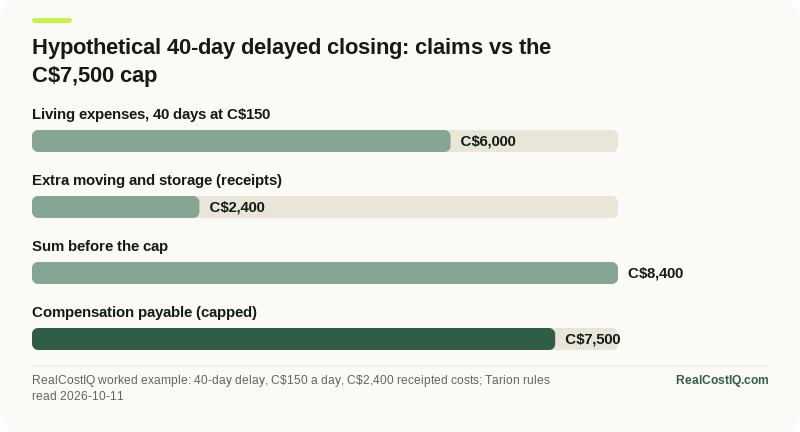
Tarion states that delayed closing (or occupancy) compensation is payable up to a maximum of C$7,500. It is payable if closing happens after the firm date. It is also payable if you end the agreement because of the delay, as the Addendum permits. If you end the agreement, you are also entitled to a full refund of all money paid, including deposits, extras and upgrades, plus interest. The C$7,500 is built from two parts. The first is a fixed C$150 for each day of delay, for living expenses such as meals and accommodation. You need no receipts for this. The second is compensation for other costs the delay causes you, such as extra moving and storage. These must be backed by receipts. Separately, Tarion says the builder must give 10 days' notice of a closing delay. If it does not, you are compensated C$1,500 (C$150 for 10 days). Tarion's pages do not say how that C$1,500 interacts with the C$7,500 maximum. Confirm that with a lawyer or Tarion before counting on both.
| Item | Basis | Amount (CAD) |
|---|---|---|
| Living expenses, 40 days | C$150 a day, no receipts | C$6,000 |
| Extra moving and storage | Receipts supplied (hypothetical) | C$2,400 |
| Sum before the cap | C$8,400 | |
| Compensation payable | Capped at C$7,500 | C$7,500 |
At C$150 a day the living-expense portion alone reaches the C$7,500 cap after 50 days of delay. Whether the delay is compensable at all depends on the Addendum and on exceptions such as unavoidable delay or a mutually agreed new date.
The ways compensation gets lost
- Unavoidable delay. Tarion defines it as an extraordinary circumstance through no fault of the builder or purchaser. Examples are a strike, fire, explosion, act of God, civil insurrection, war, terrorism or a pandemic. The builder may extend deadlines by up to the length of the delay without paying compensation. But it must tell you at the outset, estimate the length and give written notice when the delay ends.
- Mutual agreement. Tarion warns that special rules apply when you agree to change a date. An amendment may waive compensation that would otherwise be available. Do not sign a date amendment without reading what it says about compensation. As a general rule, at least 90 days' written notice is required to change a closing date.
- Missing the claim window. You may claim to the builder within 180 days of your closing date, or of the date you terminate. Suppose the builder does not pay, or you cannot agree on the amount. Then you may claim to Tarion during the first year of possession, or up to 365 days after terminating. Use the Delayed Closing/Occupancy Claim Form on MyHome. Keep every receipt, because the Tarion claim will need them.
- Not tracking the dates. Tarion publishes a Statement of Critical Dates calculator for exactly this reason. Put the dates and the notice deadlines in your calendar the day you sign.
Condominium differences worth knowing
Condominium buyers have extra protections. Tarion notes that the Condominium Act gives a 10-business-day cooling-off period. In that time you can review the agreement and cancel if you wish. Separately, the Tarion Addendum requires each early termination condition to carry a satisfaction date. Freehold buyers have equivalent Addendum rules, with a 3-business-day cooling-off for certain conditions. An early termination condition lets the builder cancel the deal if something does not happen. The Addendum limits these to certain types. They are usually approvals needed to build and occupy, such as site plan approval or completion of roads and utilities. A minimum sales threshold or confirmation of project financing are among the examples. Conditions outside the permitted list are not enforceable. Waivable conditions that need no proof from an approving authority are also allowed. Examples are unit sales exceeding a threshold, or the builder arranging satisfactory financing. If you are buying a pre-construction condominium, read this section of the Addendum before the financing section of the agreement. A project cancelled under a valid condition returns your deposit. It does not pay you for the lost opportunity.
How to check that the builder is licensed
The HCRA licenses and regulates new home builders and sellers in Ontario. Its free Ontario Builder Directory is the place to check one. In a July 2026 post for buyers, the HCRA advises this. Look up the builder or seller in the directory before you sign an agreement or pay a deposit. Confirm they are listed as licensed. Treat a missing listing as a serious warning sign that the builder may be operating illegally. The directory also shows how long the builder has been active and how many homes they have built. It shows any regulatory action the HCRA has taken against them, including charges and convictions. And it shows warranty information for a specific home.
- Get the legal names of the builder and the seller from the draft agreement. They may be different companies, and both need a licence.
- Search the Ontario Builder Directory for each name and open the profile. Confirm the status is licensed.
- Read the regulatory history on the profile. The HCRA says outcomes of complaints may be published in the directory.
- Confirm the home is enrolled with Tarion. Also confirm the agreement has the Tarion Addendum with the Statement of Critical Dates.
- Have a real estate lawyer review the agreement before you sign. Be wary of high-pressure sales tactics.
Know what the HCRA can and cannot do for you. Its complaints process covers the conduct of licensed builders and sellers, including breaches of the Code of Ethics, and their competency. It also covers unlicensed building or selling. It does not accept anonymous complaints. A staff member should contact you within three to five business days of a complaint. If the evidence supports the allegations, the HCRA takes regulatory action. But it cannot award damages or compensation. Warranty claims, new home defects, delayed-closing compensation and deposit protection go to Tarion. The HCRA blog gives the split of duties in one line. The municipality issues building permits, the HCRA licenses builders, and Tarion handles warranty and deposit-related concerns.
| Problem | Where it goes |
|---|---|
| A defect covered by the one-, two- or seven-year warranty | Builder first, then a Tarion claim on the warranty forms |
| A closing or occupancy date that was missed | Builder (within 180 days), then Tarion (within the first year of possession) |
| A deposit not refunded after a cancellation | Tarion deposit refund claim (see the deposit section on the pre-construction page) |
| Unlicensed building, or a licensed builder's conduct or competence | HCRA complaint |
| A dispute over Tarion's assessment | Tarion decision letter, then the Licence Appeal Tribunal within 30 days, or a lawyer for court or arbitration |
| A building permit or Building Code inspection | The municipality |
What the warranty means for your budget
The warranty changes the cost of a new home in two ways that a closing-cost spreadsheet misses. The first is a reserve for what it does not cover. That includes the exclusions list, the heating and cooling appliances, and anything past year seven. It also includes the gap between a problem and a Tarion decision. A new-home budget should still hold a repair reserve. The first-home buyer total cost calculator shows the one-time costs a buyer carries into the first year.
The second is the tax on the purchase itself. A new Ontario home carries HST, with a federal rebate available in some cases. The GST/HST rebate calculator models it. A closing date that slips is also a question to put to your lender. Ask how long your mortgage approval and rate hold last. Compensation of C$7,500 at most is a cap on the builder's liability for the delay. It is not an estimate of what a delay costs you. That is why the Addendum's dates, the notice rules and the termination right matter more than the cap. Deposit protection is a separate coverage with its own limits. As Tarion has announced, a change in how freehold buyers register their purchase is deferred until 1 January 2027. The figures are on the pre-construction deposit calculator, and this post does not repeat them.
A checklist for the day you sign and the day you take possession
- Before signing: look up the builder and the seller in the Ontario Builder Directory. Confirm the Tarion Addendum is attached and the Statement of Critical Dates is signed. Have a real estate lawyer read both.
- At signing: record the Firm or First Tentative Closing Date, the Outside Closing Date and every notice deadline. Note whether selections must be made within 30 days.
- Any time the builder proposes a new date: read the compensation language before you agree. Ask in writing whether you are waiving anything.
- Before the PDI: print the PDI checklist and bring the purchase agreement. Decide whether a designate will attend and has written authority to sign.
- At the PDI: list every damaged, missing, incomplete or inaccessible item, and every substitution. Photograph what you cannot assess. Keep your copies of the PDI form and the CCP.
- In year one: add items to the Initial, Mid-Year and Year-End forms as they appear. Watch day 41, day 183 and day 365 and the 10-day grace period.
- In year two: file Second-Year forms for water penetration, cladding and the delivery systems.
- Through year seven: file a Major Structural Defect form promptly if something structural fails. If repairs have been paid against the limit, ask Tarion for a statement of coverage used.
What we did not verify
Everything here comes from Tarion and HCRA web pages read on 2026-10-11. We did not read the Ontario New Home Warranties Plan Act or its regulations, because the e-Laws page returned only a script shell. We also did not read the Addendum itself, which is the binding document in your own deal. Tarion's pages are a summary of the Act. If a figure or date on a page conflicts with the Addendum or the statute, the statute and the signed documents govern. Amounts and deadlines have changed before, as the coverage-limits table shows. Tarion has also announced a further change to deposit coverage for freehold buyers. Re-check the figures on Tarion's pages before relying on any of them for a purchase. Treat this post as a map to the questions to ask, not as legal advice.