A condo fee is the monthly bill you pay the building. It goes up when the building ages, when costs rise and when the owners have saved too little for big repairs. Most buyers look at the fee as one number. A better way is to turn it into a price per square foot. Then you can compare one building with another, and you can see when a fee looks too high or too low. All money in this post is in Canadian dollars (CAD).
What a condo fee pays for
A condo corporation is the group of owners that runs the building. Each year it sets a budget. The Condominium Authority of Ontario (CAO), the province's condo agency, says the fee covers care of the shared parts of the building, contributions to the reserve fund, and services such as cleaning, repairs and management. The declaration, which is the building's founding document, sets what share of the budget each unit pays. The CAO gives a round example. With a C$1,000 monthly budget and a 5% share, an owner pays C$50 a month.
The reserve fund is the building's savings account. It is kept only for big repairs and replacements of shared parts, such as the roof, the elevators and the parking garage. A fee that is too low to feed the reserve fund is the main way a building ends up with a special assessment.
This post is about the fee and the reserve fund. It does not walk through the paperwork you get when you buy. That is covered in our post on the status certificate and the other provincial condo documents. You will want both. The fee tells you what the building costs today. The status certificate tells you what the building owes and has planned.
What is a normal fee per square foot in Toronto?
No public body publishes a single official Toronto average for condo fees per square foot. We looked for one at the Toronto Regional Real Estate Board (TRREB), the Condominium Authority of Ontario and the Wahi data team, and none gives it. What exists is a mix of data analysis and expert opinion. We show each one with its date so you can see how old it is.
The most recent number is from The Canadian Press, published on June 22, 2026. Brendon Cowans, a vice-president at Property.ca, said fees should fall between 75 and 85 cents per square foot. He said fees above C$1.00 per square foot may be dear, depending on the amenities. Amenities are the extras, such as a pool, a gym or a concierge. His example was about C$595 a month for a 700-square-foot condo, which he called within reason.
A second number is older but comes from data. In March 2024 BlogTO reported on a Toronto Star analysis that used condos.ca data. It found fees had climbed to around 81 cents per square foot in Toronto. That sits inside the Property.ca range, which is a useful check. Two sources from different years agree on the middle of the range.
The Canadian Press piece also gives a warning from the other side. Karolina Armstrong, a broker at Right At Home Realty in Toronto, said a fee of 50 cents a square foot in a 20-year-old building is too low in her opinion. She said low fees can signal an underfunded reserve. We come back to that below.
| Source | Date | What it says (CAD per square foot per month) |
|---|---|---|
| Property.ca, quoted by The Canadian Press | June 22, 2026 | C$0.75 to C$0.85 is reasonable; above C$1.00 may be dear |
| Toronto Star analysis of condos.ca data, reported by BlogTO | March 25, 2024 | Around C$0.81 in Toronto |
| Right At Home Realty broker, quoted by The Canadian Press | June 22, 2026 | C$0.50 in a 20-year-old building is too low |
Opinion and data are mixed here. Only the Star figure comes from a dataset, and it is from 2024. The Canadian Press figures are the views of two named people. We did not use broker blog pages that give no source for their numbers. Sources read on 2026-11-01.
Wahi, a real estate data company, studied about 2,000 existing GTA condo buildings using 2025 sales from ITSO (Information Technology Systems Ontario) and TRREB, and published the results on July 27, 2026. It ranked buildings by the median fee on a one-bedroom unit. It does not give a price per square foot, because unit sizes are often listed as a range. It did show how wide the spread is. Median monthly fees on one-bedroom units ran from C$254 to C$2,275. Seven of the ten highest-fee buildings were finished in 1991 or earlier, and nine of the ten are in the City of Toronto.
That spread is the main lesson. The fee depends on the building, not on Toronto as a whole. A new tower with a pool and a concierge and an older low-rise with no amenities can sit more than C$2,000 apart. So use the per-square-foot rate as a screen, not as a verdict.
What the rate means in dollars
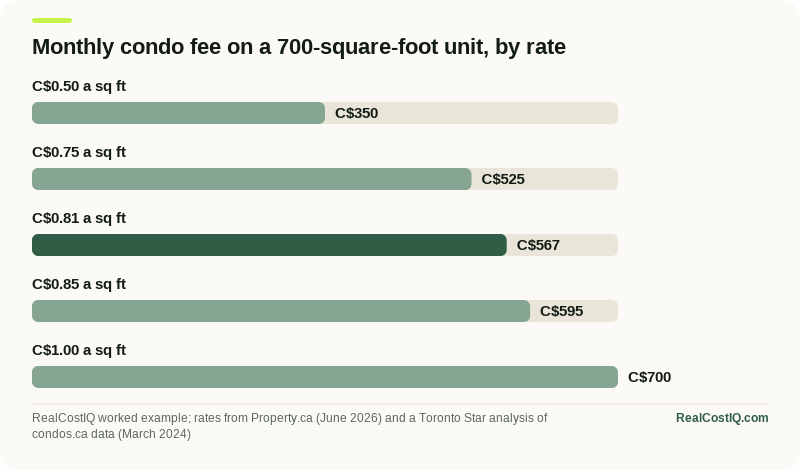
Take a round example. A unit is 700 square feet. At the Property.ca range the monthly fee is C$525 to C$595. At the Star's C$0.81 it is C$567. At C$1.00 it is C$700. At the C$0.50 that the broker called too low for an older building, it is C$350.
| Rate per square foot | Monthly fee (CAD) | Yearly fee (CAD) | How to read it |
|---|---|---|---|
| C$0.50 | C$350 | C$4,200 | Low. Check the reserve fund in an older building |
| C$0.60 | C$420 | C$5,040 | Below the Property.ca range |
| C$0.75 | C$525 | C$6,300 | Bottom of the Property.ca range |
| C$0.81 | C$567 | C$6,804 | Toronto average in the 2024 Star analysis |
| C$0.85 | C$595 | C$7,140 | Top of the Property.ca range |
| C$1.00 | C$700 | C$8,400 | May be dear, depending on amenities |
Hypothetical. Fee equals rate times 700 square feet. The 700-square-foot size is a round example. Check the real size on the floor plan, because the fee is set by the corporation's share formula, not by a rate.
What the fee does to your mortgage and your budget
The fee is not part of your mortgage payment. It is a second monthly bill, and it never ends. A mortgage ends after 25 or 30 years. The fee lasts as long as you own the unit.
Lenders do count it. CMHC (Canada Mortgage and Housing Corporation) says 50% of the condo fee must be included in the gross debt service (GDS) and total debt service (TDS) ratios. GDS is your housing costs divided by your gross household income, and TDS adds your other debts. CMHC caps GDS at 39% and TDS at 44% for insured mortgages. It also says the payment must be tested at the greater of your contract rate plus 2 percentage points or 5.25%. The CMHC page we read was published in 2018, so confirm today's rules with your lender.
On a C$595 fee, the lender counts C$297.50 a month. That is less than the full bill, but you pay all of it. So a lender can say yes to a unit whose true monthly cost is higher than your budget allows. Do your own sum with the full fee.
Here is one way to see what C$595 really costs. Our mortgage engine uses Canadian rules, where a fixed rate is compounded twice a year. For a 25-year amortization at an example rate of 4.50%, each C$100 a month of payment carries about C$18,068 of mortgage. That is a cash-flow comparison. It does not mean a lender will lend you that much. By that measure, a C$595 fee costs about the same each month as a C$107,500 mortgage. A C$100 higher fee is the same monthly burden as about C$18,000 more borrowing. The rate is an illustration, not a quote.
You can test your own numbers in the condo fee affordability calculator. It shows how a fee cuts the price you can afford. To compare a condo with a house, where you pay for the roof yourself, use the condo vs house calculator.
How fast do condo fees rise?
Fees rise every year in most buildings. Neither Ontario nor British Columbia sets a legal cap on yearly increases, The Canadian Press reported in June 2026. The board sets the amount it needs. Boards cannot freeze fees forever, because costs keep growing.
The best dated figures we found come from the same 2024 Star analysis. Across 12 areas of the city, average maintenance fees rose more than 5.5% between 2022 and 2023. The year before that, the rise was 2.72%, and the year before that it was 2.98%. In 2023 the increase nearly doubled. Wahi's 2026 report says increases typically fall between 2% and 5%. It does not give a source for that range. Treat both as a plausible band, not a promise.
We ran a simple test. Start with a C$595 fee today and apply three yearly rises: 2.72%, 3% and 5.5%. These are the three figures from the Star analysis, plus the round 3% between them. The result is not a forecast. It shows how much the pace matters.
| Yearly increase | Year 1 | Year 3 | Year 5 | Year 10 |
|---|---|---|---|---|
| 2.72% (the Star's lowest year) | C$611 | C$645 | C$680 | C$778 |
| 3.00% (the middle case) | C$613 | C$650 | C$690 | C$800 |
| 5.50% (the Star's 2022 to 2023 year) | C$628 | C$699 | C$778 | C$1,016 |
Hypothetical. Fee times one plus the rate, compounded each year, rounded to the nearest dollar. Starting fee C$595 is the Property.ca example for 700 square feet. A real building's rise changes year to year.
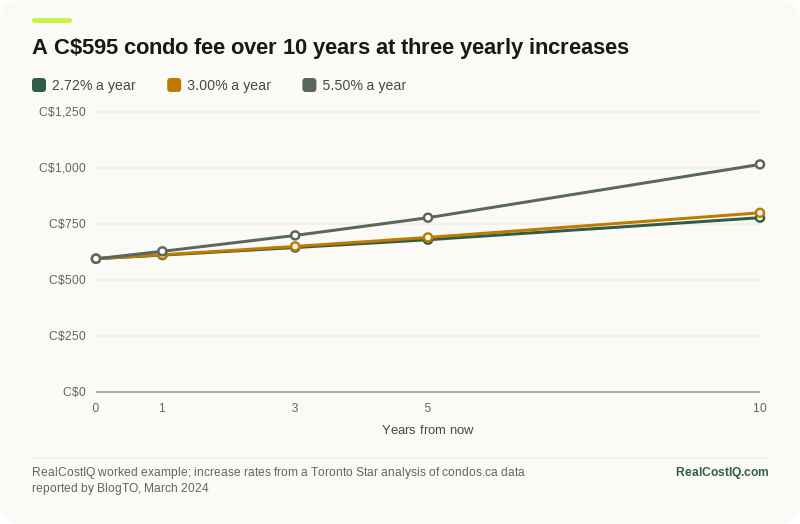
Look at year 10. The gap between the slow case (C$778) and the fast case (C$1,016) is C$238 a month. That is C$2,856 a year, for the same unit. The gap grows each year. So when you compare two buildings, ask each for its fee history over the last three to five years. A building that has raised its fee by 2% to 3% a year is on a steadier path than one that held its fee flat for years and then jumped.
Why a low fee can be a warning
A low fee feels like a bargain. In an older building it is often a warning. The reason is simple. Roofs, windows, elevators and garages wear out on a schedule. The money for them has to come from somewhere. If the monthly fee does not include enough savings, the bill comes later as a special assessment or a big jump in the fee.
The Canadian Press quotes Cowans on the same point: how well the reserve fund is funded, and whether the building has been kept up, decide whether a fee is enough. The Wahi data fits this. Its highest-fee buildings skew old. Seven of the ten were finished in 1991 or earlier. Older buildings need more care, and the owners have to pay for it one way or another.
A special assessment is a one-time charge to all owners. The CAO says a board can levy one through the common expense fees without asking owners for permission. Each owner pays the same percentage share used for the regular fee. If an owner does not pay, the corporation can place a lien on the unit. A lien is a legal claim on the property for the unpaid amount, plus interest and the legal costs of collecting it. The CAO lists the usual reasons: unforeseen expenses, under-budgeting and legal costs.
The CAO also points to a court decision in which a buyer was excused from a special assessment, because the corporation had not made clear in the status certificate that one could come. That is why the status certificate matters. It is also why you should read it for planned work, as our status certificate post explains.
How the reserve fund study works
A reserve fund study is a report by a qualified professional. It lists the shared parts of the building that will need repair or replacement within 30 years. It estimates what each will cost. It then sets out a funding plan, which says how much the corporation must put aside each year so the money is there when it is needed.
The CAO page on reserve funds gives the rules we found. The first study must be done in the year after the building is registered. After that, a full update and a lighter update take turns at least every three years. Class 1 is the full study, with a physical examination and a projection of at least 30 years. Class 2 adds a site inspection. Class 3 is a records review and interviews. Only parts that cost C$500 or more to replace need to be listed. The board must review a new study within 120 days and put a plan in place that makes the fund adequate by the next fiscal year after the study.
That last point is worth a second look. If the study says the fund is short, the plan can force higher contributions. That means higher fees. So a new study is often a warning of a coming rise. When you buy, ask the date of the latest study and read what it says about the fund. The CAO also advises boards to be careful about departing from professional advice, as they could face liability.
A reserve-fund-per-unit check you can do in 10 minutes
We found no public pass mark for how much reserve per unit is enough. No regulator or industry body we read publishes one. So we do not give you a magic number. Instead, use the study's own numbers. The check has four steps.
- Find the balance. The status certificate shows the reserve fund balance. Write it down.
- Find the next 10 years of spending. The latest reserve fund study lists expected repairs and replacements by year. Add up the first 10 years.
- Divide both by the number of units. This puts a big building and a small building on the same scale.
- Compare. Ask whether the balance, plus the planned yearly contributions, covers the planned spending. If the study itself says there is a gap, that is your answer.
Here is a round example. It is not a real building. A building has 300 units and a reserve fund of C$3,000,000. That is C$10,000 per unit. The study says the next 10 years of repairs will cost C$9,000,000, or C$30,000 per unit. The fund covers one third of that. Planned contributions might cover some of the rest, but a gap of this size is a flag. Ask the board how it plans to close it.
| Item | Whole building (CAD) | Per unit (CAD) |
|---|---|---|
| Reserve fund balance today | C$3,000,000 | C$10,000 |
| Planned repairs and replacements, next 10 years | C$9,000,000 | C$30,000 |
| Share of the 10-year spending covered by today's balance | 33% | 33% |
| Gap before planned contributions | C$6,000,000 | C$20,000 |
Hypothetical round numbers to show the method. They are not data about any building. The study's own funding plan says how much of the gap yearly contributions will cover.
A fee at the low end is not a problem if the study shows a fully funded plan. A fee at the high end is not a comfort if the study shows a big gap. The study is the better guide, and the rate per square foot is the quick screen.
What a special assessment can cost
A special assessment is shared by ownership percentage. The formula is the cost of the job times your share. Take a round example. A building must replace its parking garage membrane, and the job costs C$6,000,000. Your unit holds a 0.30% share of the building. Your bill is C$6,000,000 times 0.30%, or C$18,000.
How big is that? With a C$595 fee, C$18,000 equals about 30 months of fees. It would take 30 months to pay a bill that arrived all at once. Most buyers do not keep that kind of cash. Some owners use a line of credit. Some boards allow payment over time, but the CAO page does not set a rule for that, so ask. A bill like this can also hurt the resale value of the unit in the short term, as the broker quoted by The Canadian Press warned.
| Your ownership share | Your bill (CAD) | Months of a C$595 fee |
|---|---|---|
| 0.20% | C$12,000 | About 20 |
| 0.30% | C$18,000 | About 30 |
| 0.40% | C$24,000 | About 40 |
Hypothetical. Bill equals the repair cost times the share. Months equal the bill divided by C$595, rounded. Your share is in the declaration and the status certificate.
Older building or newer building?
Neither is always better. A newer building has a newer roof and new systems, so near-term repair risk is lower. It may also have more amenities, and those raise the fee. An older building may have a lower fee per square foot and bigger repair risk. The Wahi finding that seven of the ten highest-fee buildings date from 1991 or earlier shows that age and fee often rise together.
A rule of thumb helps you start. For a building of about 20 years, compare its rate to the C$0.75 to C$0.85 range. If it is far below, ask for the study and the last three budgets. If it is far above, ask what the fee buys. A pool, a concierge and 24-hour security cost money, and you pay for them even if you never use them.
A short checklist before you make an offer
- Work out the rate: fee divided by the unit's square feet. Compare it with the C$0.75 to C$0.85 range and the C$1.00 warning line.
- Ask for the last three to five years of fee changes. A steady 2% to 3% rise is easier to plan for than a long freeze followed by a jump.
- Read the status certificate for the reserve fund balance, any special assessment passed or planned, and any lawsuits. Our status certificate post shows what to look for.
- Ask for the latest reserve fund study. Check its date and read the funding plan. Do the per-unit check in the section above.
- Add the full fee to your monthly budget, not half. Then test the price in the condo fee affordability calculator.
- If you could buy a house instead, compare the real total in the condo vs house calculator.
- Keep a cash cushion for a special assessment. Even C$10,000 helps.
These are general facts, not legal or financial advice. Your lawyer should review the status certificate, and your lender will tell you how it counts the fee for your mortgage. Fee benchmarks change from year to year, and the ones above were read on November 1, 2026.
We tried to confirm a recent buyer discussion on the RedFlagDeals forum and on Reddit for this topic. We could not reach either site's threads, so we do not cite one.