Most people who buy a home in Ontario pay one land transfer tax. Buyers in the City of Toronto pay two. The first is Ontario's tax. The second is the City's own tax, called the municipal land transfer tax. Toronto is the only city in Ontario that charges it. A buyer in Mississauga, Markham or Vaughan pays only the Ontario tax.
Each tax has its own first-time buyer rebate. The two rebates use almost the same test, but they are claimed from two different offices, they have two different maximums, and they handle a second person on the deed in slightly different words. That second point is where buyers get surprised. A parent who helps with the down payment and goes on title can cut both rebates. A spouse who owned a home before can remove both.
This post works out the bill for two Toronto homes: one at C$800,000 and one at C$1.1M. It then changes who is on the deed and shows what each change costs. All amounts are Canadian dollars (CAD). The tax rates, the rebate rules and the market figure were read on 2026-10-28 and are listed at the end. This is general information, not legal advice. Your lawyer's statement of adjustments is the number that counts.
Two taxes on one deed
Land transfer tax is a one-time tax on the price of a home. You pay it when the sale closes and the deed is registered. Your lawyer collects it from you on closing day and pays it on your behalf. It is not part of your mortgage. You bring it as cash, along with your down payment.
Ontario's tax is set by the province. For a home with one or two single-family units, it is 0.5% on the first C$55,000 of the price, then 1% up to C$250,000, then 1.5% up to C$400,000, then 2% on everything above that up to C$2 million. The rate is 2.5% on the part above C$2 million. That is from Ontario.ca, on a page updated April 22, 2026.
Toronto's municipal tax is a second tax on top of the provincial one. Up to C$2 million, the City uses the same bands and the same rates. The City page, last modified April 7, 2026, lists 0.5%, 1%, 1.5% and 2% in the same steps, then 2.5% from C$2 million to C$3 million. Council has since voted new, higher rates for the very top. They apply from April 1, 2026, and they start above C$3 million: 4.40% on the slice from C$3 million to C$4 million, rising to 8.60% above C$20 million. None of that touches the two homes in this post.
Because the two bands match below C$2 million, the two taxes come out to the same amount for a home in that range. That makes Toronto easy to estimate. Take the Ontario tax and double it. For a home under C$2 million, doubling is exact.
Which homes pay the city tax
The city tax applies when the land is inside the City of Toronto. That covers the whole City, not only the downtown core. It does not depend on the mailing address. A house with a Toronto mailing address that sits in another municipality does not pay it. Your lawyer checks the legal description on the deed. If you are unsure, ask before you sign the offer. The cost of getting this wrong is a surprise of C$12,475 or more on closing day.
Condos pay the same two taxes as houses, because the tax is on the price of the unit. New homes pay too. A new home may also carry GST or HST in the price, which is a separate matter that the post on Ontario's new-home HST break covers.
The bill at C$800,000 and C$1.1M
Start with the two prices. The Toronto Regional Real Estate Board reported on October 15, 2026 that the average selling price across the whole Greater Toronto Area in September 2026 was C$1,006,409, down 5.1% from a year earlier. That is a regional average across all home types, not a City of Toronto figure. It is a useful reminder that C$800,000 is a typical price for a condo or a small semi-detached home, and C$1.1M is typical for a detached house in many parts of the city.
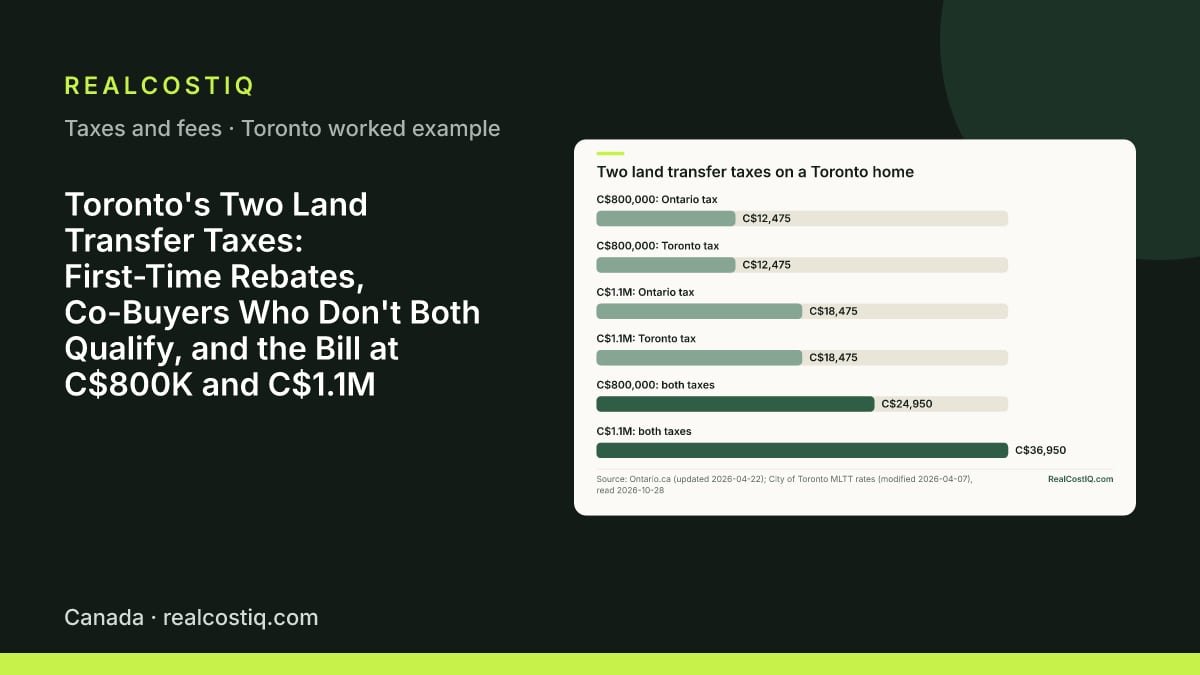
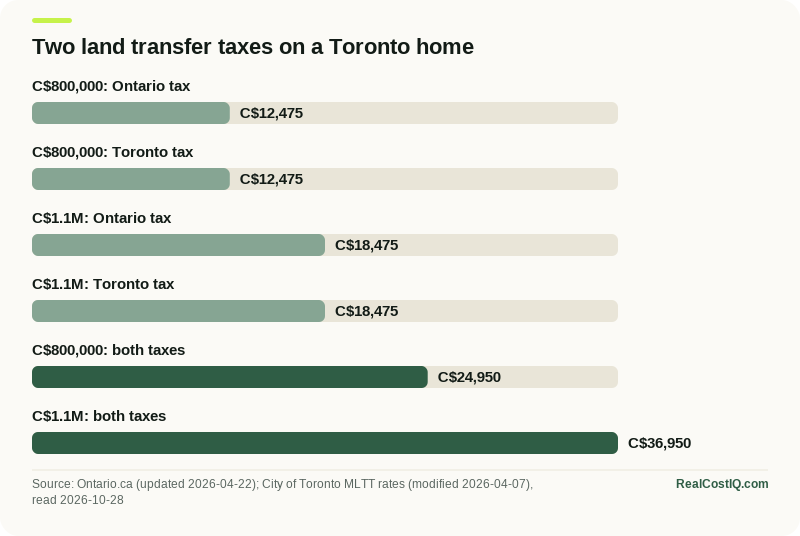
Here is the tax at each price, before any rebate. The work is short. On the first C$400,000 of any price, the tax is C$4,475. Above that, it is 2% of the extra amount. At C$800,000, the extra C$400,000 adds C$8,000. At C$1.1M, the extra C$700,000 adds C$14,000.
| Price | Ontario tax | Toronto tax | Total two taxes | Total as % of price |
|---|---|---|---|---|
| C$800,000 | C$12,475 | C$12,475 | C$24,950 | 3.12% |
| C$1,100,000 | C$18,475 | C$18,475 | C$36,950 | 3.36% |
Rates: Ontario.ca (page updated 2026-04-22) and City of Toronto, MLTT rates and fees (page modified 2026-04-07), both read 2026-10-28. One or two single-family residences. Matches the land transfer tax calculator.
Look at the last column. The two taxes together take about 3.1% of a C$800,000 price and about 3.4% of a C$1.1M price. The tax is rising faster than the price because each new dollar above C$400,000 is taxed at 2% twice, once by the province and once by the City, which is 4% of each extra dollar. The same house in Mississauga would carry only the Ontario half, which is why a buyer comparing Toronto with a nearby city should add the City tax to the Toronto side.
Two rebates, two offices
A first-time buyer can get money back from both governments. Ontario's refund is up to C$4,000. Ontario.ca says that for an eligible home, no land transfer tax is due on the first C$368,000 of the price. The City's rebate is up to C$4,475. The Toronto Municipal Code sets that amount in section 760-60. It equals the City's tax on the first C$400,000 of the price.
Both are flat caps. They do not grow with the price. So the same C$8,475 comes off the bill whether the home costs C$600,000 or C$1.1M. On a C$800,000 home, the two rebates wipe out 34% of the land transfer tax. On a C$1.1M home they wipe out 22.9%. The benefit is biggest, as a share, on cheaper homes.
The test for each rebate
The tests are very close. In each case the buyer must be at least 18. The buyer must be a Canadian citizen or a permanent resident. The buyer must never have owned a home, or any share in a home, anywhere in the world. And the buyer must move in and make the home a principal residence within nine months of closing. The word "anywhere" matters. A home you owned in another country, or a share you held in a family property, can count against you.
There is a small gap for newcomers. The Ontario page says a buyer who is not yet a citizen or permanent resident on the closing date may claim later if that changes within 18 months. The City's page says the same. So a person who closes in the month before their permanent residence card arrives may not be shut out for good. They would claim after the fact, which takes more paperwork.
How you claim each one
Ontario's refund is easiest at registration. Your lawyer ticks the box in the electronic land transfer tax affidavit, and you simply pay less on closing day. If it is missed, you pay the full tax and apply to the Ministry of Finance within 18 months. The ministry's page says documents such as a utility bill or home insurance are not accepted as proof that you moved in.
The City's rebate works the same way. Claim it at registration, or apply to the City's revenue office within 18 months. The City's page says a processing fee applies to a later claim, and it asks for a separate proof of occupancy for each first-time buyer. Claiming both at closing is cleaner. It keeps the cash you need on closing day lower, and it avoids a fee and a waiting period.
To see your own numbers with both rebates switched on, use the Ontario closing costs calculator. It adds the lawyer's fee and the title insurance allowance, which this post leaves out.
When one co-buyer does not qualify
This is the part most guides skip. Many first-time buyers do not buy alone. A parent adds their name to help the child qualify for a mortgage. A couple buys with a friend. A spouse owned a condo years ago. In each case somebody on the deed has owned before. The rules for what happens next depend on who that person is.
Case 1: a spouse who owned before
This is the harshest rule. If your spouse owned a home, or any interest in one, anywhere in the world, at any time while you were married to or in a spousal relationship with each other, then neither of you qualifies. Ontario.ca states it that way, and so does the City. It does not matter that you personally have never owned. It does not matter if the spouse sold years ago. Only a home owned before the marriage or relationship began is outside the rule. The Ontario page uses the word spouse. Whether a particular partner counts as a spouse is a legal question, so ask your lawyer before you rely on an answer from the internet.
The result is that the couple pays the full C$24,950 at C$800,000, or C$36,950 at C$1.1M, with no rebate at all.
Case 2: a co-buyer who is not your spouse and who owned before
A parent, sibling or friend on the deed is not your spouse, so the rule is different. You can still claim, but only for your share. The Ontario page gives the example of a parent and child who each hold half. The child can claim 50% of the maximum refund, which is C$2,000. The City's code says the same in section 760-60, subsection D. If the first-time buyer is not the only buyer named in the conveyance, the rebate is cut to the part that matches the first-time buyer's interest.
The code does not give a worked example. Our reading is that the City's cap shrinks in the same proportion, so a 50% share gets 50% of C$4,475, which is C$2,237.50. Treat that as an estimate. Ask the City's revenue office or your lawyer how they will apply it before closing. The Ontario example is the official one.
Case 3: a partner who is not yet a citizen or permanent resident
Both governments say this buyer can usually not be counted in the maximum on closing day. If the status changes within 18 months, a claim may be made at that point, and the combined claims cannot exceed the maximum. This is a case where the money arrives late. Plan the closing cash as if the rebate for that person is zero until it is paid.
What each case costs
The table below puts the cases side by side. The 50% and 25% rows assume the other person on the deed is not a spouse and has owned a home before. The shares are shares of ownership on the deed. A parent who lends money but is not on title does not change the claim, though a lender may still want their name on the mortgage, which is a different question from title.
| Who is on the deed | Rebates (Ontario + Toronto) | Net tax at C$800,000 | Net tax at C$1,100,000 |
|---|---|---|---|
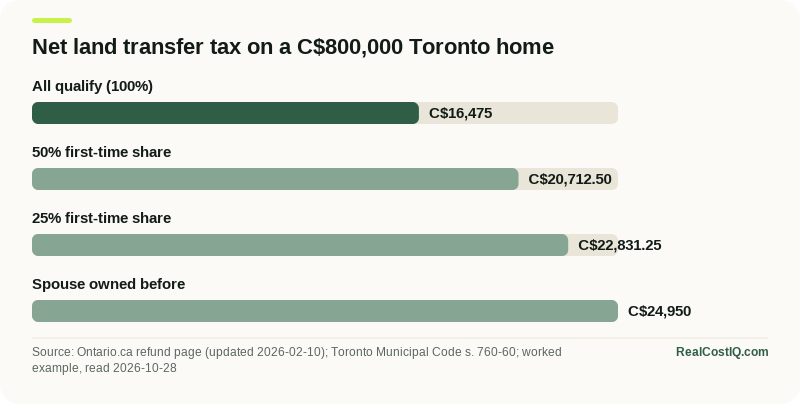
| First-time buyer(s), all qualify (100%) | C$4,000 + C$4,475 = C$8,475 | C$16,475 | C$28,475 |
| First-time buyer holds 50%, other owner has owned before | C$2,000 + C$2,237.50 = C$4,237.50 | C$20,712.50 | C$32,712.50 |
| First-time buyer holds 25%, other owner has owned before | C$1,000 + C$1,118.75 = C$2,118.75 | C$22,831.25 | C$34,831.25 |
| Spouse owned before, or buyer not first-time | None | C$24,950 | C$36,950 |
Ontario's 50% share follows the Ontario.ca example (read 2026-10-28). The City's share is our reading of Toronto Municipal Code s. 760-60(D) and is not confirmed by a City example. Both rebates are taken at the stated shares of the maximum.
Is putting a parent on title worth it?
Here is the trade-off in plain numbers. Say a child buys a C$800,000 Toronto condo and a parent who owned before goes on title with a 50% share. The land transfer tax rebates fall from C$8,475 to C$4,237.50. That costs C$4,237.50 in cash on closing day. If the parent holds 25%, the loss is C$6,356.25.
The parent may be needed. A lender may want the parent's income to approve the mortgage, and that can be done two ways. The parent can co-sign the mortgage without being on title, or the parent can go on both the mortgage and the deed. Lenders differ on whether they allow the first. Co-signing without title keeps the child's rebates intact. It also leaves the parent with a debt and no ownership, which has its own risks, such as what happens if the child stops paying. A lawyer and a mortgage broker should walk through that choice before you sign anything.
This post is only about the tax, not the gift letter or the lender's rules. The point here is narrow: add the C$4,237.50 or more to your closing-cash plan if a parent goes on title, and ask whether another structure meets the lender's needs.
There is also a timing trick that some buyers ask about: buy alone as a first-time buyer, claim both rebates, and add a parent to title later. Adding a name later is a new transfer, and it may or may not be taxed, and it brings its own forms, lawyer's fee, and tax rules. We did not read the family-transfer rules for this post, and we do not recommend building a plan on this trick. If you are considering it, ask your lawyer before you buy, not after.
What the rebates do to cash on closing day
Closing day cash is the amount your lawyer needs from you beyond the mortgage. The land transfer tax is the biggest single item in it. With both rebates claimed at registration, an all-first-time-buyer deal at C$800,000 needs C$16,475 for the tax, not C$24,950. The rebate is taken off the bill. You do not pay first and wait to get it back.
If you plan to claim afterwards, you need the whole C$24,950 on closing day. You then wait for the refund. Ontario's page says to apply within 18 months. The City's page says the same, with a fee. Waiting costs you the use of C$8,475 for months. For a buyer who had to stretch to close, that gap matters.
A few other things to confirm on the lawyer's reporting letter. Check that the price on the deed matches the agreement, because the tax is on the full consideration. Check that any chattels, such as appliances you agreed to buy, are listed apart from the price if the contract says so. Check that the tax shown is the sum of two lines. If you see only one land transfer tax line on a City of Toronto deal, ask which tax it is.
Remember also that a first-time buyer rebate comes with a duty: you must move in within nine months. If you do not, the government can ask for the money back. A buyer who buys to rent out the unit does not qualify. Do not claim the rebate on a home you plan to rent from day one.
A short checklist before you sign the offer
- Confirm the property is inside the City of Toronto. The deed's legal description decides, not the mailing address.
- Add the Ontario tax and the City tax. At prices under C$2 million, they are equal, so double the Ontario figure.
- List every person who will be on the deed. For each one, ask whether they have ever owned a home or a share in one, anywhere in the world.
- If a spouse owned before, assume no rebate at all. Ask your lawyer to confirm.
- If a parent or friend who owned before will be on title, work out their share. Use the table in this post to see the loss.
- Ask your lawyer to claim both rebates at registration and to show them as two lines on the statement of adjustments.
- Plan to move in within nine months. Keep proof that is allowed: a utility bill is not accepted by either government as proof of occupancy.
- Add the other closing costs from the closing costs calculator for Ontario, since the tax is only part of the cash you need.
What the calculator does and does not model
The land transfer tax calculator uses the same rates and rebate caps as this post. It treats the first-time rebate as all or nothing. You either claim the full amounts or you claim none. It does not split a rebate by ownership share. So for a co-buyer case, use the calculator for the no-rebate and full-rebate figures, and use this post's table for the shares in between.
The calculator also assumes one or two single-family units on the land. A building with more units, a farm, or land with a commercial use can be taxed on different bands. If your purchase is one of those, a lawyer should work out the tax.
What this post did not read
- The Ontario Land Transfer Tax Act and its regulation on the refund, as printed text. The e-Laws site did not return the statute text in this session, so the Ontario rules here come from the Ontario.ca guidance pages above.
- The Toronto Municipal Code was read from the City's consolidated PDF, which is dated September 6, 2023. The rebate rules in section 760-60 are the ones we use. The 2026 rate changes come from the City's rate page, not from that PDF. The rebate maximum of C$4,475 matches both the code and the City's rebate page.
- How the City applies the rebate share in practice. The code says the rebate is cut to the first-time buyer's interest. No worked example was found, so the C$2,237.50 and C$1,118.75 figures are our estimate.
- The family-transfer rules for adding a name to title later.
- A forum thread from the last 12 months. We searched RedFlagDeals for threads about a parent on title and the Toronto rebate. The threads that came up were old, and we could not confirm a post from the last 12 months, so none is quoted. The Reddit site was not reachable for this check.