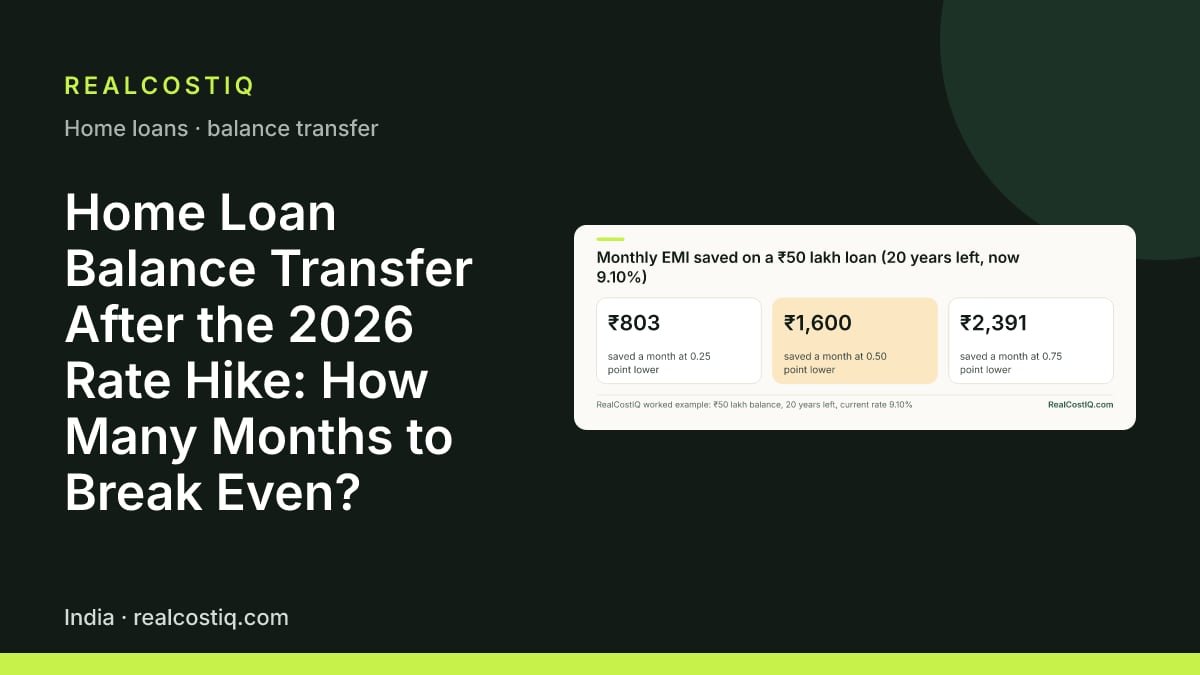
The RBI raised the repo rate by 0.25 points to 5.50% on 7 October 2026 and changed its stance to calibrated tightening. Home loan rates followed. SBI's repo-linked base rate (EBLR) rose from 7.90% to 8.15% on 15 October, plus the bank's own premiums. When rates rise, a lender who is still quoting a low rate looks tempting. That is when many borrowers ask the same question: if another bank offers me 0.50 points less, is the switch worth the trouble? The answer is a number of months. We start with the sums.
A ₹50 lakh loan with 20 years left
Take a home loan with ₹50,00,000 (₹50 lakh) still to repay and 20 years left. You pay 9.10% a year. We made up the 9.10% for this example. It is not a bank's rate. Another bank offers you a lower rate. We do not know what that rate is for you, so the table tries three cuts: 0.25, 0.50 and 0.75 points. At 9.10% your EMI is ₹45,308, and over 20 years you pay about ₹58.74 lakh in interest.
| New rate | New monthly EMI | EMI saved each month | Cash kept in 12 months | Cash kept in 36 months | Interest saved over 20 years |
|---|---|---|---|---|---|
| 9.10% (no change) | ₹45,308 | ₹0 | ₹0 | ₹0 | ₹0 |
| 8.85% (0.25 lower) | ₹44,505 | ₹803 | ₹9,639 | ₹28,918 | ₹1.93 lakh |
| 8.60% (0.50 lower) | ₹43,708 | ₹1,600 | ₹19,203 | ₹57,608 | ₹3.84 lakh |
| 8.35% (0.75 lower) | ₹42,918 | ₹2,391 | ₹28,689 | ₹86,066 | ₹5.74 lakh |
Loan ₹50,00,000, 20 years left, monthly repayment, same tenure after the transfer. EMI and interest use the standard EMI formula that the site's EMI calculator uses. The rates are illustrations, not offers. Cash kept is the EMI saving times the months, before any fee. Interest saved is the 20-year total at 9.10% minus the total at the new rate.
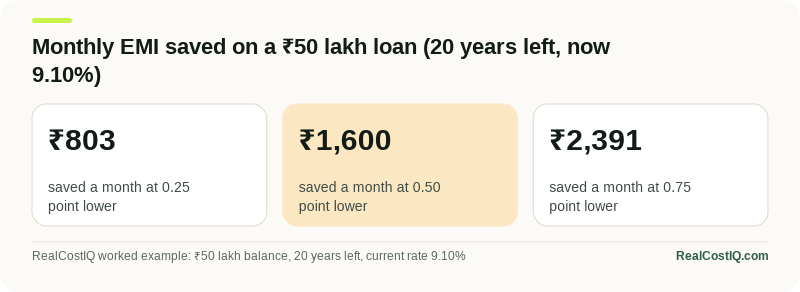
Two things stand out. The first is that the monthly saving is small. At 0.25 points lower it is ₹803, which is under 2% of the EMI. The second is that the saving is the same every month. So the break-even month is just the total cost divided by the monthly saving. Everything now depends on the cost. That is the next section.
What a transfer costs at SBI, HDFC Bank and ICICI Bank
The new bank charges you. The old bank, as far as the pages we read show, does not charge a penalty to close a floating-rate home loan. We opened each bank's own fee page on 28 October 2026 and added up the lines that apply to a ₹50 lakh loan taken over from another lender. We show every fee before GST, because none of these pages gives the GST rate.
| Bank | Processing fee | Other lines | Total on ₹50 lakh |
|---|---|---|---|
| SBI | 0.35% of the loan, minimum ₹5,000, maximum ₹15,000 (salaried). On ₹50 lakh the cap applies: ₹15,000. Non-salaried cap is ₹18,000. | CERSAI registration fee ₹100 for a loan above ₹5 lakh (SBI's PMAY page). | ₹15,100 plus GST |
| HDFC Bank | Up to 0.50% of the loan or ₹4,000, whichever is higher, for a salaried applicant. On ₹50 lakh that is up to ₹25,000. | Administrative charge up to ₹5,000. CERSAI at actual, up to ₹100. | Up to ₹30,100 plus taxes |
| ICICI Bank (FAQ fee) | 0.5% of the sanctioned amount on ICICI's processing-fee FAQ: ₹25,000. | Administrative charge 0.25% or ₹5,000, whichever is lower: ₹5,000. CERSAI ₹100 above ₹5 lakh. | ₹30,100 plus taxes |
| ICICI Bank (table fee) | The fee table on the same page says up to 2% of the loan amount: ₹1,00,000. | Same administrative charge and CERSAI. | Up to ₹1,05,100 plus taxes |
Sources: SBI Processing Fee Card Rates (PDF, no printed date) and SBI PMAY page; HDFC Bank home loan page, Processing Fees & Charges (no effective date shown); ICICI Bank home loan service charges page (no effective date shown). The totals are our addition. The ICICI page shows two different processing fees; we show both and do not pick one. None of the three pages says what the transfer fee is for a loan being taken over from another bank, so we used the fees for a new home loan.
The spread is wide. SBI's cap keeps the total near ₹15,000 on a ₹50 lakh loan. HDFC Bank and ICICI Bank charge a share of the loan, so the cost grows with the loan. ICICI Bank's page lists two different fees, a 0.5% line in the FAQ and a line of up to 2% in the table. Ask the bank which one applies to a transfer, and ask for it in writing. A fee of ₹1.05 lakh would change the whole answer.
There is one more cost that no bank page gives. When you take a new loan, the lender takes your property papers as security, and in many states that needs a stamp-duty charge on a memorandum of deposit of title deeds, or a similar document. That charge is set by each state, and in some states by the city. We could not read any state portal today, so we give no rate. Read the section on the state charge below, and add that number to the cost before you work out your own break-even.
The break-even month: rate gap against total cost
Now we divide. The table below takes each monthly saving from the first table and divides the cost by it. The first cost column is ₹5,000. That is the processing fee SBI lists for moving a loan from MCLR to its repo-linked rate inside the same bank, and HDFC Bank lists up to ₹5,000 to switch to a lower rate inside the bank. The other three columns are the transfer totals from the fee table.
| Rate cut | EMI saved each month | ₹5,000 (switch inside your own bank) | ₹15,100 (SBI-type total) | ₹30,100 (HDFC, ICICI FAQ total) | ₹1,05,100 (ICICI table total) |
|---|---|---|---|---|---|
| 0.25 point | ₹803 | 6.2 months | 18.8 months | 37.5 months | 130.8 months |
| 0.50 point | ₹1,600 | 3.1 months | 9.4 months | 18.8 months | 65.7 months |
| 0.75 point | ₹2,391 | 2.1 months | 6.3 months | 12.6 months | 44.0 months |
Break-even months = total cost ÷ monthly EMI saving, with the same tenure after the transfer. Fees are before GST and exclude the state's mortgage charge, so every real break-even is longer than the figure shown. The ₹5,000 column is a same-bank switch, not a transfer, and is shown for comparison.
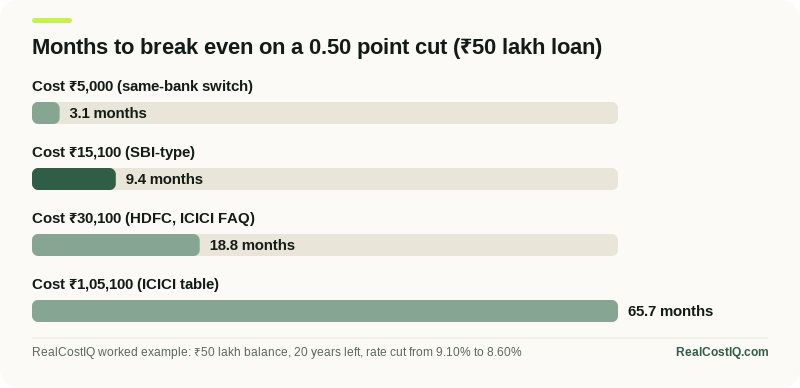
Read the table from the left. With a 0.50 point cut and SBI-type fees, you are even in about 9 months. With HDFC Bank or ICICI Bank fees of about ₹30,100, it is about 19 months. If ICICI Bank's 2% line applied, it would be 66 months, which is more than five years. At a 0.25 point cut and a ₹30,100 cost the answer is 37.5 months, over three years. If you sell the flat or close the loan before that, the transfer loses money.
Here is the same idea as rupees kept after fees, for a borrower who stays 36 months. At a 0.50 point cut you keep ₹57,608 of EMI savings in 36 months. Take away ₹15,100 and you are ₹42,508 ahead. Take away ₹30,100 and you are ₹27,508 ahead. Take away ₹1,05,100 and you are ₹47,492 behind. At a 0.25 point cut and a ₹30,100 cost you are ₹1,182 behind after 36 months. Those are the cases in which the answer is no.
Ask your own bank first
A transfer is not the only way to get a lower rate. Your own bank can move you to a lower rate, and the fee for that is often small. SBI lists ₹5,000 plus GST for the switch from MCLR to its repo-linked rate. HDFC Bank lists, for a switch to a lower rate on a variable-rate loan, up to 0.50% of the principal or ₹3,000, whichever is lower, for the first conversion, and its separate conversion page lists 0.25% or ₹5,000, whichever is lower, plus taxes. Compare those with the ₹15,100 to ₹1.05 lakh above. For the rules on moving from MCLR to a repo-linked rate inside one bank, see our post on EBLR vs MCLR. We do not repeat it here.
One more point from RBI's Interest Rates on Advances Directions, 2025. A switch to an external benchmark inside the same bank is not treated as a foreclosure of the loan (paragraph 41). A transfer to a new bank is different. Your old loan is closed and a new one is opened.
What the old bank does, and what it may charge
Closing a floating-rate home loan early used to carry a penalty at some banks. The pages we read today say that, for the usual floating-rate loan, it does not. SBI's regular home loan page and its balance transfer page both list "No Pre Payment Penalty". HDFC Bank's charges list shows premature closure charges of "Nil" for adjustable-rate home loans, and 2% plus taxes for fixed-rate loans unless the prepayment comes from your own sources. ICICI Bank's FAQ says you can repay at any time and advises you to confirm with the lender whether there are prepayment penalties. RBI's own list of withdrawn circulars shows that its Pre-payment Charges on Loans Directions of 2 July 2025 were folded into later Directions. We could not read the current text, because RBI serves it only as a PDF to browsers, so check your own loan agreement.
Check two other things with the old bank. First, ask for the foreclosure letter and the list of original documents it holds. SBI's takeover page asks the borrower to bring the list of original documents held at the old bank, the loan statement for the past year and the sanction letter. Second, collect your property papers quickly. HDFC Bank's charges list a property document retention charge of ₹1,000 per calendar month, starting two calendar months after all linked loans are closed. If another lender has the papers for a few weeks during the handover, find out who pays for the delay.
Who will take your loan, and on what terms
A new bank looks at the loan like any new application. SBI's takeover page says the borrower must meet its home loan eligibility rules, must have paid interest and instalments regularly under the original sanction, and must have valid papers showing title to the flat. HDFC Bank's FAQ says that a borrower needs at least 12 months of regular payments on the existing loan, and that the longest term is 30 years or until retirement, whichever is earlier. ICICI Bank's FAQ says its transfer offer depends on income, property details and a credit score of 700 or above. So a missed EMI in the past year can shut this door before the rate matters. A recent missed EMI is the most common reason for a refusal.
| Lender | Rate shown | How it is set | Date or basis |
|---|---|---|---|
| SBI | 7.50% onwards | Repo-linked. EBLR was 8.15% plus premiums from 15 October 2026. | Rate on SBI's home loan rate page, w.e.f. 15 October 2026; page last updated 15 October 2026 |
| HDFC Bank | 8.00% to 13.45% | Repo rate 5.50% plus a spread of 2.50 to 7.95 points | HDFC's balance transfer page says all rates are benchmarked to the policy repo rate; no date shown |
| ICICI Bank | 7.80% for pre-approved digital loans | Depends on bureau score | ICICI's home loan rates page; repo rate effective 8 October 2026 is shown on the page |
Sources: SBI home loan interest rates page and EBLR page; HDFC Bank home loan balance transfer page; ICICI Bank home loan interest rates page. Each bank sets your own rate from its bureau score, loan size and profile, so the range is not an offer.
HDFC Bank's FAQ says its balance transfer loans carry the same rates as its regular home loans. That means the rate you would get is the rate a new borrower with your profile would get, not a special transfer rate. That helps you in one way. You can check the bank's rate for a new customer before you apply. It also tells you the real gap: it is the gap between your current rate and the new-customer rate, not the headline "starting from" figure.
Does the rate hike change the answer?
It depends on what your old loan is linked to. If your old loan and the new one are both linked to the repo rate, the hike moves both by the same amount. The gap you were offered is a gap in spreads, and it survives the hike. If your old loan is linked to the bank's MCLR, it is different. SBI's one-year MCLR rose from 8.70% to 8.85% on 15 October, which is 0.15 points, while the EBLR rose 0.25 points. An MCLR loan feels the rise only when it resets, which can be up to a year later. So in a rising cycle, an MCLR borrower may find the gap to a new repo-linked offer is closing, because the old loan has not yet caught up.
Get the new rate in writing, with the date it applies from. A rate that is quoted today on a loan that resets every three months can move before your second EMI. RBI's Directions say the rate on an external benchmark loan is reset at least once in three months (paragraph 38). Ask which month the first reset falls in, and ask how much the spread is. The spread is the part that stays.
When a transfer rarely pays
The ₹50 lakh and 20 years in our example are a fair case for a transfer. Many loans are not like that. Three things push the break-even out.
- A small balance. The saving is a share of the balance, but some fees are fixed. On ₹25 lakh with a 0.25 point cut, the monthly saving is ₹402. Against ₹15,100 that is about 38 months.
- A big balance with a percentage fee. On ₹1 crore with a 0.25 point cut the saving is ₹1,607 a month. At a fee of ₹1,05,100 that is about 65 months. The saving grew with the loan, but so did the fee.
- Few years left. With 10 years left, a 0.50 point cut on ₹50 lakh at 9.10% saves ₹1,348 a month, and only about ₹1.62 lakh over the whole loan. The saving ends sooner. Most of your EMI at this stage is already principal.
Why do few years left hurt? The monthly saving does not shrink, because it is the gap between two EMIs on the same tenure. What shrinks is the number of months left to collect it. A transfer in year 15 of a 20-year loan has only five years to pay back its fees. The same transfer in year 1 has nineteen. Time is the thing a late transfer lacks.
The tenure trap
A new bank may offer you the longest tenure it allows, up to 30 years, to make the EMI look low. Take our loan at the 8.60% offer. Over 30 years the EMI would be ₹38,801. That is ₹6,507 below your present EMI of ₹45,308, which looks like a big saving. But the interest over 30 years comes to about ₹89.68 lakh, against about ₹58.74 lakh on your current loan. You would pay about ₹30.94 lakh more in interest. The rate cut has been spent on a longer loan.
The fix is simple. Ask for the transfer at your remaining tenure, 20 years here, and compare like with like. If you want a lower EMI, take the longer tenure but keep paying the old EMI. You then clear the loan early and get the benefit of both. Use the home loan EMI calculator to test your own numbers.
The state's mortgage charge
This is the one cost the banks do not set. Most new loans are secured by a document that records the lender's claim on the flat. In some states it is a memorandum of deposit of title deeds, and in others a mortgage deed. Each state prices that document in its own way. It can be a flat fee, a share of the loan with a cap, or a different rate in a city. A transfer needs a fresh one, because the new bank is a new lender.
We give no rate. Rates differ by state, and we could not read a state registration portal today. To find yours, look up your state's stamp duty on the instrument that the new bank will use, and ask the bank for the amount in the sanction letter. Our stamp duty calculator lists the state pages for the duty on the purchase of a flat, which is a different charge. Whatever the number is, add it to the fee total in the break-even table. If it is a few thousand rupees, little changes. If it is a percentage of the loan, it can move you from the ₹15,100 column to the ₹30,100 column.
Before you sign: seven questions
- What is my rate today, and what will the new bank's rate be? Get the new rate in writing, with the date and the benchmark it follows.
- What is the total cost: processing fee, administrative charge, legal and valuation fees, CERSAI fee, and the state's mortgage charge? Ask for all of it before GST and with GST.
- Is the new loan at my remaining tenure? If not, what happens to total interest?
- Does my old bank charge anything to close the loan, or to release my papers? How long does it take?
- How many months until the saving pays back the cost, and am I sure I will keep the loan that long?
- Is a same-bank rate cut on offer, and what does it cost? Ask for it before you apply elsewhere.
- Does the new bank ask for a top-up, insurance or an account with it, as a condition of the rate? Ask what the rate is without them.
If you are unhappy about a fee or how a bank handled the transfer, RBI's complaint route is free. RBI's FAQ page says the Reserve Bank - Integrated Ombudsman Scheme, 2026 came into force on 1 July 2026 and that complaints can be filed online at cms.rbi.org.in. Complain to the bank first, as the scheme asks.
What we did not read
Three limits apply. We did not read any state registration portal, so the state's mortgage charge has no figure. We could not read the current wording of RBI's Responsible Business Conduct Directions or of its prepayment rules, which RBI serves as PDFs to browsers, so the statements about prepayment come from the banks' own pages and from RBI's list of withdrawn circulars. And none of the fee pages carries an effective date, so treat the fees as a guide, not as a quote. This post covers banks. Housing finance companies such as LIC Housing Finance have their own Directions, which we did not read. It is about the cost of a home loan. It does not tell you how to plan your tax or your savings.