How the numbers are worked out
People ask "How much flat can I buy on 15 LPA?" in a hundred ways. The answer comes from four steps. Each step has a rule, and I name where each rule comes from, because two of them are not law.
- Take-home pay. LPA means lakh per annum of fixed pay before tax. I work out your monthly take-home from the Income-tax Act, 2025, new regime, for each salary. The steps are in the next section. Take-home is about 94% of salary at ₹10 LPA and about 74% at ₹40 LPA, so one flat percentage would be wrong.
- The EMI limit. Lenders limit your total EMIs as a share of income. This is called the fixed obligations to income ratio, or FOIR. Axis Bank's home loan page says banks generally allow EMIs of up to 40% of net monthly income. Bajaj Housing Finance says a FOIR of 40% to 55% is generally considered favourable. Godrej Capital says 40% to 50%. So I show 40% and 50%. The RBI does not set a FOIR. It is each lender's own rule.
- Rate and years. I use 8.50% a year over 25 years. HDFC Bank's page showed 8.50% for a credit score of 800 and above, with no effective date. Axis Bank lists a maximum tenure of up to 30 years. The RBI raised the repo rate by 0.25 points to 5.50% on 7 October 2026, so rates are not falling.
- The loan-to-value cap. The RBI's Commercial Banks (Credit Facilities) Directions, 2025, paragraph 111, set the largest loan as a share of the property value. For a loan up to ₹30 lakh it is up to 90% (loans above 80% carry a higher risk weight for the bank, so many stop at 80%). For a loan above ₹30 lakh and up to ₹75 lakh it is 80%. Above ₹75 lakh it is 75%. I use 80% for the first band, which is also what the site's calculator uses.
These are the same rules the site's home loan eligibility calculator uses. Everything below was run through that engine. The stamp duty figures come from the site's stamp duty comparison, which shows the state portal and the date each rate was checked.
Take-home pay, worked out in plain steps
Banks size the EMI on what reaches your account. So the first job is to turn each salary into take-home pay. I use the new tax regime, because the Income-tax Act, 2025 makes it the default for an individual (section 202(1)). Here are the steps, each from the Act as published in the Gazette of India on 21 August 2025.
- Standard deduction. A salaried person subtracts ₹75,000 from salary (Schedule, standard deduction, where tax is computed under section 202(1)). That gives taxable income.
- Tax slabs. Section 202(1): nothing up to ₹4 lakh; 5% from ₹4 lakh to ₹8 lakh; 10% to ₹12 lakh; 15% to ₹16 lakh; 20% to ₹20 lakh; 25% to ₹24 lakh; 30% above that.
- Rebate. Section 156(2) takes off the whole tax, up to ₹60,000, if taxable income is ₹12 lakh or less. So ₹10 LPA pays no income tax. Above ₹12 lakh there is relief that stops the tax from exceeding the income above ₹12 lakh.
- Cess. I add 4% health and education cess to the tax. This comes from the yearly Finance Act, which I did not read today.
- Provident fund. I assume basic pay is half of salary and you put 12% of basic into the employee provident fund. That is 6% of salary. It is my assumption. Your payslip may differ.
| Salary | Taxable income | Tax with cess | Provident fund | Take-home a year | Take-home a month | Share of salary |
|---|---|---|---|---|---|---|
| ₹10 LPA | ₹9,25,000 | Nil | ₹60,000 | ₹9,40,000 | ₹78,333 | 94% |
| ₹15 LPA | ₹14,25,000 | ₹97,500 | ₹90,000 | ₹13,12,500 | ₹1,09,375 | 87.5% |
| ₹25 LPA | ₹24,25,000 | ₹3,19,800 | ₹1,50,000 | ₹20,30,200 | ₹1,69,183 | 81% |
| ₹40 LPA | ₹39,25,000 | ₹7,87,800 | ₹2,40,000 | ₹29,72,200 | ₹2,47,683 | 74% |
Worked from Income-tax Act, 2025 (Gazette of India Extraordinary, 21 August 2025, read 30 October 2026): section 202(1) slabs, section 156(2) rebate, standard deduction of ₹75,000. Cess at 4% and the provident fund share are assumptions. The old regime, a higher basic pay, a large bonus or other deductions will change your own figure. Use your payslip.
Check the ₹15 LPA row by hand. Taxable income is ₹14,25,000. The tax is ₹20,000 on the second slab, ₹40,000 on the third and ₹33,750 on the part of the fourth slab up to ₹14,25,000, which is ₹93,750. Cess of 4% makes it ₹97,500. Take that and ₹90,000 of provident fund off ₹15,00,000 and you keep ₹13,12,500, or ₹1,09,375 a month.
The ladder: loan and flat price at 40% FOIR
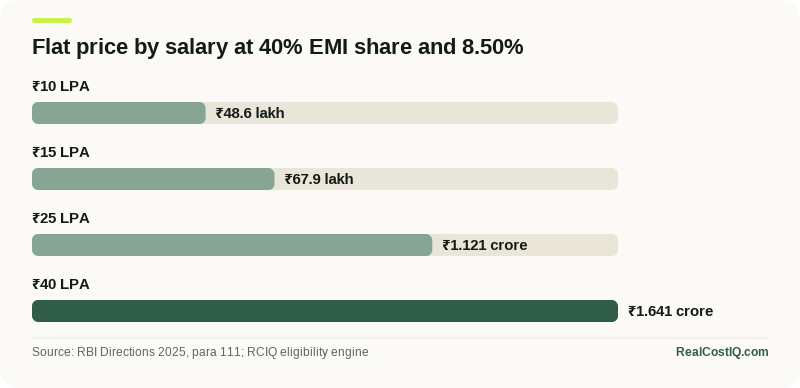
Start with the cautious case, where the bank lets 40% of take-home go to EMI. This is the safer number to plan on if you also have a car loan, a credit card balance or a young family.
| Salary | Take-home a month | Largest EMI (40%) | Loan | Flat price | Down payment |
|---|---|---|---|---|---|
| ₹10 LPA | ₹78,333 | ₹31,333 | ₹38.91 lakh | ₹48.6 lakh | ₹9.69 lakh |
| ₹15 LPA | ₹1,09,375 | ₹43,750 | ₹54.33 lakh | ₹67.9 lakh | ₹13.57 lakh |
| ₹25 LPA | ₹1,69,183 | ₹67,673 | ₹84.04 lakh | ₹1.121 crore | ₹28.06 lakh |
| ₹40 LPA | ₹2,47,683 | ₹99,073 | ₹1.23 crore | ₹1.641 crore | ₹41.06 lakh |
Engine: home loan eligibility calculation, 25 years, 8.50%, no other EMIs, take-home from the table above. Loan rounded to the nearest ₹1,000 and flat price to the nearest ₹10,000. Down payment is flat price minus loan. Loan cap per RBI paragraph 111, read 29 October 2026.
Where the 50% case lands
Some lenders go to 50% of take-home. The loan and flat price rise, and so does your monthly squeeze. A 50% EMI share leaves half of your take-home for food, school fees, travel, the electricity bill and everything else.
| Salary | Largest EMI (50%) | Loan | Flat price | Down payment |
|---|---|---|---|---|
| ₹10 LPA | ₹39,167 | ₹48.64 lakh | ₹60.8 lakh | ₹12.16 lakh |
| ₹15 LPA | ₹54,688 | ₹67.92 lakh | ₹84.9 lakh | ₹16.98 lakh |
| ₹25 LPA | ₹84,592 | ₹1.05 crore | ₹1.401 crore | ₹35.05 lakh |
| ₹40 LPA | ₹1,23,842 | ₹1.54 crore | ₹2.051 crore | ₹51.30 lakh |
Same engine and assumptions as the table above, with the EMI share set to 50%. Above a ₹75 lakh loan, the RBI cap of 75% applies, which is why the down payment is a quarter of the price from ₹25 LPA up.
The ₹75 lakh line that changes your down payment
Look at the down payment column. On ₹10 LPA and ₹15 LPA it is 20% of the flat price. On ₹25 LPA and ₹40 LPA it is 25%. That jump is the RBI loan-to-value rule. A loan above ₹75 lakh can fund at most 75% of the price. A loan of ₹75 lakh or less can fund up to 80%.
This makes a small cliff. On a ₹93.75 lakh flat, a ₹75 lakh loan is exactly 80%, so the down payment is ₹18.75 lakh. On a ₹1.05 crore flat, the bank can lend at most 75%, which is ₹78.75 lakh, so your own money is ₹26.25 lakh. A price that is only ₹11.25 lakh higher means ₹7.5 lakh more of your own cash. If you are close to the line, check whether a slightly cheaper flat saves you more cash than it seems.
The cash you need on day one
The loan is not the whole bill. Paragraph 113 of the same RBI directions says a bank must not include stamp duty, registration and other documentation charges in the cost of the house it finances. The only exception is a house costing ₹10 lakh or less. So stamp duty and registration come out of your own pocket.
Stamp duty is a state levy. It depends on the state, the city body and the buyer. The table uses the rates held in the site's comparison tool for a male buyer in the main city body of each state, at the flat prices from the 40% ladder. Women buyers often pay less in some states. Check the state portal for your own case.
| Salary | Flat price | Maharashtra (Mumbai, BMC area) | Delhi | Tamil Nadu (Chennai) |
|---|---|---|---|---|
| ₹10 LPA | ₹48.6 lakh | ₹3,21,600 | ₹3,40,200 | ₹5,34,600 |
| ₹15 LPA | ₹67.9 lakh | ₹4,37,400 | ₹4,75,300 | ₹7,46,900 |
| ₹25 LPA | ₹1.121 crore | ₹7,02,600 | ₹7,72,600 | ₹12,33,100 |
| ₹40 LPA | ₹1.641 crore | ₹10,14,600 | ₹10,84,600 | ₹18,05,100 |
From the rates held in the site's stamp duty comparison tool. Maharashtra: Department of Registration and Stamps (igrmaharashtra.gov.in), stamp duty checked 10 September 2026, registration 24 August 2026. Delhi: Revenue Department (revenue.delhi.gov.in), checked 21 August 2026. Tamil Nadu: Inspector General of Registration (tnreginet.gov.in), checked 24 August 2026. The same flat price costs very different duty in different states.
Now add the down payment and the duty. This is the cash that has to be in your account before the first EMI.
| Salary | Flat price | Down payment | Stamp duty and registration | Own cash needed |
|---|---|---|---|---|
| ₹10 LPA | ₹48.6 lakh | ₹9.69 lakh | ₹3.22 lakh | ₹12.91 lakh |
| ₹15 LPA | ₹67.9 lakh | ₹13.57 lakh | ₹4.37 lakh | ₹17.94 lakh |
| ₹25 LPA | ₹1.121 crore | ₹28.06 lakh | ₹7.03 lakh | ₹35.09 lakh |
| ₹40 LPA | ₹1.641 crore | ₹41.06 lakh | ₹10.15 lakh | ₹51.21 lakh |
Maharashtra duty from the site's comparison tool (igrmaharashtra.gov.in; checked 10 September 2026 and 24 August 2026). In Delhi the same flats add about ₹18,600 to ₹70,000 more duty. In Chennai they add about ₹2.13 lakh to ₹7.91 lakh more. Brokerage, GST on an under-construction flat, society charges and interiors are not included.
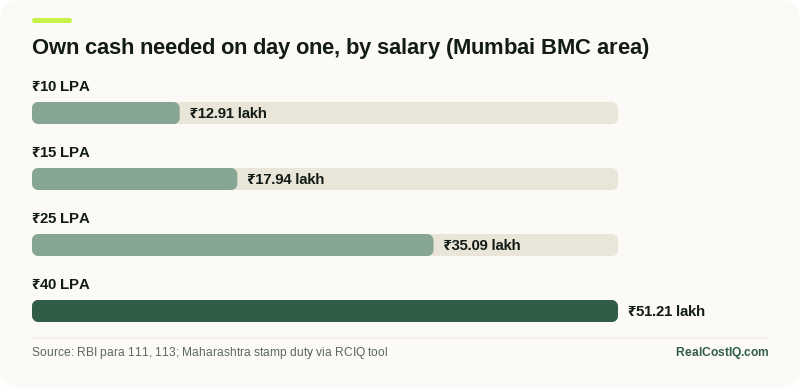
Notice the ratio. At ₹10 LPA the cash is about 27% of the flat price. At ₹40 LPA it is about 31%. The share grows with price because of the RBI 75% cap. A rule of thumb that you need "20% down" is too low for any flat that needs a loan above ₹75 lakh, even before duty.
What salary does a ₹1 crore flat need?
This is the most common question. The RBI line makes it simple. On a ₹1 crore flat the largest loan is ₹75 lakh, which is 75% of the price. Over 25 years at 8.50% the EMI on ₹75 lakh is about ₹60,392.
| EMI share of take-home | Take-home needed a month | Salary needed (LPA) |
|---|---|---|
| 40% | ₹1,50,980 | About ₹21.8 lakh |
| 50% | ₹1,20,784 | About ₹16.7 lakh |
EMI of ₹60,392 divided by the EMI share gives the take-home needed. I then ran the tax steps above backwards to find the salary that leaves that take-home (about 83% of salary at ₹21.8 lakh and 87% at ₹16.7 lakh). On top of the loan you need ₹25 lakh as down payment plus stamp duty and registration: ₹6.3 lakh in Mumbai (BMC area), ₹7 lakh in Delhi or ₹11 lakh in Chennai, from the site's comparison tool.
So "Can I buy a ₹1 crore flat on 20 LPA?" is a yes at a 50% EMI share and a no at 40%. A ₹20 LPA salary leaves about ₹1,40,600 a month, so 40% is ₹56,250, short of ₹60,392, and 50% is ₹70,300, enough. And in either case you need about ₹31 lakh to ₹36 lakh in cash. That cash is the part most calculators leave out.
What moves the numbers
Another EMI you already pay
Existing EMIs come off the allowed amount. A ₹10,000 car EMI takes ₹10,000 off the EMI you can have. At 8.50% over 25 years each ₹1 lakh of loan costs about ₹805 a month, so ₹10,000 of EMI is about ₹12.4 lakh of loan. Repay the car loan or the credit card before you apply if you can.
A longer or shorter tenure
A longer loan lets you borrow more, but you pay more interest. On the ₹67,673 EMI of the ₹25 LPA rung, the loan is about ₹78 lakh over 20 years, ₹84 lakh over 25 years and ₹88 lakh over 30 years. Another way to see it: stretching from 25 to 30 years adds about ₹4 lakh of loan. It does not change the RBI cap. And if your loan passes ₹75 lakh, you need the larger 25% down payment.
A rate change
A higher rate cuts the loan your pay can carry. On a ₹67,673 EMI, a rise from 8.50% to 8.75% cuts the loan from about ₹84 lakh to about ₹82.3 lakh, a fall of about ₹1.7 lakh. The RBI raised the repo rate on 7 October 2026 and changed its stance to calibrated tightening, so the rate you are offered may be higher than the 8.50% in the tables. Test your own rate in the home loan EMI calculator below.
A co-applicant
A working spouse adds to the pay the bank counts. That can lift both the loan and the flat price. It also lifts your risk if one income stops. The monthly-salary angle is in the post on a ₹50,000 salary. It walks through one salary with a co-applicant in more detail than this post does.
Pay that is not a fixed salary
Banks treat fixed pay and variable pay differently. A bonus or an incentive may be counted at only a part of its value, or not at all, unless it shows up in your records for a few years. If your ₹25 LPA is ₹18 LPA fixed and ₹7 LPA bonus, the lender may use a number closer to the ₹18 LPA rung than the ₹25 LPA one. Self-employed buyers are judged on tax returns and profit, not on a payslip. No lender I read publishes the exact share it counts, so ask for it in writing before you shortlist a flat.
A useful habit is to run the tables with the pay you are sure of. Work out the flat price on your fixed pay alone, then see what the bonus adds. If the flat only works with the bonus, it is a stretch. Treat the bonus as a cushion that pays for a prepayment, not as the base for the EMI.
Should you borrow the most you can?
No. The tables show what a bank may lend, not what is wise. A lender's FOIR looks at your EMI against your pay today. It does not know about school fees, a parent's care or a job change. A cautious plan keeps the EMI at or below 40% and keeps six months of EMI and costs in an emergency fund after you pay the down payment, duty and move-in costs.
A second check is to compare buying with renting the same flat. The rent versus buy calculator shows how long it takes for owning to beat renting at your price. For a wider list of costs after the flat is bought, see the true cost of buying a flat in India.
What these tables do not include
- GST on an under-construction flat, brokerage and society charges. These are extra cash on day one.
- Loan processing and legal charges. See the post on home loan processing and legal and technical charges.
- Pre-EMI. If you buy an under-construction flat, you may pay interest on the part of the loan the bank has released, before full EMIs begin.
- Home loan tax benefits. They are not counted here. The site's home loan tax benefit calculator covers Section 24 and 80C relief on the loan.
- Women buyers and city bodies. Duty differs by buyer and by city. The tables use a male buyer in the main city body.
What I could not confirm
- A single FOIR rule. No lender I read publishes a binding cap. Each of Axis, Bajaj and Godrej describes what lenders generally allow.
- Cess and provident fund. The 4% cess comes from the yearly Finance Act, which I did not read today. The 12% provident fund on a basic of half the salary is my assumption. The old tax regime, a higher basic or a large bonus will change your take-home.
- A recent forum thread. Reddit was unreachable on 30 October 2026, so I did not confirm a forum thread from the last 12 months.
- Live rates at each lender. The 8.50% comes from one HDFC Bank page, which showed no effective date. Ask your bank for a sanction letter.