The two definitions, side by side
Mumbai flat buyers meet two laws on carpet area. The older one is the Maharashtra Ownership Flats Act, 1963, called MOFA. The newer one is the central Real Estate (Regulation and Development) Act, 2016, called RERA. For a project registered with MahaRERA (RERA's main sections took effect on 1 May 2017), the agreement uses RERA carpet area. Older agreements were drawn under MOFA, which has not been repealed.
The Supreme Court of India set out MOFA's rule in its judgment of 31 August 2010 in *Nahalchand Laloochand Pvt. Ltd. v. Panchali Co-operative Housing Society Ltd.* The court quoted Section 3(2)(m)(i): when flats are advertised for sale, the promoter must disclose "the extent of the carpet area of the flat including the area of the balconies which should be shown separately". It also quoted the Explanation to clause (n): "the carpet area of the flat shall include the area of the balcony of such flat".
RERA says something different. Section 2(k), as published in the Gazette of India on 26 March 2016, reads: carpet area "means the net usable floor area of an apartment, excluding the area covered by the external walls, areas under services shafts, exclusive balcony or verandah area and exclusive open terrace area, but includes the area covered by the internal partition walls of the apartment".
| Question | MOFA (1963) | RERA (2016), Section 2(k) |
|---|---|---|
| Balcony | Included in carpet area, and shown separately in the advertisement | Excluded (exclusive balcony or verandah) |
| Exclusive open terrace | Not mentioned in the text quoted by the Supreme Court | Excluded |
| Internal partition walls | The quoted text is silent | Included |
| External walls and service shafts | The quoted text is silent | Excluded |
| When it applied in Maharashtra | Agreements drawn before RERA took effect on 1 May 2017 | Projects registered with MahaRERA (RERA's main sections took effect on 1 May 2017) |
MOFA text: Supreme Court of India, Civil Appeal No. 2544 of 2010, judgment of 31 August 2010, quoting Section 3 of MOFA. RERA text: Gazette of India Extraordinary, Part II Section 1, No. 17, 26 March 2016 (copy hosted by the Housing Department, Government of Maharashtra). I could not open the current MOFA text on India Code or the MahaRERA site on 29 and 30 October 2026, so MOFA is quoted as the Supreme Court set it out in 2010.
So is MOFA carpet bigger or smaller?
It depends on the flat, and commentary disagrees. A builder-side explainer from L&T Realty (14 February 2024) says RERA usually gives a higher number because it counts internal walls. Other commentary that I came across says the RERA number is generally smaller because the balcony drops out. Both are partly right. The balcony pushes the MOFA number up. The internal walls push the RERA number up. Which effect is bigger depends on the balcony size and the wall layout. A flat with a large balcony will usually have a larger MOFA figure. A flat with no balcony may show almost no gap.
To convert a figure for your own flat, use the carpet area calculator. It does the arithmetic. This post is about what the two rules mean for your rights.
A Mumbai example: 720 sq ft or 650 sq ft?
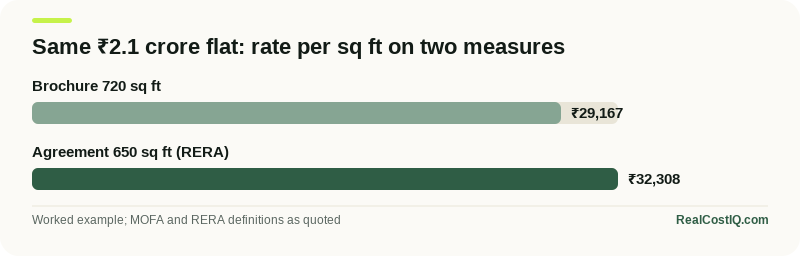
Here is an example with round, made-up numbers. A flat in Mumbai costs ₹2,10,00,000 (₹2.1 crore). The old-style brochure says 720 sq ft carpet area, which includes a 70 sq ft balcony. The registered agreement for sale, made under RERA, says 650 sq ft. It is the same flat. To keep the arithmetic simple, assume the internal-wall difference is nil. In a real flat the RERA figure would be a little higher, because RERA counts internal walls. The carpet area calculator lets you enter the wall area.
| Measure | Area | Price per sq ft |
|---|---|---|
| Brochure (MOFA style, balcony included) | 720 sq ft | ₹29,167 |
| Agreement (RERA style, balcony out) | 650 sq ft | ₹32,308 |
₹2,10,00,000 divided by each area. The price per square foot is about 10.8% higher on the RERA measure. The flat, the balcony and the total price have not changed.
This is the trap. A buyer who sees ₹29,167 a square foot in one tower and ₹32,308 in another may think the second is dearer. If the first tower quotes MOFA-style area and the second quotes RERA carpet, they may be about the same. Always compare the rate per RERA carpet square foot, and ask the seller to state the balcony area separately.
Which document wins when the numbers differ?
The Maharashtra Real Estate Appellate Tribunal answered this in a judgment of 23 April 2024 in *Kamal Kishore Uniyal v. Accord Builders*. The buyer relied on two earlier papers, a challan and a draft agreement, that showed a larger area (the judgment quotes about 767 sq ft). The registered agreement for sale, dated 10 August 2018, said 50.29 sq m. With 0.31 sq m of duct and service slab, the Tribunal put the total at 544.66 sq ft. The buyer claimed compensation for a shortfall of roughly 225 sq ft.
The Tribunal said no. It relied on the registered agreement, which stated the area in clause 3.2 and had an "entire agreement" clause (clause 63) that replaced any allotment letter or earlier paper. It also noted that the buyer took possession on 21 December 2018 without objecting to the area, and raised the issue only later. The appeal was dismissed.
A booking under MOFA, an agreement under RERA
Some flats were booked before May 2017 and the agreement was signed after. MahaRERA looked at one such case in *Deepak Pande v. Larsen & Toubro Ltd.* (Complaint No. CC006000000100256), decided on 17 August 2021. The allotment letter was dated 1 October 2015, when MOFA applied. The agreement for sale was dated 20 December 2017, after RERA.
The buyers asked for a refund of the "excess funds collected for carpet area of 57.60 square feet" at ₹28,131.67 a square foot, a claim of ₹16,20,384 plus interest. MahaRERA's chairperson, Ajoy Mehta, held that the carpet area was defined differently in the two Acts. There was "no actual change", only a difference in how the area was calculated. The agreement also allowed a variation of up to 3% for design change and construction needs, which the buyers had accepted. The complaint was dismissed with costs of ₹20,000.
Two lessons follow. First, a gap that is only a change of method, such as a balcony moved out of the figure, is not a shortfall. Second, the buyers lost partly because they signed a letter that said they were fully satisfied. Read any letter of satisfaction or possession form before you sign it.
The 3% variation clause and what a real shortfall is worth
Many Maharashtra agreements carry a clause that lets the final area differ from the agreed area by up to 3%. A June 2026 column in the Free Press Journal by Shirish Deshpande, chairman of Mumbai Grahak Panchayat, quotes Clause 1(g) of MahaRERA's Model Agreement for Sale. It says the promoter must confirm the final carpet area after the occupancy certificate, "subject to a variation cap of 3%". The price is recalculated. If the area is smaller, the promoter must refund the excess within 45 days, with interest at the MCLR plus 2% a year, from the dates of the payments. Extra area is billed at the same rate per square metre.
The column's view is that the 3% is a cap on the adjustment, not a free allowance. A 1% or 2% shortfall is still refundable. This is one consumer-group chairman's reading of the model clause, not an order of MahaRERA, and the developer in that case argued the opposite. Your own agreement's wording controls. If it is vague, ask a lawyer to read it before you sign.
The column's own example is a 500 sq ft flat that is delivered at 490 sq ft, bought at ₹28,000 a square foot for ₹1.40 crore. The shortfall is 10 sq ft, which is 2%. At ₹28,000 a square foot the refund is ₹2,80,000.
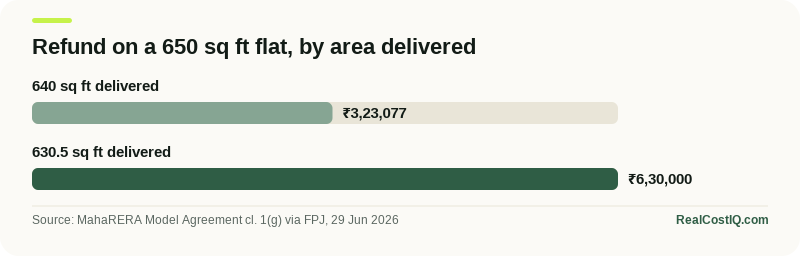
Apply that to the 650 sq ft flat above. At ₹32,308 a square foot, 3% of 650 sq ft is 19.5 sq ft, worth ₹6,30,000. If the delivered area is 640 sq ft, the shortfall is 10 sq ft and the refund is about ₹3,23,077. These are worked from the model clause as quoted. Interest would be extra.
| Area delivered | Shortfall | Share of 650 sq ft | Refund at ₹32,308 a sq ft |
|---|---|---|---|
| 650 sq ft | None | 0% | Nil |
| 640 sq ft | 10 sq ft | 1.5% | ₹3,23,077 |
| 630.5 sq ft | 19.5 sq ft | 3% | ₹6,30,000 |
Worked example. Refund is the shortfall in square feet times the rate on the agreement area, as in Clause 1(g) of MahaRERA's Model Agreement for Sale quoted by the Free Press Journal on 29 June 2026. Interest is not included. The result depends on the wording of your own agreement.
Read your agreement: seven checks
- Find the carpet area clause. The registered agreement should state the carpet area in square metres or square feet, and say it is RERA carpet area. If it says only "saleable" or "built-up" area, ask why.
- Find the balcony. It should be listed on its own, with its area. Under MOFA the balcony was inside the carpet figure. Under RERA it is not.
- Compare it with the brochure. If the brochure showed 720 sq ft and the agreement says 650 sq ft, work out the balcony and wall effect. The carpet area calculator can check that the gap is only the method.
- Look for the variation cap. Check whether it is 3% and whether the clause says the price will be recalculated both ways.
- Look for an entire agreement clause. Clause 63 in the Tribunal case replaced all earlier papers. Anything you were promised in writing should be inside the agreement.
- Keep the original papers. The brochure, booking form and allotment letter may not bind the builder, but they show what you relied on.
- Measure at possession, and object in writing. In the Tribunal case the buyer took possession without protest. Note any shortfall on the possession form, in writing, before you sign.
Resale flats, redevelopment and old papers
Not every Mumbai flat comes from a builder's first sale. In a resale, the area on the seller's papers is whatever was agreed years ago. A flat bought in 2012 will have been described the MOFA way, with the balcony inside the carpet figure. A newer flat in the same building may be described the RERA way. If you are comparing two flats in one tower, ask each seller for the balcony area on its own. Then put both on the same basis before you compare the price per square foot.
The same care applies in a redevelopment. A society may be promised a new flat with an "area equal to your old flat". Old flats were often counted the MOFA way. If the new flat is counted the RERA way, a balcony in the old number can quietly leave the new one. Ask the developer to state in writing which measure each side uses. I did not read a redevelopment ruling on this point, so treat it as a question to put to your lawyer.
Your own tape measure helps too. RERA carpet area is the usable floor inside the walls, so you can check it yourself on possession. Measure each room wall to wall, add them up, and add the thickness of the internal walls the area covers. If your figure is far from the agreement's, note it on the possession form. The Tribunal case above shows why a note made at the time matters.
Stamp duty and the loan do not depend on the area
Stamp duty is charged on the agreement value, not on a square-foot figure. In the example, the site's Maharashtra stamp duty calculator gives ₹10,50,000 stamp duty, ₹2,10,000 of metro cess and ₹30,000 of registration (capped) on ₹2.1 crore in the Mumbai BMC area, a total of ₹12,90,000 for a male buyer. Source: the rates held in the site's calculator from the Department of Registration and Stamps, Maharashtra (igrmaharashtra.gov.in), stamp duty checked 10 September 2026 and registration 24 August 2026. Rates differ by buyer and by city body, so check the state portal before you sign.
A refund for a real shortfall lowers the price you pay. Ask your lawyer whether it changes what you owe at registration, because the duty is set by the value on the document. The area label does not change the duty. The price does.
If you are unsure of your rights after a delay or a dispute, the site's RERA buyer rights guide lists what to do next. This post covers the area rules only.
Questions to put to the builder in writing
- What is the RERA carpet area of my unit, in square feet and square metres, and what is the balcony area on its own?
- Is the carpet area in the brochure measured the old way, with the balcony in, or the RERA way?
- Will the final area be confirmed after the occupancy certificate, and how soon?
- If the area is lower than the agreement, how will the refund be worked out, and by what date will it be paid?
- Which clause says this agreement replaces earlier papers, and is every promise I rely on written into it?
Ask for the answers by email. A written reply is easier to use later than a talk at the sales office. If a builder will not answer a simple question about area, that tells you something before you have paid a rupee.
What I could not confirm
- The current text of MOFA. I read it as the Supreme Court quoted it in 2010. India Code and MahaRERA's site did not open on 29 and 30 October 2026, so I cannot say whether a later amendment changed it.
- The MahaRERA order itself. I read the SCC Times report of the 2021 order. I read the 2024 Tribunal judgment as a PDF.
- Whether the 3% cap is a free allowance. I found one consumer-group chairman's reading and one developer's opposite view. I did not find a tribunal ruling that settles it.
- A recent forum thread. Reddit was unreachable on 30 October 2026. The only forum comment I read was an October 2023 question on a legal news site about service ducts and MOFA carpet area, so I did not confirm a thread from the last 12 months.