What the law says now, and what changed
The old Income-tax Act, 1961 had Section 54 for this. The Income-tax Act, 2025 replaced it. It was published in the Gazette of India on 21 August 2025, and the same rule now sits at Section 82. The money-saving idea is the same. The numbering is not, so a guide that still says "Section 54" is talking about the old Act.
Three sections matter if you sell a home to fund the next one. They moved like this, according to the text of the 2025 Act:
| Old Act (1961) | New Act (2025) | What it covers | Time to reinvest |
|---|---|---|---|
| Section 54 | Section 82 | Gain on a residential house, reinvested in another residential house | Buy 1 year before or 2 years after; build within 3 years |
| Section 54EC | Section 85 | Gain on land or building, reinvested in specified bonds | 6 months; ₹50 lakh limit |
| Section 54F | Section 86 | Any other long-term asset (not a residential house, e.g. a plot), with the net sale price reinvested in one house | Buy 1 year before or 2 years after; build within 3 years |
Source: Income-tax Act, 2025, sections 82, 85 and 86, Gazette of India Extraordinary, 21 August 2025, read 30 October 2026. This post covers Section 82 and Section 85. Section 86 applies when what you sold was not a residential house, for example a plot, a shop or shares. It works on the net sale price, not the gain: the exempt share is the cost of the new house divided by the net sale price. This post covers only a house sold to buy a house.
The Act came into force on 1 April 2026, so a sale in the 2026-27 tax year is the first full year under the new numbers. Many forms and bank pages still say "Section 54". When I read the State Bank of India's application form for a Capital Gains Account on 30 October 2026, it still listed sections 54, 54B, 54D, 54F, 54G and 54GB of the old Act. That is not a problem for you. Just do not be thrown when your bank, your broker and your tax filer use different numbers for the same rule. If your sale took place before 1 April 2026, the old Section 54 still governs that sale, even if you buy the new flat after that date.
Who qualifies under Section 82
Section 82(1) is short. You need to be an individual or a Hindu undivided family. The asset you sold must be a building, or land that goes with it, and it must be a residential house whose income would be charged as "Income from house property". The gain must be long-term. For a house, the Act says that means you held it for more than 24 months.
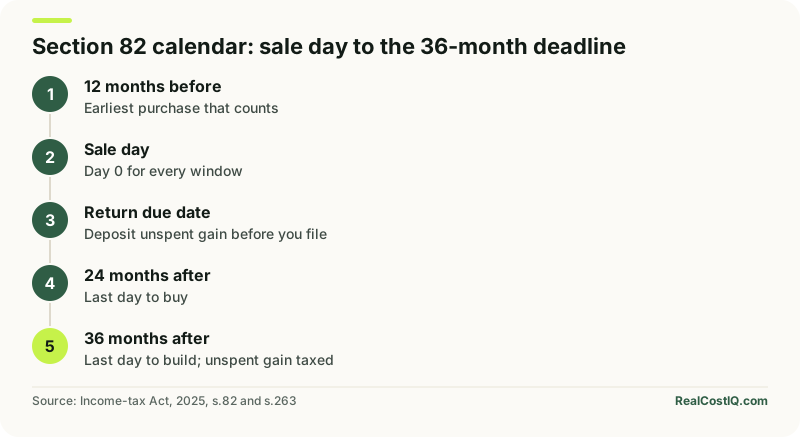
Then you must have bought one residential house in India within one year before or two years after the date of the sale. Or you must have built one within three years after the sale. If you sold on 15 December 2026, the purchase window runs from 15 December 2025 to 15 December 2028. The building window ends on 15 December 2029.
- Sold a flat you lived in or let out: it counts, as long as the income is house-property income.
- Bought the new flat before selling the old one: it counts, up to one year before the sale.
- Bought a plot and plan to build: you have three years from the sale to finish building.
- Bought a flat abroad: it does not count. The Act says the new house must be in India.
- Short-term gain (held 24 months or less): Section 82 does not apply to it, because the section opens with long-term capital gains.
Section 82(5) has a rule that surprises people. If your capital gain is ₹2 crore or less, you may choose to buy or build two houses instead of one. You can use that choice only once in your life. Section 82(6) says that if you used it in any tax year, you cannot use it in the same year or in any other year.
The clock, from the day of the sale
Everything is counted from the date of the transfer. That is the date of the sale, not the date you got the money. For an ordinary resale, think of the date on which the registered sale deed is signed. If you are not sure which date applies to your deal, ask the chartered accountant who files your return before you pick a closing date.
| Date | Months from sale | What happens |
|---|---|---|
| 15 December 2025 | 12 months before | Earliest date a new flat can be bought and still count |
| 15 December 2026 | 0 | Sale of the old flat. This is Day 0 |
| 31 July 2027 | About 7.5 months after | Return due date for most individuals. Gain not yet spent must be in a Capital Gains Account before you file, and no later than this date |
| 15 December 2028 | 24 months after | Last day to buy the new flat |
| 15 December 2029 | 36 months after | Last day to finish building. Any gain still unspent is taxed in tax year 2029-30 |
| 15 December 2029 | 36 months after | If you sold the new flat before this date, its cost is cut by your exempt gain (see below) |
Dates worked from Income-tax Act, 2025, section 82(1), (2), (4) and section 263(1)(c) (return due date 31 July for an assessee not in the audit or company classes), read 30 October 2026. The 31 July date can be extended by the government. Check the date for your own tax year.
Rupee examples: how much tax is saved
Say you sold a flat and your long-term capital gain, after you worked out the cost and any indexation, is ₹70,00,000 (₹70 lakh). The sale price does not matter for what follows. Only the gain matters. Section 197(1)(b) of the 2025 Act sets tax on long-term gains at 12.5%. To work out the gain itself, use the property capital gains tax calculator. It also handles the older-purchase option, so this post does not repeat it.
Section 82(1) compares your gain with the cost of the new flat. If the new flat costs more than the gain, the whole gain is exempt. If it costs less, the part of the gain above the cost is taxed.
| Cost of the new flat | Gain charged to tax | Tax at 12.5% (before cess) |
|---|---|---|
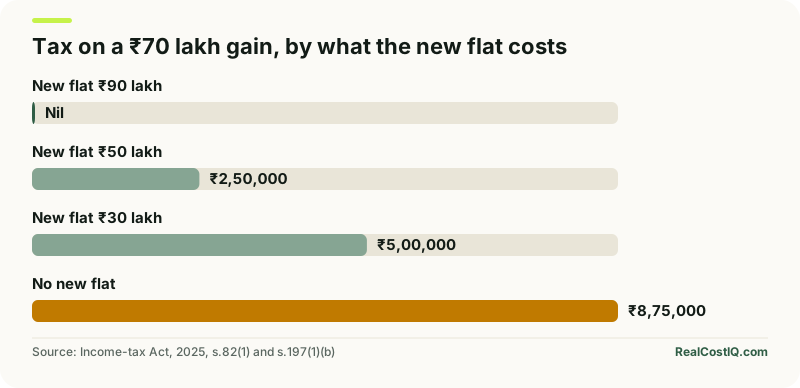
| ₹90,00,000 (₹90 lakh) | Nil | Nil |
| ₹70,00,000 (₹70 lakh) | Nil | Nil |
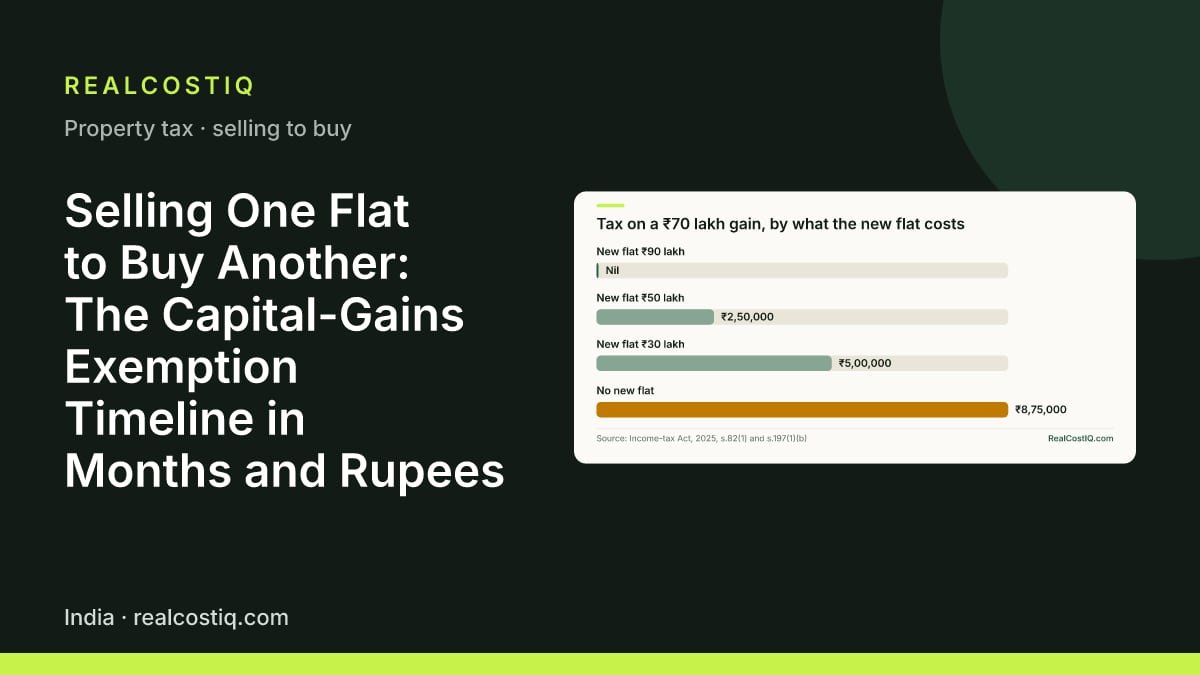
| ₹50,00,000 (₹50 lakh) | ₹20,00,000 (₹20 lakh) | ₹2,50,000 |
| ₹30,00,000 (₹30 lakh) | ₹40,00,000 (₹40 lakh) | ₹5,00,000 |
| No new flat | ₹70,00,000 (₹70 lakh) | ₹8,75,000 |
Worked from Income-tax Act, 2025, section 82(1)(i) and (ii) and section 197(1)(b). Health and education cess and any surcharge come on top. The gain is an example, not a market figure.
A new flat that costs less than the gain
Look at the ₹50 lakh row. The flat covers ₹50 lakh of the gain. The other ₹20 lakh is charged at 12.5%. That is ₹2,50,000 before cess. You did not need to buy the same size of flat. You needed the cost to be at least as large as the gain.
Only the gain has to go into the flat
Many sellers think the whole sale price must be reinvested. The text of Section 82 does not say that. It compares the capital gain with the cost of the new asset. If you sold for ₹1.8 crore and your gain is ₹70 lakh, a ₹70 lakh flat is enough to clear the gain. The text also does not say the new flat must be paid for with the sale money. A flat bought with a home loan counts by its cost.
Gain you have not spent yet: the Capital Gains Account
Say you sell in December 2026 and will buy in 2028. Your tax return for the 2026-27 tax year is due long before that. Section 82(2) deals with this. If you have not used the gain to buy or build by the time you file, you must put the unspent part in a specified bank or institution, under a scheme the Central Government notifies. The deposit must be made before you file the return, and no later than the due date. You send proof of the deposit with the return.
In practice this is the Capital Gains Accounts Scheme, 1988. The Bank of Baroda's page, read on 30 October 2026, describes two kinds of account. Account A is a savings-type deposit. Account B is a term deposit. It says the deposit period is not more than 24 months or 36 months from the date of transfer, depending on the section, and that all branches of public sector banks except rural ones can accept the deposit. It also says joint accounts cannot be opened under the scheme, and that the minimum deposit is ₹1,000 with no upper limit.
If you do not use the deposit in time, Section 82(4) is clear. The unused amount is charged to tax as income of the tax year in which three years from the date of the sale end. You can then withdraw the unused amount under the scheme. Note the detail: even if the rule was to buy within two years, the tax on the unspent money falls in the year the third year ends. In the example, that is tax year 2029-30.
If you sell the new flat too soon
Section 82(1)(i) and (ii) both contain a lock-in. If you sell the new flat within three years of buying or building it, its cost for the new gain is not what you paid.
- If your gain was more than the cost of the new flat, the cost of the new flat is treated as nil when you sell it within three years.
- If your gain was equal to or less than the cost of the new flat, the cost is reduced by the gain you saved tax on.
Take the ₹90 lakh flat and the ₹70 lakh gain. The cost of the new flat for a quick resale is ₹90 lakh minus ₹70 lakh, which is ₹20 lakh. If you sold that flat for ₹1 crore within three years, your new gain would be ₹80 lakh, not ₹10 lakh. After three years the normal cost applies. So the exemption is a deferral that you keep only if you hold on to the new home.
Section 85 bonds: the six-month option
Section 85 (the old Section 54EC) is a different tool. It applies to long-term gains from land or building. You invest the gain in a "long-term specified asset" within six months of the sale. The Act defines that asset as a bond redeemable after five years, issued on or after 1 April 2018 by the National Highways Authority of India or the Rural Electrification Corporation, or any other bond the Central Government notifies.
- Limit: investment from the gain of one or more assets cannot be more than ₹50 lakh in a tax year, or in the year of transfer and the next tax year taken together.
- Lock-in: if you transfer the bonds or take a loan against them within five years, the gain you saved tax on is charged as long-term gain in that year.
- Window: six months is short. For a sale on 15 December 2026, the last day is 15 June 2027.
Bonds suit a person who does not want a second home. They also suit a seller whose gain is bigger than the new flat's cost. In the ₹50 lakh row above, the ₹20 lakh left over is below the ₹50 lakh limit. Do the Section 82 and Section 85 rules allow one gain to be split between a flat and bonds? Neither section says they exclude each other. But I did not find a rule that says you may combine them either. Ask a chartered accountant before you rely on a split.
The cash you need on the buying side
Tax is only one cost of moving up. A buyer who is also a seller needs cash at two points, and stamp duty is the one people forget. The RBI's directions say a bank must not include stamp duty, registration and other documentation charges in the cost of the house it finances (paragraph 113, Commercial Banks (Credit Facilities) Directions, 2025, read 29 October 2026). The one exception is a house that costs ₹10 lakh or less. So duty is your own cash.
The same directions set the largest loan share at up to 90% for a loan of ₹30 lakh or less, 80% above ₹30 lakh and up to ₹75 lakh, and 75% above ₹75 lakh (paragraph 111). On a ₹90 lakh flat, 80% is ₹72 lakh. That leaves ₹18 lakh as your down payment. Duty is extra. These totals come from the rates held in the site's stamp duty comparison, for a male buyer in the main city body of each state:
| State and city | Stamp duty and registration | Down payment (20%) | Own cash before the loan |
|---|---|---|---|
| Maharashtra (Mumbai, BMC area) | ₹5,70,000 | ₹18,00,000 | ₹23,70,000 |
| Delhi | ₹6,30,000 | ₹18,00,000 | ₹24,30,000 |
| Tamil Nadu (Chennai) | ₹9,90,000 | ₹18,00,000 | ₹27,90,000 |
Duty from the site's comparison tool. Maharashtra: Department of Registration and Stamps (igrmaharashtra.gov.in), stamp duty checked 10 September 2026 and registration 24 August 2026. Delhi: Revenue Department (revenue.delhi.gov.in), checked 21 August 2026. Tamil Nadu: Inspector General of Registration (tnreginet.gov.in), checked 24 August 2026. Rates differ by state, buyer type and city body. Check the state portal before you sign.
A ₹72 lakh loan over 25 years at 8.50% has an EMI of about ₹57,976. HDFC Bank's home loan page showed 8.50% for a credit score of 800 and above when I read it on 29 October 2026. Your rate will depend on your own profile. To test your own numbers, use the home loan EMI calculator. If you need to check what a bank may lend on your income, use the home loan eligibility calculator.
Buy first or sell first?
Section 82 lets you do either. Buying up to one year before the sale still counts. Selling first has a benefit: you know the exact gain, and you know how much cash you have. Buying first has a benefit too: you do not rush the sale. But you carry two homes for a while. If the old flat still has a loan, you will pay two EMIs. Add that to your cash plan. Whichever way you go, write down both dates the day the first deed is signed.
Under-construction flats and the "date of purchase"
A builder flat can take years to finish. Which date counts as "purchased": the booking, the agreement or the possession? Section 82 does not define it. A reader on the Kaanoon legal forum asked the same question about a flat booked under construction in 2015. The advocates who answered cited an ITAT decision and a High Court judgment (CIT v. Smt. Beena K. Jain, 217 ITR 363) for the view that the date of possession can count. The page says the question was asked about nine years ago (read 30 October 2026), and it was written under the old Act. Treat it as a pointer, not as advice. If your flat is not ready, ask your tax adviser to confirm the date in writing before the 24-month mark gets close.
Mistakes that cost the exemption
- Missing the return-date deposit. If the gain is not yet spent when you file, the Capital Gains Account deposit must be made by the due date. Do it before the return, not after.
- Counting from the wrong date. Count from the sale date for every window. Do not count from the date the money reached your account.
- Letting the building window pass. Three years sounds long. Approvals, loans and the monsoon can use up most of it.
- Selling the new flat inside three years. The cost drops, and the saved tax comes back as a bigger gain.
- Using the two-house choice twice. It is allowed once in your life, and only if the gain is ₹2 crore or less.
- Assuming a cap does not apply. The cost of the new flat that counts is limited to ₹10 crore under Section 82(7), and gain above ₹10 crore is ignored for the deposit under Section 82(8).
What I could not confirm
- The Income Tax Department's own pages. The department's site refused my requests on 30 October 2026, so I read the Act in the Gazette of India instead.
- A recent forum thread. Reddit was unreachable on 30 October 2026. The only forum thread I could read on this topic was the Kaanoon question above, which the page says was asked about nine years ago.
- The notified Capital Gains scheme under the 2025 Act. I could not confirm whether the 1988 scheme was re-notified. Bank pages still describe it under the old section numbers.
- Cess and surcharge. I show the tax at 12.5% before cess. The calculator adds them.
None of this is tax advice for your case. Your facts, such as joint ownership, a gift, or a house you let out, can change the answer. Take your dates and deed to a chartered accountant before you commit to a purchase.
A five-step checklist
- Write down the sale date, then add dates for 12 months before, 24 months after and 36 months after.
- Work out the gain with the capital gains calculator. Do not use the sale price.
- Decide the cost of the new flat you need to match the gain, and add stamp duty and registration to your cash plan using the stamp duty comparison.
- If the gain will not be spent before you file, open a Capital Gains Account and pay in before the return due date.
- Keep the sale deed, the new deed or builder agreement, the bank receipts and the deposit proof together for the return.