
Every week, a new thread appears on Reddit’s r/FirstTimeHomeBuyer with some version of this regret: “I wish someone had told me FHA mortgage insurance never goes away.” Meanwhile, lenders hand out FHA approvals with a smile because a lower down payment = an easier close. Comparison sites show you the monthly payment and move on. Nobody runs the 10-year math.
We will. Below you’ll find a full side-by-side breakdown of FHA vs. conventional loan costs — exact monthly figures, the total cost at 5, 10, and 30 years, and the specific crossover point where conventional beats FHA even though it starts out more expensive. The answer depends heavily on your credit score, your down payment, and how long you plan to stay. Let’s get into it.
FHA MIP (Mortgage Insurance Premium) on loans with less than 10% down lasts the entire life of the loan for mortgages originated after June 2013. Conventional PMI (Private Mortgage Insurance) is automatically cancelled at 78% LTV and can be requested at 80%. Over 30 years, that difference can exceed $40,000.
Section 1: The Quick Comparison
Before we run the math, here’s the structural comparison. Your lender will give you option A or B — they rarely show you this table.
| Parameter | FHA Loan | Conventional Loan |
|---|---|---|
| Min. Credit Score | 580 (3.5% down) 500 (10% down) | 620 minimum Best rates at 740+ |
| Min. Down Payment | 3.5% with 580+ score | 3% via Conventional 97 |
| Mortgage Insurance | MIP for life of loan if <10% down ⚠ TRAP | PMI cancels at 80–78% LTV ✓ REMOVABLE |
| Upfront Insurance Cost | 1.75% UFMIP (financed) | None (PMI is monthly only) |
| Annual MIP / PMI Rate | 0.55% (30yr, <5% down) | 0.20–1.50% (varies by credit + LTV) |
| 2026 Loan Limits | $524,225 baseline Up to $1,209,750 high-cost | $806,500 conforming limit |
| Property Condition | Strict FHA appraisal standards — must be move-in ready | More flexible; fixer-uppers OK |
| DTI Limit | Up to 50% with compensating factors | Typically 43–45% max |
| Seller Concessions | Up to 6% | 3% (<10% down) or 6% (10%+ down) |
Sources: [3,4,8,9] — FHA loan limits confirmed via HUD Mortgagee Letter (Jan 2026); conforming limit from FHFA announcement. See Sources section.
On paper, FHA looks attractive: lower credit score floor, same-ish down payment, slightly lower interest rates. But that mortgage insurance column is where the real cost hides. Let’s dig in.
Section 2: The FHA MIP Trap — What Nobody Tells You
Here’s the sentence that should be printed in bold on every FHA closing disclosure: if you put down less than 10%, your mortgage insurance premium will never automatically cancel.
Most buyers don’t hear this until they’re in the regret thread.
How FHA MIP Is Structured
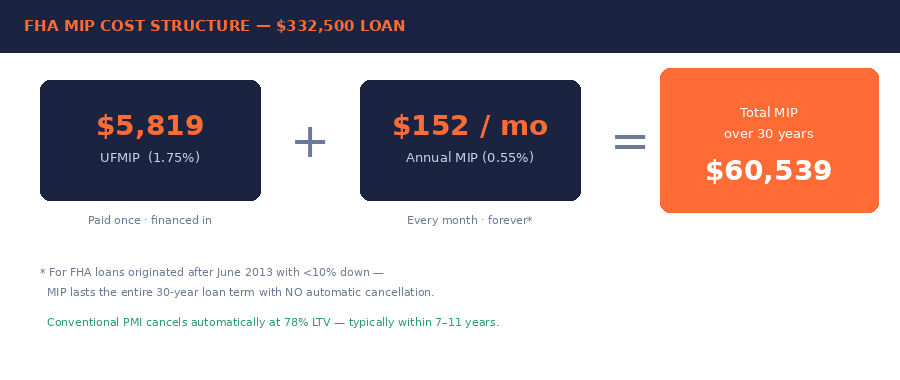
FHA mortgage insurance has two parts. First, the Upfront Mortgage Insurance Premium (UFMIP): a flat 1.75% of the loan amount, typically financed into the loan balance rather than paid at closing. On a $332,500 base loan, that’s $5,819 added to what you owe on day one.[1,2]
Second, the Annual MIP: currently 0.55% per year for a 30-year loan with less than 5% down, divided into monthly payments. On that same $332,500 loan, that’s $152 per month added to your payment — every month — indefinitely.
The Life-of-Loan Clause
Before June 2013, FHA MIP worked more like conventional PMI — it could be cancelled once you hit certain equity thresholds. Congress changed the rules. Now, for any FHA loan originating after June 3, 2013, with a down payment below 10%, the annual MIP lasts for the entire 30-year loan term. Full stop. [1]
If you put down exactly 10% or more, FHA MIP does cancel — but only after 11 years of on-time payments. Not at 20% equity. After 11 years, regardless of equity.[2]
How Conventional PMI Actually Works
Conventional PMI is far more flexible. Under the federal Homeowners Protection Act:[5]
- Automatic cancellation at 78% LTV based on the original amortization schedule (no action required)
- Requested cancellation at 80% LTV — you can contact your servicer once you’ve paid down enough or your home has appreciated
- Some lenders allow early cancellation with a new appraisal showing 80% LTV based on current market value
In a typical scenario, conventional PMI on a 5% down, 680-credit-score loan disappears in roughly 7–9 years through a combination of normal amortization and modest home appreciation. After that, your monthly payment drops by $200+. FHA borrowers keep paying that premium until year 360.
On a $350,000 home with 5% down: FHA annual MIP = $152/month. If you stay 30 years, that’s $54,720 in MIP payments alone (roughly, before the balance declines reduce it slightly), on top of the $5,819 UFMIP already financed in. Conventional PMI at the same down payment with a 680 score costs about $222/month — but disappears in year 7, totaling approximately $18,648 over the full loan term.
Section 3: The Side-by-Side Math — A Real Scenario
Your lender won’t run this comparison for you. Here it is.
Scenario: $350,000 home price · 5% down ($17,500) · 680 credit score · 30-year fixed. FHA rate: 6.0%. Conventional rate: 6.1% (typical spread for this credit profile).[7] Conventional PMI is assumed to cancel at month 84 (year 7) via a combination of paydown and modest 3%/year appreciation, allowing an 80% LTV request.
In months 1–84, FHA costs $56 less per month. After month 84, the PMI drops and the conventional payment falls to $2,015/month — now $166 cheaper per month than FHA. That’s the flip. Let’s see what it means across time horizons.
5-Year Cost Comparison
At five years, conventional already costs $2,459 less. Even with a higher monthly payment, no UFMIP, and a lower rate works in its favor. But this is a 680-credit scenario. At 620 credit, the PMI rate would be higher, and FHA would likely lead at year 5. Credit score is everything here.
10-Year Cost Comparison — The Crossover
By year 10, conventional leads by $7,091. The crossover actually occurs closer to years 8–9 in this scenario, as the PMI savings compound. From this point forward, conventional’s advantage only grows.
30-Year Cost Comparison — The Full Picture
Over the full 30-year life of the loan, the conventional borrower in this scenario pays approximately $46,931 less in total mortgage costs. That’s not a rounding error — that’s a car, a college semester, or a significant retirement contribution. Your lender will not volunteer this number. We will.
Section 4: When FHA Wins — and When Conventional Wins
The 680-credit, 5%-down scenario above is a swing case that favors conventional. But the honest answer is: it depends. Here’s where each product actually earns its place.
- Credit score is 580–660. Conventional rates are punishing below 680. PMI at those scores can hit 1.20–1.50%, making FHA’s 0.55% MIP genuinely cheaper — at least in the short term.[6]
- Down payment is under 5% and credit is below 680. Conventional PMI at low scores + high LTV can run $300+/month. FHA’s MIP is flat regardless of credit score.
- DTI exceeds 45%. FHA allows up to 50% debt-to-income with compensating factors. Conventional typically caps at 43–45%, and many lenders tighten further.[10]
- Short time horizon (<5 years). If you’re selling or refinancing before the FHA MIP trap fully manifests, the lower monthly cost can work in your favor.
- Credit score is 680+. PMI is cheaper than MIP, rate premiums are smaller, and — critically — PMI cancels. At 740+, the gap widens further.[6,9]
- Down payment is 10%+. At 10% down, conventional PMI is lower and drops even faster. At 20%, no PMI at all. FHA still requires 10% to even get the 11-year MIP cancellation window.
- Staying 7+ years. The PMI removal math overwhelmingly favors conventional for long-term homeowners. The longer you stay, the more $46K+ you leave on the table with FHA.
- Buying a fixer-upper or non-standard property. FHA’s strict appraisal requirements can torpedo deals on distressed properties. Conventional is more forgiving.
Read that chart carefully. At 620–659 credit, conventional PMI is nearly twice the cost of FHA MIP — and still removable, but it takes longer and costs more in the meantime. Below 680, FHA often wins on the monthly cost. Above 680, conventional PMI crosses below FHA MIP, and the removal advantage makes it a clear long-run winner.[6]
Section 5: The Refinance-Out Strategy
Here’s a move that experienced buyers use intentionally: start with FHA, then refinance to conventional.
The logic is sound. If your credit score is 620–650 today — not quite the sweet spot for conventional — an FHA loan gets you into the home. You make on-time payments, your credit score improves, your equity builds (partly through payments, partly through appreciation), and in two to four years you refinance into a conventional loan without PMI.
What to Factor Into the Refinance Math
The refinance-out strategy works, but it’s not free. You need to account for:
- Closing costs: A refinance typically runs 2–5% of the new loan amount. On a $325,000 loan, that’s $6,500–$16,250. You need your monthly savings from eliminating MIP to pay this back within a reasonable timeframe (the breakeven period).
- 20% equity requirement: To refinance without new PMI, you need roughly 20% equity — a combination of your down payment, principal paydown, and home appreciation. With 5% down and typical appreciation, this usually takes 3–5 years.
- Rate environment: If rates have risen significantly since your FHA origination, the refinance savings on MIP elimination may be offset by a higher base rate. Run the numbers before you commit.
You eliminate $152/month in MIP via refinance. Closing costs: $9,000. Breakeven: $9,000 ÷ $152 = 59 months (about 5 years). If you plan to stay longer than 5 more years, the refinance makes sense. If you might sell in 3 years, it may not pencil out.
The refinance-out strategy is a legitimate tool, but it requires discipline: maintain perfect payment history, monitor your credit score monthly, track your home’s value, and have a refinance date on your calendar. Don’t just assume it will happen — make it happen on purpose.
Section 6: Run Your Own Numbers
Everything above uses a specific scenario: 680 credit, 5% down, $350,000 home. Your numbers are different — and they’ll produce a different crossover point. The two biggest levers in your calculation are:
- Credit score: Every 20-point band shifts PMI costs significantly. At 740+, conventional PMI can drop to 0.20–0.30%, making it dramatically cheaper than FHA MIP from day one.[6]
- Down payment percentage: Going from 5% to 10% down on a conventional loan both reduces the PMI rate and accelerates removal. Going from 5% to 10% on an FHA loan gives you the 11-year MIP cancellation window — still worse than conventional, but better than the life-of-loan trap.
The only way to know your specific crossover point is to run your actual numbers. Use our calculators to do exactly what we did above — but with your credit score, your down payment, and your home price.
Plug in your real credit score, down payment, and home price. See your actual PMI vs. MIP costs side by side — and find your personal crossover point.
The Bottom Line
The FHA vs. conventional loan decision is not a simple “which has the lower payment” question. It’s a math problem with three key variables — credit score, down payment, and time horizon — and the answer flips depending on how those variables combine.
For most buyers with a 680+ credit score who plan to stay in the home more than seven years, conventional is almost certainly the better choice, even with a higher monthly payment in the early years. The PMI removal event is a game-changer that FHA can never match.
For buyers with credit scores in the 580–650 range, a high debt-to-income ratio, or a genuine short-term outlook, FHA earns its place as a legitimate entry point. Just go in clear-eyed: that MIP is not going anywhere on its own, and you need a proactive refinance strategy if your goal is long-term savings.
The mistake isn’t choosing FHA. The mistake is choosing FHA without understanding the life-of-loan MIP clause and building a plan around it. Now you know. Run the math, use the calculators above, and make the decision that actually serves your financial future — not just the one that closes easiest.
Sources
All financial figures and regulatory thresholds are sourced from primary government and industry sources. Cited inline throughout the article as [superscript numbers].
- [1] FHA MIP Life-of-Loan Rule: HUD Mortgagee Letter 2013-04 — Changes to FHA Mortgage Insurance Premiums, effective June 3, 2013. hud.gov
- [2] FHA MIP Rate Schedule: HUD Single Family Housing Policy Handbook (HUD 4000.1), current MIP rate tables. hud.gov/handbook-4000-1
- [3] 2026 FHA Loan Limits: HUD Mortgagee Letter (effective Jan 2026) — baseline $524,225, high-cost ceiling $1,209,750. hud.gov/program_offices/housing
- [4] 2026 Conforming Loan Limit: FHFA News Release — conforming loan limit $806,500 for 2026. fhfa.gov
- [5] PMI Cancellation Rights: Homeowners Protection Act of 1998 (12 U.S.C. §4901 et seq.) — automatic cancellation at 78% LTV; borrower-requested cancellation at 80% LTV. consumerfinance.gov
- [6] Conventional PMI Rate Benchmarks: Urban Institute Housing Finance Policy Center; MGIC, Radian, and Essent published PMI rate cards 2025–2026. urban.org
- [7] FHA vs. Conventional Interest Rate Spreads: Freddie Mac Primary Mortgage Market Survey (PMMS), weekly data Q1 2026; MBA rate data. freddiemac.com/pmms
- [8] FHA Credit Score Requirements: HUD 4000.1 §II.A.4 — 580 minimum for 3.5% down; 500 minimum for 10% down. hud.gov/handbook-4000-1
- [9] Conventional Loan Requirements: Fannie Mae Selling Guide B3-5.1 (credit score requirements); Freddie Mac Single-Family Seller/Servicer Guide. fanniemae.com
- [10] FHA DTI Limits: HUD 4000.1 §II.A.4.b — maximum 43% qualifying DTI; up to 50% with documented compensating factors. hud.gov/handbook-4000-1