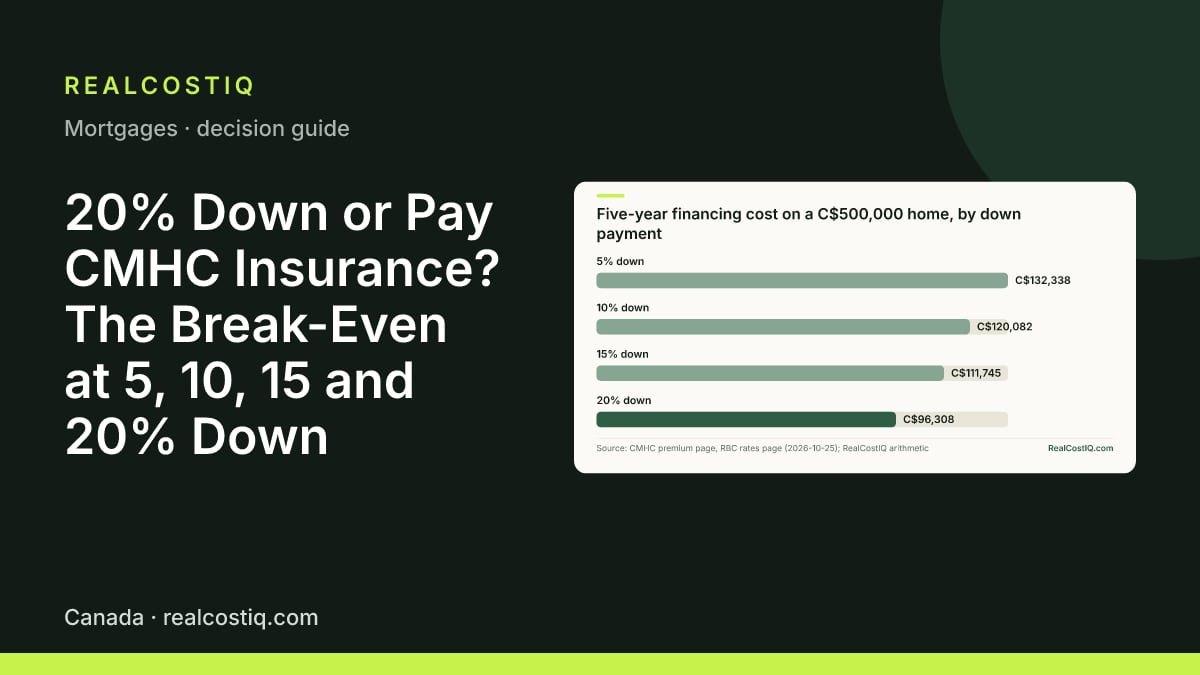
If you put down less than 20% of a home's price in Canada, the mortgage must be insured. The Canada Mortgage and Housing Corporation (CMHC) is one of the companies that sells this insurance. You pay a one-time premium. The insurance protects the lender, not you. So the question many buyers ask is simple. Is it better to wait until I have 20% down, or buy now and pay the premium?
This post answers that with numbers. It does not repeat CMHC's premium table or the price cap. The CMHC insurance calculator has those. Here we treat the premium as a cost and ask what the next C$25,000 of down payment earns. All amounts are in Canadian dollars (CAD). We read every source on 2026-10-25.
The example we use
Take a C$500,000 home in Ontario. We use that price because the minimum down payment is a clean 5% on a home up to C$500,000. Above that, CMHC's requirements page says the minimum is 5% of the first C$500,000 plus 10% of the rest. So the rule is simple at this price. The insured price limit is below C$1.5 million, according to the same page. FCAC, the federal consumer agency, says a home at C$1.5 million or more needs at least 20% down.
We compare four down payments: 5% (C$25,000), 10% (C$50,000), 15% (C$75,000) and 20% (C$100,000). We use a 25-year amortization and a five-year fixed term. The amortization is the number of years to repay the whole loan. The term is the length of one rate contract. Payments use Canadian semi-annual compounding, the way Canadian fixed mortgages are quoted.
CMHC's premium page (read 2026-10-25) gives the premium as a share of the loan, set by the loan-to-value ratio. That ratio is the loan divided by the home's value. For a standard purchase with a traditional down payment, the rates are 4.00% when you put down 5% to under 10%, 3.10% for 10% to under 15%, and 2.80% for 15% to under 20%. There is no premium at 20% or more. The page says provincial sales tax may apply, and that you can pay the premium in one lump sum or add it to the mortgage. We add it to the mortgage.
What each down payment costs in premium and tax
Start with 5% down. The loan before insurance is C$475,000. The premium is 4.00% of that, which is C$19,000. Added to the loan, the mortgage becomes C$494,000. That is the first surprise. You borrowed C$475,000 but you owe C$494,000, and you pay interest on the extra C$19,000.
The second surprise is the tax. Ontario charges retail sales tax at 8% on taxable insurance premiums, according to the province's guide. CMHC's premium page says some provinces, currently Ontario, Quebec and Saskatchewan, apply provincial sales tax to the mortgage loan insurance premium, and that the tax cannot be added to the loan amount. A mortgage guide from Nesto, dated 2025-07-10, gives the Ontario rate as 8% and says it is paid in cash at closing. The Ontario page itself does not name mortgage default insurance, so confirm the amount with your lender or lawyer. On a C$19,000 premium the tax is C$1,520.
| Down payment | Cash down | Loan before premium | CMHC premium | Ontario tax on premium (cash) | Mortgage after premium |
|---|---|---|---|---|---|
| 5% | C$25,000 | C$475,000 | C$19,000 (4.00%) | C$1,520 | C$494,000 |
| 10% | C$50,000 | C$450,000 | C$13,950 (3.10%) | C$1,116 | C$463,950 |
| 15% | C$75,000 | C$425,000 | C$11,900 (2.80%) | C$952 | C$436,900 |
| 20% | C$100,000 | C$400,000 | None | None | C$400,000 |
Premium rates from CMHC's premium page, traditional down payment, read 2026-10-25. Tax is 8% of the premium. Other closing costs are left out of every row.
Other provinces differ. The Nesto guide lists Saskatchewan at 6% and Quebec at 9% on default insurance premiums, as of 2025. On the 5%-down premium of C$19,000 that would be C$1,140 in Saskatchewan and C$1,710 in Quebec. CMHC's page names the same three provinces: Ontario, Quebec and Saskatchewan. The federal consumer agency's page names Manitoba instead of Saskatchewan, so we follow CMHC. The tax is paid in cash on top of the down payment.
The rate can differ for insured and uninsured mortgages
The premium is not the only price that changes. Lenders often quote a lower rate for an insured (high-ratio) mortgage than for an uninsured one. The insurance protects the lender if you default, so the lender takes less risk. This means putting 20% down can raise your rate even as it removes the premium.
RBC's rates page, read today, shows how big the gap can be. For a five-year fixed purchase mortgage, it lists a special rate of 5.140% for an amortization of 25 years or less. It lists 4.840% for a high-ratio mortgage, which means less than 20% down with default insurance. That is a 0.30-point gap. The page shows no date for the rates. The only date it shows is the end of a limited-time offer on 2026-10-31. TD's rates page also lists a separate five-year fixed high-ratio mortgage, for buyers with less than 20% down who get default insurance. The TD rate figures were blank on the page as served, so we do not use them. We use RBC as one example, not as the market.
We use 4.84% for the 5%, 10% and 15% down cases. We use 5.14% for the 20% down case. Your lender's gap may be bigger, smaller or zero. A 20%-down buyer may be able to shop around for a better rate, which would help the 20% case. We test that later by removing the gap.
What each option costs over a five-year term
Now the arithmetic. For each down payment we work out the monthly payment, the interest paid over five years and the balance still owed after five years. Then we add the premium and the tax. That total is what the financing cost you over the term.
| Down payment | Monthly payment | Interest paid in 5 years | Balance after 5 years | Premium and tax | Financing cost over 5 years |
|---|---|---|---|---|---|
| 5% | C$2,828 | C$111,818 | C$436,120 | C$20,520 | C$132,338 |
| 10% | C$2,656 | C$105,016 | C$409,591 | C$15,066 | C$120,082 |
| 15% | C$2,501 | C$98,893 | C$385,710 | C$12,852 | C$111,745 |
| 20% | C$2,358 | C$96,308 | C$354,804 | C$0 | C$96,308 |
RealCostIQ arithmetic on the rates above. Financing cost is interest paid plus the premium plus the tax on it. It does not include the down payment, which is equity you own.
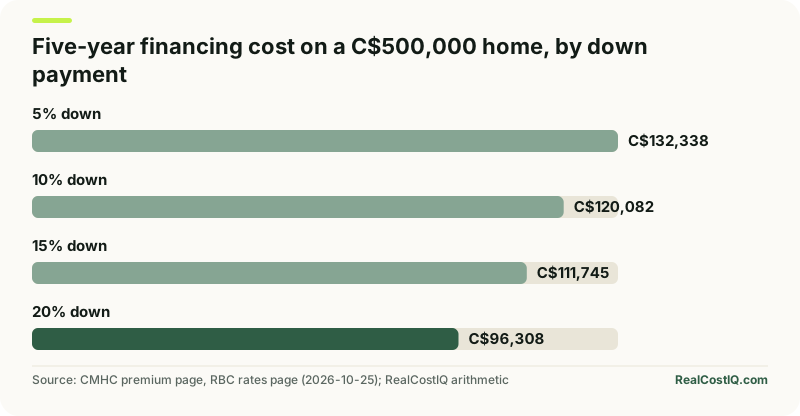
Read the last column. The cheapest option is 20% down, at C$96,308. The dearest is 5% down, at C$132,338. The gap between them is C$36,030 over five years. But that comparison is not fair on its own. The 20% buyer put in C$75,000 more cash. That cash could have earned something elsewhere. So the next step is the one that matters: what does each extra C$25,000 earn?
The break-even: what each extra C$25,000 earns
Think of the extra down payment as money you lend to yourself. What do you get back? You get three things. Your monthly payment is lower. Your balance after five years is lower. And the premium and tax are lower, which is built into both of those. To compare it with a savings account, we find the yearly rate that makes the money you put in equal to what you get back. Financial people call this an internal rate of return. Here we call it the return on the extra down payment.
Here is one step by hand, with round ideas. Moving from 5% to 10% down means you put in C$24,596 more in cash. That is C$25,000 more down, less C$404 saved in tax. In return, your payment falls by about C$172 a month. After five years you owe C$26,529 less. A yearly rate of about 10.1% makes those match. So the extra C$24,596 behaves like an investment paying about 10.1% a year.
| Step | Extra cash needed | Payment falls by | Balance after 5 years is lower by | Return per year |
|---|---|---|---|---|
| 5% to 10% down | C$24,596 | C$172 a month | C$26,529 | 10.1% |
| 10% to 15% down | C$24,836 | C$155 a month | C$23,881 | 7.1% |
| 15% to 20% down | C$24,048 | C$143 a month | C$30,906 | 12.0% |
| 5% to 20% down | C$73,480 | C$470 a month | C$81,316 | 9.8% |
RealCostIQ arithmetic, same example. Return is the yearly rate at which the extra cash, the lower payments and the lower balance after five years balance out, assuming the home is held for the full term.
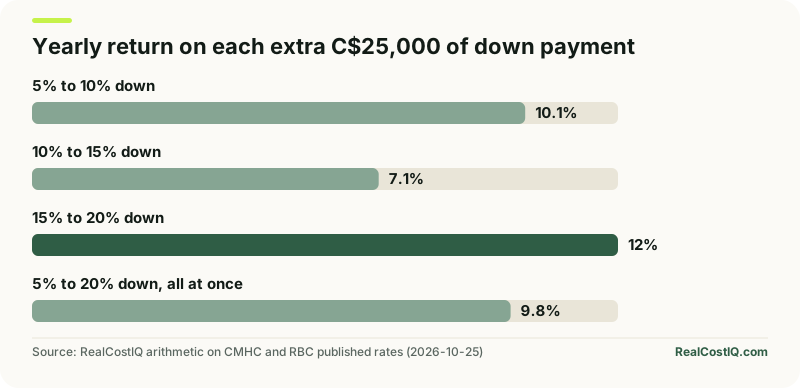
How to use this. Compare each return with what your cash would earn if you did not put it into the house. If you hold the cash in a high-interest savings account or a guaranteed investment certificate (GIC), look at its current yield and subtract tax if it is not in a registered account. If your safe yield is below the return in the table, the extra down payment is the better use of the cash on these numbers. The return is a saving on a known loan, so it does not depend on stock or bond markets.
There are two reasons not to take the number at face value. First, the return depends on the rate gap. Second, the return is a saving, not a cash gain. You get it back slowly, through lower payments, and in full only if you hold the mortgage for five years.
Why the middle step is the weakest
The step from 10% to 15% earns the least, at 7.1%. The reason is the premium schedule. Going from 5% to 10% down moves the premium rate from 4.00% to 3.10%, a drop of 0.90 points. Going from 10% to 15% moves it from 3.10% to 2.80%, a drop of only 0.30 points. The extra cash is almost the same each time, about C$25,000. But the premium saved is C$5,050 in the first step and C$2,050 in the second. The loan is also smaller each time, so the premium rate applies to fewer dollars.
The last step earns the most. Going from 15% to 20% down removes the entire premium of C$11,900 and the C$952 in tax. That more than makes up for the higher rate in our example. If you are at 14% or 15% and can reach 20% soon, this is the step to aim for. If you are at 5%, the first extra C$25,000 earns 10.1%, because it moves you out of the 4.00% tier.
Test the rate gap
The 12.0% return at the top step assumes a 0.30-point higher rate at 20% down. What if there is no gap? What if your lender charges 5.14% on every insured mortgage too? Or what if a 20%-down buyer gets the same 4.84%? The table shows the range.
| Step | RBC example: 4.84% insured, 5.14% at 20% down | No insured-rate discount: 5.14% on every option |
|---|---|---|
| 5% to 10% down | 10.1% | 10.4% |
| 10% to 15% down | 7.1% | 7.4% |
| 15% to 20% down | 12.0% | 16.8% |
| 5% to 20% down | 9.8% | 11.7% |
RealCostIQ arithmetic. In the right-hand column all four options carry the 5.14% rate, so removing the insurance does not change the rate.
The rate gap matters most at the top step. With a 0.30-point discount for insured mortgages, the 15%-to-20% step returns 12.0%. With no discount it returns 16.8%. So when you compare lenders, ask for both an insured and an uninsured quote at each down payment you are considering. Do not assume the gap. In both columns the weakest step still returns 7.1% or more.
Keep one more thing in mind. The Bank of Canada held its policy rate at 2.25% on 2026-09-02. Its next decision is on 2026-10-28. So the 4.84% and 5.14% above are a snapshot, not a forecast. The pattern between the steps will hold even if all the rates move together.
The other side: what waiting costs
A high return on the extra down payment does not mean you should wait until you have 20%. Waiting has its own cost. You keep paying rent. You do not build equity. And home prices may move while you save. Here is a way to put a number on it.
Suppose you can save C$1,500 a month. Each step needs about C$24,000 to C$25,000 more cash. That takes about 17 months. In that time you would not own the home. Compare that with the five-year saving from the step. The 15%-to-20% step saves C$15,437 in financing cost. Spread over 17 months, that is about C$908 a month. So waiting 17 months to reach 20% only pays if the monthly cost of waiting is below about C$908.
| Step | Cash to save | Time to save it | Five-year financing cost saved | Waiting pays only if it costs less than, per month |
|---|---|---|---|---|
| 5% to 10% down | C$24,596 | About 17 months | C$12,256 | About C$721 |
| 10% to 15% down | C$24,836 | About 17 months | C$8,337 | About C$490 |
| 15% to 20% down | C$24,048 | About 17 months | C$15,437 | About C$908 |
RealCostIQ arithmetic. The C$1,500 monthly saving is an assumption. Monthly figure is the five-year saving divided by 17 months, rounded.
What is the monthly cost of waiting? It is the rent you pay, minus what owning the home would have cost you each month in interest, property tax and upkeep. The part of your mortgage payment that repays principal is not a cost. It is savings you own. So if your rent is close to what owners pay in interest, tax and upkeep, the cost of waiting is small, and waiting for the next tier can pay. If rent is far above those costs, waiting is expensive.
This test leaves out price changes. If home prices in your area rise while you save, you may need a bigger down payment to reach 20%, and the target moves. If prices fall, waiting helps. We make no forecast. Use the down payment savings calculator to see how long it takes to save the gap at your own monthly amount, and the mortgage calculator to see the payment at your own price and rate.
What the test does not cover
- Closing costs. Land transfer tax, legal fees and moving costs are real cash outlays. We leave them out of every option equally. Add them to the cash you need.
- Your emergency fund. A high return does not help if putting more down leaves you with no cash for a roof repair or a job gap. Keep a cushion before you stretch the down payment.
- Qualifying. The lender must also approve you under the stress test, which checks your income against a higher qualifying rate. A bigger down payment makes qualifying easier. A smaller one may be all your income allows. This post does not test that.
- Selling or breaking the mortgage early. The return assumes you keep the mortgage for the full five-year term. A premium is a one-time cost. If you sell in year two, you have spent the premium on a shorter stay.
- Thirty-year amortization. CMHC's calculator page says insured mortgages can go to 30 years for first-time buyers and new builds. A June 2024 CMHC notice described a 20-basis-point premium surcharge for qualified first-time buyers who choose 30 years. We did not test that case. All examples use 25 years.
- Lenders who require insurance at 20%. FCAC says lenders may require insurance even with 20% down for some borrowers, such as the self-employed or those with poor credit. If that applies to you, check before you plan around 20%.
One more point on the premium itself. CMHC's premium schedule lists 4.00% for a loan of 90.01% to 95% of the home's value, and a higher 4.50% for the same band with a non-traditional down payment. CMHC's quick reference guide says a traditional down payment can come from savings, the sale of a property, or a non-repayable gift from a relative. A non-traditional one is arm's length and not tied to the purchase, such as an unsecured personal loan or line of credit. So a family gift counts as traditional and uses the 4.00% row, while money from an unsecured loan or line of credit would use 4.50%. This post uses 4.00% throughout. If any of your down payment is borrowed, ask your lender which premium applies. FCAC's page, which gives a range of 0.6% to 4.5%, is consistent with that.
A simple rule for your own case
- Get two quotes at each down payment you can reach. One insured, one uninsured if you are near 20%. Ask for the rate, the premium and the tax in dollars.
- Work out the extra cash for the next tier. If it is about C$25,000, the table above gives the return in your price range as a guide.
- Compare that return with your safe savings yield after tax. If the return is higher, more down is the better use of the cash.
- Price the wait. Divide the five-year financing cost you would save by the months it takes to save the gap. Compare it with your monthly rent minus owner costs.
- Keep your cushion. Never let the down payment drain your emergency fund.