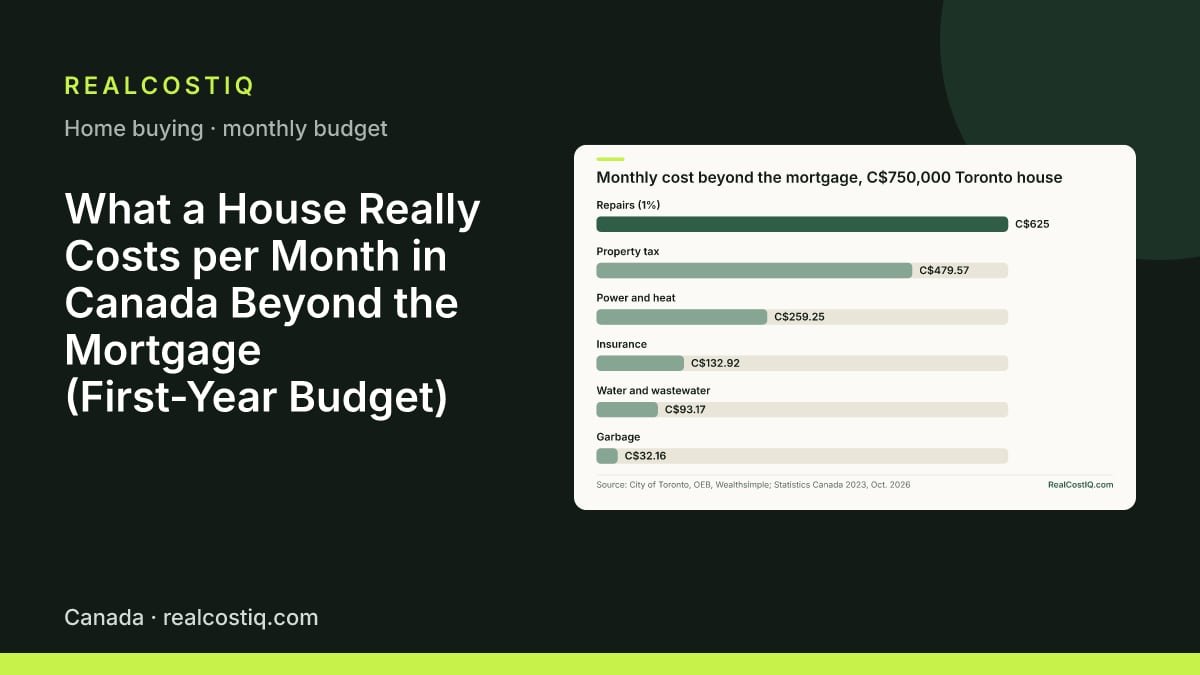
When people price a home, they look at the mortgage payment. The mortgage is the biggest line, but it is not the only one. Property tax arrives whether or not you have a mortgage. So do water, power, insurance and repairs. In the first year there are surprises on top of that. This post shows how to build the whole monthly picture, in Canadian dollars (CAD), before you sign.
We built one worked example for a Toronto house. We chose Toronto because the City publishes every rate we need. We read Statistics Canada, CMHC, the Financial Consumer Agency of Canada (FCAC), the City of Toronto, the Ontario Energy Board (OEB) and Wealthsimple. Where the City publishes no rate, we use Statistics Canada's 2023 averages for owner households and say so. Your city will differ.
In plain English
- The mortgage is not the whole bill. Property tax, water, waste, power, heat, insurance and repairs all come on top.
- A good starting point is real data. Statistics Canada says the average Canadian owner with no mortgage spent C$13,750 on shelter in 2023. That is about C$1,146 a month, and it is a national average.
- Repairs are the line people forget. A common rule is to set aside 1% to 2% of the home's price each year. On a C$750,000 home that is C$625 to C$1,250 a month.
- Lenders count only some of these costs. For the debt tests, they count principal and interest, property tax, heat and half of any condo fees. They do not count water, power, insurance or repairs.
- Get the seller's real bills. Ask for twelve months of tax, heat, power and water bills before you make an offer.
The national benchmark: what owners actually spend
Statistics Canada's Survey of Household Spending, 2023, gives a useful floor. Canadian homeowners spent an average of C$27,831 on shelter in 2023, up 17.4% from 2021. Owners with a mortgage spent C$38,718. Owners without a mortgage spent C$13,750, up 7.5%. Condo fees averaged C$1,118. Statistics Canada reports mortgage payments of C$21,342 a year, which it says is more than half of owners' shelter spending.
The article does not list every part of shelter spending, so we cannot say exactly what is in each average. The owner-with-no-mortgage figure is the closest thing to a national "beyond the mortgage" number, because there is no mortgage payment in it. C$13,750 a year divided by 12 is C$1,145.83, or about C$1,146 a month. That is an average across all homes, in all provinces, in 2023. It will be lower than a Toronto house in 2026, and we show why below.
A worked example: a C$750,000 Toronto house
Take a C$750,000 detached house in Toronto, Ontario. The buyer puts 10% down, which is C$75,000. CMHC's premium for 85.01% to 90% of the price is 3.10%, added to the loan. The loan is C$675,000 plus C$20,925, or C$695,925. At an example rate of 5.14% (RBC's special 5-year fixed rate, which we read on October 29, 2026), a 25-year amortization and semi-annual compounding, the payment is C$4,103.18 a month. That is the mortgage. Now the rest.
Property tax
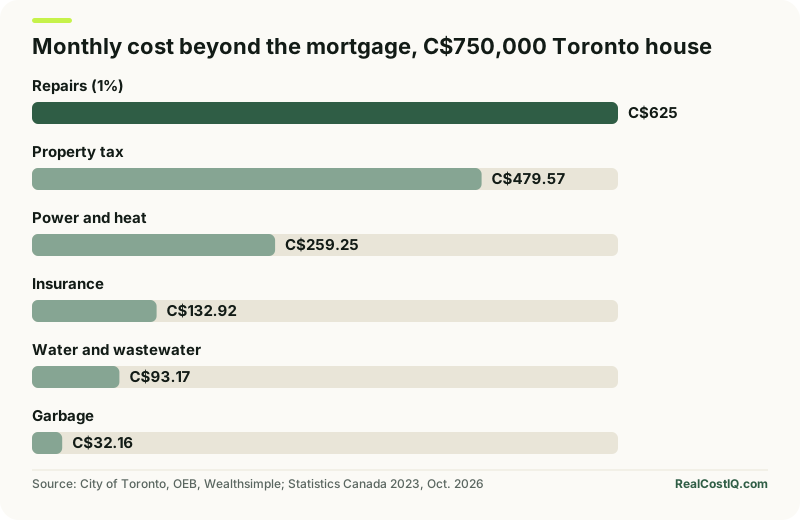
The City of Toronto's page (modified May 11, 2026) shows a 2026 residential rate of 0.767311%. That is 0.605295% city tax, 0.153000% education and 0.009016% for the City Building Fund. On C$750,000 it is C$5,754.83 a year, or C$479.57 a month. One caution. The rate applies to the property's assessed value, not the price you pay. In Ontario, MPAC says 2026 property taxes are still based on assessed values as of January 1, 2016, so a home's assessed value is often well below today's price. We use the price as a ceiling. The seller's tax bill shows the real figure. Our property tax calculator lets you test other cities.
Water and waste
Toronto's water rate has been C$4.8629 per cubic metre since January 1, 2026, if the bill is paid by the due date. The City says an average home using 230 cubic metres a year pays about C$1,118 a year, after a 3.75% increase. That is C$93.17 a month. Garbage fees are separate. The City's interim 2026 fee for a medium bin is C$385.86 a year, or C$32.16 a month. These are interim rates that the City said it would finalize in its budget. The water rate page still shows the same rate after the budget.
Electricity and heat
The OEB sets electricity prices once a year. From November 1, 2026, the tiered price is 11.2 cents per kilowatt hour up to 1,000 kWh a month in winter (600 in summer) and 13.2 cents above that. On a use of 800 kWh, the energy charge is about C$89.60 in winter and C$93.60 in summer. That is the energy price only. Delivery, regulatory charges and tax come on top, and we did not read them. Natural gas has the same split. The OEB lists Enbridge's gas supply price at 9.1080 cents per cubic metre from October 1, 2026, and delivery is extra.
Because we cannot price delivery charges, we anchor this line on Statistics Canada instead. Its Table 11-10-0225-01 shows owner households with a mortgage spent an average of C$1,911 on electricity, C$979 on natural gas and C$221 on other fuel in 2023. That is C$3,111 a year, or C$259.25 a month. These are national averages. A large older Toronto house can use more. Ask the seller for twelve months of actual bills.
Home insurance
Insurers price a house on what it would cost to rebuild, your claims history, the age of the wiring, plumbing and roof, and your location. We did not find an official Toronto average. We use Statistics Canada's national figure instead. Table 11-10-0225-01 shows owner households with a mortgage paid an average of C$1,595 a year in 2023 for homeowners' insurance, or C$132.92 a month. A C$750,000 Toronto house, and prices since 2023, may mean a higher premium. A broker's quote for the exact address is the number to use.
Repairs and upkeep
Wealthsimple, on a page we read on October 29, 2026, suggests budgeting 1% to 2% of the home's purchase price each year, aiming for the higher end on an older home. It gives C$7,500 to C$15,000 for a C$750,000 home. CMHC, in its guide for new homeowners, puts maintenance and repair costs at the top of the list of ongoing costs but gives no percentage. This is a rule of thumb, not a standard, and a new house may need less in its first year. An older house with a roof near the end of its life may need more.
Wealthsimple lists typical lifespans: 15 to 25 years or more for heating systems, 15 to 20 years for asphalt roofs and 10 to 20 years for insulated windows. Your home inspection report should show the age of each. Divide a big item's cost by its remaining life to get a yearly figure.
| Line | Monthly | Basis |
|---|---|---|
| Property tax | C$479.57 | City of Toronto 2026 rate 0.767311%, applied to the price as a ceiling |
| Water and wastewater | C$93.17 | City of Toronto: C$1,118 a year for 230 cubic metres |
| Garbage (medium bin) | C$32.16 | City of Toronto interim 2026 fee: C$385.86 a year |
| Power and heat | C$259.25 | Statistics Canada, owners with a mortgage, 2023: electricity C$1,911, natural gas C$979, other fuel C$221, per year |
| Home insurance | C$132.92 | Statistics Canada, owners with a mortgage, 2023: C$1,595 a year |
| Repairs and upkeep (1%) | C$625.00 | Wealthsimple rule of thumb: C$7,500 a year |
| Total beyond the mortgage | C$1,622.07 | Sum of the lines above |
With repairs at 2% (C$1,250 a month) the total is C$2,247.07. Sources are listed at the end. The power, heat and insurance lines are 2023 national averages, so replace them with real bills and quotes.
How the example compares with the national average
Our low case is C$1,622.07 a month, or about C$19,465 a year. The high case, with repairs at 2%, is C$2,247.07 a month, or about C$26,965 a year. The Statistics Canada average for an owner with no mortgage is about C$1,146 a month. Our example sits 42% to 96% above it. That is not an error. A C$750,000 Toronto house costs more to tax and repair than the average Canadian home, and our power, heat and insurance lines are the 2023 averages, so they are probably low for it.
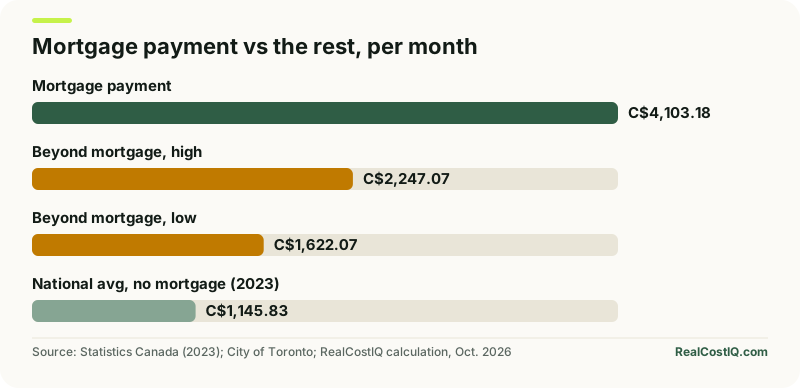
Put together, the low case is C$5,725.25 a month (C$4,103.18 plus C$1,622.07). The high case is C$6,350.25. That is the number to compare with your take-home pay, not the mortgage payment on its own. FCAC repeats CMHC's guide that housing costs should stay under about 39% of gross monthly income, and that total debts should stay under 44%. But CMHC's housing costs for that test are only principal and interest, property tax, heat and half of any condo fees. So you can pass the test and still be short once water, power, insurance and repairs arrive. The test is a floor on safety, not a full budget.
A condo changes the lines
If you buy a condo, the repair line shrinks and a new one appears: condo fees. Statistics Canada puts the average at C$1,118 a year for owners, though that average includes everyone, not only condo owners. Fees often cover building insurance, water, common-area repairs and a reserve fund. They do not cover your own contents insurance or, in some buildings, your power. Lenders count half of the condo fee in the housing-cost test, per CMHC. Our condo vs house calculator compares the two on cost.
The first-year extras
The first year has costs that do not repeat. We cover the big ones in our post on closing costs beyond land transfer tax, so here is only the summary. FCAC says to be ready to spend between 1.5% and 4% of the purchase price on one-time costs such as the home inspection, legal fees and title insurance. On C$750,000 that is C$11,250 to C$30,000. This is separate from the monthly list above. Land transfer tax is separate again.
- Move-in basics. Locks, smoke and carbon monoxide alarms, a first deep clean and any paint. These are small, but they come in the first week.
- Appliances and window coverings. Many homes are sold without them. Ask what the sale includes.
- Items found in the inspection. An inspection often finds small repairs you can do within a few months. Put a figure on each before you close.
- A repair fund from day one. The 1% to 2% rule applies in the first year too. If the roof or furnace is old, start at the high end.
- An emergency cushion. CMHC suggests saving five per cent of take-home pay in a separate account for unexpected repairs, illness or job loss.
- Insurance for your contents. Your home policy covers more than the house. Check the limits on belongings.
How to build your own list
- Property tax. Ask for the last tax bill. If the home was reassessed or the city changed its rate, ask your lawyer or realtor how the new owner's bill will compare.
- Utilities. Ask for twelve months of power, gas or oil, water and waste bills. Winter and summer differ a lot.
- Insurance. Get a real quote for the exact address. Ask what is excluded, such as sewer backup and overland flood.
- Repairs. Use your home inspection report. List the roof, furnace, windows, water heater and any other big item, with its age and a cost to replace.
- Condo fees. Ask for the status certificate. It shows the current fee, the reserve fund and any special assessments.
- Add the mortgage payment. Our first-time buyer total cost calculator adds the one-time cash you need at closing.
- Compare with take-home pay. Set a limit that leaves room for savings. Do not use gross income for this.
Mistakes to avoid
- Using the mortgage payment as your housing cost. In our example it is only about 72% of the total.
- Forgetting that property tax changes. Rates and assessments move. Budget a small rise each year.
- Skipping the repair fund because the home is new. Costs still arrive, and you start saving late.
- Trusting averages for your own house. National figures are useful for scale, but your bills are what count.
- Believing the lender's test is a budget. The 39% test leaves out water, power, insurance and repairs.
- Spending the emergency cushion on the down payment. Keep cash back for the first year.
What this post did not read
We used the price as a ceiling for property tax, because we did not find Toronto's assessed value for a typical house. We did not read the OEB's or Enbridge's delivery charges, so the power, heat and insurance lines use Statistics Canada's 2023 national averages for owner households with a mortgage (Table 11-10-0225-01, downloaded October 30, 2026). They are not Toronto figures. The Daily article does not break shelter spending into its parts. The repair rule of 1% to 2% comes from Wealthsimple, a financial services firm, and is not a government standard. We did not read a forum thread from the last 12 months because Reddit would not load. The house, the rate and the down payment are examples. This post is general information, not advice.