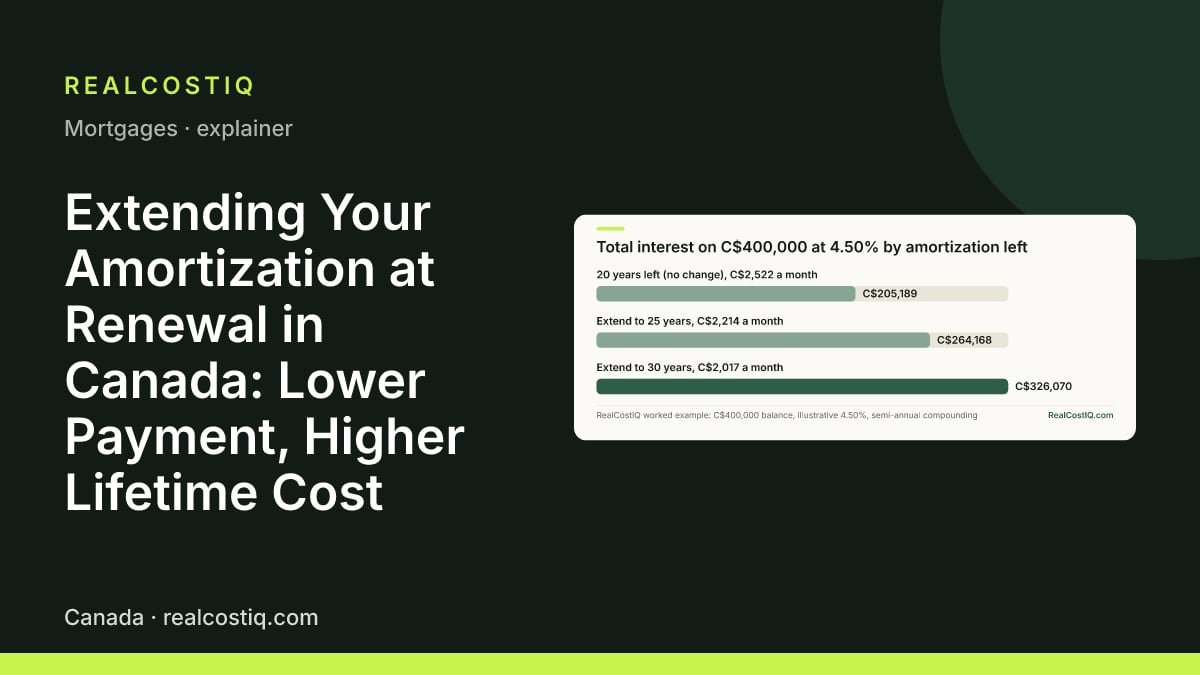
Here is the whole trade in one example. You owe C$400,000 and have 20 years left on your amortization. Your term is ending and the payment feels tight. You ask to stretch the amortization to 25 or 30 years. At an illustrative 4.50%, the payment falls by C$308 or C$505 a month. The total interest you pay rises by C$58,979 or C$120,881. This post shows where those numbers come from, who can say yes, and what to ask before you agree.
The worked example: C$400,000 with 20 years left
The inputs are simple on purpose. The balance is C$400,000. The rate is 4.50%, and it is illustrative: it is not a quote, and it is not a rate any lender offered us. We use it for every row so that only the amortization changes. The payment is monthly. The maths is the Canadian method: a fixed-rate mortgage compounds twice a year, not monthly, which is why a Canadian payment differs from a US payment at the same stated rate. The figures come from the same payment and interest functions that run the Canadian amortization calculator and the mortgage renewal tool, run at these inputs on 2026-10-18.
| Amortization left | Monthly payment | Relief vs 20 years | Total interest to pay it off | Extra interest vs 20 years |
|---|---|---|---|---|
| 20 years (no change) | C$2,522 | none | C$205,189 | none |
| 25 years | C$2,214 | C$308 a month | C$264,168 | C$58,979 |
| 30 years | C$2,017 | C$505 a month | C$326,070 | C$120,881 |
Computed with the site's Canadian mortgage engine (semi-annual compounding, equivalent monthly rate). The payment is rounded to the dollar; interest is the sum over the full schedule, and the balance is assumed to stay at C$400,000 with no fees added. Rate checked as an assumption on 2026-10-18.
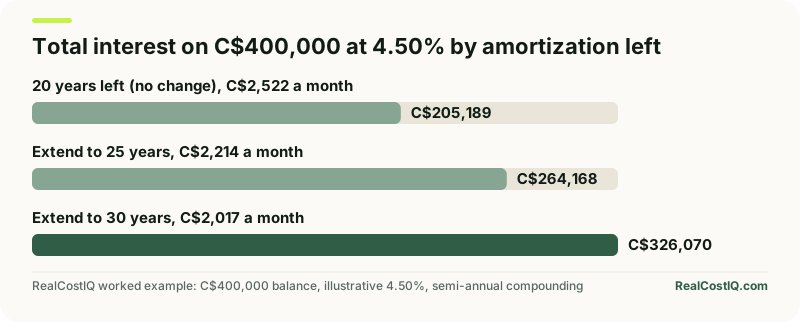
Read the table from the right. Going to 25 years buys C$308 a month of room and costs C$58,979 over the life of the loan. Going to 30 years buys C$505 a month and costs C$120,881. The Financial Consumer Agency of Canada (FCAC) warns about this in plain terms. Its renewal page says to think twice before extending your amortization to lower your payments, because the interest costs will be higher and the difference may add up to thousands or tens of thousands of dollars. On this balance it is tens of thousands.
Is the cost worth it? That depends on what the lower payment lets you do. If it keeps a household current on the mortgage during a hard stretch, it may be the right tool. If it frees money that then goes to spending, it is an expensive way to feel better. The rest of this post helps you tell the difference.
What you are really asking the lender for
Two words cause most of the confusion here. The FCAC defines the mortgage term as the time your mortgage contract is in effect. It defines the amortization period as the time it takes to pay your mortgage off. A five-year term inside a 25-year amortization is the common pattern in Canada. When the five years end, the contract ends. You then renew for a new term, and the amortization clock keeps counting down.
That is why renewal is the one moment when changing the amortization is a normal request. Nothing new is being bought. You are agreeing a new term on the balance you still owe, and the lender can set the payment on any schedule it is willing to offer. The balance in the example is C$400,000 with 20 years left. A request to extend says: set my new payment as if I had 25 or 30 years left.
The lender has to tell you about renewal in writing. The FCAC says the lender must send a renewal statement at least 21 days before the end of your term. The statement lists the remaining balance, the interest rate, the payment frequency, the term and any fees. It must also say that the offered rate will not increase before your renewal date. The same page says you do not have to renew with the same lender, and that you must renew at the end of each term unless you pay the balance in full.
Notice what the statement does not list. It does not list your amortization choices. The renewal paper you get in the mail is usually a rate and a term. A longer amortization is a request you make, not a box already ticked. Ask for the payment at your current schedule and at the longer one, in writing, so you can set the two side by side. Our mortgage renewal calculator longform already covers the stay-or-switch decision and the requalification checks. This post stays on the amortization question.
Who can say yes: uninsured and insured mortgages
The rules depend on how you bought the home. A mortgage with a down payment of less than 20% had to be insured, usually by the Canada Mortgage and Housing Corporation (CMHC) or a private insurer. A mortgage with 20% or more down is uninsured. The rule for how long you can amortize is different for each.
Uninsured mortgages: the lender sets the limit
For a down payment of 20% or more, the FCAC says the lender sets the maximum amortization. There is no federal number on this page for those loans. In practice, the answer is the policy of the lender in front of you. We did not find a published list of lender limits, so ask.
Insured mortgages: 25 years, or 30 in two cases
For a down payment below 20%, the federal rules cap the amortization at 25 years in general. Section 5(1)(c) of the Insurable Housing Loan Regulations (SOR/2012-282, current to 2026-09-30) says the loan must be scheduled to amortize over a period that does not exceed 25 years. Section 5(1.1) allows up to 30 years if any borrower is a first-time home buyer, or if the home is newly built. The FCAC's term and amortization page says the same thing in consumer language.
Here is the part to be careful about. Section 5 sets the limit for a loan being insured. It says nothing about renewals. The regulation does say, in section 3(3), that a change to a loan which needs an extra insurance premium is treated as a new loan approved on that day. We read that sentence as a warning: if extending your amortization on an insured mortgage needs a new premium, the 25 and 30 year limits can come back into play. We cannot tell you how a given insurer or lender treats your file. Ask which case you are in before you assume the answer.
There is one more fact for insured borrowers. CMHC's premium page says an amortization period beyond 25 years is subject to a 0.20% surcharge on the premium. That surcharge is part of the cost of a 30-year insured loan at the start. Whether it is charged again if you extend later is a question for your lender, and we did not find an answer on the page. The page itself is dated 2018 with a 2026 footer, so check the live figure.
The stress test question
The stress test is the federal rule that you must show you could pay a higher rate than the one you sign. For uninsured mortgages the Office of the Superintendent of Financial Institutions (OSFI) sets it. Its page, last modified 2026-01-29, says the qualifying rate is the greater of the mortgage contract rate plus 2%, or 5.25%. On our 4.50% example, that is 6.50%.
Does that test apply when you extend at renewal? The honest answer is that it depends on who you renew with and what you change. The same OSFI page says it does not expect lenders to apply the test to uninsured straight switches at renewal. A straight switch means moving to a new federally regulated lender with no increase in the loan or the amortization. The Department of Finance release on insured low-ratio mortgages uses the same idea. One condition for an insured straight switch is that the borrower has maintained the existing contractual amortization schedule. That measure took effect on 2024-12-16.
So an extension is, by the wording of both rules, not part of the exemption. If you move to a new lender and ask for a longer amortization at the same time, expect the test to apply. Our renewal engine models it that way. At 4.50% with a five-year extension and a C$110,000 household income, it applies the test at 6.50% and the borrower passes. At the same balance and rate, a household with much less income may not.
What about renewing with your current lender and extending? The OSFI page does not address it. Do not read that silence as a yes. It means the rule is not spelled out on that page, and the lender's own credit policy decides. Some borrowers will find the lender simply agrees. Others will be asked for income documents. Ask early, at least a couple of months before the term ends, so you have time to shop if the answer is no.
Switching lenders and extending at the same time
The cleanest renewal is a straight switch: same balance, same amortization, new lender, lower rate. Adding an extension to that move changes the file in three ways.
- The stress test can apply. As above, the exemption needs the same amortization schedule.
- A new insurance premium may come into play for insured mortgages. The FCAC's renewal page lists extending your amortization among the changes that may lead to a new mortgage loan insurance premium when you switch lenders. The page does not give a rate, so ask the new lender to price it in dollars.
- Switching costs add up. The FCAC lists set-up fees, appraisal fees and other administration fees, and says you can ask the new lender to pay some or all of them.
If your current lender will extend and your new lender will not, the extension may be worth more than a small rate gap. Put numbers on both. Our mortgage renewal calculator takes an extension in years and warns you when a payment gap comes from the longer schedule and not from the rate. Use it to avoid calling a stretch a saving.
The price of each dollar of relief
A useful way to judge an extension is to ask what each dollar of monthly relief costs in lifetime interest. At 4.50%, going to 25 years costs about C$192 of extra interest for every C$1 a month you save. Going to 30 years costs about C$239. The second step is more expensive per dollar because the extra years come at the end, when the balance is still large and the interest keeps piling up.
| Illustrative rate | To 25 years: monthly relief | To 25 years: extra interest | Per C$1 of relief | To 30 years: monthly relief | To 30 years: extra interest | Per C$1 of relief |
|---|---|---|---|---|---|---|
| 3.99% | C$313 | C$50,994 | C$163 | C$515 | C$104,352 | C$203 |
| 4.50% | C$308 | C$58,979 | C$192 | C$505 | C$120,881 | C$239 |
| 5.00% | C$302 | C$67,086 | C$222 | C$494 | C$137,675 | C$279 |
Same engine and inputs as the first table, run at three illustrative rates on 2026-10-18. These are assumptions, not quotes. A higher rate does not make the relief bigger; it makes the interest bill bigger.
Two things stand out. First, a higher rate barely changes the monthly relief, from about C$313 down to C$302 for the 25-year case. But it raises the extra interest a lot, from C$50,994 to C$67,086. The lower payment is cheap when rates are low and dear when they are high. Second, the price per dollar rises with every year you add. If you do need relief, a smaller extension is a better deal per dollar than a bigger one.
For context on rates today, the Bank of Canada held its target for the overnight rate at 2.25% on 2026-09-02, and its next announcement is on 2026-10-28. The overnight rate is not your mortgage rate. Your renewal rate comes from your lender, and it moves with bond yields and competition as well as with the policy rate. We use illustrative rates so the maths stays clear and does not pretend to forecast the next decision.
The balance you carry into the next renewal
There is a second cost that does not show in the interest total. A longer amortization pays down the balance more slowly. When your next term ends, you owe more than you would have. That matters because the next renewal is another moment when rates may have moved, and a larger balance is more exposed to them.
| Amortization left | Interest paid in five years | Balance after five years | More owed than with 20 years |
|---|---|---|---|
| 20 years | C$81,842 | C$330,545 | none |
| 25 years | C$84,019 | C$351,186 | C$20,641 |
| 30 years | C$85,413 | C$364,401 | C$33,856 |
Computed with the site's Canadian mortgage engine over the first 60 payments. The five-year view shows that most of the extra cost builds up later: the interest gap in the first five years is small, but the balance gap is not.
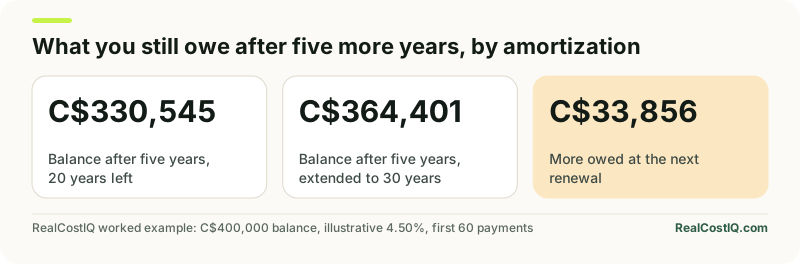
Look at the interest column. In the first five years, the 30-year path pays only C$3,571 more interest than the 20-year path. That is why an extension feels cheap on the day you sign. The cost sits in the balance. After five years you owe C$33,856 more, and that is debt you still pay interest on for the next 25 years.
Think about what you give up as well. A smaller share of each payment goes to principal. That slows the growth of your equity, the part of the home you own. Equity is what lets you refinance, borrow against the home, or sell with a larger cheque at the end. It is also what keeps you under the 80% line that decides whether you can borrow more against the house later. A longer amortization moves that line further away.
Keeping the relief optional
The best use of an extension is as insurance, not as a new normal. You take the longer schedule so the required payment is lower. You then pay more than the required amount whenever you can. That way the lower number protects you in a bad month and you still pay the loan down faster.
Here is what that looks like at our inputs. Say you extend to 30 years and set your payment halfway between the 30-year and 20-year payments, at C$2,269. You pay off the mortgage in 287 months, just under 24 years, and total interest is C$251,030. That is C$75,040 less than staying on the full 30-year schedule. You keep the safety net of the lower required payment, but you give back about half of the relief.
| Path | Monthly payment | Time to pay off | Total interest |
|---|---|---|---|
| Keep 20 years | C$2,522 | 20 years | C$205,189 |
| Extend to 30 years, pay the minimum | C$2,017 | 30 years | C$326,070 |
| Extend to 30 years, pay C$2,269 | C$2,269 | 23 years 11 months | C$251,030 |
| Extend to 25 years, pay C$2,368 | C$2,368 | 22 years 3 months | C$230,771 |
Computed with the site's Canadian mortgage engine at a fixed 4.50% for the whole period. In real life the rate resets at each renewal, so these show the shape of the trade, not a forecast.
There is a catch. Paying extra is only possible within your prepayment privileges. Closed mortgages usually limit how much you can pay on top of the regular payment in a year, and contracts differ on how much you can raise the payment. Our post on comparing Canadian mortgage offers beyond the rate covers those limits and why they matter more than a small rate gap. Check them before you rely on the plan above.
Another option is to extend now and shorten later. The CMHC default tool page says a borrower can shorten the amortization at renewal when their situation improves. Suppose you take the 30-year schedule for one term, then re-set to 20 years left at the same 4.50% at the next renewal. Five years at C$2,017 leaves a balance of C$364,401. Re-setting that balance to 20 years gives a payment of C$2,297 and total interest over the whole path of C$272,341. That is C$67,152 more than never extending, and C$53,729 less than staying on 30 years. A breather has a price, and the price depends on how long you stay in it.
Hardship extensions are a different tool
Everything above treats an extension as a choice made at renewal, with a lender that is in no rush. There is a separate case for borrowers in trouble. CMHC's Default Management Tool Selector, for insured loans, lists an extension of amortization as a workout option. It says the approved lender can approve extended amortization periods up to the lesser of 40 years from the original interest adjustment date or the remaining economic life of the property. It adds that this is subject to a documented and substantiated workout analysis.
That is a safety valve, not a product to shop for. It is built for a borrower who needs to lower payments over the longer term and who has a reason the lender can document. The same page says the borrower can shorten the amortization when the situation improves, either at renewal or by using prepayment privileges. If you are missing payments or about to, call the lender before the term ends. Do not wait for the renewal letter. The page is dated 2018, so ask the lender how the program works today.
If your mortgage has a variable rate with a fixed payment, there is a related risk. When the rate rises, the payment may no longer cover the interest, and the amortization grows by itself without you asking. We cover that in our post on the trigger rate. It is a reason to check your contract before you rely on any payment number, long or short.
Other ways to lower the payment
An extension is one lever. Before you pull it, check the others. They all cost something too, but the cost is not always the same.
- Shop the renewal. A lower rate cuts the payment without adding years. The FCAC says to start a few months before the term ends. A straight switch to a new lender is not stress tested for uninsured mortgages, per the OSFI page above. Use the mortgage renewal calculator for the stay-or-switch comparison.
- Make a lump-sum payment at renewal. Ask whether your lender lets you pay down the balance at the renewal date without a penalty. Even a small payment lowers the balance the new payment is built on.
- Choose a different term. Rates can differ by term, so ask for quotes at several terms. A term does not change the amortization, but it changes how soon you face the next reset.
- Ask for the longer schedule but pay the old amount. This is the path in the table above. It works only if the lender's prepayment rules allow it.
- Do not break a term early just to extend. If your term has not ended, leaving it costs a penalty. Price it with the mortgage penalty calculator first. The FCAC says that if you break a closed mortgage you normally pay a prepayment penalty.
A final note on the 30-year rule for insured buyers. The 30-year limit for first-time buyers and buyers of new builds, in section 5(1.1) above, is written for a loan being insured. It is a rule for people buying. Do not assume a renewing borrower can claim it after the fact. Ask the lender.
Questions to ask before you say yes
- Is my mortgage insured or uninsured? If insured, who is the insurer?
- What is the longest amortization you will offer me at renewal, and what is the payment at 25 years and at 30?
- Does extending trigger a new insurance premium or a surcharge? If so, what is the dollar cost, and is it added to my balance?
- Do you have to run an income check or a stress test if I extend with you? What documents do you need?
- Can I keep paying my old payment amount, and how much extra can I pay each year before a penalty?
- Can I shorten the amortization again at the next renewal without a fee?
- If I switch lenders, what are the full costs: appraisal, legal, discharge and assignment fees? Will the new lender pay them?
- Please put the rate, the term, the amortization, the payment and the fees in the written renewal offer.
Ask for the answers in writing, and ask early. The FCAC says your lender must send the renewal statement at least 21 days before the term ends. That is the minimum, not a target. Start the conversation two to four months out, so that a no from your lender is still a problem you have time to solve.
What this post did not read
We read the FCAC renewal and term pages, the OSFI qualifying rate page, the Department of Finance release on straight switches, the Insurable Housing Loan Regulations, CMHC's premium page and its default management page, and the Bank of Canada's rate page, all on 2026-10-18. Where a page did not answer a question, we said so above and did not fill the gap.
We did not read any lender's credit policy. Whether your own lender allows an extension at renewal, how it prices it and what it asks for are facts only that lender can give you. We did not read private mortgage insurers' rules. The rates in the tables are illustrative assumptions, so your payment and interest will differ. Provincial rules on mortgage fees and notaries or lawyers vary, and we did not read them here, so we gave no provincial fee figures. This is general information and not advice on your mortgage.