An assignment sale is a resale of the contract, not of the building. The original buyer is called the assignor. The assignor has signed an agreement of purchase and sale with a builder for a house or condominium unit that is not finished yet. Before the builder hands over title (legal ownership), the assignor sells that agreement to someone else. That person is the assignee. The assignee steps into the agreement and later closes the deal with the builder. Until 7 May 2022, the tax on that sale depended on why the assignor had signed the agreement. Since that date, the question is gone. The Canada Revenue Agency (CRA) says all assignment sales of newly constructed or substantially renovated residential housing are taxable for GST/HST purposes. This includes a sale by an individual.
This post covers the tax and fee steps that sit between the assignor's price and the assignee's closing statement. It focuses on Ontario, where HST is 13% (5% federal plus 8% provincial). It does not cover how an assignor's profit is taxed. That is income tax, which this site does not cover. The deposit schedule and the interim occupancy fee (what you pay the builder to live in the unit before closing) are already modelled in the pre-construction deposit calculator, so they are not repeated here. All dollar figures are Canadian dollars (CAD). The worked HST examples are our own arithmetic at named inputs. Every legal statement below comes from a federal or Ontario government page read on 2026-10-10. The source list shows the date on each page. This is information, not legal or tax advice. An assignment is signed with a real estate lawyer, not off a web page.
The rule at a glance
| Question | What the page says | Where it was read |
|---|---|---|
| Is an assignment taxable? | Yes. Since 7 May 2022, all assignment sales of newly constructed or substantially renovated single unit residential complexes and residential condominium units are taxable for GST/HST, including those by individuals. | CRA RC4052 ("What's new"); CRA Notice 323 (individuals); Excise Tax Act, s. 192.1 (consolidation current to 21 September 2026) |
| What is the taxable amount? | The consideration for the assignment, less any part the assignment agreement states in writing reimburses a deposit paid under the original agreement. With no written statement the reduction is zero. | Excise Tax Act, s. 192.1 |
| Who collects and remits the tax? | Notice 323 says assignors generally remain responsible for collecting and remitting. If the assignor is a non-resident, the assignee self-assesses. | CRA Notice 323 (dated May 2022) |
| What does the assignee still owe the builder? | GST/HST on the house or unit itself, paid to the original builder. The assignee generally pays tax to the builder for the house and to the assignor for the interest acquired. | CRA GI-120 (page last updated 7 July 2022) |
| How many new housing rebate applications? | One per house. The assignment price is added to the purchase price where tax was paid on the assignment. | CRA GI-120; CRA RC4028 (page details 13 March 2026) |
| Land transfer tax base on the assignee? | The assignment consideration, the price in the assigned agreement and the value of extras and upgrades. HST is not part of the base. | Ontario Ministry of Finance (page updated 8 July 2025) |
The rows restate the pages; they are not a substitute for the assignment agreement or for your lawyer's reading of it.
What changed on 7 May 2022
The older guidance is still on canada.ca. It is the best place to see how the tax used to work. GST/HST Info Sheet GI-120 is dated July 2011, and its web page was last updated on 7 July 2022. It explains that a sale of an interest in a new house is generally taxable when the seller is a builder. Whether an individual counted as a builder turned on why they acquired the interest. An individual who signed to live in the home and then sold the agreement could be outside the tax. An individual who signed to resell could be inside it. That was a question about intent, decided after the fact. It left buyers and sellers guessing whether tax belonged on the assignment price.
Budget 2022 was tabled on 7 April 2022. It proposed a new section 192.1 of the Excise Tax Act to end that guessing. CRA Notice 323 is dated May 2022 and describes the proposal. Assignment sales of new single unit residential complexes (such as a house) and residential condominium units would become taxable. That includes sales by individuals that might have been exempt under the old rules. The notice warns that its commentary does not confirm the proposal will become law in its current form. That warning has been overtaken. Section 192.1 is now in the consolidated Act, added by 2022, c. 10, s. 52. CRA's own current guidance (RC4052 and the GI-120 web page) states the rule as in force from 7 May 2022.
One date detail deserves a mention, because the wording inside Notice 323 differs. Its proposed provision applies where the assignment "is made after May 6, 2022". Its overview and its questions and answers refer to assignment agreements "entered into" after May 6, or on or after May 7, 2022. Both point to the same day. One turns on when the supply (the sale itself) is made. The other turns on when the assignment agreement is signed. Your contract is unlikely to sit near the cut-off by 2026. If it does, ask your lawyer which date governs. For anything signed today, the point is moot.
The taxable amount and the deposit exception
Section 192.1 treats an assignment by anyone other than the builder as a taxable supply of the assignor's interest in the property. This applies where the original sale was a taxable supply made in Canada of a single unit residential complex or a residential condominium unit. The tax is charged on the consideration for the assignment. Consideration is simply the price paid. The Act then cuts that consideration by one specific amount, and only one. The cut applies if, and only if, the assignment agreement states in writing that part of the consideration reimburses (pays back) a deposit paid under the original agreement. The cut is the part attributable solely to that reimbursement. If the agreement is silent, the reduction is nil.
That makes the deposit line in the assignment agreement a tax term, not a courtesy. In a typical Ontario pre-construction deal, the assignor has already paid the builder a stack of deposit instalments. The assignee pays the assignor back for those instalments as part of the price. That money is the assignor's own money coming back. The rule recognises this by leaving the repaid portion out of the taxable base, provided the document says so. Notice 323 states the same condition. The exclusion applies when the assignment agreement identifies the reimbursement in writing. Otherwise no exclusion applies.
| Scenario (CAD) | Total paid by assignee to assignor | Deposit reimbursement stated in the assignment agreement | Taxable amount | HST at 13% |
|---|---|---|---|---|
| A. Reimbursement stated, with a C$40,000 premium | C$100,000 | C$60,000 | C$40,000 | C$5,200 |
| B. Same price, nothing stated | C$100,000 | None | C$100,000 | C$13,000 |
| C. Sold at cost, reimbursement stated | C$60,000 | C$60,000 | C$0 | C$0 |
| D. Sold at cost, nothing stated | C$60,000 | None | C$60,000 | C$7,800 |
Inputs are hypothetical: a C$600,000 builder price on which the assignor has paid C$60,000 in deposits. HST is the 13% Ontario rate applied to the taxable amount from section 192.1 of the Excise Tax Act. Whether the quoted price is before or after HST is a contract term, and these figures treat the price as before tax.
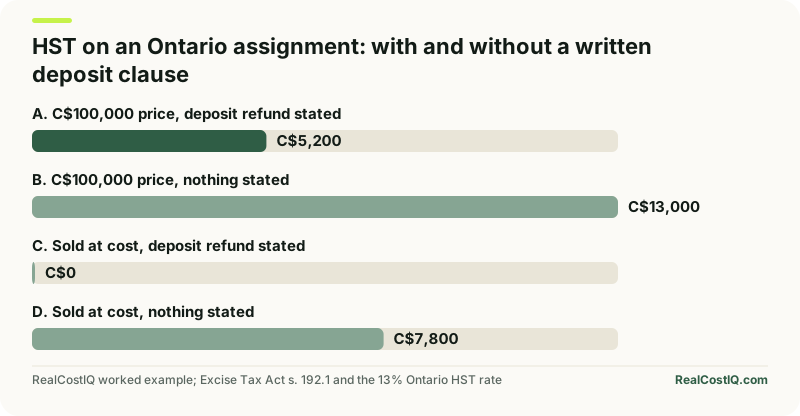
Scenarios A and B show the whole point. The assignor and assignee agree on the same C$100,000. The assignee in B pays C$7,800 more tax than in A, for the lack of one sentence. Scenarios C and D show that selling at cost is not tax-free by default. In D the whole C$60,000 is taxable because the document never labelled it. In every row, the tax is a cost to one side or the other. The parties settle who bears it. Ask early whether the price you are quoted is before or after HST. On a fully taxable C$100,000 consideration, a before-tax price means paying C$113,000 in total. An HST-included price means paying C$100,000, of which about C$11,504 is tax.
What the assignee pays, and to whom
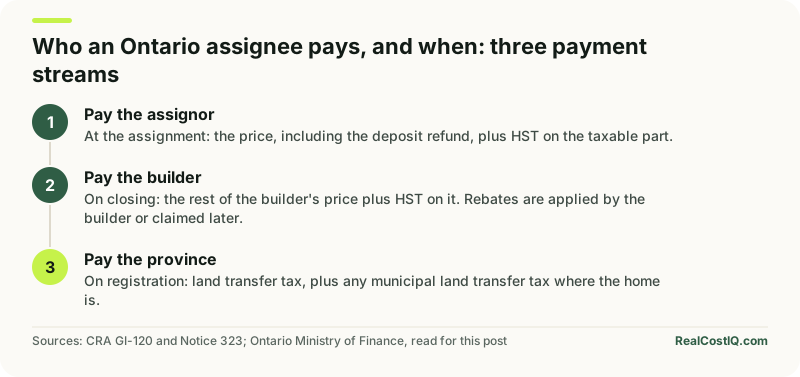
The assignee has up to three payment streams. The mistake most readers make is to look at only one. Under GI-120, the assignee generally pays GST/HST to the original builder for the house itself. The assignee also pays GST/HST to the assignor for the interest acquired. The first is the building's tax at closing. The second is the new tax on the assignment. The rebates on the building, covered below, are not the same thing as the tax on the assignment price.
- To the assignor, at the time of the assignment: the assignment price, including the deposit reimbursement, plus HST on the taxable part of it.
- To the builder, on closing: the rest of the builder's price under the original agreement, plus HST on the builder's price. Eligible rebates are applied by the builder or claimed afterwards.
- To the province, on registration: land transfer tax, plus any municipal land transfer tax where the home is. It is charged on a base set out in the next section.
Put another way, the assignment does not replace the builder's HST. It adds a second layer of HST on the amount paid to the assignor. In scenario A of the table, the assignee pays C$100,000 on a C$600,000 builder price and faces tax on both. There is C$5,200 on the assignment, and the builder's HST on C$600,000. We do not work out that second figure here, because it depends on rebate eligibility, which varies by buyer. Enter your own inputs in the GST/HST new home rebate calculator to see what you can get back at your price and eligibility.
What the assignee can claim back
CRA's rebate guide, RC4028, treats the assignment as part of the purchase. Its page details show 13 March 2026. For a house bought from a builder, the purchase price before tax plus any taxable assignment amount must be below C$450,000 for the federal GST/HST new housing rebate. That rebate is 36% of the 5% federal tax, up to a maximum of C$6,300. It is reduced on prices above C$350,000 and is nil at C$450,000 or more. For Ontario's enhanced new housing rebate, the page applies a C$1,850,000 limit on the purchase price plus any taxable assignment price. On the rebate application, the assignment price goes on the purchase-price line wherever tax was paid on the assignment.
Three details from the guide matter for an assignee. First, there is one rebate application per house. An assignee cannot file once through the builder for the tax paid to the builder and again for the tax paid to the assignor. GI-120 adds that the assignee may apply directly to CRA to claim tax paid to both parties. Second, only the builder who sells the house can pay or credit a rebate. The assignor cannot pay or credit any part of it. To recover tax paid to the assignor as well as to the builder, GI-120 says the assignee may file directly with CRA. Third, the guide describes a federal first-time home buyers' GST/HST rebate for homes valued under C$1.5 million. The amount is reduced from C$1 million, and there is no rebate at C$1.5 million or more. Whether you qualify depends on eligibility rules beyond price. Run your situation through the calculator rather than relying on this summary.
The practical effect is about timing and paperwork. You pay the tax on the assignment up front to the assignor. Rebates arrive through the builder at closing, or through a CRA application afterwards. Budget the cash for the tax first and the recovery second. The pre-construction deposit calculator shows the cash calls on the builder side, so you can lay the two schedules side by side.
Ontario land transfer tax on an assignment
The Ontario Ministry of Finance has a page on finding the value of the consideration for transfers of new homes. It was updated 8 July 2025 and deals with assignments directly. Say purchaser B assigns an interest to C. The page says the true value of the consideration on the transfer to C includes three things. These are the consideration for the assignment, the purchase price in the assigned agreement, and the value of extras, upgrades and installations. The page lists other items that can be part of the base, such as development charges and lot levies. HST is not included in determining the value of the consideration. Where HST is paid in full and the rebates are assigned to the vendor (the seller), the rebate amounts form part of the consideration. Where the HST sent in is already reduced by the rebates, they do not.
There are two things the page does not settle, so this post does not assert them. First, it does not say how a reimbursed deposit should be treated when the purchase price in the assigned agreement already includes that deposit. Ask your lawyer how the Ministry expects the base to be worked out in your deal. Second, the rate brackets sit on a separate Ministry page that was not read for this post. No Land Transfer Tax Act text or rate table was read on 2026-10-10, so no rate or first-time buyer refund figure is stated here. Municipal land transfer tax, where one applies, was not read either. Use the land transfer tax calculator for the rates and the refund, with the base from your lawyer.
Builder consent and assignment fees
Nearly every builder's agreement limits assignment. Many require consent and charge an administration fee. No Ontario government page read for this post publishes a figure for that fee. None of the pages read shows a regulator setting one. A number in a forum post or a broker's blog is not a primary source, so none is given here. The fee, any cap on the number of assignments, and a ban on advertising the unit for assignment are all terms of your own agreement of purchase and sale. So is whether the consent can be withheld. Read the assignment clause before you pay a deposit. That clause decides whether the assignment option exists at all.
Budget the fee as a cost to the assignor or the assignee, by agreement. Say the assignee pays a fee to the builder on top of the price. Ask whether it is taxable and what it is called in the assignment agreement. The HST rule above is about the consideration for the assignment paid to the assignor. The CRA pages read for this post do not say how a separate fee paid to the builder is treated. That is a question for your lawyer or accountant. An Ontario closing-cost estimate can carry the fee as a line once you have the number from your contract.
Deposit protection when the agreement is assigned
Tarion's pre-possession coverage page sets out the deposit protection on new homes in Ontario. Tarion is the body that runs Ontario's new home warranty program. For freehold homes (where you own the home and the land) under agreements signed on or after 1 January 2018, deposits are protected up to C$60,000 where the price is C$600,000 or less. Where the price is above C$600,000, they are protected up to 10% of the price, capped at C$100,000. Agreements signed before that date are capped at C$40,000. For condominium units, the deposit must be held in trust under the Condominium Act. Tarion provides protection of up to C$20,000 if the builder does not return a deposit after terminating the agreement. The page also describes a planned change for freehold buyers. They would need to register within 45 days of signing to receive the maximum coverage. The page says the change is deferred to 1 January 2027.
The page does not mention assignments. It does not say whether protection follows the agreement to the assignee. It does not say whether the assignee must register anything. It does not say what happens to the registration timing when the agreement changes hands. Put those questions in writing to your lawyer and, if needed, to Tarion before you pay the assignor. Deposit reimbursement matters here too. The money you pay the assignor to repay their deposits is not the same as a deposit you pay the builder. Nothing on the page read says whether it counts toward coverage.
Agreements assigned before 7 May 2022
A small number of readers will hold or inherit agreements assigned before the cut-off, which may still be closing. GI-120 shows the old rule through an example. Where an assignment sale was taxable under the old rules, the tax applied to the whole amount paid for the interest. That included any deposit the assignor had paid to the builder. In its example, a C$10,000 deposit resold for C$15,000 is taxed on the full C$15,000. The written-reimbursement exception is a feature of the new section 192.1, not of the old rules. Do not assume an older assignment can use it. Whether an older assignment was taxable at all depended on the assignor's purpose.
A negotiation checklist for both sides
- Assignor: confirm the builder's consent and fee in writing before listing. Confirm your own HST duties on the sale with an accountant. Notice 323 says assignors generally remain responsible for collecting and remitting the tax.
- Assignee: ask for the builder's most recent statement of deposits paid, the agreement and every amendment, and the Tarion warranty documents that belong to the unit.
- Both: put the deposit reimbursement in its own clause with a dollar figure, separate from the premium, so section 192.1 can apply.
- Both: state whether the price is before or after HST, and who collects it.
- Assignee: treat the rebate claim as money back later. It does not reduce what you must fund when you pay the assignor.
- Assignee: ask your lawyer for the land transfer tax base in writing, including how a reimbursed deposit is treated.
What this post does not cover
Profit on an assignment is taxed as income or as a capital gain, depending on the facts. That is income tax, which this site does not cover. Financing is not covered either. Each lender has its own approach to an assignment. That includes whether it will advance money on an assignment before the builder closes. The closing mortgage is qualified under the rules in force when you close, not today's. The Canadian mortgage mechanics (term, amortization, the stress test at closing) are covered in our mortgage stress test post and are not restated here. Term is the length of your mortgage contract. Amortization is the number of years it would take to pay the loan off. The stress test checks that you could still pay at a higher rate. Quebec, British Columbia and the other provinces have their own new-home and tax rules. They were not read for this post. This is an Ontario post.