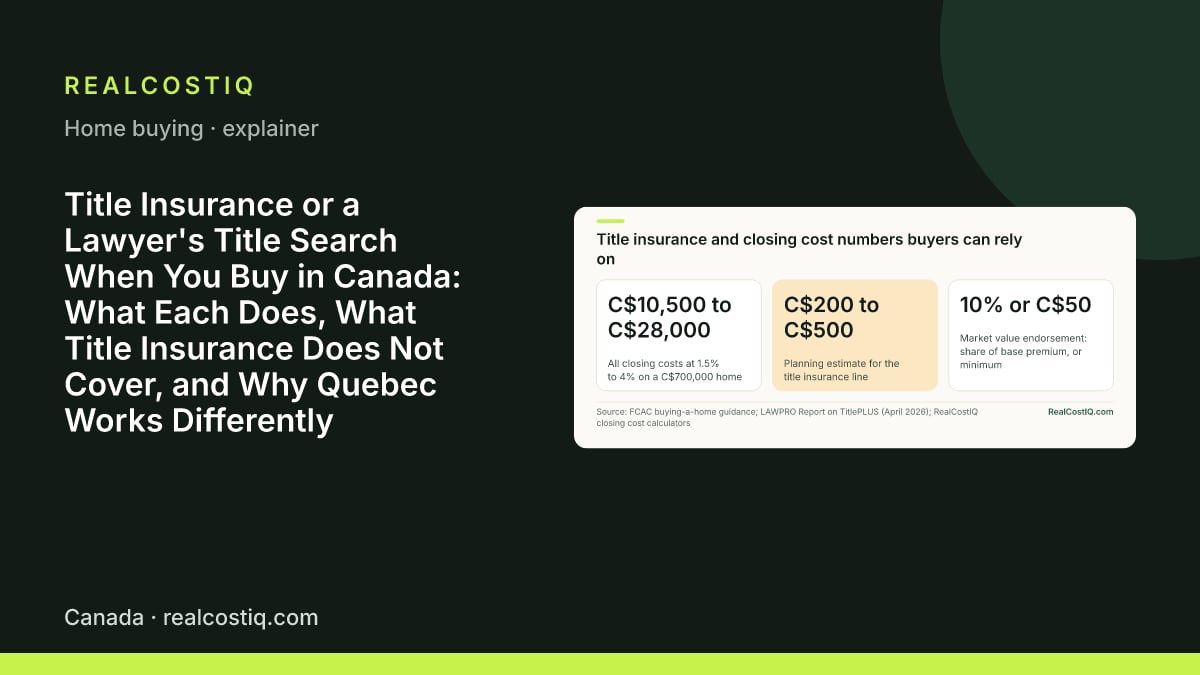
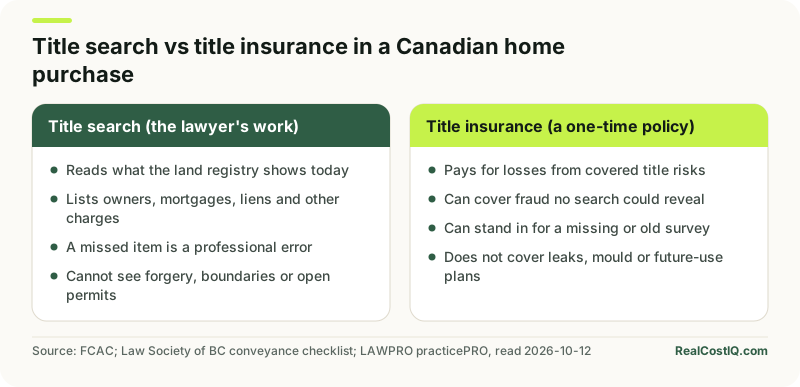
Buyers often see title insurance as one line on a lawyer's statement of adjustments. That is the bill that lists who owes what at closing. The usual question is whether the policy replaces the title search or just repeats it. It does neither. The search is work. Someone qualified checks what the land registry says about the property and tells you what is registered against it. The policy is a contract. You pay a one-time premium, which is the price of the insurance. In return, an insurer agrees to pay for losses from certain title risks. One is a process and the other is a financial backstop. They cover different failures. If a search misses something, that is a professional error. If a fraud could not be seen by any search, that is an insured risk. Some problems, such as a leaking roof, are neither.
This post explains what each one does. It covers what title insurance does and does not pay for, according to LAWPRO. LAWPRO is the insurer behind the TitlePLUS program. It also covers what the Law Society of British Columbia's conveyancing checklist tells a lawyer to do about title and insurance. Conveyancing means the legal work of transferring a property. Then the post shows how the Alberta and Quebec registries differ, and what is publicly known about cost. It was written from sources read on 2026-10-12, listed at the end. All dollar amounts are Canadian dollars (CAD). This is information, not legal advice. The wording of the policy your lawyer gives you is what counts.
One limit comes first. No premium schedule was found today on a regulator's page or on an insurer's page that could be read. So this post does not quote a premium. The site's own closing cost pages carry planning estimates. Those are editorial figures, and the cost section explains them. That section also covers what can honestly be said about cost.
Two different things: a search and a policy
The Financial Consumer Agency of Canada (FCAC) tells buyers to do a land title search with the provincial or territorial land registry office. It says the search will show the name of the property owner and any mortgages or liens registered on the title. A lien is a legal claim on a property for a debt. In the same guidance on real estate fraud, it says to consider buying title insurance to protect against losses from title fraud. The two tips sit side by side because they answer different questions. The search answers what the registry shows today. The insurance answers what happens if something is wrong that the registry did not show, or that was shown and misread.
The Law Society of British Columbia's Residential Conveyance Practice Checklist makes the split concrete. It is a document for lawyers. Its section 3 is headed Search Title. It tells the lawyer to obtain and review the Land Title and Survey Authority (LTSA) search of the property. The lawyer also reviews the plan of the property and other plans that affect it. The lawyer must check all notations, miscellaneous notes, charges and encumbrances, including pending documents and registrations of fixtures. An encumbrance is a claim or limit on the property, such as a mortgage or a right of way. Later items tell the lawyer to discuss with the client the exceptions to indefeasibility of title in section 23 of the Land Title Act. Indefeasibility means a registered title is generally treated as final, with some exceptions. The lawyer is also told to deal with the survey separately. On the survey, the checklist says to ask the vendor, who is the seller, for any existing survey certificate. If there is none, the lawyer should advise the purchaser to obtain a survey or consider using title insurance. If the client decides not to, the lawyer should confirm in writing that certain risks lie with the client, not the lawyer. Those risks are about lot size, encroachment or illegal setback. An encroachment is when a building or fence crosses a boundary. A setback is the least distance a building must sit from the lot line. The checklist adds that if financing is required, the lender will usually require a survey, title insurance, or a protocol opinion.
That is the working relationship in short. The search is the lawyer's job in every province. Title insurance is something the lawyer weighs against other ways to handle risks that a search of the register cannot settle. One example is where a fence or a pool sits compared with the lot line. In BC, insurance is one of three answers a lender can accept, alongside a survey and a protocol opinion. For a buyer with no survey, it is the practical alternative to paying for one.
What the insurance covers, according to the insurer
FINTRAC, the federal financial intelligence agency, defines the product in its guidance for title insurers. It says title insurance is insurance against loss or damage caused by any of four things. The first is the existence of a mortgage, charge, lien, encumbrance, servitude or any other restriction on real property. The second is the existence of a mortgage, charge, lien, pledge, encumbrance or other restriction on personal property. The third is a defect in any document that shows the creation of such a restriction. The fourth is a defect in the title to property. It also covers any other matter affecting the title or affecting the right to the use and enjoyment of property. The definition is lifted from the schedule to the Insurance Companies Act. It is broad. That is why the actual policy wording, with its exceptions, is what counts.
For policy wording, the best-documented source in Canada is LAWPRO. It is the Ontario lawyers' professional liability insurer. Its TitlePLUS program sells title insurance through lawyers. LAWPRO's practice-risk site, practicePRO, published an article on June 1, 2026 (last updated June 26, 2026). It is titled Help your clients understand what is and isn't covered by title insurance. The article groups TitlePLUS coverage into four categories. The first is defects in legal title. The second is compliance risks, where a government authority has ordered a problem with the property fixed. The third is property access and encroachment issues. The fourth is the legal services the lawyer provides on the purchase. LAWPRO is the insurer. So this is a statement of how the product is designed, not a neutral review. It is read that way here.
The same article is most useful for what it says is not covered. It names three claims that are often reported but generally not covered. The first is that title insurance is not home insurance. Homeowners report leaky roofs, flooding basements, mould and shoddy work. The article says title insurance is not meant to cover physical problems unless the problem also falls under a covered risk in the policy. Its example is a sunroom a former owner added without a permit. A leak in that sunroom is not covered on its own. But say a building inspector then orders the current owner to make the sunroom meet the rules. That order is on the public record, and TitlePLUS would cover what is needed to satisfy it. In the article's words, coverage is not for the leak but for the order.
The second is vendor misrepresentation. A vendor is the seller. The article says a vendor who hides a known problem, such as a basement that floods in the spring, is not covered by that fact alone. It is covered only if the issue also falls within a coverage clause. One example is a foundation that was the subject of an open permit that never had its final inspection. The third is future use. The article says title insurance is generally meant to cover title as it existed at the time of purchase. It also covers title-related problems that a lawyer could reasonably have found before closing, with a few exceptions. It does not cover plans such as an addition, a lot severance or development if zoning or by-laws prevent them. A lot severance means splitting a lot into separate lots. Suppose the buyers asked their lawyer in writing to make sure the plans could be carried out, and the lawyer failed to. That situation may fall under the policy's legal services coverage.
| Situation | Covered by the title policy? | Why, in the article's terms |
|---|---|---|
| A government order to fix an unpermitted addition made by a former owner | Yes, for the order | A compliance risk: the order is in the public record and can surface at resale |
| The same addition leaks | No, for the leak | A physical problem is not a covered risk on its own |
| Vendor knew the basement flooded and said nothing | Not by itself | Misrepresentation must also fall under a coverage clause |
| You plan to add a second unit and zoning does not allow it | Generally no | Future-use plans are not covered; the lawyer's written advice may be a separate matter |
| A lawyer's negligent error on the purchase file | Yes, where legal services coverage is included | LAWPRO's April 2026 report says legal services coverage is automatically included in most lawyer-prepared TitlePLUS transactions |
Source: LAWPRO, practicePRO, Help your clients understand what is and isn't covered by title insurance (posted 2026-06-01); the legal-services row also relies on LAWPRO, Report on TitlePLUS (April 2026). TitlePLUS is one insurer's product; other insurers' policies have their own wording and exceptions.
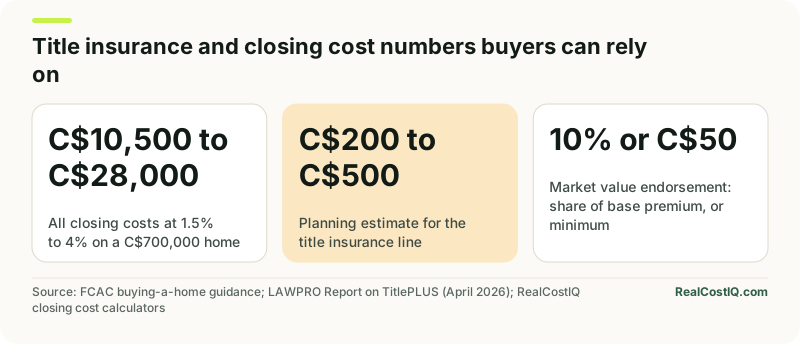
LAWPRO's April 2026 Report on TitlePLUS adds two product facts. First, TitlePLUS automatically includes legal services coverage for most lawyer-prepared transactions at no extra charge. This helps protect clients against negligent errors and omissions by the lawyers completing the transaction. Second, the report describes a Market Value Endorsement, available at the time of purchase. An endorsement is an add-on to a policy. This one ties compensation to the home's market value at the time of a claim, up to C$10 million. It costs 10% of the owner policy's base premium, or a minimum of C$50. The report says that coverage applies to natural market appreciation, which means the home rising in value on its own. It does not extend to gains from renovations. The TitlePLUS home page adds that its residential policies are available for properties with purchase prices and mortgage amounts up to C$5 million.
Taken together, these texts make the point of this post. Title insurance is real protection against a defined list of things, including some that no search can reveal. It is a poor fit for the physical and commercial problems that buyers worry about most. The lawyer's search and advice catch most of what can be caught in advance. The policy is for the rest.
What a search cannot see
A search reads a register. Three kinds of problem sit outside what a register shows. The first is fraud and forgery. The Alberta government's page on land titles assurance fees says Land Titles occasionally receives fraudulent documents. These include forged signatures or wrongfully obtained corporate seals. The office tries to stop them at examination, but the page says such documents are from time to time registered. Its worked example is a registered owner whose signature is forged on a transfer, after which the property is sold to a third party. A title search done after that transfer would show a clean chain to the new owner. Only the original owner would know otherwise.
The second is physical facts that the register does not record, such as whether a building sits over a boundary or an easement. An easement is a right for someone else to use part of your land. A survey fills that gap. In Alberta the document is the Real Property Report. A guest article dated June 30, 2026 appeared on the Legal Education Society of Alberta site. It was written by an employee of the title insurer Stewart Title, which sponsors LESA. It says title insurance can cover losses from unknown adverse matters. These are matters that an up-to-date Real Property Report would have revealed. The cover applies where a report is unavailable or outdated. It calls insurance an additional layer of protection that does not replace the report or the lawyer's role. An insurer wrote it, so treat it as the industry's account of its own product. Still, it describes the intended use accurately. Insurance stands in for information when information is missing.
The third is municipal compliance. A work order, an unclosed permit or a zoning violation is not part of the land title, though it can follow the property. LAWPRO's article treats an order of this kind as a covered risk. Buyers who want to know before they close ask the municipality. That is a separate search from the title search. It is usually a separate line on a lawyer's account.
How this works in Ontario, British Columbia, Alberta and Quebec
Ontario
In Ontario, this post has read documents for the TitlePLUS program from LAWPRO, which sells title insurance through lawyers. The program's material is written for lawyers. Its own report says it sells coverage only through lawyers and notaries and does not sell through lender channels. That positioning is the insurer's, and other insurers work differently. No government or insurer page read today says what share of Ontario purchases include a policy. A 2023 article in the Quebec consumer magazine Protégez-Vous says title insurance is involved in more than 90% of real estate transactions in Ontario. But that is a secondary figure relayed from a broker, and it is not verified here.
British Columbia
British Columbia's register is run by the LTSA. It is the starting point of the lawyer's work under section 3 of the Law Society checklist. The checklist also tells lawyers to discuss the exceptions to indefeasibility of title in section 23 of the Land Title Act. That is the BC legal reason a search is not the whole story. An indefeasible title still has exceptions, and the lawyer explains them. The checklist treats title insurance as one way to deal with a survey gap. It also flags a rule change. Effective October 1, 2025, title insurers have to follow the federal Proceeds of Crime (Money Laundering) and Terrorist Financing Act. That includes verifying the identity of purchasers before issuing an owner's title insurance policy. Title insurers have said they will ask lawyers to act as their agent for the identity check. FINTRAC's page for title insurers, headed Effective October 1, 2025, confirms that title insurers are now subject to the Act. For a buyer, the result is one more identity check at the lawyer's office.
Alberta
The Alberta government's land titles overview says the province's system is based on the Torrens system of land registration. In a Torrens system, the government keeps the register of land titles and stands behind it. The system operates under the Land Titles Act. The overview says the government has custody of all original titles, documents and plans. It also has the legal responsibility for the validity and security of all registered land title information. The government also runs an assurance fund. The assurance fees page says people can claim if they lost an interest in land through a registrar's mistake or fraudulent activity. Claims must be made within six years of the loss. The page says such claims are complex and a lawyer is strongly recommended. It limits claims to people whom the Act prevents from suing to recover their interest. This is a public remedy that exists in addition to any private policy. It is limited to the situations the Act describes.
So an Alberta buyer has four layers. There is a state-run title system with an assurance remedy. There is a lawyer. There is a Real Property Report where one is obtained. And there is optional title insurance. The insurance fills the gaps the first three leave. The government's assurance fund is a remedy after a loss. A buyer who has lost a home to forgery still has to bring a claim. Title insurance, for the risks it covers, is paid by an insurer under a policy. That is a different experience. Neither page read says one is better.
Quebec
Quebec differs in principle. The Government of Quebec's page on land registry publicity was last updated April 11, 2025. It says the Registre foncier makes the rights a person holds in an immovable public, so that nobody can claim to ignore them. An immovable is land or a building. Those rights are enforceable against everyone. The page then says the system neither creates nor confers any right. Registering a transaction does not give a right over its object. Rights arise when two parties sign an agreement or contract. The page adds that the registry's staff are not authorized to express an opinion on a deed being prepared. So someone outside the registry must analyze the titles. In a Quebec sale that is typically the notary. The page read does not say so, and the Chambre des notaires pages that would could not be read today.
Title insurance exists in Quebec. The TitlePLUS website says it is meant for all provinces and territories except Quebec. It points Quebec readers to TitrePLUS. But few Quebec buyers buy it. The 2023 Protégez-Vous article says only 4% of homeowners in Quebec hold a policy. It cites data from the brokerage ABRI that was provided to La Presse. It also says some professionals consider a policy unnecessary in most cases because the Quebec register is reliable. A consumer page sponsored by the OACIQ, Quebec's real estate brokerage regulator, appears on the Protégez-Vous site. It says a notary may recommend a policy when the seller's title is not completely clear. It gives as examples a minor encroachment, such as a shed roof over a neighbouring lot, or a pool installed on a public utility easement. These are secondary sources. A Quebec reader who wants a primary statement should ask the notary and read the guidance of the Chambre des notaires du Québec. Its pages returned an access error to the automated reader used for this post, so they could not be read today.
What it costs, and what can honestly be said about premiums
The only government figure on the whole bundle of costs is from the FCAC. Its buying-a-home guidance lists home inspection fees, legal fees, property tax adjustments and title insurance as examples of closing costs. Closing costs are the fees and taxes you pay when the sale completes, on top of the price. The guidance tells buyers to be ready to spend between 1.5% and 4% of the home's purchase price on them. Take a hypothetical C$700,000 purchase. That range is C$10,500 to C$28,000 (0.015 x C$700,000 and 0.04 x C$700,000) for the closing costs FCAC describes, before the down payment. The page does not say whether land transfer tax is inside that range. It does not break out title insurance, and it does not give a premium. Land transfer tax is a tax the province charges when ownership changes hands. It is also municipal in Toronto. Price it separately with the land transfer tax calculator.
No premium schedule was found today on a source that could be read and counted as primary. Private insurers sell title insurance in Canada on their own rate sheets. The TitlePLUS page read today offers a get-a-quote function for lawyers and clerks. It shows no rate table. The site's Ontario, BC and Alberta closing cost calculators each carry a planning estimate of C$200 to C$500 for the title insurance line. That is an editorial range for budgeting. This post does not cite that range as a premium. A buyer should take the actual figure from the lawyer's statement of adjustments. The national closing costs calculator puts the line in context among the other costs.
One formula is documented. LAWPRO's April 2026 report prices the Market Value Endorsement at 10% of the base premium of the owner policy, or a minimum of C$50. Here is a hypothetical, not a quote. Say a base owner premium were C$300. Then 10% would be C$30, so the C$50 minimum would apply. If a base premium were C$900, the endorsement would cost C$90. The point is the mechanism. The endorsement is a share of whatever the base premium is, with a floor. The example says nothing about what a base premium is.
There is a second cost that is easy to miss: the cost of not buying. A buyer who skips a survey and a policy keeps the premium but accepts the risk. The BC checklist tells the lawyer to confirm in writing that survey and encroachment risks lie with the client. That records exactly this trade. Whether the trade makes sense depends on the property. A newer subdivision with a recent survey on file is a different risk from an older house with an addition and no records.
When the lender decides for you
For many buyers the mortgage answers the question. The BC checklist's purchase item says that, if financing is required, the lender will usually require a survey, title insurance or a protocol opinion. The passage read does not define a protocol opinion further. It is a lawyer's assurance given to the lender under a conveyancing protocol, and your lawyer can explain it. The mortgage instructions the lender sends to the lawyer say which option it accepts. The lawyer will tell you which are acceptable.
The identity-check change matters here too. Since October 1, 2025 a title insurer has to verify the buyer's identity before an owner's policy is issued. Both FINTRAC's page and the BC checklist say so. The BC checklist lists a survey and a protocol opinion as the other things a lender usually requires. Those are the alternatives to raise with your lawyer.
How to decide, and what to ask your lawyer or notary
- Ask what the lender will accept. If a survey, an opinion or a policy would each satisfy it, compare the price and the protection of each.
- Ask whether there is a current survey, or in Alberta a Real Property Report with municipal compliance, and how old it is. An old report can omit later additions. That is the case title insurance is sold for.
- Ask about the property's history of work, such as additions, finished basements, decks and garages built by former owners. Unpermitted work is where an order can surface later. Per LAWPRO's article, a government order can be a covered risk even where the leak behind it is not.
- Ask for the policy itself, including the schedule of exceptions, not only the summary. The exceptions list for the property is where specific risks are carved out.
- Ask what the legal services coverage includes, and whether your policy has it. LAWPRO's April 2026 report says it is automatically included for most lawyer-prepared TitlePLUS transactions. Check what any other insurer's policy includes.
- Ask whether an endorsement for rising value is available, and what it costs for your property. The market value endorsement is priced as a share of the base premium, with a floor.
- If you are buying in Quebec, ask the notary what the title analysis found. Ask whether any irregularity, such as an encroachment, makes a policy worth buying. Ask what happens if you decline.
- Keep the policy. It is a contract that lasts as long as you own the home. In a claim you will need the schedule and the date.
What this post does not cover
This post does not recommend buying or declining a policy for any particular property, and it does not rank insurers. It does not quote a premium. It also does not claim that the site's C$200 to C$500 planning estimate reflects any insurer's current rates. It does not cover Manitoba, Saskatchewan, the Atlantic provinces or the territories, because their registries and practices were not read for this post. It does not cover commercial or new-build warranty products, such as Ontario's new-home warranty. Those are covered elsewhere on the site. It does not cover home insurance, which is a separate policy against physical loss. Several of the insurer documents read are marketing or practice material from the insurer. So the claims about coverage are the insurer's own, and the policy wording has the final say.