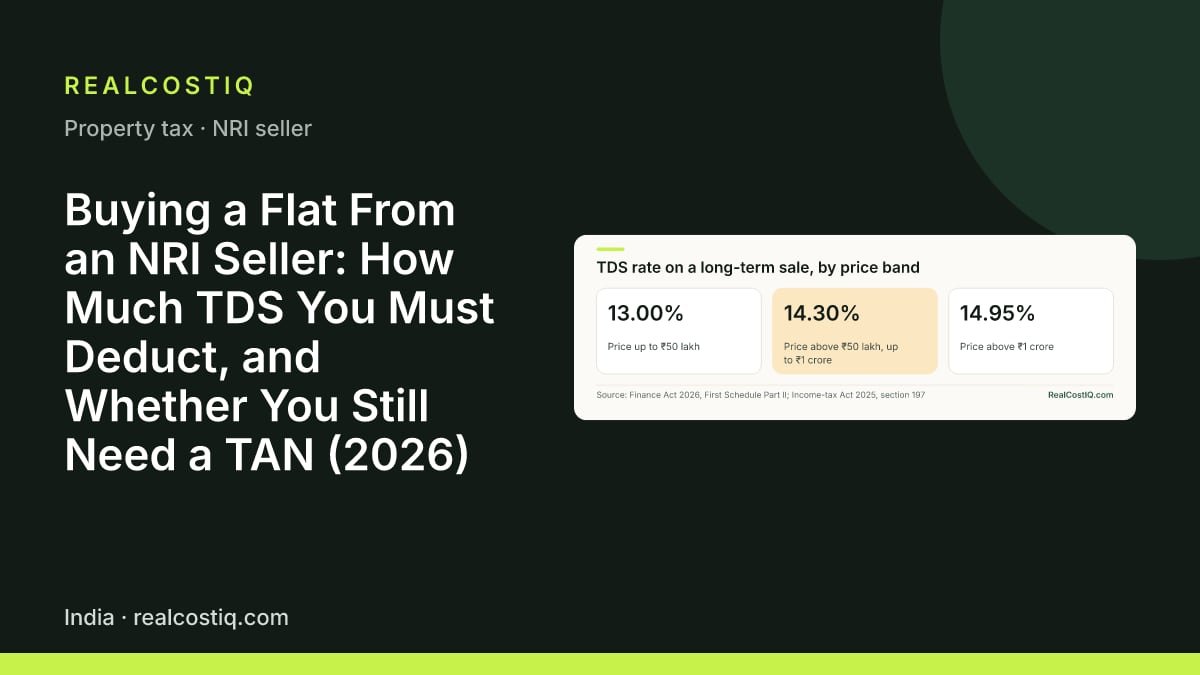
Say you have found a ₹1 crore flat in Pune. The owner lives in Dubai and sells through a power of attorney. The agent says, "Nothing special. Deduct 1% and finish the registry." That advice is wrong, and the mistake is expensive. If you deduct ₹1,00,000 when the law needs ₹14,30,000, you are short by ₹13,30,000. The tax office can come after you for that gap, plus interest.
This post is about the buyer's side only. It explains what you must deduct, when a certificate changes the sum, whether you need a TAN, and how you pay. It does not plan the seller's tax. Every section number below is from the Income-tax Act 2025, which took over from the 1961 Act on 1 April 2026. We show the old number in brackets, because most guides, banks and agents still use it. All rates were read on 20 October 2026.
Why the 1% rule does not apply
Most buyers have heard of the 1% rule. It applies when the seller lives in India. The buyer holds back 1% of the price, or of the stamp duty value if that is higher, when the price is ₹50 lakh or more. This rule sits in section 393(1), table serial 3(i), of the 2025 Act. It was section 194-IA before.
A non-resident seller is a different case. The deduction moves to section 393(2), table serial 17. This was section 195 before. It has no ₹50 lakh floor. It covers any sum paid to a non-resident that the Act charges to tax. The table sets the rate as "rates in force". That means you read the rate from the Finance Act of the year. The 2026 Finance Act sets it in Part II of its First Schedule.
| Point | Seller lives in India | Seller is a non-resident |
|---|---|---|
| Section, Income-tax Act 2025 | 393(1), table serial 3(i) (formerly 194-IA) | 393(2), table serial 17 (formerly 195) |
| Floor | ₹50 lakh | None. Even a token advance counts |
| Rate | 1% of the higher of price and stamp duty value | Rates in force: 12.5% for long-term gain, plus surcharge and cess |
| On what amount | The price or stamp duty value | The whole payment, unless a certificate says otherwise |
| Form | Form 141, Schedule B | Form 141, Schedule E (individual or HUF buyer) |
| TAN | Not needed | Not needed for an individual or HUF buyer from 1 October 2026 |
Sources: Income-tax Act 2025, sections 393, 397 and 402; Finance Act 2026, section 87 and First Schedule Part II; Income Tax Department, Form 141 FAQs. Read 20 October 2026.
Who counts as a non-resident? Not only a person who holds an Indian passport and lives abroad. The test is about where the person lived, not what the passport says. The Act sets day-count tests for each tax year. A person who spent too few days in India is a non-resident for that year. Ask the seller for a written statement of residence status, and keep it with your papers. If you get the status wrong, you may deduct 1% when you owed 14%. That is the costly error.
The rate: 12.5% plus surcharge plus cess
A flat is a capital asset. If the seller held it for more than 24 months, the gain on sale is long-term. Section 2(101)(a) of the 2025 Act (formerly section 2(42A)) sets that 24-month line for property. The tax on a long-term gain is 12.5% without indexation. Indexation is the old trick of inflating the cost price. For a non-resident seller it no longer applies to property sold on or after 23 July 2024, as the Central Board of Direct Taxes explained when the change was made. (Section 197(3) of the 2025 Act keeps an old option for resident individuals and HUFs who bought before that date. It does not help a non-resident.) The 12.5% now sits in section 197 of the 2025 Act.
Before 23 July 2024 the rate was 20% with indexation, for residents and non-residents alike. Many articles and forum answers still say 20%. That figure is out of date. It also explains why some agents quote a much higher deduction than the law now needs.
Two add-ons raise the 12.5%. The first is surcharge. The Finance Act 2026 sets it by the size of the payment you make, not by the seller's total income. The second is the 4% health and education cess, charged on the tax plus surcharge. For capital gains the surcharge cannot go above 15%.
| Payment to the seller | Surcharge | Tax at 12.5% | Tax with surcharge and cess | Effective rate |
|---|---|---|---|---|
| ₹50 lakh or less (say ₹45,00,000) | Nil | ₹5,62,500 | ₹5,85,000 | 13.00% |
| Above ₹50 lakh, up to ₹1 crore (say ₹1,00,00,000) | 10% | ₹12,50,000 | ₹14,30,000 | 14.30% |
| Above ₹1 crore (say ₹1,20,00,000) | 15% | ₹15,00,000 | ₹17,94,000 | 14.95% |
How it works: tax at 12.5%, add the surcharge on that tax, then add 4% cess on the total. On ₹1,00,00,000: ₹12,50,000 + 10% (₹1,25,000) = ₹13,75,000. Add 4% cess (₹55,000) to get ₹14,30,000. Source: Finance Act 2026, First Schedule Part II, read 20 October 2026.
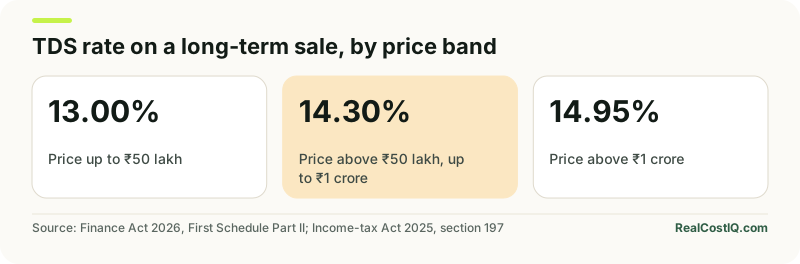
Look at the band edge. A price of exactly ₹1,00,00,000 is not "above" ₹1 crore, so the 10% surcharge applies. A price of ₹1,00,00,001 takes the 15% surcharge. On the same flat that one rupee moves the deduction from ₹14,30,000 to about ₹14,95,000 on the whole price, a jump of about ₹65,000. Ask your lawyer to check how the payments are split before you settle any figure near the line.
Our TDS on property calculator handles the resident-seller case. For a non-resident seller it declines to give a number. That is on purpose, because the seller's holding period and any certificate change the answer. Use the table above as your starting point.
Why you deduct on the whole price
Here is the part that surprises buyers. The seller's tax is only on the gain. The gain is the sale price minus what the seller paid, with some costs. Yet without a certificate, the safe practice is to apply the rate to the whole payment. Banks and tax guides follow this. The reason is practical. You, the buyer, do not know the seller's cost or other costs. The Act does not ask you to guess them.
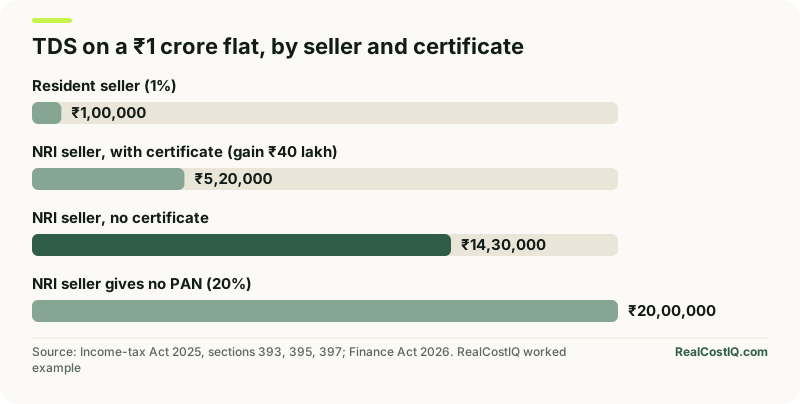
Take an example. The seller bought the flat in 2018 for ₹60,00,000. He sells it for ₹1,00,00,000. The gain is about ₹40,00,000 before costs. His real tax at 12.5% is ₹5,00,000, and ₹5,20,000 with cess. Yet with no certificate you hold back ₹14,30,000. That is ₹9,10,000 more than his actual tax. The tax office keeps the excess until the seller files his return and claims a refund. That can take months. Many sellers will not close the deal until the problem is solved.
To see how a seller's gain is worked out, try our property capital gains tax calculator. It shows the gain and the tax on it for the 12.5% route.
The lower-deduction certificate: get it before you pay
A lower-deduction certificate is a letter from the tax office. It names a lower rate, or says no tax, and it says how long it is valid. Section 395(1) of the 2025 Act (formerly section 197) lets the seller apply. Once you hold a valid certificate, you must deduct at the rate it names. If it names a lower rate, you pay less. Section 395(1)(c) says so in plain words.
There is also a second door. Section 395(2) (formerly section 195(2)) lets the person who pays a non-resident apply too. This is you, the buyer. You ask the Assessing Officer to decide what share of the sum is really taxable. Then you deduct only on that share. Use this route if the seller will not apply, or if you want your own protection.
The Finance Act 2026 added a faster path. A new sub-section (6) in section 395 lets the application go to a prescribed tax authority. That authority checks it online. It can then either issue the certificate or reject the application. This change is in the Act. The details of the online form come from the rules, so check the e-filing portal before you rely on timing.
- The seller needs a PAN. Section 397(2)(f)(ii) says that no certificate is granted if the applicant has not given a valid PAN.
- The certificate has a validity period. Check that your payment dates fall inside it. A payment made outside it goes back to the full rate.
- Match the amounts. The certificate often covers a stated sale price. If you pay more than that, the extra is not covered.
- Pay the balance in the right order. If the certificate arrives after you paid a token advance, ask a chartered accountant how to treat that advance.
Plan for time. The certificate is not instant. Many deals slip because the buyer and seller sign a sale agreement first and think about tax later. Put the certificate in the sale agreement as a condition. Write down what happens to the price if the certificate does not arrive by a set date.
Short-term gains and missing PAN
If the seller held the flat for 24 months or less, the gain is short-term. The rate is then not 12.5%. Part II of the First Schedule puts such income, for an individual, in the "whole of the other income" line at 30%. The surcharge and cess go on top. The surcharge for this income can rise above 15% when the payment is large, because the 15% cap is only for capital gains of the kinds named in the Act. A seller who sold within two years is a case for a chartered accountant, not a rule of thumb.
If the seller does not give you a valid PAN, section 397(2) of the 2025 Act (formerly section 206AA) applies. The deduction is at the highest of the normal rate, the rate in force, or 20%. On a ₹1 crore flat, 20% is ₹20,00,000 before any surcharge or cess. Ask your chartered accountant whether surcharge and cess come on top in your case. The Act lets a non-resident who is not a company escape this 20% rule for some payments, but only on conditions the rules set (section 397(2)(c)(ii)). Do not assume it covers a flat sale. Also remember that a seller without a PAN cannot get a certificate at all.
Do you still need a TAN?
A TAN is a ten-character tax deduction account number. Under the old rules, a buyer who deducted tax from an NRI seller had to apply for one first. Then the buyer filed a quarterly statement, Form 27Q, and gave the seller a TDS certificate. Many forum answers still say this. One answer posted on 13 August 2026 on a tax forum says the buyer needs a TAN and must file Form 27Q every quarter. That was right until 30 September 2026.
The Finance Act 2026 changed it. Section 87 of that Act replaced section 397(1)(c) of the 2025 Act with effect from 1 October 2026. The new clause says the TAN duty does not apply to "a resident individual or Hindu undivided family" who must deduct tax on the price of immovable property under section 393(2), table serial 17. The deduction itself is not removed. Only the TAN step is.
| Buyer | Before 1 October 2026 | From 1 October 2026 |
|---|---|---|
| Resident individual | TAN, quarterly Form 27Q, TDS certificate | No TAN. Pay and report on Form 141, Schedule E, with your PAN |
| Resident Hindu undivided family | TAN, quarterly Form 27Q, TDS certificate | No TAN. Form 141, Schedule E, with the HUF's PAN |
| Company, firm or LLP | TAN and quarterly statement | Still on the TAN-based statement. Schedule E is closed to you |
| Non-resident buyer | TAN and quarterly statement | Still on the TAN-based statement. Schedule E needs a resident deductor |
Sources: Finance Act 2026, section 87 (amending section 397(1)(c)); Income Tax Department, Form 141 FAQs 3, 7 and 9. Read 20 October 2026. The old Form 27Q name is the 1961 Act form; a TAN-based buyer should confirm the current form name with a chartered accountant.
Look at the dates when you sign. A buyer who deducts on or after 1 October 2026 uses the new route. A buyer who deducted earlier may already hold a TAN and have filed a statement. Do not mix the two. If you are unsure which side of the line your payment falls on, the date of each payment decides it, because the law looks at the time of credit or payment.
How to pay and report on Form 141
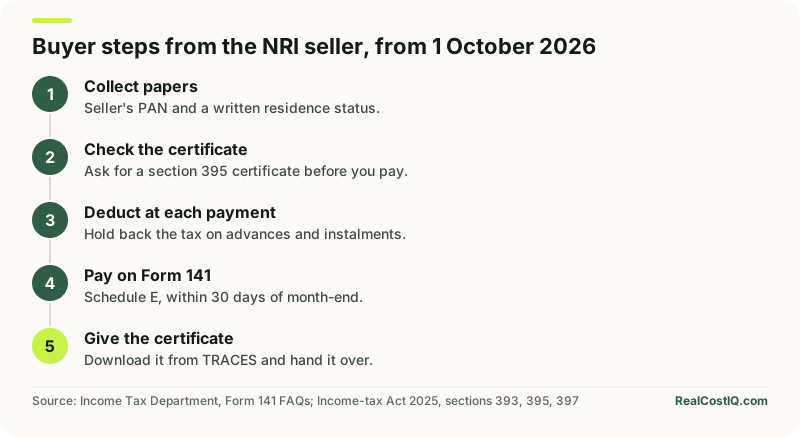
Form 141 is a single form that replaced four older challan forms, including Form 26QB. It has five schedules. Schedule B is for a resident seller. Schedule E is new. It is only for a resident individual or HUF who buys immovable property from a non-resident. The Income Tax Department says each Form 141 covers one type of transaction. If two people buy a flat together, each files for their own share.
- Log in to the e-filing portal with your own PAN. Form 141 can only be filed under a PAN login.
- Go to e-File, then e-Pay Tax. Pick the Income Tax Act 2025, then New Payment, then Form 141.
- Choose Schedule E. Enter the seller's details, the sale price, the date of deduction and the tax you held back.
- Pay the tax. It must reach the government within 30 days from the end of the month in which you deducted it.
- File the challan-cum-statement within one month from the end of that month.
- Download the TDS certificate from the TDS-TRACES site and give a copy to the seller.
Here is an example with dates. You pay the seller a token advance of ₹5,00,000 on 12 November 2026. You hold back the tax on it that day. Your deadline to pay is 30 December 2026, which is 30 days after the end of November. You must also file the statement within one month from the end of November. Each later instalment starts its own clock. A mistake in the form is fixed on the TRACES site, not on the e-filing portal.
Note what the Income Tax Department does not say. Its FAQ gives no single rate for Form 141, because the rate depends on the type of payment. It says the tax is deducted at the rate in the Act, at the higher rate under section 397(2) if the PAN is missing, or at the rate in a section 395 certificate. That matches the structure in this post.
What counts as the price
Do not apply the rate only to the headline price. Section 402(9) of the 2025 Act says the "consideration for transfer" of immovable property includes club membership fee, car parking fee, electricity or water facility fee, maintenance fee, advance fee and any similar charge linked to the transfer. If the agreement shows ₹95,00,000 for the flat and ₹5,00,000 for parking and club fees, the base is ₹1,00,00,000.
This matters for the surcharge band too. A flat priced at ₹96,00,000 with ₹6,00,000 of add-ons is a ₹1,02,00,000 payment. It lands in the 15% surcharge band, not the 10% band. Show all the charges to your chartered accountant before you decide the base.
Old advice you will still see online
The web is full of advice that was true once. Here are the four claims that now fail, and the facts that replace them.
- "The long-term rate is 20%." It was, for transfers before 23 July 2024. It is 12.5% now.
- "The effective rate is 22.88%." That number mixes 20% with a surcharge and cess. It is wrong for a sale today. Our own TDS page once carried the same figure and removed it, because the surcharge depends on the payment and no single rate fits every sale.
- "You always need a TAN." Not if you are a resident individual or HUF paying on or after 1 October 2026.
- "Form 26QB is for all property purchases." It is gone. Form 141 took its place, and Schedule E handles the NRI case.
Even the forum threads lag. A tax forum thread on this very question was answered on 13 August 2026, seven weeks before the TAN change. The answer then was correct. A reader who finds it in November would be misled. Always check the date of an answer against 1 October 2026.
A checklist before you sign
- Get the seller's PAN and a written statement of residence status for the tax year.
- Ask whether a section 395 certificate exists. If not, ask the seller to apply now.
- Work out the price base using section 402(9). Add the parking, club and other charges.
- Fix the surcharge band from that base, and work out the tax with the table above.
- Check your own category. An individual or HUF buyer uses Form 141, Schedule E. A company or firm still needs a TAN.
- Write the deduction, and what happens if the certificate is late, into the sale agreement.
- Pay through a bank and keep the proof of every payment, with its date. The date of each payment starts its own deduction and filing clock.
- Pay the tax and file Form 141 on time, then give the seller the TDS certificate.
Foreign exchange rules govern what the seller can send abroad afterwards. That is the seller's job, not yours, and it is outside this post. Our NRI property buying guide covers the other side of the table, for NRIs who buy in India.
What this post leaves out
- Seller tax planning. Exemptions such as reinvestment relief, and how a seller should file, are the seller's concern.
- Agricultural land. The immovable property definition in the Act excludes it, so different rules apply.
- Company, firm or non-resident buyers. They stay on the TAN route. Ask a chartered accountant for the current form name and due dates.
- Lender rules. Banks add their own checks when they finance a flat bought from an NRI.
A last word on proof. We read the Act, the Finance Act and the Form 141 FAQs on 20 October 2026. The FAQ page does not show an update date. The Form 141 online screens may change, so follow the portal's own prompts for the fields. When the stakes are ₹14,30,000, a chartered accountant's fee is small. Use the rates here to check the quote you are given, not to replace the advice.