Most guides on buying a resale flat start with the price and the loan. They skip the step in the middle. Between your agreed price and your loan sits the bank's valuation. If it comes in low, the whole plan moves. This post puts rupees on that step, using the one loan rule that matters here: the Reserve Bank of India's limit on how much of a flat's value a bank may lend.
We keep to that rule on purpose. We do not cover interest rates, EMI plans or tenure. The loan calculators on this site handle those. Here the question is narrower. If the valuation is lower than the price, how much more cash do you need, and what else should you check on an older building?
The rule: how much a bank may lend on a flat
The RBI sets a loan-to-value ratio, or LTV. LTV is the share of the property's value that a bank may lend. An LTV of 80% means the bank lends up to 80 rupees for each 100 rupees of value, and you pay the other 20. The limits sit in the RBI's Commercial Banks (Credit Facilities) Directions, 2025. We read the version updated as on 15 July 2026 on the RBI website on 25 October 2026. Paragraph 111 holds the table.
| Size of the loan | Highest LTV | Your own money, at least |
|---|---|---|
| Up to ₹30 lakh | 90% | 10% of the value |
| Above ₹30 lakh, up to ₹75 lakh | 80% | 20% of the value |
| Above ₹75 lakh | 75% | 25% of the value |
Source: Reserve Bank of India, Commercial Banks (Credit Facilities) Directions, 2025, paragraph 111, version updated as on 15 July 2026, read 25 October 2026. The Directions state the limits through risk weights. We read the bands by the size of the loan, as the table is laid out. A bank can set a tighter limit than the RBI does.
Two points make this table behave oddly. First, the bands run on the size of the loan, not the size of the flat. A bigger loan gets a lower LTV. Second, the RBI table says what percentage of the "value" a bank may lend. It does not say whose number the value is. In practice, banks lend on the lower of the agreed price and their own valuation. That is common practice, not RBI text. We use it as an assumption in every example below, and we say so each time.
Paragraph 99 of the same Directions says banks must follow the RBI's separate Credit Risk Management Directions, 2025 for the valuation of property they take as security. We did not read that document for this post. So we say nothing here about how a valuer is chosen, how the valuer measures the flat, or who pays the valuer.
The gap in rupees: ₹95 lakh agreed, ₹85 lakh valued
Take a resale flat. You and the seller agree on ₹95,00,000. The bank's valuer says the flat is worth ₹85,00,000. Assume the bank lends on the lower number. Here is what the RBI table does to your loan.
At a valuation of ₹95,00,000, you hope for 80%. That is ₹76,00,000. But a loan above ₹75 lakh falls in the 75% band, which gives only ₹71,25,000. So the best the bank can do is a loan of exactly ₹75,00,000 in the 80% band. That is 78.9% of the price. The top loan is ₹75,00,000. Your own money is ₹20,00,000.
At a valuation of ₹85,00,000, 80% is ₹68,00,000. That loan is under ₹75 lakh, so the 80% band applies. The top loan is ₹68,00,000. Your own money is ₹95,00,000 less ₹68,00,000, which is ₹27,00,000. That is ₹7,00,000 more than in the first case. It is ₹8,00,000 more than the ₹19,00,000 a buyer would expect from a simple 20% down payment on the price.
| Bank valuation | Highest loan | Own money for the price | Own money as a share of the price |
|---|---|---|---|
| ₹95,00,000 | ₹75,00,000 | ₹20,00,000 | 21.1% |
| ₹90,00,000 | ₹72,00,000 | ₹23,00,000 | 24.2% |
| ₹85,00,000 | ₹68,00,000 | ₹27,00,000 | 28.4% |
| ₹80,00,000 | ₹64,00,000 | ₹31,00,000 | 32.6% |
Highest loan is 80% of the valuation, capped at ₹75,00,000 for the 80% band (RBI paragraph 111). Own money is the price less the loan. The "lower of price and valuation" step is common bank practice, assumed here, and is not stated in the RBI text we read.
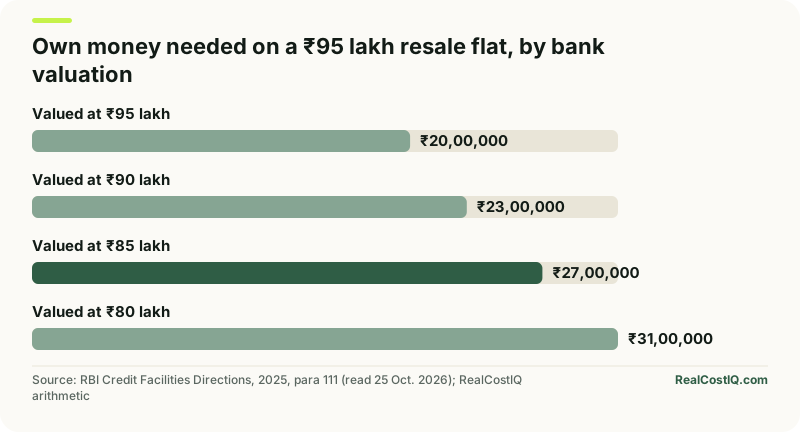
Read the pattern. A fall of ₹5 lakh in valuation costs you ₹4 lakh of extra cash, or ₹3 lakh for the first step, where the ₹75 lakh cap absorbs part of the fall. That is the 80% band at work. The bank no longer lends the share it would have lent on the part of the price it will not recognise, so you fill that hole yourself, at full price.
The flat zone around ₹75 lakh of loan
The bands also create a flat zone. Suppose the valuation sits anywhere from ₹93,75,000 to ₹1,00,00,000. Eighty per cent of that is more than ₹75 lakh, and the 75% band would give no more than ₹75,00,000. So the highest loan stays at ₹75,00,000 across the whole range. A flat valued at ₹94,00,000 and one valued at ₹1,00,00,000 get the same top loan. Above ₹1 crore, the 75% band takes over and the loan grows again, at 75 paise per rupee of value.
A smaller version of the same effect sits at the ₹30 lakh line. For a valuation between about ₹33,33,333 and ₹37,50,000, the top loan stays at ₹30,00,000. Before that, 90% of the value is under ₹30 lakh. After that, 80% of the value is above ₹30 lakh and the next band opens. In both zones, a small change in valuation moves your cash need by nothing, and the next small change moves it a lot.
| Agreed price | Valuation | Highest loan | Own money | Own money if the valuation had matched the price |
|---|---|---|---|---|
| ₹40,00,000 | ₹36,00,000 | ₹30,00,000 | ₹10,00,000 | ₹8,00,000 (loan ₹32,00,000) |
| ₹95,00,000 | ₹85,00,000 | ₹68,00,000 | ₹27,00,000 | ₹20,00,000 (loan ₹75,00,000) |
| ₹1,20,00,000 | ₹1,10,00,000 | ₹82,50,000 | ₹37,50,000 | ₹30,00,000 (loan ₹90,00,000) |
Loans follow the RBI paragraph 111 bands read by loan size: 90% up to ₹30 lakh, 80% above ₹30 lakh up to ₹75 lakh, 75% above ₹75 lakh. The ₹1,20,00,000 case: 75% of ₹1,10,00,000 is ₹82,50,000; 75% of ₹1,20,00,000 is ₹90,00,000.
The table shows that the same ten per cent gap in valuation hurts more as the price rises. On ₹40 lakh, the extra cash is ₹2,00,000. On ₹95 lakh, it is ₹7,00,000. On ₹1.2 crore, it is ₹7,50,000. A buyer who prepared for a 20% down payment on a ₹95 lakh flat, which is ₹19,00,000, would have been short by ₹8,00,000.
What the loan never covers: duty, registration and the rest
The loan share is only part of your cash need. Paragraph 113 of the RBI Directions says a bank shall not include stamp duty, registration and other documentation charges in the cost of the property it finances. There is one exception. If the house costs up to ₹10 lakh, the bank may add them. For a flat at ₹95 lakh, the exception does not apply. So duty and registration come out of your own money, on top of the gap.
State rates differ, and this post does not quote any state's rate. To keep the sums clean, we assume a combined duty and registration of 6% of the price. That is an example, not a state's rate. Get the real figure for your state, body and buyer type from the stamp duty comparison.
Add brokerage. Many resale flats come through a broker. We assume 1% of the price from the buyer, which is ₹95,000 on ₹95 lakh. A registered broker also charges GST on that fee. Notification 11/2017-Central Tax (Rate) lists real estate services under heading 9972 at 9% central tax. With the equal state share, that is 18%. So ₹95,000 carries ₹17,100 of GST, and brokerage costs ₹1,12,100 in all. Brokerage is a negotiation, and the right figure depends on your city. Use the broker commission calculator to set your own percentage.
| Item | Valued at ₹95,00,000 | Valued at ₹85,00,000 |
|---|---|---|
| Own money against the price | ₹20,00,000 | ₹27,00,000 |
| Stamp duty and registration at an assumed 6% | ₹5,70,000 | ₹5,70,000 |
| Brokerage at an assumed 1%, plus 18% GST | ₹1,12,100 | ₹1,12,100 |
| Society transfer fee, bank valuation and legal fees | Ask; not counted | Ask; not counted |
| Total cash counted | ₹26,82,100 | ₹33,82,100 |
Duty is taken on the price of ₹95,00,000 for simplicity. In many states duty runs on the higher of price and circle rate; check yours. The last row is left open because we have no sourced figure for it. Add it when you have the quotes.
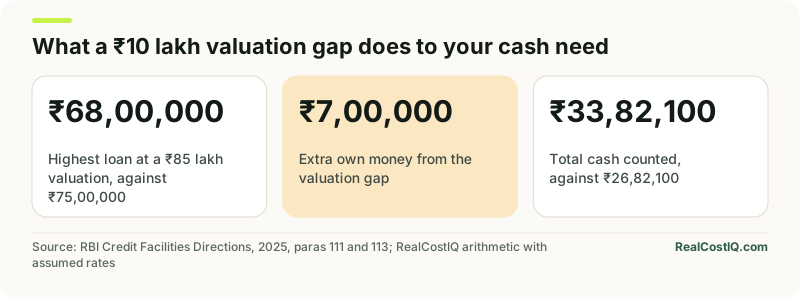
Our true cost of buying a flat post lists every charge on a flat, new and resale, with the sources. The point of this post is the one line that jumps without warning: your own money, once the valuation comes in.
Why a valuation comes in low on a resale flat
A valuation is not a fact. It is the bank's opinion of what the flat would fetch. Several things push it below the price you agreed.
- The seller's price may carry a hope. A seller may ask for the best price any flat in the lane has fetched. A valuer may look at a typical sale instead.
- Area is counted differently. Sellers and brokers quote a price on the super built-up area. A valuer may work on built-up or carpet area. Carpet area is the floor space inside the walls. The Real Estate (Regulation and Development) Act, 2016 defines it in section 2(k) as the net usable floor area, without the external walls, service shafts, and exclusive balcony or open terrace, but with the internal partition walls. The smaller the area the valuer accepts, the lower the number. To see how a super built-up figure converts to carpet area, use the carpet area calculator.
- Condition and age. A flat that needs repairs, or sits in an older building, is often valued lower than a newer one next door.
- Fresh deals are few. In a lane with few recent sales, a valuer leans on older records and on the circle rate. If the agreed price is above both, the valuer may not follow.
- The bank's own caution. A bank can value low, and set a tighter limit than the RBI. The RBI limit is the highest, not the usual.
None of this makes the valuer wrong, and none of it makes the seller dishonest. It means the price and the valuation are two different things, and the loan follows only one of them.
Four ways to handle a low valuation
- Get the valuation early. Ask the bank for its valuation before you pay a large token or sign the agreement to sell. A seller who wants a quick sale may agree to wait a few days. A token paid before the valuation can be hard to recover if the loan falls through.
- Renegotiate with the report in hand. The valuer's number is a reason to talk. Ask the seller to meet you partway. A cut of ₹5 lakh in price saves you that ₹5 lakh, and it lowers the stamp duty if duty runs on the price.
- Cover the gap with your own money, in the open. Pay the difference by bank transfer, and put the full price in the agreement. Do not leave part of the price out of the papers to "match" the valuation. A gap between the paper price and the real price creates trouble for both sides.
- Try a second lender. Banks use their own valuers. A second bank may value the same flat higher or lower. Do not apply to many lenders at once without a reason. Each application may bring a processing fee, so ask before you apply.
The society transfer fee
On a resale, the housing society will often charge a transfer fee, and sometimes a premium, for recording you as the new owner. The rules differ by state, by type of society and by bye-law, and some of them are in flux. We cover who may charge what, with the sources, in our guide to the IFMS, corpus fund and society transfer fee. Read it before you budget. For this post it is enough to say that the fee is outside the loan, like duty. Ask the society for its written schedule, and add the figure to the cash table above.
An older building: what a bank asks, and what we could not find
Banks set their own limits for older buildings, and we found none we could source. Here is what the RBI text requires, and where it stops.
The RBI housing-finance chapter, in paragraphs 91 and 92, sets conditions for a loan on a built-up house or flat. We read them in full on 25 October 2026. For a built-up flat:
- The buyer must declare, in an affidavit and undertaking, that the property was built as per the sanctioned plan or the building bye-laws, and, as far as possible, has a completion certificate (paragraph 92(4)).
- An architect appointed or empanelled by the bank must certify, before the loan is paid out, that the property follows the sanctioned plan or the bye-laws (paragraph 92(5)).
- No loan should be given on properties in unauthorised colonies, until they are regularised and the development and other charges are paid (paragraph 92(6)).
- No loan should be given for a residential property the buyer plans to use for commercial purposes, if the buyer says so (paragraph 92(7)).
Notice the words "as far as possible" on the completion certificate. In an old building, the certificate may not exist, or the society may not have it. The RBI text does not bar a loan for that reason alone. It asks for the declaration and the architect's check. A bank can still be stricter than the RBI, and many are.
Now the part we could not source. We searched the housing-finance chapter for any cap on the age of a building, a rule on the building's remaining life, or any cut to the loan period for an old building. We found none. Banks set such rules in their own credit policies. We did not read any bank's policy for this post, so we give no age limit, no remaining-life rule and no tenure cut. We will not guess one. If your flat sits in an old building, put four questions to the bank in writing.
- Is there a maximum age for the building, and what is it for this flat?
- Does the valuer assume a remaining life for the building, and does that change the valuation or the loan period?
- Does the bank need the completion certificate or the occupancy certificate, and what does it accept if the society has none?
- Will the bank apply a tighter loan-to-value than the RBI table for this building?
The last question matters most for this post. If the bank trims the LTV for an older building, the tables above understate your cash need. Redo the sums at the lower percentage. A cut from 80% to 70% on a ₹85 lakh valuation takes the loan from ₹68,00,000 to ₹59,50,000, and your own money to ₹35,50,000. That 70% is an example, not a bank's rule.
GST on a resale flat
Buyers sometimes ask whether GST applies to a resale. The GST notification on residential flats, Notification 03/2019-Central Tax (Rate), carves out flats where the whole price is received after the completion certificate. The Tax Research Unit's FAQ of 7 May 2019 repeats the date-of-completion logic. A flat that already has its completion certificate, bought from an individual owner, is a different case from a new flat bought from a promoter. We did not find a text that answers every resale case, such as the transfer of rights in a flat that is still under construction. If that is your case, ask a chartered accountant. For the usual completed flat, expect duty and registration to be the state charges, not GST on the flat.
A checklist before you sign
- Ask the bank for a written valuation before a large token. Note the date. The first-time home buyer guide shows where this step sits among the ten steps of a purchase.
- Run the RBI bands on the lower of price and valuation. Use the table in this post.
- Add duty and registration for your state, body and buyer type. Use the state calculators.
- Add brokerage with 18% GST, if a broker is involved.
- Ask the society for its written transfer fee schedule and any no-objection charges.
- For an older building, ask the four questions in the section above, in writing.
- Check that the agreement states the full price, and that any gap is paid by bank transfer.
- Keep a buffer. A second valuation or a tighter LTV can move the number again.
What this post could not check
The short version: the price you agree is not the number the loan follows. Ask for the valuation early, run the RBI bands on it, and add the charges the loan never covers. Then you know the cash you need, and the cost of a low valuation, before you sign.