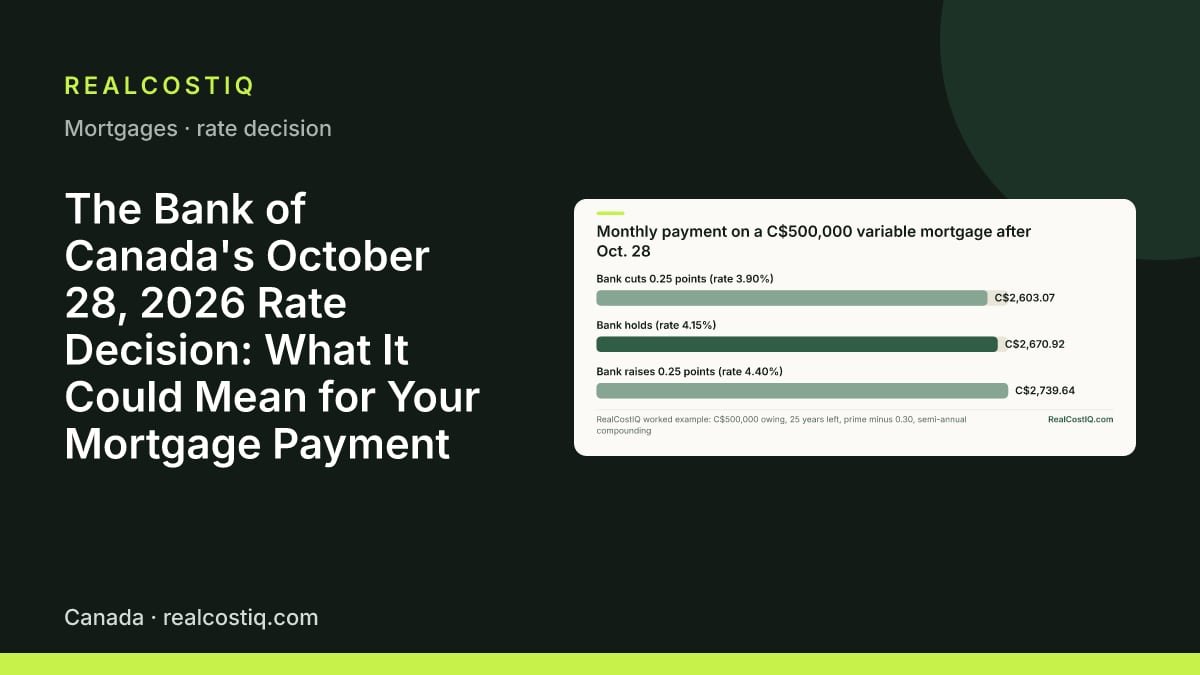
The Bank of Canada is the country's central bank. Eight times a year it announces its policy rate. That is the main interest rate it controls. When the rate changes, the cost of borrowing across Canada tends to change with it. Some mortgage holders feel it right away. Others feel it years later. Many feel nothing at all.
This post answers one plain question. If the Bank holds, cuts or raises its rate on October 28, what happens to your mortgage payment? It shows the answer in Canadian dollars (CAD) on one round example. Then it shows who is affected at once and who is not.
In plain English
- The Bank of Canada sets one key rate. It is called the policy rate. Today it is 2.25%.
- Banks use that rate to set their own prime rate. Today the prime rate is 4.45%. Prime is the starting point for variable-rate mortgages and many credit lines.
- If you have a variable-rate mortgage, a move in prime changes your interest cost. With an adjustable payment, your payment changes too. With a fixed payment, the payment stays but less of it pays down your loan.
- If you have a fixed-rate mortgage, a decision on October 28 does not change your payment. Your rate resets only when your term ends.
- The decision is on October 28, 2026. Nobody knows the result today, so this post shows all three outcomes side by side.
What the Bank of Canada says today
We read the Bank of Canada's own pages on October 14, 2026. The key facts are simple.
- The policy rate is 2.25%. The Bank calls it the target for the overnight rate. The overnight rate is the rate banks charge each other for one-day loans.
- The Bank of Canada's next announcement is on Wednesday, October 28, 2026. The Bank's 2026 schedule lists it, and the Bank's September 2 press release repeats it. A new Monetary Policy Report comes out the same day. That report is the Bank's regular outlook for the economy.
- The Bank last changed its rate on October 29, 2025, when it cut by 0.25 percentage points to 2.25%. Since then the rate has not moved. The Bank's rate table shows seven decisions in a row at 2.25%, from December 10, 2025 through September 2, 2026.
- The Bank's other two rates sit just around the policy rate. As of September 2, 2026, the Bank Rate was 2.5% and the deposit rate was 2.20%.
- After that, the next date is December 9, 2026.
In its September 2 statement, the Bank said the economy and inflation were moving broadly as it expected in July. It said risks that inflation will run higher had grown. It said new tariffs make the outlook for growth less certain. It also said it is ready to adjust its policy as needed. Inflation, which is the rate at which prices rise, had been near 3% in recent months, mostly because of gasoline. Without gasoline it was 2.2%.
That is a summary of the Bank's words. It is not a forecast of the next move. The Bank has not said what it will do on October 28. Anyone who tells you they know is guessing. That is why the rest of this post uses scenarios.
How the policy rate reaches your mortgage
The Bank of Canada does not set mortgage rates. It sets one short-term rate. The rest follows in steps.
- The Bank changes the policy rate.
- Each bank then decides whether to change its prime rate. Prime is the rate a bank uses as a base for loans such as variable-rate mortgages and lines of credit. The Bank of Canada says a policy rate change leads to similar changes in short-term rates, and prime is one of them.
- Your lender prices your variable rate as prime plus or minus a set amount. That amount is written in your contract. Your rate moves when prime moves.
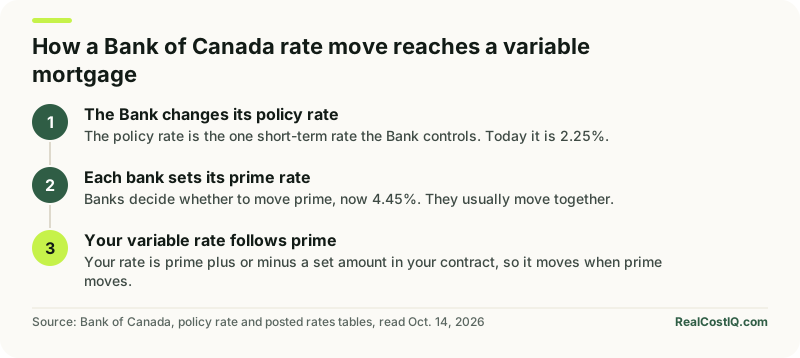
Prime is not set by the Bank of Canada. Each bank sets its own, and they usually move together. On October 7, 2026, the Bank of Canada's weekly table of posted rates showed prime at 4.45%. It was 4.45% every week from September 9 to October 7. Royal Bank of Canada's mortgage page showed the same prime rate of 4.45% when we read it on October 14. Compare that to the policy rate: 4.45% is exactly 2.20 percentage points above 2.25%. The weekly table shows prime sitting at 4.45% across that whole stretch, with no change between decisions. So a 0.25-point change in the policy rate normally shows up as a 0.25-point change in prime. This is the usual pattern, not a rule. Your own lender may be a day or two later than the others.
A fixed rate works differently. A fixed rate does not follow prime. The Bank of Canada says a lender's funding cost makes up most of its mortgage rate. That cost depends on interest rates in Canada and abroad. A policy rate move can affect longer-term rates too, mainly when people expect the move to last. So a Bank decision may nudge new fixed rates, but it cannot change the rate on a fixed mortgage you already have. For context, the Bank's weekly series showed the posted 5-year conventional mortgage rate at 6.19% on October 7, 2026. A posted rate is the bank's list price. Most borrowers pay less after they negotiate.
Three words to know: variable, adjustable and fixed
The word "variable" is used in two ways in Canada. This trips up many borrowers. The Financial Consumer Agency of Canada (FCAC) is the federal body that explains consumer finance. It separates the cases like this.
| Type | What changes when the rate moves | Does the payment change? |
|---|---|---|
| Fixed rate | Nothing, for the whole term. A term is the length of your mortgage contract, often five years. | No. It changes only at renewal. |
| Variable rate with an adjustable payment | Your rate moves with prime. A set amount of each payment goes to principal. Principal is the money you borrowed. | Yes. The payment goes up or down. |
| Variable rate with a fixed payment | Your rate moves with prime, but your payment stays the same. The split inside the payment changes. | No. But more or less of each payment goes to interest. |
Source: FCAC, Interest on mortgages, read 2026-10-14. FCAC says that with fixed payments, if the rate goes up, more of your payment goes to interest and less to principal. If rates reach a limit in your contract, your lender may raise the payment.
Check your contract or your latest statement. It will say which kind you have. If it is not clear, ask your lender: "Does my payment change when prime changes?"
One example: a C$500,000 variable mortgage
Here is the example, in plain numbers. We use a round figure. It is not your mortgage. It is a way to see the size of the effect.
- You owe C$500,000.
- You have 25 years left to pay it off. That is called the amortization: the total time to repay the loan. It is different from the term. The term is only the length of the current contract.
- Your rate is prime minus 0.30 points. With prime at 4.45%, that is 4.15%. We picked this because Royal Bank of Canada's page, read on October 14, showed a variable special of prime minus 0.30 for amortizations of 25 years or less. Your own rate will differ.
- Your payment is adjustable. It is worked out again whenever prime changes.
The payment is worked out with the same method as the site's mortgage calculator. Canadian mortgage rates are quoted as yearly rates that are compounded twice a year. Compounding means interest is added on top of earlier interest. The calculator turns that into a monthly rate before it finds the payment. We explain more on that below.
| Outcome | Prime | Your rate | Monthly payment (CAD) | Change from today |
|---|---|---|---|---|
| Bank cuts by 0.25 points | 4.20% | 3.90% | C$2,603.07 | C$67.85 lower |
| Bank holds | 4.45% | 4.15% | C$2,670.92 | No change |
| Bank raises by 0.25 points | 4.70% | 4.40% | C$2,739.64 | C$68.72 higher |
Hypothetical figures worked out on October 14, 2026, on the day the payment is reset, with C$500,000 owing and 25 years left, using semi-annual compounding. A cut or rise passes through to prime in full in this example. In real life your lender decides when and whether it does.
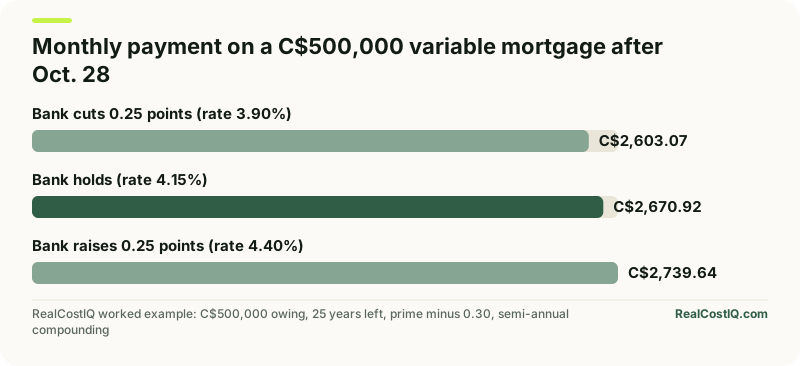
A quarter-point move changes this payment by about C$68 a month. That is about C$825 a year. It is real money. But it is small next to a payment of C$2,671. A full percentage point is four times as much, or about C$280 a month.
Now the same cut or rise on other balances. This lets you scale the example to your own mortgage. We keep the 25 years left and the 4.15% rate.
| Balance owing | Payment today at 4.15% | If the Bank cuts 0.25 | If the Bank raises 0.25 |
|---|---|---|---|
| C$300,000 | C$1,602.55 | C$40.71 lower | C$41.23 higher |
| C$400,000 | C$2,136.73 | C$54.28 lower | C$54.98 higher |
| C$500,000 | C$2,670.92 | C$67.85 lower | C$68.72 higher |
| C$600,000 | C$3,205.10 | C$81.42 lower | C$82.46 higher |
| C$800,000 | C$4,273.47 | C$108.56 lower | C$109.95 higher |
Hypothetical. Semi-annual compounding, 25 years left, rate of prime minus 0.30 with prime at 4.45%. A shorter time left changes the dollar amounts. For example, on C$400,000 with 20 years left, the same 0.25-point rise adds about C$52 a month.
A rise costs a little more than a cut saves. That is not a mistake. Interest builds on itself, so the same step up adds a bit more than the same step down takes off.
Who feels the change at once, and who does not
A rate decision does not hit everyone on the same day. Here is the order.
| Your situation | Effect right away | What to do or watch |
|---|---|---|
| Variable rate, adjustable payment | Your payment changes when your lender moves prime. For a 0.25-point move on C$500,000, that is about C$68 a month. | Look for your lender's notice. Your payment letter will show the new amount. |
| Variable rate, fixed payment | Your payment stays the same. If the rate rises, less of each payment pays down your balance. If it falls, more does. | Learn your trigger rate. That is the rate at which your payment covers only interest. The post on the trigger rate explains it. |
| Home equity line of credit (HELOC) | A HELOC is a credit line secured by your home. Many are priced off prime, so the interest you pay moves when prime moves. Your contract states the margin. | On C$100,000 borrowed, a 0.25-point move changes interest-only cost by about C$21 a month. The HELOC calculator works out your own figure. |
| Fixed rate, mid-term | No change at all. | Nothing to do now. Your term ends on a date in your contract. |
| Fixed rate, renewing in the next year | No change to your current rate. But the rate you are offered at renewal can be affected by the market. | Use the mortgage renewal calculator to test a higher rate before the offer arrives. |
| Shopping for a new mortgage | New fixed and variable quotes may change. Fixed quotes also follow other things, such as lender funding costs. | Compare the offers on the same day. Ask whether the rate is held while you shop. |
HELOC interest example: C$100,000 borrowed, interest only, simple monthly interest at prime of 4.20%, 4.45% and 4.70%: C$350.00, C$370.83 and C$391.67 a month. Hypothetical. The size of the margin over prime depends on your contract.
What a fixed-payment variable mortgage looks like
If your payment is fixed, you might think the decision does not matter. It does, in a quieter way. The payment stays the same, but its two parts shift. One part is interest. The other is principal.
Take the same C$500,000 loan and a payment of C$2,670.92. The first month's interest at each rate is below.
| Rate after the decision | Interest in the payment | Principal in the payment |
|---|---|---|
| 3.90% (cut) | C$1,611.95 | C$1,058.97 |
| 4.15% (hold) | C$1,714.40 | C$956.52 |
| 4.40% (rise) | C$1,816.75 | C$854.17 |
Hypothetical. Interest for the first month on C$500,000 with semi-annual compounding. The payment of C$2,670.92 is the one set at 4.15% over 25 years.
A rise of 0.25 points sends about C$102 more of the payment to interest each month. You still pay the same cash. But your debt falls more slowly, so you take longer to finish paying. A cut does the opposite. If the rate rises by a lot, the payment could one day cover only interest. The trigger rate for this loan, on its opening balance, is about 6.50%. A single 0.25-point move is nowhere near it. The trigger-rate post covers what lenders do when a loan gets there.
Why the decision is not just a number
Three things come out on October 28. First, the rate decision itself. Second, a short statement that explains it. Third, the Monetary Policy Report, which is the Bank's regular outlook for the economy.
For a borrower, the statement and the outlook can matter as much as the rate. Here is why. Fixed mortgage rates follow what lenders expect about the future. If the Bank signals that rates will stay low for longer, new fixed rates may ease. If it signals that inflation worries are growing, they may firm up. This is a general pattern. It is not a promise that any rate will move.
Here is a simple way to read the news on October 28.
- Look first at the rate. Is it 2.25%, 2.00% or 2.50%?
- Then look at the last paragraph of the Bank's statement. It often says how the Bank sees its next steps.
- Check your lender's website for its new prime rate. Your lender may post its change on the same day or a little later.
- If you have an adjustable payment, find your next payment amount in your lender's online account or mailed notice.
What to do before October 28
You do not need to guess the result. You can do a few simple things now. None of them is advice to pick one product over another. They are checks.
- Find out which type you have. Is the rate fixed or variable? If variable, is the payment adjustable or fixed? Your contract says.
- Write down your balance, your rate and the years left. Those three numbers are all you need to try a rate change in the mortgage calculator.
- Try plus and minus 0.25 points, then plus 1 point. See if your budget works at the higher payment. A budget that only works if rates stay flat is a risk worth knowing about.
- If your term ends within a year, test the renewal rate. Use the mortgage renewal calculator. Add a full percentage point to see a stress case.
- If you have a HELOC, find your rate and its margin over prime. Then work out the interest on your balance at today's prime and at 0.25 points above it.
- If you plan to buy soon, remember the qualifying rule. Uninsured borrowers (20% or more down) must show they could pay at the contract rate plus 2 percentage points, or 5.25%, whichever is higher. The Office of the Superintendent of Financial Institutions (OSFI) sets it. Its page was last changed on January 29, 2026. A new rate decision does not change that rule by itself.
Common mistakes when the Bank is in the news
- Thinking a cut lowers every mortgage payment. It lowers payments only on variable-rate mortgages with adjustable payments, and on credit lines. Fixed-rate holders see nothing until they renew.
- Assuming your lender passes the full change on the same day. Each bank sets its own prime. They usually move together, but timing can differ.
- Mixing up the policy rate and prime. The policy rate is 2.25%. Prime is 4.45%. Your variable rate is built from prime, not from the policy rate.
- Treating the term and the amortization as the same thing. The term is the contract you have now, often five years. The amortization is the total time to repay the loan, often 25 years. A rate decision hits the term. Renewal gives you a new term but the same long-run amortization clock.
- Using a US source. A US central bank decision or a US 30-year rate does not set Canadian mortgage payments. Canadian mortgages are priced off Canadian rates, usually with a 5-year term.
What we will update after October 28
After the decision, this page will carry a short update at the top. It will state the Bank's decision and the new rate. It will also show which of the three rows in the tables above applies. It will not change the worked numbers, since those are labelled as scenarios.
If the Bank moves by a different amount than 0.25 points, we will add a row for it. The method is simple. A move of x percentage points shifts prime by x. Then you run your balance, rate and years left through the mortgage calculator.