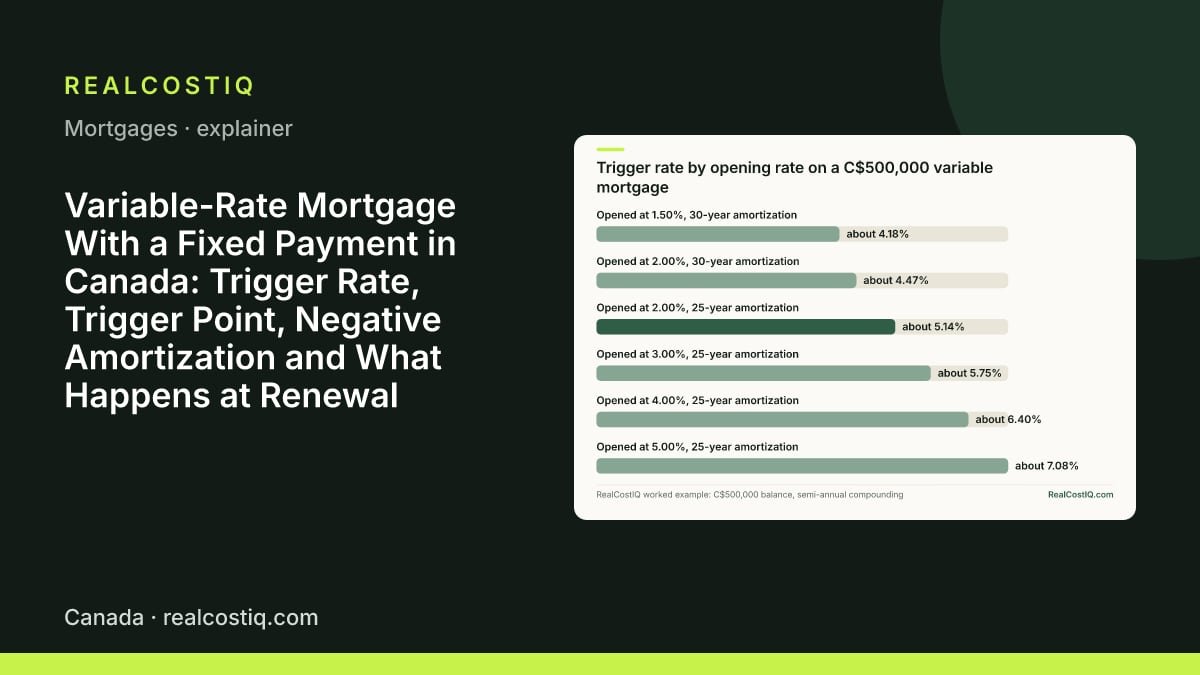
A Canadian variable-rate mortgage has a rate that moves with the lender's prime rate. The prime rate is the base rate a lender uses to price its loans. When prime rises, the mortgage can behave in two very different ways. If the payment is adjustable, it goes up with the rate, and the principal repayment stays on schedule. (Principal is the amount you borrowed and still owe.) If the payment is fixed, it stays put, but the split inside it moves. More goes to interest and less goes to principal. Push the rate high enough and none of the payment reduces the principal at all. That line has a name: the trigger rate. The Financial Consumer Agency of Canada (FCAC), the Bank of Canada and the Office of the Superintendent of Financial Institutions (OSFI) have all written about what happens when borrowers cross it.
This post explains the mechanics from the regulators' own pages, read on 2026-10-09. It then works the arithmetic in Canadian dollars (CAD). The examples use the same semi-annual compounding as the site's mortgage calculator. That is the Canadian way of turning a stated yearly rate into a monthly rate, and it assumes interest compounds twice a year. The examples are hypothetical. Your contract decides what your lender does, not this page. Contract wording differs from lender to lender. If you are weighing a variable rate against a fixed one, the post on comparing mortgage offers beyond the rate covers the clauses that sit beside the rate. This post goes deeper on one of them.
Three payment structures that all get called variable
To see what a Bank of Canada decision does to a variable payment, read the October 28, 2026 rate decision and your mortgage payment. It works through a hold, a cut and a rise on a C$500,000 mortgage.
FCAC sorts variable-rate mortgages by what the payment does when the rate moves. The word "variable" alone says the rate can change. It does not say whether your payment will.
| Structure | What happens when the rate rises | What happens to the balance | Where the risk sits |
|---|---|---|---|
| Variable rate, adjustable (variable) payment | The payment goes up. FCAC says a set amount of each payment goes to principal, and the interest part moves with the rate. | Falls on a known schedule, so you know how much principal you will have repaid by the end of the term. | Your monthly budget. |
| Variable rate, fixed payment | The payment does not move. More of it goes to interest and less to principal. | Falls more slowly. At the extreme, none of the payment reduces principal and the amount owing grows. | The balance and the amortization. |
| Hybrid (part fixed, part variable) | Only the variable portion reacts. | Depends on how the contract splits the payment. | Mixed. FCAC notes hybrids can be harder to move to another lender. |
Source: FCAC, "Interest on mortgages" and mortgage-type guidance, read 2026-10-09. FCAC advises anyone with a fixed-payment variable mortgage to contact their lender as soon as possible to discuss options.
The Bank of Canada studied this product in a November 2022 staff note. It found that variable-rate mortgages made up about one-third of outstanding mortgage debt, up from about 20% at the end of 2019. About three-quarters of those variable-rate mortgages had fixed payments. That is why regulators paid attention: the fixed-payment version had become the common one.
The trigger rate: the arithmetic
The Bank of Canada defines the trigger rate as the interest rate at which the interest portion of the payment equals the whole payment. At that rate the principal portion is zero. The payment was set when the mortgage opened, at a lower rate and a given amortization. (Amortization is the total number of years it would take to pay off the loan.) So the trigger rate follows from three numbers: the opening rate, the amortization and the current balance.
Here is how to find it. Take the fixed monthly payment and divide it by the current balance. Add 1, raise the result to the sixth power, subtract 1 and double what is left. That turns the monthly interest the payment can cover into a yearly rate under Canadian semi-annual compounding. Two features matter. First, the trigger rate is not fixed for the life of the loan. It is worked out on today's balance. It drifts up as the balance falls while the rate is below the trigger. It drifts down if the balance grows. Second, it depends on the compounding method in your contract. That is why the examples below say what they assume.
| Opening rate | Amortization | Fixed monthly payment (CAD) | Trigger rate |
|---|---|---|---|
| 1.50% | 30 years | C$1,724.48 | about 4.18% |
| 2.00% | 30 years | C$1,846.03 | about 4.47% |
| 2.00% | 25 years | C$2,117.26 | about 5.14% |
| 3.00% | 25 years | C$2,366.23 | about 5.75% |
| 4.00% | 25 years | C$2,630.10 | about 6.40% |
| 5.00% | 25 years | C$2,908.02 | about 7.08% |
Computed with the site's Canadian payment formula (nominal rate compounded semi-annually, converted to a monthly rate), labelled hypothetical. Real contracts vary in compounding and in how the lender states the trigger. The 1.50% / 30-year row lands near the 4.2% trigger rate the Bank of Canada used in its own hypothetical (a 30-year amortization starting at 1.5%).
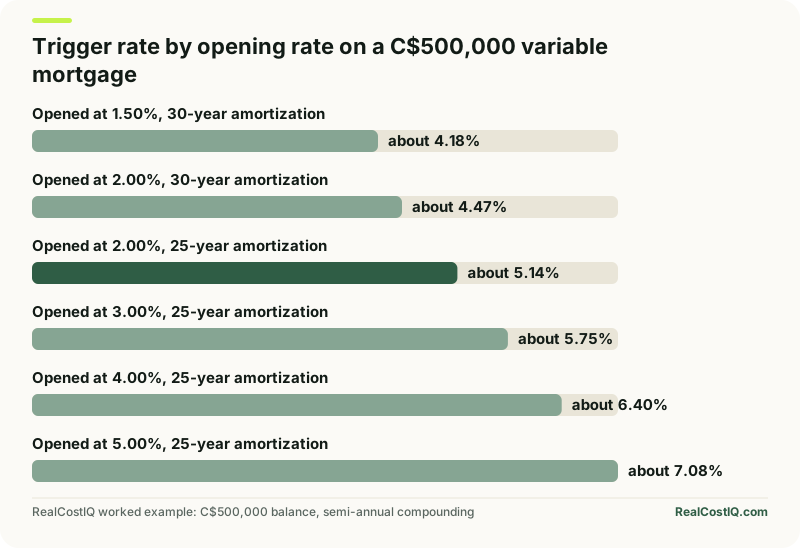
Two patterns follow. First, a longer amortization lowers the payment, so it also lowers the trigger rate. The same 2.00% opening rate has a trigger near 5.14% on a 25-year amortization and near 4.47% on a 30-year one. Second, a lower opening rate means a lower trigger. That is why mortgages opened when rates were lowest were the first to cross theirs. The amortization calculator shows how much a longer schedule trims the payment and what it costs in interest. That is the same trade that shrinks this safety margin.
What lenders do when the trigger rate is reached
The Bank of Canada notes that lenders differ. Some raise the payment automatically so it keeps covering interest. They raise it again if rates rise further. Others let the interest exceed the payment. Then the principal portion goes negative, and the balance grows month by month. The Bank also noted that some lenders contact borrowers before the trigger rate is reached. They offer options such as a switch to a fixed rate or a lump-sum payment.
FCAC gave a briefing to the House of Commons Standing Committee on Finance (hearing of 2024-02-13, page dated 2025-09-09). It adds the options written into the contract. Lenders may require borrowers to increase payments, make extra payments to cover the excess interest, or convert to a fixed-rate mortgage. FCAC's consumer page describes the unpaid-interest outcome plainly: the lender will generally add unpaid interest to the balance owed. FCAC's interest page uses the phrase "trigger point" for the payment-increase threshold. So the two terms are not used the same way in every document. Read your contract to see what each word means there.
| Response | Monthly payment | Balance | Typical borrower experience |
|---|---|---|---|
| Lender raises the payment to cover interest | Rises, possibly again if rates rise further | Does not grow, but does not fall either at the trigger rate | A budget shock, but the debt does not compound on itself. |
| Lender lets the balance grow (negative amortization) | Unchanged | Grows each month by the unpaid interest | A comfortable payment now and a larger bill later. Renewal and the trigger point are where it surfaces. |
Source: Bank of Canada Staff Analytical Note 2022-19 and FCAC briefing (2024-02-13), both read 2026-10-09. Which response applies is a contract term.
The trigger point is a different line
The trigger rate is about the payment. The trigger point is about the balance. In FCAC's briefing, the trigger point is reached when the balance has grown past the ratio of loan to home value that the lender will accept. Until then, the briefing says, a variable-rate mortgage can sit above its trigger rate. Once the trigger point is hit, the lender can require the borrower to adjust payments, make a prepayment (an extra lump sum) or pay off the balance.
Neither the Bank of Canada nor FCAC publishes a standard percentage for the trigger point. It is a contract term. To make it concrete, suppose a contract set it at 105% of the original C$500,000, which is C$525,000. That figure is illustrative only. The point is the timing, which the next section works through. A mortgage can sit above its trigger rate for years before it reaches the trigger point. Then the lender's remedies arrive together.
A five-year path, worked in CAD
The table holds the rate constant for the whole five-year term. Real prime rates move, so treat each row as a what-if, not a forecast. Each row starts as a C$500,000 variable-rate mortgage on a 25-year amortization, and the 30-year row is marked. The payment stays fixed at the level set by the opening rate.
| Opening rate | Rate for the term | Fixed payment | Interest in month 1 | Balance after 60 months | Reaches C$525,000 (105%)? |
|---|---|---|---|---|---|
| 2.00% | 4.00% | C$2,117.26 | C$1,652.95 | about C$469,200 | No (payment still covers interest) |
| 2.00% | 5.00% | C$2,117.26 | C$2,061.96 | about C$496,200 | No (just below the trigger rate) |
| 2.00% | 5.50% | C$2,117.26 | C$2,265.84 | about C$510,200 | No |
| 2.00% | 6.50% | C$2,117.26 | C$2,672.37 | about C$539,100 | Yes, around month 41 |
| 2.00% (30-year) | 5.50% | C$1,846.03 | C$2,265.84 | about C$528,900 | Yes, around month 53 |
| 4.00% | 6.50% | C$2,630.10 | C$2,672.37 | about C$503,000 | No |
| 5.00% | 6.50% | C$2,908.02 | C$2,672.37 | about C$483,400 | No (payment still covers interest) |
Computed with the site's Canadian mortgage formula, labelled hypothetical. 'Reaches C$525,000' uses the illustrative 105% trigger point above, not any lender's actual setting.
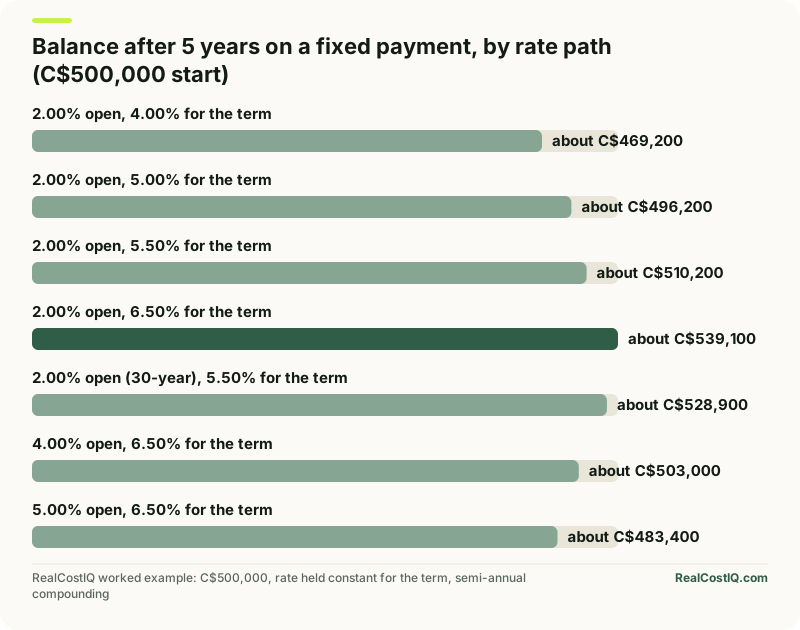
The row with a 2.00% opening rate and 5.50% is the quiet case. In month 1 the payment falls short of the monthly interest by about C$148.58. The balance grows, so the trigger rate drifts lower and the shortfall persists. After five years the balance sits around C$510,200, above the C$500,000 borrowed. The same mortgage at 6.50% runs a shortfall of about C$555.11 in month 1. It crosses the illustrative trigger point in the fourth year. The 30-year amortization is more fragile. At 5.50% it crosses the same point in the fifth year, while the 25-year schedule at the same 5.50% never does. The mortgage opened at 5.00% never goes negative at 6.50%, because its trigger rate was already near 7.08%.
You can test your own inputs in the mortgage calculator. It gives the opening payment under the Canadian compounding convention. You can repeat the negative-amortization arithmetic above by hand, as a simple balance roll-forward. Each month, add the interest at the current rate. Then subtract the payment.
What changes at renewal
A mortgage must be renewed at the end of each term. FCAC notes that most borrowers need several terms to repay a mortgage. At renewal, the lender prices the balance you actually owe, over the amortization that remains, at the renewal rate. A negatively amortizing loan arrives at that date with a bigger balance and the same years left, or a stretched schedule. So the maths gets harder.
| Opening rate / path | Balance at month 60 | Payment before | Payment after (20 years remaining) | Change |
|---|---|---|---|---|
| 2.00%, then 4.00% | about C$469,200 | C$2,117.26 | about C$2,835 | about +34% |
| 2.00%, then 5.00% | about C$496,200 | C$2,117.26 | about C$3,261 | about +54% |
| 2.00%, then 5.50% | about C$510,200 | C$2,117.26 | about C$3,492 | about +65% |
| 2.00%, then 6.50% | about C$539,100 | C$2,117.26 | about C$3,992 | about +89% |
| 4.00%, then 6.50% | about C$503,000 | C$2,630.10 | about C$3,725 | about +42% |
Assumes the renewal rate equals the rate that applied during the term and that the lender re-amortizes over the 20 years that remain. Both are assumptions for illustration; a lender can offer a different rate, and a longer re-amortization lowers the payment at the cost of more interest. Check your own renewal quote in the mortgage renewal calculator.
Two details sit behind those percentages. First, the payment jump is mostly the rate, not the negative amortization. A borrower on an adjustable payment would see the payment move with the rate all through the term. That borrower would pay roughly C$3,052 a month on a C$500,000, 25-year mortgage at 5.50% from day one. What negative amortization changes is when the cost arrives. It also changes how much extra principal has to be repaid, because the higher balance is spread over fewer years. Second, renewal is also where the lender can offer conversion to a fixed rate, a payment reset, or a longer amortization to soften the payment. FCAC's guideline says any amortization extension granted as relief should be the shortest possible. It should come with a plan to restore the original amortization within a reasonable time.
What the regulators did about it
OSFI is the federal regulator of banks and insurers. It revised its Capital Adequacy Requirements guideline and its mortgage-insurer capital test. Federally regulated lenders and mortgage insurers must now hold more capital against mortgages where the payment does not cover the interest. (Capital is the money a lender must keep in reserve to absorb losses.) OSFI's announcement said the revisions took effect on January 1, 2024 for most institutions. For banks with an October 31 fiscal year-end, the date was November 1, 2023. It also said existing borrowers' monthly payments would not rise because of the change. FCAC's briefing records OSFI's Superintendent calling the product dangerous when speaking to the Senate committee. The Superintendent noted that it can leave balances growing and raise default risk.
FCAC has a Guideline on Existing Consumer Mortgage Loans in Exceptional Circumstances. It applies to federally regulated institutions. It covers borrowers on fixed-payment variable mortgages who have seen a much larger share of the payment go to interest, or who may face negative amortization. It lists temporary relief a lender should consider. That includes waiving prepayment penalties when a borrower makes a lump-sum payment to avoid negative amortization. It includes waiving internal fees for a limited period and not charging interest on capitalized interest (unpaid interest added to the balance). At renewal, it includes not offering a worse rate just because the borrower could not adjust the agreement or qualify elsewhere. The guideline also expects lender and borrower to agree a plan to restore the original amortization.
FCAC's supervisory report on the guideline gives the scale. In September 2023, 31% of variable-rate fixed-payment mortgages reported to FCAC were in negative amortization (217,000 of 699,011 accounts). By June 2024 the share was 18% (119,000 of 657,272), or about 2.4% of all principal-residence mortgages. The same report used OSFI data. It found that as of July 2024 about 69% of outstanding mortgages were due for renewal by the end of 2026, down from 76% in February 2024. The earlier Bank of Canada note looked at October 2022, when a typical variable rate was near 5.1%. It estimated that about half of fixed-payment variable mortgages had reached their trigger rate. The median trigger among those was 4.8%. Where lenders raised payments, the typical increase was no more than about 5%. The Bank called this an upper-bound estimate (the most it could be) because it ignored prepayments and switches.
These are the figures and guidelines of federally regulated lenders. The guideline covers only federally regulated institutions. A borrower with a provincially regulated credit union or a non-bank lender should ask that lender directly what relief it offers. Do not assume the same terms.
Where the policy rate stands today
On September 2, 2026 the Bank of Canada held its target for the overnight rate at 2.25%, with the Bank Rate at 2.5%. It said its next announcement is scheduled for October 28, 2026. The policy rate is not your mortgage rate. Your rate follows your lender's prime rate, plus or minus the spread in your contract. The relevance here is context. The mortgages that struggled were those opened at very low variable rates. A new fixed-payment variable mortgage today starts with a payment set at today's higher level. So it has more room before it hits its trigger rate than one opened at 1.5% did. The arithmetic table above shows that. The same 25-year amortization has a trigger near 5.14% when opened at 2.00% and near 6.40% when opened at 4.00%.
How to read your own contract
FCAC says the trigger point is listed in your mortgage contract. The Bank of Canada says each borrower has an individual trigger rate stated there. Quebec mortgages are drafted under the Civil Code of Québec and may be laid out differently. I did not read a Quebec lender's contract today, so use the checklist as a prompt, not a template.
- Find the payment type. Does the contract say the payment is fixed for the term, or that it changes when the rate changes?
- Find the trigger rate and the trigger point. Are they stated? Are they a rate, a balance, or a loan-to-value ratio (the loan as a share of the home's value)? Which one does the lender call the trigger?
- Find what the lender does at each line. Does it raise the payment, require a lump sum, convert to fixed, or add the unpaid interest to the balance?
- Check the notice period. How soon after you reach the line must the lender tell you? How long do you have to respond?
- Check the conversion and prepayment terms. Is there a fee to convert to a fixed rate during the term? Is there a penalty on a lump sum?
- Ask for a current statement. The lender can tell you your balance and the current trigger rate at that balance. It can also tell you the gap between your rate and that trigger.
Options before the line, and after it
FCAC's consumer pages say to contact the lender as soon as possible once you suspect a problem. The practical options fall into four groups.
- Prepay principal. A lump sum cuts the balance and raises the trigger rate. Check the prepayment privilege in your contract. FCAC's guideline asks lenders to consider waiving the penalty on a lump sum made to avoid negative amortization.
- Raise the payment voluntarily. Pay the adjustable-payment amount for your balance and rate. That rebuilds principal repayment without waiting for the lender. Many contracts allow this, so confirm it.
- Convert to a fixed rate. FCAC notes a convertible feature usually carries a fee and conditions. The new fixed rate may be higher than the variable rate you give up. Compare the full cost, including any penalty for leaving the term early.
- Extend the amortization, with a plan to restore it. The FCAC guideline treats this as a last resort. It expects the extension to be as short as possible, with a plan to restore the old schedule.
If you are a first-time buyer choosing a rate type, the site's stress-test post explains how the qualifying rate is set. The qualifying test is not the same thing as the trigger rate. The first is a lender's affordability rule at application. The second is a contract feature during the term. Passing one tells you nothing about the other.
What this post does not cover
It does not model your lender's compounding, because contracts vary. It does not predict rates. It does not cover the practices of provincially regulated or private lenders, which the federal guideline does not reach. The figures from the Bank of Canada and FCAC reflect the dates stated. The share of mortgages in negative amortization has moved since and will keep moving. For the term-end decision itself, use the tools linked above. Ask your lender for a written renewal quote that states the payment, the balance and the remaining amortization.