People who compare Calgary and Edmonton usually start with the price of a house. That is only one of the costs. This post adds up the rest: the down payment, mortgage insurance, the yearly property tax, and the fees to register the home. It uses the 2026 tax rates from each city and the September 2026 price reports from each real estate board. Every amount is in Canadian dollars (CAD).
In plain English
- Both cities are in Alberta. Alberta has no land transfer tax, and the same fee schedule, mortgage rules and insurance premium table apply in both. So on the same price, buying costs the same in either city.
- Property tax is the big difference. Edmonton's 2026 residential rate is about 1.04% of assessed value. Calgary's is about 0.67%. On a C$500,000 home, that is about C$5,182 a year in Edmonton and C$3,325 in Calgary.
- Prices work the other way. In September 2026 the benchmark detached home was C$739,400 in Calgary. The matching Greater Edmonton figure was C$518,900.
- At those benchmark prices and an illustrative 4.50% rate, the mortgage payment plus tax is about C$4,384 a month in Calgary and C$3,280 in Edmonton, for a house. The cheaper price wins by far more than the tax gap costs.
- On an apartment, the pattern holds on the payment. The tax gap is small in dollars, but Edmonton's tax is higher even though the apartment costs less.
Words you need first
- Assessed value: the value a city puts on your property to work out your tax. It is set by the city. It can differ from the price you pay.
- Mill rate: the tax rate, written per C$1,000 of assessed value. A rate of 6.65 mills means C$6.65 of tax for every C$1,000 of value. A rate written as 0.0066499 is the same thing as a decimal.
- Property tax: the yearly bill. It equals the assessed value times the rate. Part goes to the city and part goes to the province for schools. The schools part is called the education tax.
- Benchmark price: a price report from a real estate board. It tracks a typical home of each type, so it is steadier than an average of sales. It is not the price of any one home.
- Land titles fee: the fee Alberta charges to register a change of owner and to register your mortgage. It is a fee set by a schedule. It is not a land transfer tax.
- CMHC: the Canada Mortgage and Housing Corporation. It is a federal Crown corporation. It insures mortgages for buyers who put down less than 20%. The cost of that insurance is called the premium.
- Down payment: the part of the price you pay in cash. In Canada the minimum is 5% of the first C$500,000 plus 10% of the part above that.
- Amortization and term: the amortization is the total time to repay the loan, often 25 years. The term is the length of one contract, often five years. At the end of a term you renew at the rates then on offer.
Worked example: the same C$500,000 home in both cities
Start with round numbers and one price. Suppose you buy a C$500,000 home. Pretend it stands in Calgary, then in Edmonton. You put down the minimum. The Financial Consumer Agency of Canada (FCAC) says a price of C$500,000 or less needs 5% down. That is C$25,000. Here is the loan step by step.
- Loan before insurance: C$500,000 minus C$25,000 is C$475,000. That is 95% of the price.
- CMHC premium: for a loan of 90.01% to 95% of the price, CMHC's premium table says 4.00% of the loan. That is C$19,000. Alberta does not charge provincial sales tax on this premium. CMHC names only Ontario, Quebec and Saskatchewan. We add the premium to the loan.
- Total mortgage: C$475,000 plus C$19,000 is C$494,000.
- Payment: over a 25-year amortization at an illustrative 4.50%, the payment is about C$2,734 a month. This is not a quote. Canadian mortgages compound interest twice a year, not monthly. The site's mortgage calculator uses that rule.
- Registration fees: Alberta charges C$50 plus C$5 per C$5,000 of value. The transfer on C$500,000 is C$550. The mortgage registration on the C$494,000 insured mortgage (the premium is part of the loan) is C$545.
- Property tax: assessed value times the 2026 rate. Calgary is C$500,000 times 0.0066499, or about C$3,325. Edmonton is C$500,000 times 0.0103637, or about C$5,182.
| Item | In Calgary | In Edmonton |
|---|---|---|
| Down payment (5%) | C$25,000 | C$25,000 |
| CMHC premium (4.00% of C$475,000) | C$19,000 | C$19,000 |
| Total mortgage | C$494,000 | C$494,000 |
| Monthly mortgage payment | about C$2,734 | about C$2,734 |
| Land titles fee, transfer | C$550 | C$550 |
| Land titles fee, mortgage | C$545 | C$545 |
| 2026 property tax, per year | about C$3,325 | about C$5,182 |
| 2026 property tax, per month | about C$277 | about C$432 |
| Payment plus tax, per month | about C$3,011 | about C$3,166 |
Rates: City of Calgary and City of Edmonton 2026 residential tax rates, read 2026-10-16. Premium: CMHC premium table, read 2026-10-16. Fees: Alberta Land Titles Registration Levy, in force for submissions on or after 2024-10-20. Payment and fees from the site's mortgage and Alberta closing-costs calculators. The mortgage fee is figured on the insured mortgage, premium included, as the site's Alberta calculator does. Assumes the assessed value equals the price.
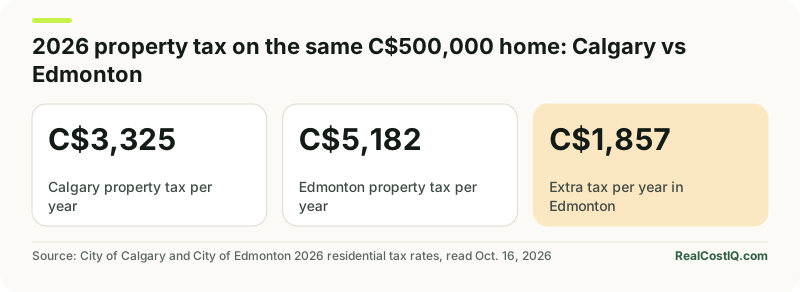
The only line that changes is property tax. On this home, Edmonton costs about C$1,857 more a year, or about C$155 a month. Over a five-year term that is about C$9,285, if the rates and the assessed value stayed where they are. They will not stay still, but it shows the size of the gap.
Now the formula, which you can check against any bill. Property tax equals assessed value times the rate. Calgary's own page gives it as: total tax due is the assessment times the City's rate, plus the assessment times the Province's rate. Edmonton works the same way, with one extra small line.
Why the tax bills differ: the 2026 rates
Each city publishes its rates in a table. Here are the 2026 residential rates, with 2025 beside them. Residential means a home you live in, not a business property.
| Part of the rate | Calgary 2026 | Edmonton 2026 |
|---|---|---|
| City (municipal) part | 0.0038906 (0.38906%) | 0.0077419 (0.77419%) |
| School (education) part | 0.0027593 (0.27593%) | 0.0025409 (0.25409%) |
| Education requisition allowance | none listed | 0.0000809 (0.00809%) |
| Total | 0.0066499 (0.66499%) | 0.0103637 (1.03637%) |
| Total in 2025 | 0.0061803 | 0.0101391 |
| Change in the total rate, 2025 to 2026 | up about 7.6% | up about 2.2% |
Calgary: City of Calgary, Historical Tax Rates (Property Tax Bylaw 9M2026), read 2026-10-16. Edmonton: City of Edmonton, Historical Tax Rates (2026 Bylaw 21442), read 2026-10-16. The percent changes are our arithmetic from the two columns.
Look at the school part first. It is nearly the same in both cities: about 0.28% in Calgary and about 0.26% in Edmonton. The province sets it, so that is no surprise. The whole gap sits in the city part. Edmonton's city rate is about double Calgary's. That alone adds about 0.385 percentage points.
Why would one city charge double? The pages we read do not compare the two budgets, so we can only explain the arithmetic. A city sets its rate so the tax it collects meets its budget. If home values are lower, a city needs a higher rate to raise the same money from homes. Edmonton's homes are cheaper, as the next section shows. Business property pays a different rate too. In Edmonton the 2026 non-residential total is 2.92663%. Treat this as the general rule, not as a finding about either budget.
Prices: where Calgary costs more
Now the other half. The Calgary Real Estate Board (CREB) and the REALTORS® Association of Edmonton (RAE) both publish a benchmark price each month. RAE calls its figure the MLS® HPI benchmark price; CREB's report lists a benchmark price and an index. The two reports cover different areas. CREB covers the city of Calgary. RAE covers the Greater Edmonton Area, which is wider than the city. So read the comparison as close, not exact.
| Home type | Calgary (CREB) | Greater Edmonton (RAE) | Calgary minus Edmonton |
|---|---|---|---|
| All residential (composite) | C$566,700 | C$423,100 | C$143,600 |
| Detached / single-family | C$739,400 | C$518,900 | C$220,500 |
| Row / townhouse | C$412,400 | C$269,500 | C$142,900 |
| Apartment | C$291,400 | C$197,400 | C$94,000 |
CREB, September 2026 Calgary Monthly Stats Package; RAE, September 2026 Monthly Market Statistics (released 2026-10-02). Both read 2026-10-16. The last column is our subtraction. CREB also lists semi-detached homes at C$685,200; the RAE table has no semi-detached benchmark.
A Calgary detached home costs about 42% more than the Edmonton single-family benchmark. An apartment costs about 48% more. CREB's report shows prices flat to lower from a year ago. The Calgary composite fell 0.82% and the detached price fell 0.95% year over year. Apartments fell 8.28%. RAE shows the Edmonton composite down 0.3% from a year ago and the single-family price about flat. Apartments there fell 1.1%.
The boards also report supply. In September 2026 CREB counted 1,650 sales in Calgary, down 3.85% from a year earlier, and 3.93 months of supply. RAE counted 1,959 sales in the Greater Edmonton Area, down 10.3% from a year earlier, and said inventory was 16.7% higher than a year ago. These numbers can change fast. A buyer who needs to move in a short time should read the latest report, not this post.
Worked example two: a benchmark detached home in each city
Back to the cost of owning. This time each city gets its own benchmark price. The steps are the same as before. The down payment rule is 5% of the first C$500,000 plus 10% of the rest. The premium is 4.00% in both cases, because each loan is between 90.01% and 95% of the price. The rate is the same illustrative 4.50%. The tax uses each city's 2026 rate, with the benchmark price standing in for the assessed value.
| Item | Calgary detached | Edmonton single-family |
|---|---|---|
| Price (September 2026 benchmark) | C$739,400 | C$518,900 |
| Minimum down payment | C$48,940 (6.6%) | C$26,890 (5.2%) |
| Loan before insurance | C$690,460 | C$492,010 |
| CMHC premium (4.00%) | C$27,618 | C$19,680 |
| Total mortgage | C$718,078 | C$511,690 |
| Monthly payment (4.50%, 25 years) | about C$3,974 | about C$2,832 |
| Land titles fees (transfer + mortgage) | C$1,560 | C$1,135 |
| 2026 property tax, per year | about C$4,917 | about C$5,378 |
| Payment plus tax, per month | about C$4,384 | about C$3,280 |
Premium and rate: CMHC premium table and the site's mortgage calculator. Fees: site's Alberta closing-costs calculator, at the Alberta fee schedule effective 2026-10-01 (levy rate in force since 2024-10-20), with the mortgage fee on the insured mortgage including the premium. Property tax: 2026 residential rates from each city, read 2026-10-16. The benchmark price is a stand-in for the assessed value, and a real assessment will differ.
Read the last row. The Calgary buyer pays about C$1,104 a month more. The Edmonton buyer pays about C$461 a year more in property tax, but about C$1,142 a month less on the mortgage. The tax gap is real, but it is small next to the price gap. The cash to close also differs. The Calgary buyer needs about C$22,050 more for the down payment, and about C$425 more in land titles fees.
One more way to see the tax rate. An Edmonton home pays the same yearly tax as a Calgary detached home at C$739,400 if its assessed value is about C$474,400. At the Edmonton benchmark of C$518,900, the Edmonton owner is already past that line. This is just the rate ratio. Edmonton's rate is about 1.56 times Calgary's.
The same test on an apartment
An apartment condo is where the tax gap looks odd. Both benchmark apartments need exactly 5% down, because each costs less than C$500,000.
| Item | Calgary apartment | Edmonton apartment |
|---|---|---|
| Price (September 2026 benchmark) | C$291,400 | C$197,400 |
| Down payment (5%) | C$14,570 | C$9,870 |
| CMHC premium (4.00%) | C$11,073 | C$7,501 |
| Monthly payment (4.50%, 25 years) | about C$1,593 | about C$1,079 |
| 2026 property tax, per year | about C$1,938 | about C$2,046 |
| Payment plus tax, per month | about C$1,755 | about C$1,250 |
Same method and sources as the detached table. Condo fees are not included. They are a separate monthly charge set by each building, and they can be large. The assessed value is assumed to equal the benchmark price.
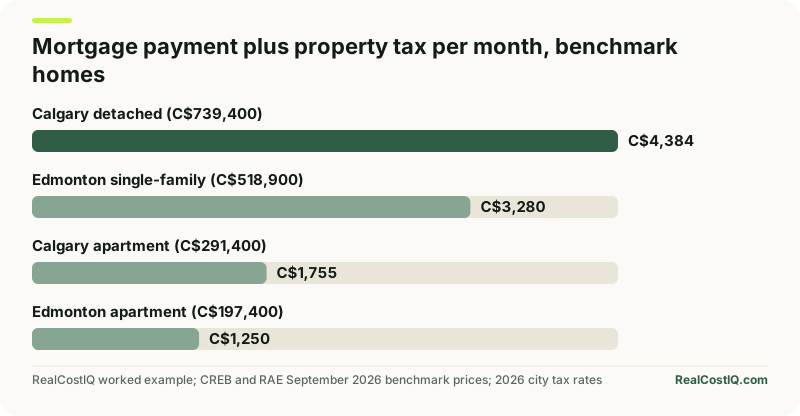
The Edmonton apartment costs C$94,000 less, yet its yearly tax is about C$108 higher. That is the rate gap at work. Still, the monthly payment plus tax is about C$505 lower in Edmonton. Condo fees are the missing piece. Add the fee for a real building before you compare. The site's property tax calculator lets you test a city rate against a price you choose.
Closing costs: Alberta has no land transfer tax
Alberta does not charge a land transfer tax. Buyers in Calgary and Edmonton pay the same land titles fees instead. Since October 20, 2024, the Alberta government's Land Titles Registration Levy has set the sliding scale at C$5 per C$5,000 of value, for both a transfer of land and a mortgage registration. Before that, the scale was C$2 per C$5,000 for transfers and C$1.50 per C$5,000 for mortgages. Many older web pages still show the old numbers.
Our worked examples use a C$50 base plus the C$5 scale, as the site's Alberta calculator does. Alberta's fee schedule, updated effective October 1, 2026, lists both as C$50 plus C$5 per C$5,000. Check the schedule for the exact fee on your documents. The key point is the size. On a C$739,400 home the two fees total about C$1,560. That is small next to the C$27,618 premium or the down payment.
The costs that do vary are legal fees, a title search or title insurance, and a home inspection. They are set by firms and not by a government schedule. We found no source that shows them differing by city. The site's Alberta closing costs calculator shows them as ranges. This post leaves them out so the comparison stays on the costs we can source.
What changed in 2026 on the tax bill
The province's share is growing fast in both cities. Calgary's page shows a typical single-family home with an assessed value of C$706,000 in 2026, up from C$697,000 in 2025. For that home, the City's part rose by C$49, or 1.8%. The province's part rose by C$338, or 21%. At the 2026 rates, C$706,000 gives about C$2,747 for the City and about C$1,948 for the province. That is about C$4,695 in all.
Edmonton's one-page guide shows the same push. It lists a 7.3% change in the municipal tax and a 10.2% change in the provincial education tax. It gives 8.0% as the total rise for a typical home, with assessed values up 5.7% overall. The City says its budgeted increase was 6.9%. The extra comes from a decision to phase out a higher rate on multi-family property.
What this means for a buyer is simple. The tax on a home you buy today will not match the tax the seller paid. Ask for the seller's latest bill, then work it out again with the current rate and the new assessment. Do not assume the old amount carries over.
Other costs this post leaves out
Owning a home costs more than a mortgage and a tax bill. Home insurance matters a great deal in Alberta, because of hail. Insurance Bureau of Canada work covered in our home insurance post says hail risk is highest around Calgary. We did not compare premiums here, because they depend on the roof, the street and the insurer.
We also did not compare water, power, gas or heating, and we did not compare condo fees. These can add a few hundred dollars a month, and they vary by building and by house. A fair last step is to get a real quote or bill for each cost on a home you are serious about.
About the 4.50% rate
The 4.50% used above is a round number to make the examples easy to follow. It is not an offer, and it is not today's posted rate. The Bank of Canada held its target for the overnight rate at 2.25% on September 2, 2026. Its next decision is set for October 28, 2026. Mortgage rates move with bond markets and lender pricing, not only with that target.
If you want to test another rate, the effect is easy to see. On the Calgary detached loan of C$718,078, a payment at 5.50% instead of 4.50% is about C$4,383 instead of C$3,974. That is C$409 more a month. The Edmonton loan of C$511,690 goes from about C$2,832 to about C$3,123, which is C$291 more. The same rate change costs the bigger Calgary loan more in dollars.
A simple way to compare any two homes
- Write down the price. Work out the minimum down payment with the 5% and 10% rule.
- Find the CMHC premium rate from the loan size as a share of the price. Add it to the loan.
- Work out the monthly payment at one rate for both homes, over the same amortization.
- Look up the city's current residential tax rate on its own website. Multiply it by the assessed value, or by the price if you do not have an assessment yet.
- Add condo fees, insurance and utilities from real quotes.
- Compare the total per month, then compare the cash you need to close.