A home insurance quote is one number. But it is built from a short list of facts about the building, about you, and about where the building stands. Most owners only see the total price and the deductible. (The deductible is the amount you pay yourself before the insurer pays a claim.) So they cannot tell which fact is moving the price. They often find out what was left out only when a basement floods. This post answers two questions. The first half covers what insurers weigh when they price a house in Canada, using the Insurance Bureau of Canada's own descriptions. We call it IBC from here on. The second half covers three water and earth risks that standard policies commonly leave out. It also gives the province-specific points that regulators and insurers' own materials make.
One rule governs this whole post: no premium dollar figure appears in it. (The premium is the price you pay for the policy.) Premiums change by insurer, by street and by year. The only figure worth quoting is one from a primary source with a date. None of the sources below states a Canadian home insurance premium. All were opened and read on 2026-10-08. So we quote none. The only percentages here are ones a named source states, and each is labelled. The home insurance estimator on this site shows how changing inputs moves an illustrative estimate. It is a model, not a quote. Nothing in this post relies on its figures.
This is information, not insurance advice. Policies differ by insurer, and the wording of your own policy is what applies. IBC says the same on its pages. Check your own policy, and check cost and availability with your insurance representative.
What an insurer weighs when it prices a house
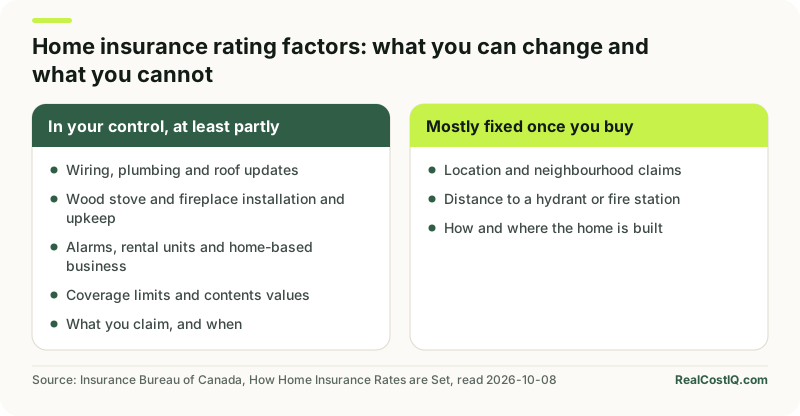
IBC's page "How Home Insurance Rates are Set" lists seven factors. Each one is something an owner either knows or can find out. Several can be changed. That makes the list a good checklist.
| Factor (IBC) | What IBC says | Is it in your control? |
|---|---|---|
| Replacement cost | A home's size, how and where it is constructed and the value of your contents significantly affect what you pay | Partly: you choose limits and contents values; construction is fixed |
| Maintenance and updates | Insurers ask about electrical, plumbing and roofing; they generally prefer roofs updated within 20 years | Yes, over time, by upgrading systems |
| Wood stoves and fireplaces | If not properly installed or maintained they can cause fires and carbon monoxide poisoning; they can affect availability and cost | Yes: installation and maintenance |
| Unique property features | Home-based businesses, rental units, heritage designation, alarms, pools and extra structures | Partly: alarms and use of the home |
| Location | Insurers track claims by neighbourhood; severe weather driving up claims where you live may raise costs | No, apart from where you buy |
| Distance to fire services | Properties far from a hydrant or fire station may cost more, because faster firefighting reduces restoration costs | No, apart from where you buy |
| Claims history | Past claims are often an insurer's best predictor of future claims activity | Partly: what you claim and when |
Source: Insurance Bureau of Canada, How Home Insurance Rates are Set, read 2026-10-08. The IBC page gives no premium figures or percentages.
Rebuild cost is not market value
This first factor surprises owners who think of their house as what it would sell for. IBC's page on types of home coverage says the building coverage should reflect what it would cost to rebuild if the home were destroyed. It adds that the replacement value of your home may differ from the market value and from the municipal tax assessment value. A house on an expensive city lot can be worth far more on the market than it costs to rebuild. A custom house in a small town can cost more to rebuild than it would sell for. The insurer prices the building, not the land under it.
The Financial Consumer Agency of Canada (FCAC) gives the owner's side of this. Its page on insurance for unexpected events and disasters is dated 2026-07-14. It says to find out what it would cost to rebuild your home. Also find out how your insurer calculates payouts and deductibles. Check whether your policy includes guaranteed building replacement. That feature usually has conditions, such as insuring the full replacement cost and rebuilding on the same site. Your limit is the most the insurer will pay. If it is set too low, you may be underinsured on the day it matters. If it is set too high, you pay for coverage you can never collect.
Wiring, plumbing and roof
IBC is specific about what insurers ask. For electrical systems, they ask about knob-and-tube or aluminum wiring. Knob-and-tube is an old wiring style found in older houses. They also ask about fuses or service under 100 amps. They may require updated wiring, at least 100-amp service with breakers, or an inspection by a licensed electrician. For plumbing, galvanized steel or lead pipes are more prone to cracking and leaking. Switching to copper or plastic can lower your costs. For roofing, insurers generally prefer roofs updated within 20 years. IBC notes that if a worn-out roof leaks, interior damage may be covered. The roof itself typically is not.
Remember this last point: a home insurance policy is not a maintenance contract. IBC's coverage page lists common exclusions that follow from that idea. (An exclusion is something the policy does not cover.) One is damage from freezing indoor plumbing. This applies when you are away from home for more than four days in the normal heating season without draining the plumbing or having the heat checked. Others are damage from insects and rodents, and pollution. The age-and-condition questions on an application let the insurer price the chance that a worn system fails. Then the policy must decide whether the loss was sudden damage or neglect.
Your claims, your disclosure and your deductible
Claims history works in two directions. The insurer reads your own past claims as a predictor. It also tracks claims across your neighbourhood. IBC says that if severe weather is driving up claims where you live, your costs may rise. That is why two identical houses with the same owner profile can be priced differently a few kilometres apart.
The deductible is the one factor fully in your hands when you buy. FCAC discusses this in its section on earthquake deductibles. Some insurers let you lower the deductible by paying a higher premium. Others let you lower the premium by accepting a higher deductible. The same trade is worth asking about on the base deductible. It is a choice about cash, because a higher deductible must be found on the day of a claim. A good rule of thumb for any deductible is to set it at a figure you could pay from savings without borrowing.
Finally, disclose accurately. IBC's page lists home-based businesses, rental units, extra structures and wood stoves as things insurers ask about. A policy written on incomplete answers can leave you arguing about coverage at the worst moment. So tell the insurer about a rental suite or a home business before you need to.
Three risks a standard policy commonly leaves out
A standard home policy covers many perils, which are causes of loss. But three of the costliest water and earth events are left out unless you add coverage. The sources agree on the pattern even where their wording differs. The coverage is optional. It is priced by risk. It often has a higher deductible. It may not be available at all where the risk is high.
| Risk | Standard policy | Optional coverage | What the sources say about price and limits |
|---|---|---|---|
| Sewer backup | Typically not covered | Optional sewer backup, offered by most insurers | IBC: often combined with overland flood; commonly excluded for seasonal or secondary properties; ask your insurer for the limit |
| Overland flood | Typically not covered | Optional, offered by many insurers and based on risk | IBC: availability depends on risk, often bundled with sewer backup; FCAC: premium depends on your area's flood risk, deductible usually higher, and in very high-risk areas insurers may decline |
| Earthquake | Not included | Optional add-on to an existing policy | FCAC: deductible percentages may range from 5% to 20% of the coverage limit; premiums usually higher than other coverage |
Sources: IBC (Water Damage and Flood Protection; Flooding and Insurance; Earthquake Protection; Types of Home Coverage) and FCAC (Insurance for unexpected events and disasters), all read 2026-10-08. The IBC and FCAC pages give no premium figure for any of the three.
Sewer backup
IBC's page on water damage and flood protection says a standard policy typically does not cover damage from sewers and drains backing up. It says most insurers offer optional sewer backup coverage. Its "Flooding and Insurance" page adds that basement water damage from a sewer backup is covered only if you bought specific, optional sewer backup coverage. The key question is not just whether you have it, but how much it pays. Neither IBC page states a limit, so ask your insurer for it. IBC also lists sewer backup as commonly excluded for seasonal or secondary properties. So a cottage may not carry it by default.
The prevention advice matters for pricing as well as for damage. IBC recommends installing a backwater valve as recommended by your municipality. A backwater valve stops sewage from flowing back into your house. IBC also recommends a sump pump with a battery backup. A sump pump removes water that collects under the house. IBC says some municipalities offer subsidies and some insurers offer incentives for installing them. The British Columbia (BC) government's page on insurance and emergency preparedness asks the same question from the buyer's side. Ask your broker whether a backwater valve, a battery-backup sump pump or a leak detection system earns a discount.
Overland flood
Overland flood is water coming from outside the house. IBC says optional residential overland flood coverage is now offered by many insurers and is based on risk. It notes that this coverage is commonly combined with sewer backup. The "Flooding and Insurance" page lists what overland coverage typically includes. Examples are the overflow of a lake, pond or river, surface water from heavy rain or snowmelt, and rising groundwater. It separates groundwater and seepage, saying those are typically not standard. Some insurers sell them as optional endorsements, individually or bundled, for an extra cost. (An endorsement is an add-on to a policy.)
FCAC states the pricing logic plainly. Premiums depend on your area's flood risk. In very high-risk areas, insurers may decline coverage. The deductible for flood insurance is usually higher than for many other types of damage. It may be a fixed dollar amount or a percentage of the claim. IBC adds that coastal flooding and storm surge are generally not covered, even by the optional endorsements. FCAC says flood and earthquake insurance usually cover additional living expenses, such as a hotel while your home is repaired. IBC says owners who cannot stay home after insured damage may be entitled to them.
Earthquake
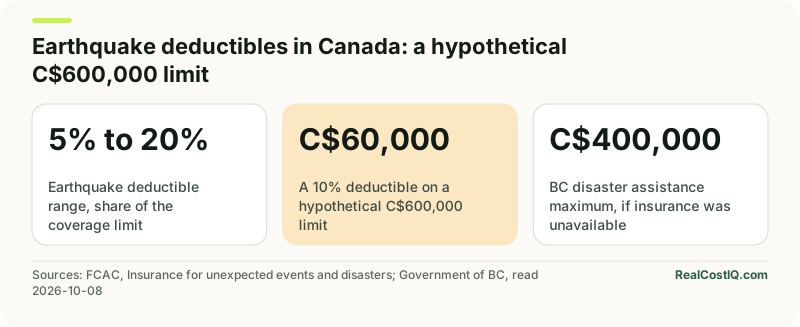
IBC's earthquake page says a standard home policy does not include earthquake damage. You can buy it as an optional add-on to your existing policy. It covers loss or damage to your property and its contents caused by the shaking of the earth. FCAC explains how it is priced. Premiums depend on location, the age of the home, the coverage limit and the deductible. The deductible is usually a percentage of the coverage limit, and the percentages may range from 5% to 20%. FCAC also notes limits of the product. Earthquake insurance may not cover damage from a tsunami or tidal waves caused by an earthquake. Damage to land value is not covered by earthquake insurance or by insurance policies in general.
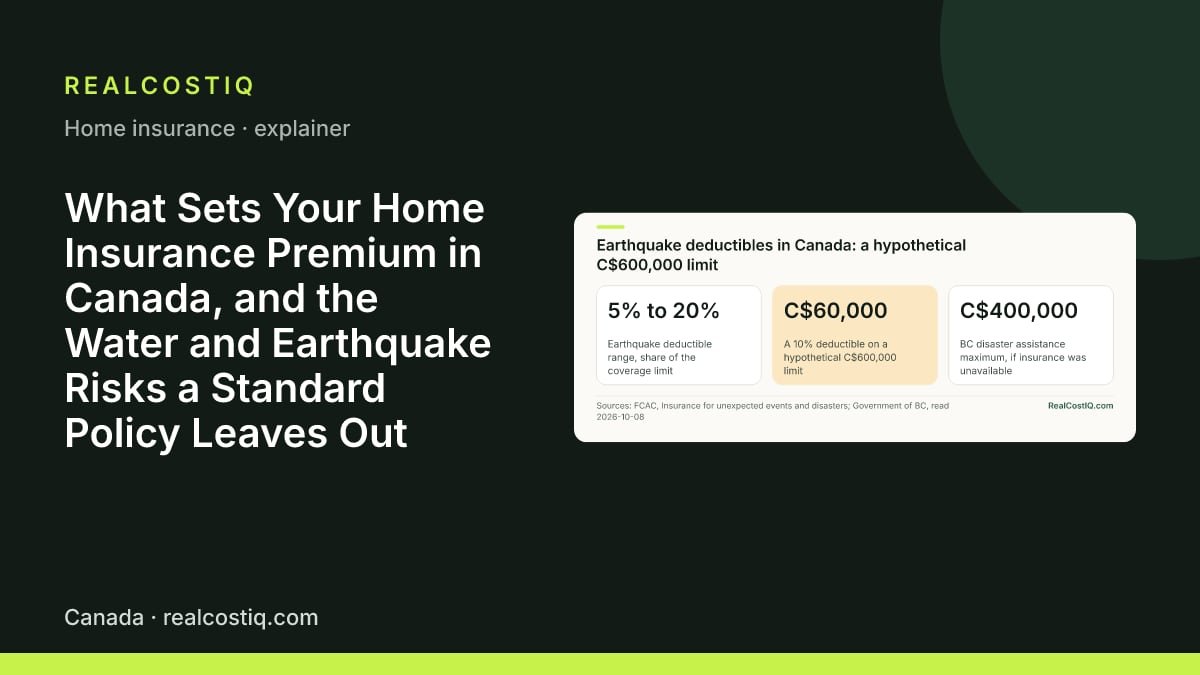
A percentage deductible changes how you should compare quotes. Take a deductible of 10% of a C$600,000 coverage limit. That is C$60,000 before the policy pays. (The limit is hypothetical, and the percentage is inside FCAC's 5% to 20% range.) Two quotes with the same premium but different deductible percentages are not the same product. BC's government page makes the same point in a question. If you have a high earthquake deductible, ask whether you can lower it.
Province by province: where each risk bites
The coverage terms are national, but the risks are not. The points below name the province and the source for each. We stop where a primary source stops.
British Columbia: earthquake, flood and the insurance-or-aid trade
Natural Resources Canada's page on seismic zones in Western Canada (page dated 2019-03-01) describes the risk behind the earthquake add-on in southwestern British Columbia. The Juan de Fuca plate is moving toward North America at about 2 to 5 centimetres a year. It is thought to be locked against the continent. Damaging crustal earthquakes occur about once per decade on average. Geological evidence indicates that huge subduction earthquakes have struck the coast every 300 to 800 years. (A subduction earthquake happens where one plate slides under another.) The page gives no probability or timeframe for the next major event, and we offer none.
The BC government's page on insurance and emergency preparedness (last updated 2025-10-20) says coverage for flood and overland water is separate from standard fire coverage and usually optional. It says earthquake coverage is also usually optional. It lists questions to put to a broker. Are you covered for overland flooding, snowmelt and sewer or groundwater backup? Is flood or earthquake coverage separate, and what are its limits and deductibles? For earthquakes, does it include living costs, fire following a quake and an option to lower a high deductible?
The same page holds a fact that changes the economics of skipping optional coverage. Provincial Disaster Financial Assistance typically covers only a portion of the damages. The maximum is C$400,000 for eligible applicants. It is not available if you did not take out an insurance policy when one was available. Proof from your broker that insurance was unavailable is required. FCAC makes the same point nationally. If you can buy earthquake insurance but choose not to, you may not qualify for provincial or territorial disaster assistance.
Alberta: hail
Alberta's distinctive risk is hail. IBC says hail coverage has shifted over the last decade, particularly in Western Canada. So a roof's material and age can change the policy's wording, not just the price. A study by the firm MNP for IBC was announced on 2026-09-28. The industry body commissioned it, so read it that way. It finds that hail risk is highest in Calgary and nearby areas. It reports that in high-risk areas hail can make up 30% to 68% of a homeowner's total premium. It says homeowners in high-risk areas who install hail-resistant roofing and siding may cut their premiums by up to 50%. It says Alberta hailstorms caused C$6 billion in insured damage over the past five years. It says a single 2024 Calgary storm caused more than C$3 billion in damage. IBC's October 2024 article gave CatIQ's initial estimate of nearly C$2.8 billion in insured losses for that storm. The 2026 release describes its figure as damage.
Insurance is one cost of owning in Alberta. Property tax and price are others. The post Calgary vs Edmonton in 2026: the full cost of buying and owning a home adds up the mortgage, the 2026 property tax and the Alberta fees for each city, and leaves insurance out because it varies by roof and street.
The same IBC article explains the policy terms an Alberta owner should look for. A roof and siding limitation endorsement limits claims settlements for roof and siding damage to actual cash value only. That means replacement cost minus depreciation, so an older roof pays out less. A resilient materials enhancement endorsement pays the extra cost to repair or replace with more resilient materials after a hail claim. Hail-resistant roofing and siding are examples. A hail-specific deductible is usually higher than the standard deductible. It is more common after a homeowner has filed multiple hail claims. Some insurers also offer a discount for a newer roof or a specific roof type. IBC's hail protection page recommends considering Class 4 impact-resistant roofing when you do upgrades or repairs.
The practical reading is this. In a hail zone, one quote is not comparable to another unless you know three things. Is the roof settled at replacement cost or at actual cash value? What is the hail deductible? Is a resilient-materials endorsement included? A cheaper quote with an actual-cash-value roof clause can cost more on the day the roof is damaged. IBC also advises telling your insurer about any roof upgrade. Its April 2024 article gives impact-resistant shingles as the example.
Quebec and Ontario: eastern earthquake risk, and the same coverage questions
Earthquake is not only a west-coast question. IBC's earthquake page names three regions at risk. They are southwestern British Columbia, the Ottawa-Quebec region along the St. Lawrence and Ottawa River valleys, and parts of the territories. Natural Resources Canada's page on earthquake zones in Eastern Canada (dated 2019-03-01) adds detail. Activity is relatively low. But large and damaging earthquakes have occurred and will inevitably occur. The Western Quebec Zone includes Montreal, Ottawa-Hull and Cornwall. An earthquake occurs in it every five days on average. Charlevoix is described as the zone of highest seismic hazard in continental eastern Canada. A magnitude 7 event in 1663 was among five historical quakes of magnitude 6 or larger there.
We did not read the Autorite des marches financiers or the Financial Services Regulatory Authority of Ontario on the day. Both sites refused an automated read, so neither is cited. We say nothing here about what either regulator requires of home insurers. For both provinces, the general rules above apply. The sound approach is the question list the BC government publishes. Is each of overland water, sewer backup and earthquake covered? With what limit and what deductible? Is it separate from the base policy? The condo version of the same questions is in our condo insurance explainer. It includes who pays the corporation's deductible.
The federal flood-insurance program: not available yet
Public Safety Canada's page on the Task Force on Flood Insurance and Relocation (dated 2026-07-28) says the government committed to a new, low-cost national flood insurance program to protect homeowners at high risk of flooding. It says the program is still in development. The government is reviewing the task force's report to inform decisions and next steps. The page gives no launch date. So a homeowner in a high-risk area should not plan around a federal program arriving. This applies to anyone an insurer tells that overland flood cover is unavailable. Keep the insurer's decline in writing. BC's disaster-assistance rules, above, make that written decline a document that matters.
Why your renewal premium jumped
A renewal letter often shows a bigger increase than your home's market value changed. Three things usually sit behind it. Ask your insurer which one applies to you, in writing.
- The rebuild cost was reset. Insurers price on what it would cost to rebuild, not on market value. The Insurance Bureau of Canada (IBC) cited Statistics Canada data in February 2025: residential construction costs rose 67% over five years, while general inflation was 18%. In Toronto the rise since 2017 was 114%, and in Calgary 100%. If your insurer raised your replacement cost to match, your premium rises with it, even if nothing about the house changed.
- Claims in your area went up. IBC's page on how rates are set says insurers watch claims in your neighbourhood. If severe weather pushes local claims up, insuring homes there may cost more. IBC reported on 2026-06-17 that insurers have paid about C$2 billion a year on catastrophic weather claims since 2009, up from about C$400 million a year from 1983 to 2008.
- Your own record or your house changed. Past claims can affect the price. IBC also lists the age of your electrical service and roof. It says insurers generally like to see roofs updated within 20 years.
IBC says premiums have risen faster than inflation in recent years. It gives no percentage, so we do not quote one. The Financial Consumer Agency of Canada (FCAC) lists ways to bring the price down: compare quotes, ask about a home and auto discount, and review your deductible. Before you accept a higher deductible to save on the premium, check that you could pay it from savings. To compare your renewal with a modelled range for your province, use the home insurance estimator.
Is your sewer-backup limit enough?
Sewer backup is an add-on, and its limit is set by you and your insurer. A low limit is the usual problem in a finished basement. The table compares three limits with a hypothetical 700-square-foot basement finished at the mid-range cost in our basement renovation cost calculator: C$80 to C$95 per square foot (Reno Quotes, article updated 2026-04-13). That is C$56,000 to C$66,500 in Calgary, which has no GTA labour premium. In Toronto the calculator adds 25% for labour, which gives C$70,000 to C$83,125. It does not include contents, which are usually a separate limit.
| Sewer-backup limit | Calgary (C$56,000 to C$66,500): share covered | Calgary: left for you | Toronto (C$70,000 to C$83,125): share covered | Toronto: left for you |
|---|---|---|---|---|
| C$10,000 | 15% to 18% | C$46,000 to C$56,500 | 12% to 14% | C$60,000 to C$73,125 |
| C$25,000 | 38% to 45% | C$31,000 to C$41,500 | 30% to 36% | C$45,000 to C$58,125 |
| C$50,000 | 75% to 89% | C$6,000 to C$16,500 | 60% to 71% | C$20,000 to C$33,125 |
Arithmetic: 700 sq ft × C$80 to C$95 = C$56,000 to C$66,500 (Calgary, multiplier 1.0). Toronto is that × 1.25 = C$70,000 to C$83,125. 10,000 ÷ 66,500 = 15% and 10,000 ÷ 56,000 = 18%; the other cells follow the same way. Assumes the whole finish is destroyed and the policy pays up to the limit with no extra deductible. Real policies have deductibles and sub-limits, so read yours.
A backwater valve is a one-way valve that stops sewage flowing back into the house. Some cities help pay for one. The City of Toronto's page, updated 2026-06-18 and read 2026-10-21, offers 80% of the invoice up to C$1,600 per valve, for up to two valves, and up to C$6,650 per property across all items. It applies to work done on or after 2025-11-12, and the city says funding is first-come, first-served. Whether a valve raises your limit or lowers your premium is something to ask your insurer. The sources we read do not say.
How to read a quote before you accept it
Pulling this together, you should accept a quote only when you can answer each question below from the document, not from a phone call.
- What is the building limit, and is it based on rebuild cost rather than market value? Does the policy include guaranteed replacement cost, and on what conditions?
- What is the base deductible, and are there separate deductibles for water, hail or earthquake? Is each a dollar amount or a percentage, and of what?
- Is sewer backup included, at what limit? Is overland water included, at what limit, and are groundwater and seepage covered or excluded?
- Is earthquake included? If so, what percentage deductible, what limit, and does it include fire following the quake and living costs?
- For a roof, is roof and siding damage settled at replacement cost or actual cash value? Is there a resilient-materials endorsement or a hail deductible?
- What did you tell the insurer about the age of the wiring, plumbing and roof? What about any wood stove, rental suite or home business, and your claims history? Does the quote match?
- If the insurer declined any of the optional coverages, do you have that decline in writing?
Those seven answers decide more of the real cost than the premium line does. Two policies at the same price can differ by tens of thousands of Canadian dollars in what they pay on a given day. The person who finds out is the one filing the claim.
Which items are worth upgrading first
IBC's rating factors imply an order. Start with systems the insurer asks about by name. These include knob-and-tube or aluminum wiring, service under 100 amps and galvanized or lead plumbing. An upgrade there changes what an insurer will accept, not just what it charges. A roof past about 20 years is the next flag, because IBC says insurers generally prefer roofs updated within 20 years. Backwater valves and battery-backup sump pumps are inexpensive, specific measures. IBC and the BC government both link them to incentives or discounts. Ask the insurer in writing what it will credit before spending money.
What this post did not read
- No premium or average-premium figure from a primary source was read, so none is quoted. IBC, FCAC and the BC and federal pages read today give none.
- The Financial Services Regulatory Authority of Ontario (FSRA) and the Autorite des marches financiers (AMF) refused automated reads. Neither is cited. Provincial regulator rules for home insurers in those provinces are not described.
- No Prairie, Atlantic or territorial flood or wildfire source was read, so we make no claim about those regions beyond the national points.
- The IBC pages read carry no publication date; they show a 2026 copyright footer, and the dated pages are named with their dates in the text.
- Insurer policy wordings. Your own policy governs, and the wording differs by insurer.