Two different things get called Canada's foreign buyer rules. Mixing them up is the most common mistake. One is a federal law that decides who may buy a home at all. The other is provincial foreign-buyer taxes. These decide what a foreign buyer pays when a purchase is allowed. A person can be outside the federal ban and still owe a provincial tax. This post covers the federal law, because it is the one with a clock on it. It also says briefly how the provincial layer relates.
Everything about the federal law below was read on 2026-10-12 from the Department of Justice's Justice Laws website. We read the Prohibition on the Purchase of Residential Property by Non-Canadians Act (S.C. 2022, c. 10, s. 235). It is shown as current to 2026-09-21 and last amended 2023-01-01. We also read the Prohibition on the Purchase of Residential Property by Non-Canadians Regulations (SOR/2022-250). They are shown as current to 2026-09-21 and last amended 2023-03-27. All dollar amounts are Canadian dollars (CAD). This is information, not legal advice. Whether the ban applies to a particular buyer and a particular property turns on facts that only a real estate lawyer can check. The penalty falls on the buyer and on anyone who knowingly helps.
The site's foreign buyer tax calculator models the BC and Ontario taxes. It says in one paragraph that the federal law is a ban and not a tax. So there is no dollar figure to calculate. This post is the explanation that paragraph points to. It does not repeat the calculator's arithmetic for Toronto, Vancouver or other municipal layers.
What the Act prohibits, in its own words
Section 4(1) of the Act says that, despite section 34 of the Citizenship Act, it is banned for a non-Canadian to purchase, directly or indirectly, any residential property. Three terms in that sentence carry most of the weight. They are non-Canadian, directly or indirectly, and residential property. Each is defined, and the Regulations add detail to all three.
Who counts as a non-Canadian
Section 2 of the Act defines a non-Canadian in four parts. The first is an individual who is none of these three: a Canadian citizen, a person registered as an Indian under the Indian Act, or a permanent resident. The second is a corporation incorporated otherwise than under the laws of Canada or a province. The third is a corporation incorporated under the laws of Canada or a province that meets two tests. Its shares are not listed on a stock exchange in Canada for which a designation under section 262 of the Income Tax Act is in effect. And it is controlled by a person in the first or second group. The fourth is a prescribed person or entity. Prescribed means named in the regulations.
A permanent resident is outside the ban, so a newcomer with PR status can buy like a citizen. Mortgage insurers also ask whether the borrower may buy under the Act. See buying your first home as a newcomer to Canada for what CMHC, Sagen and Canada Guaranty ask of a newcomer.
The Regulations fill in the fourth part and define control. Section 2 of the Regulations prescribes two kinds of entity. One is formed otherwise than under the laws of Canada or a province. The other is formed under Canadian or provincial law. Its shares or ownership interests are not listed on a designated Canadian exchange. And it is controlled by such an entity or by a non-Canadian person. Section 1 defines control in two ways. One is direct or indirect ownership of shares or ownership interests. These must represent 10% or more of the value of the equity, or carry 10% or more of the voting rights. The other is control in fact, directly or indirectly, through ownership, agreement or otherwise. The Regulations' source note shows this definition was amended by SOR/2023-66. CMHC announced the same amending regulation on March 27, 2023. CMHC stands for Canada Mortgage and Housing Corporation, the federal housing agency. Its page on the Act is cited throughout. Older articles may quote a different threshold. In practice, a private Canadian company is within the ban if a non-Canadian holds 10% of its equity or votes, or controls it in fact. A company traded on a designated Canadian exchange is outside this limb, as CMHC's page also says.
What counts as a purchase
Section 4(1) of the Regulations says that acquiring a legal or equitable interest, or a real right, in a residential property is a purchase. This holds with or without conditions. An equitable interest is a right in the property that is not yet full legal ownership. That wording is wide. It is not limited to signing the deed in your own name. Section 4(2) then carves out five things that are not a purchase. One is an individual acquiring an interest through death, divorce, separation or a gift. Another is the rental of a dwelling unit to a tenant to live in. A third is a transfer under the terms of a trust that was created before the Act came into force. A fourth is a transfer resulting from a secured creditor (a lender holding the property as security) exercising a security interest, such as a foreclosure. The fifth is an acquisition by a non-Canadian of residential property for the purposes of development.
The word indirectly in section 4(1) of the Act is why the corporate rules matter. A non-Canadian cannot avoid the ban by buying through a private company that the non-Canadian controls. That company is itself a non-Canadian under the third part of the definition.
What counts as residential property
The Act defines residential property as real property (land and buildings) or an immovable situated in Canada, other than prescribed property. It must be one of two things. The first is a detached house or similar building containing not more than three dwelling units, with the land reasonably necessary for living there. The second is a part of a building that is, or is meant to be, a separate parcel owned apart from other units. Examples are a semi-detached house, a rowhouse unit and a residential condominium unit. A dwelling unit is a unit with a private kitchen, private bath and private living area. The effect, as the CMHC page puts it, is that buildings with four or more dwelling units are not covered by the Act.
Section 3(1) of the Regulations then removes a large part of the map. A property located in an area of Canada that is not within a census agglomeration or a census metropolitan area is a prescribed real property. That means it is outside the definition. Both terms come from Statistics Canada's Standard Geographical Classification 2021. CMHC's page explains the thresholds. A census metropolitan area has a total population of at least 100,000, with at least 50,000 living in the core. A census agglomeration has a population of at least 10,000. In short, these are cities and large towns plus the built-up areas around them. CMHC offers a map tool on its page. It takes an address and says whether the address falls inside one. For a recreational or rural purchase, the first question is whether the exact address is inside or outside a census area. That is a factual question that a lawyer can answer from the Statistics Canada boundary.
The exceptions: who may still buy
Section 4(2) of the Act lists the people the ban does not apply to. Sections 5 and 6 of the Regulations add the conditions and classes the Act leaves to regulation. Reading them together gives a short list.
| Who | Condition as written | Where it is |
|---|---|---|
| Temporary resident enrolled at a designated learning institution | Filed all required income tax returns for each of the five taxation years before the year of purchase; physically present in Canada at least 244 days in each of the five preceding calendar years; purchase price not above C$500,000; has not purchased more than one residential property | Act s. 4(2)(a); Regulations s. 5(a) |
| Temporary resident with a work permit or work authorization | At least 183 days of validity remaining on the permit or authorization on the date of purchase; has not purchased more than one residential property | Act s. 4(2)(a); Regulations s. 5(b), as amended in 2023 |
| Protected person (refugee protection) | Protected person within the meaning of subsection 95(2) of the Immigration and Refugee Protection Act | Act s. 4(2)(b) |
| Non-Canadian buying with a spouse or common-law partner | The spouse or common-law partner is a Canadian citizen, a person registered as an Indian under the Indian Act, a permanent resident, or a person in the temporary-resident or protected-person groups above. Common-law partner means cohabiting in a conjugal relationship for at least one year | Act s. 2 and s. 4(2)(c) |
| Prescribed classes of persons | Diplomatic and consular passport holders; foreign nationals with temporary resident status granted on public-policy grounds for those fleeing conflict; refugee claimants whose claim has been found eligible and referred to the Refugee Protection Division | Act s. 4(2)(d); Regulations s. 6 |
| Foreign states | Purchasing for diplomatic or consular purposes | Act s. 4(4) |
| Agreements signed before the Act | The non-Canadian became liable under an agreement of purchase and sale before the day the Act came into force (January 1, 2023) | Act s. 4(5) |
| Rights under section 35 of the Constitution Act, 1982 | Where the prohibition is incompatible with the rights recognized and affirmed by section 35 | Regulations s. 8 |
Source: Justice Laws, the Act and the Regulations, read 2026-10-12. The student and work-permit rows describe temporary residents only; a temporary resident who fits neither row is not excepted by that route.
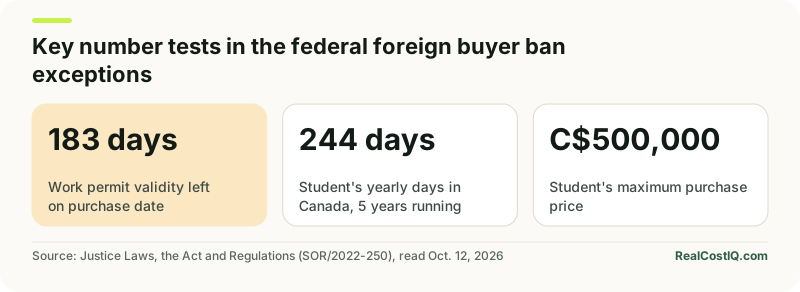
Two of those rows have changed since the Act took effect. The Government of Canada announced amendments to the Regulations on March 27, 2023, effective the same day. CMHC's news release on them describes the main changes. Work permit holders can buy if they have at least 183 days of validity left and have not bought more than one residential property. The earlier tax-filing and work-experience conditions for work permit holders were repealed. Vacant land was taken out of the ban. An exception for acquiring residential property for development was added. The student row in the table still carries the five-year tax filing and presence tests and the C$500,000 ceiling. Anyone relying on an older article should check it against the current Regulations.
The 183 days condition is a test on the date of purchase. A work permit with 150 days left on closing day does not meet it, even if the buyer plans to renew. The one-property limit is a test of what the buyer has already purchased. That is why a lawyer will ask for it in writing. Neither test turns on how long the buyer intends to stay.
The penalty, and what happens to the sale
Section 6(1) of the Act makes two groups guilty of an offence. The first is every non-Canadian that contravenes (breaks) section 4. The second is every person or entity that counsels, induces, aids or abets a non-Canadian to purchase residential property, or attempts to. This applies only if they know the non-Canadian is banned from buying it. In plain terms, that means helping or encouraging the purchase. On summary conviction (the simpler court process used for lesser offences) the fine is not more than C$10,000. Section 6(2) covers a corporation or entity that commits the offence. It adds that certain people are then a party to the offence and liable, whether or not the entity has been prosecuted. These are an officer, director, agent or mandatary, a senior official, or an individual with managerial or supervisory functions. They are liable if they directed, authorized, assented to, acquiesced in or participated in the offence.
Note the knowledge test for helpers. The offence for those who help is tied to knowing that the buyer is banned. It is not a general duty on every agent or lawyer to guarantee a buyer's status. In practice, the lawyer checks status when opening the file. We read the Law Society of British Columbia's residential conveyance checklist for this post. A conveyance is the legal transfer of a property. The checklist includes an item to determine whether the client is banned from purchasing residential property because of status under the Act. It also notes the January 1, 2027 date.
Sections 5, 7 and 8 of the Act say what happens to the home. Section 5 says that contravening section 4 does not affect the validity of the sale. The deed is not void. Section 7(1) covers a non-Canadian who is convicted of contravening section 4. In that case, the superior court of the province where the property is located may order the property to be sold, on the application of the Minister. The sale is made in the prescribed manner and under prescribed conditions. Section 8(2) requires the Regulations to provide that no non-Canadian receives more than the purchase price they paid from the proceeds of a court-ordered sale.
Section 7 of the Regulations sets conditions on that order. The non-Canadian must be the owner when the order is made. Notice must have been given to everyone who may be entitled to proceeds. The court must be satisfied that the order is not out of proportion. It weighs the nature and seriousness of the breach, the circumstances around it and the resulting conviction. The Regulations also fix the order in which proceeds are paid. First come the costs of sale, including the Minister's costs and any unpaid fines. Next come others entitled to the proceeds, in the amounts and priorities the court decides. Then the non-Canadian is repaid an amount not greater than the purchase price. Any remaining amount goes to the Receiver General for Canada.
Here is a hypothetical in dollars. A non-Canadian is convicted after buying a C$600,000 condominium in a census metropolitan area. That person would face a fine of up to C$10,000. Suppose a court also ordered a sale and the property sold for C$750,000. The non-Canadian could not receive more than the C$600,000 purchase price from the proceeds. Even that would come only after the costs of sale, any fine and the claims of others with entitlements had been paid. The C$150,000 above the purchase price would go to the Receiver General after those payments. The example is built from the text of section 8(2) of the Act and section 7(2) of the Regulations. It ignores mortgage payout and any other claim.
When the ban ends, and why the date is not obvious
The consolidated Act on Justice Laws lists, under amendments not in force, section 236 of chapter 10 of the Statutes of Canada, 2022. That section says the Prohibition on the Purchase of Residential Property by Non-Canadians Act is repealed (cancelled). The consolidation does not print a date next to it. The Regulations say in section 9 that they are repealed on the day section 236 comes into force. To find the date, the original statute has to be read.
Section 237 of that 2022 statute, the Budget Implementation Act, 2022, No. 1, is the coming-into-force provision. It says when the other sections start to apply. Subsection 237(1) says section 235, which enacts the ban, comes into force on January 1, 2023. Subsection 237(2) originally said section 236, the repeal, comes into force on the second anniversary of that day. That was January 1, 2025. Section 149 of the Budget Implementation Act, 2024, No. 1 (S.C. 2024, c. 17, assented to, or became law on, 2024-06-20) replaced subsection 237(2). The new version is headed Fourth anniversary. It says section 236 comes into force on the fourth anniversary of the day on which section 235 comes into force. The fourth anniversary of January 1, 2023 is January 1, 2027.
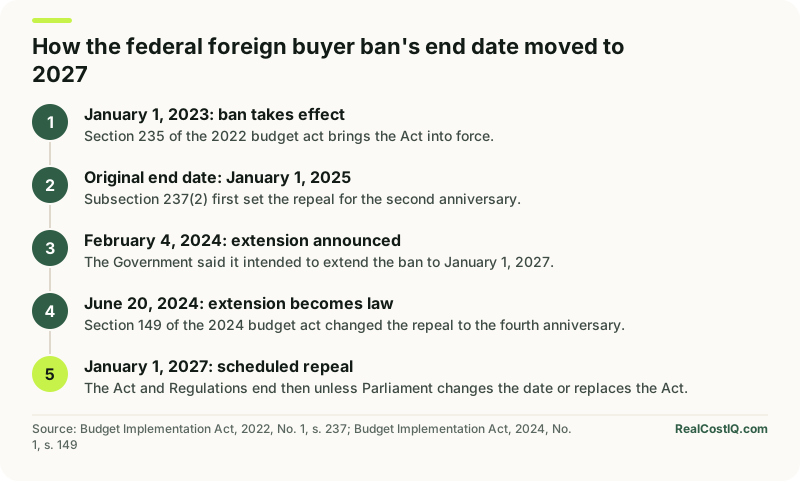
That chain is the reason a reader should be careful with old articles and some current ones. CMHC's page on the Act still opens with a sentence saying the Act prevents non-Canadians from buying residential property for 2 years. A few lines below, it says that on February 4, 2024 the Government announced its intention to extend the ban to January 1, 2027. The Department of Finance news release of February 4, 2024 says the same. The statute that actually made the change is section 149 of the 2024 statute. The Law Society of British Columbia's checklist also records that the ban was originally scheduled to expire January 1, 2025 and was extended to January 1, 2027.
For buyers, timing matters. Suppose a purchase agreement signed in 2026 closes after January 1, 2027. That raises a question the Act does not answer in its text, because section 4(1) speaks of the act of purchasing. Is a buyer's status tested on signing or on closing? Put that to a lawyer. Do not assume. A buyer who is barred today should not plan on the date arriving without checking what, if anything, replaces the Act.
Provincial foreign-buyer taxes are a separate layer
British Columbia and Ontario each charge their own foreign-buyer tax. Those taxes add a percentage to the price and forbid nothing. They can reach buyers the federal Act allows, such as a work permit holder. Ontario's Non-Resident Speculation Tax (NRST) page was updated May 4, 2026 and read on 2026-10-12. It says the federal ban is a federal measure that operates separately from the NRST. It also says a person who is subject to an exception under the federal ban may not be exempt from the NRST. The same page still describes the federal ban as running to December 31, 2024. So its description of the ban is out of date, and the Justice Laws text above governs. The provincial taxes are separate measures, so the federal repeal date is not their end date. This post gives no provincial rates, districts or rebate conditions. The foreign buyer tax calculator models them by price. The land transfer tax calculator models the ordinary transfer tax underneath. The vacant home tax calculator covers the annual vacancy taxes charged for holding a home.
The practical point is that the federal map and the provincial maps do not line up. The federal ban turns on census areas and the number of units. Provincial taxes turn on the province and on the buyer's status under provincial rules. A buyer cleared under one regime still has to check the other.
A checklist for a buyer or an agent
- Get status in writing: citizen, registered Indian, permanent resident, or something else. For something else, identify which exception row applies. Keep the evidence, such as the permit with its expiry date.
- Check the address against the census agglomeration or metropolitan area boundary. If it is outside, the federal ban does not reach it. A provincial tax may still apply.
- Count the dwelling units. A building of four or more units is not residential property under the Act. A duplex or triplex is.
- If a company is buying, find out who holds 10% or more of its equity or votes, and who controls it in fact. Check whether it is listed on a designated Canadian exchange.
- Check the date. Agreements signed before January 1, 2023 are outside the ban. The Act is scheduled to be repealed on January 1, 2027. Ask the lawyer how status is tested if the closing straddles that date.
- Price any provincial foreign-buyer tax separately, using the foreign buyer tax calculator. Ask about its conditions before buying, not after.
- Do not assist a purchase you know to be prohibited. The offence for helpers turns on knowing that the buyer is banned.
What this post does not cover
It does not give a view on whether the ban should be extended, replaced or allowed to lapse. It does not predict what happens after January 1, 2027. It does not cover any other province's own rules on foreign ownership of land, because those rules were not read for this post. It does not cover income tax, the Underused Housing Tax, immigration status, or what a non-resident owner owes in annual property tax. Those are outside the scope of a home-buying cost guide. And it does not substitute for a lawyer. A status question involving a work permit, a trust, or a company is exactly the kind of question where a wrong answer carries a criminal penalty.