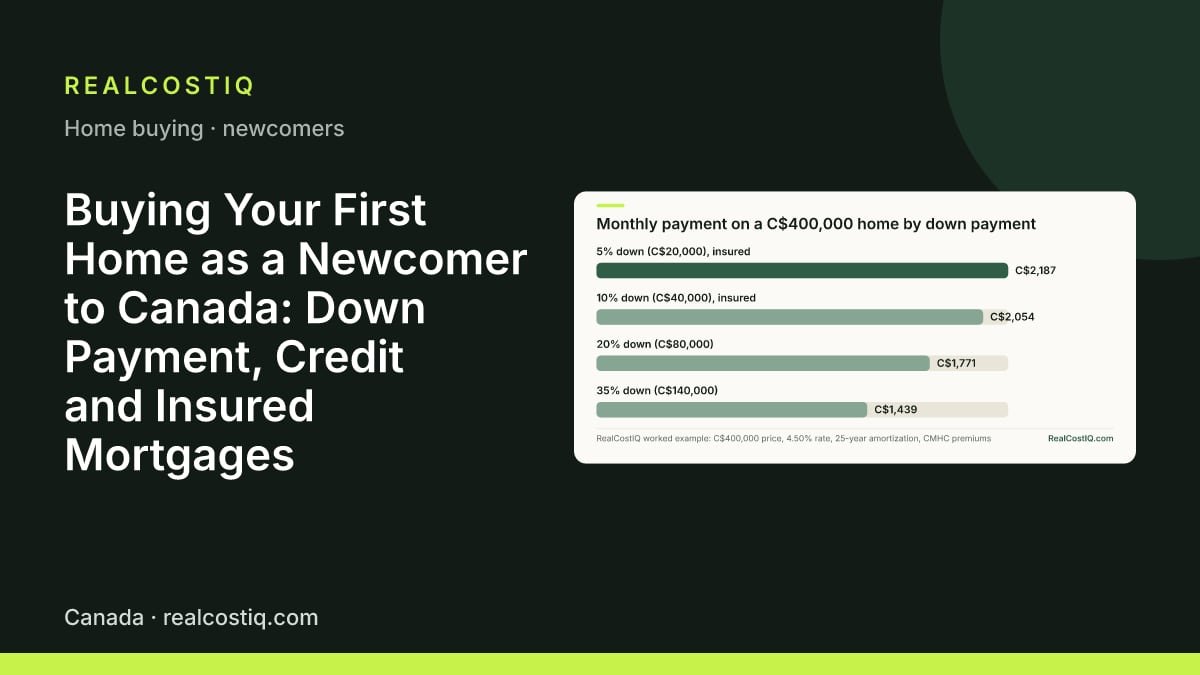
You have just arrived. You have a job or a job offer, savings in another country, and no Canadian credit file. Can you buy a home? Often yes. This post explains what the three mortgage insurers ask, how lenders treat a missing credit history, and what it costs, with the numbers worked out in Canadian dollars (CAD). It is not immigration advice and it does not tell you which lender to pick.
In plain English
- If you put down less than 20%, your mortgage must be insured. Three firms sell that insurance: CMHC, Sagen and Canada Guaranty. Each has a newcomer programme.
- The minimum down payment is the same as for anyone: 5% of the first C$500,000 plus 10% of the rest. On a C$400,000 home, that is C$20,000.
- No Canadian credit score is needed. The insurers accept other proof, such as a credit report from your home country, 12 months of rent paid, or a letter from your bank.
- Permanent residents are not caught by the federal ban on foreign buyers. Work permit holders may be, unless an exception applies.
- Lenders set their own rules on top. Read on the same day, TD asked a permanent resident for 35% down (20% for a work permit holder) to skip insurance, and RBC said no Canadian credit history was required. Ask what each lender needs.
Words you need first
- Permanent resident (PR): a person who is not a Canadian citizen but has been given permanent resident status by immigrating to Canada. Immigration, Refugees and Citizenship Canada (IRCC) says a PR can live, work or study anywhere in Canada. To keep the status, a PR must spend at least 730 days in Canada during the last five years. The days do not have to be in a row.
- Work permit: a document that lets a person who is not a PR or citizen work in Canada for a set time. It has an end date.
- Down payment: the part of the price you pay in cash. You do not borrow it.
- Mortgage default insurance: insurance that protects the lender, not you, if you stop paying. You pay for it. The cost is called the premium. It is added to your loan. It is required when you put down less than 20%.
- Credit history: the record of how you have used and repaid credit in Canada. The two credit bureaus, Equifax and TransUnion, keep it. A credit score is a number built from that record.
- Stress test: the lender checks that you could still pay if the rate rose. For an insured mortgage, the lender uses the higher of your contract rate plus 2 percentage points, or 5.25%.
- Amortization and term: the amortization is the total time to repay the loan, often 25 years. The term is the length of one contract, often five years.
- GDS and TDS: the gross debt service ratio is the share of your income that goes to housing costs. The total debt service ratio adds your other debts. The insurers cap them at 39% and 44%.
Worked example: a newcomer buys a C$400,000 home
Take round numbers. A newcomer household wants to buy a C$400,000 home. The Financial Consumer Agency of Canada (FCAC) says a home priced at C$500,000 or less needs at least 5% down. That is C$20,000. The household has more savings, so they compare four down payments. The illustrative rate is 4.50% with a 25-year amortization. It is not a quote.
- Loan before insurance: price minus down payment. With 5% down that is C$400,000 minus C$20,000, or C$380,000. That is 95% of the price.
- Premium: the Canada Mortgage and Housing Corporation (CMHC) is a federal Crown corporation that insures mortgages. Its table says 4.00% of the loan when the loan is 90.01% to 95% of the price. That is C$15,200. It is added to the loan.
- Total mortgage: C$380,000 plus C$15,200 is C$395,200.
- Payment: about C$2,187 a month. Canadian mortgages compound interest twice a year, not monthly. The site's mortgage affordability calculator uses that rule.
- Stress-test payment: the lender checks the payment at the higher of 4.50% plus 2 points, which is 6.50%, or 5.25%. At 6.50% the payment on C$395,200 is about C$2,647.
| Down payment | Cash down | CMHC premium | Total mortgage | Payment at 4.50% | Payment at the 6.50% test |
|---|---|---|---|---|---|
| 5% | C$20,000 | 4.00% = C$15,200 | C$395,200 | about C$2,187 | about C$2,647 |
| 10% | C$40,000 | 3.10% = C$11,160 | C$371,160 | about C$2,054 | about C$2,486 |
| 20% | C$80,000 | none | C$320,000 | about C$1,771 | about C$2,143 |
| 35% | C$140,000 | none | C$260,000 | about C$1,439 | about C$1,742 |
Premium rates: CMHC, Premium information for homeowner and small rental loans, read 2026-10-16. Payments from the site's Canadian mortgage engine (semi-annual compounding). In Ontario, Quebec and Saskatchewan the province charges sales tax on the premium. It cannot be added to the loan, so it is paid in cash at closing. The rate is an example, not an offer.
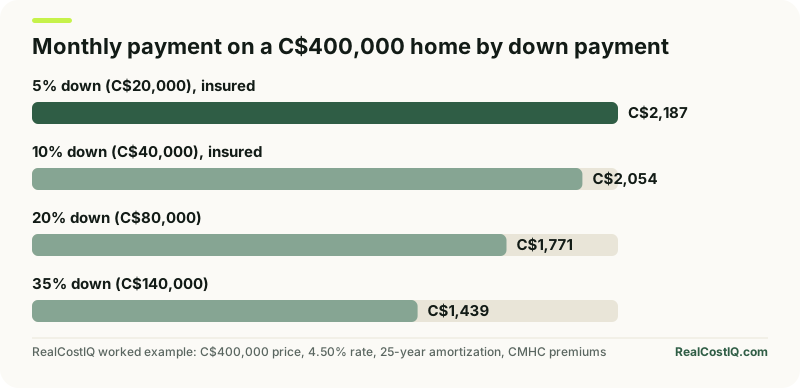
The 5% row costs C$416 a month more than the 20% row. It also needs C$60,000 less cash up front. That is the trade the insurance offers. You buy sooner, and you pay for it through the premium and a larger loan.
Now a formula, for the income check. Take the stress-test payment and divide it by the share your lender allows. With a 39% GDS cap, the 5% case needs a gross income of at least C$2,647 times 12, divided by 0.39. That is about C$81,500 a year. This is a floor. It counts only the mortgage payment. Property tax and heating also count in the GDS, so the real income needed is higher. The 35% case has the same floor at about C$53,600.
Step one: can you legally buy?
Canada has a federal law, the Prohibition on the Purchase of Residential Property by Non-Canadians Act. It came into force on January 1, 2023. The law defines a non-Canadian as a person who is not a citizen, not a registered Indian and not a permanent resident. So a permanent resident is not caught. A person on a work permit is a non-Canadian under the law. Some work permit holders can still buy under an exception.
The Regulations set the conditions. For a work permit holder, they say the permit must have 183 days or more of validity left on the purchase date, and the buyer must not have bought more than one residential property. That is a short version. Our post on the foreign buyer ban goes through who is caught, which homes are outside the ban, and the penalty. Read it before you make an offer if you are not a PR. Ask your lawyer to confirm your status in writing.
This matters to the insurers too. CMHC says a borrower who is not a PR must be exempt from the Act to be considered. Canada Guaranty says all borrowers must be allowed to buy under the Act. Sagen says buyers must not be barred under it. So a status problem stops the mortgage as well as the purchase.
What the three insurers ask of a newcomer
Each insurer published its newcomer terms on its own site. We read all three on 2026-10-16. The Canada Guaranty sheet is dated November 2025. The CMHC and Sagen pages show no date, and CMHC says its information is subject to change at any time. Ask your lender which insurer it uses for your file. Treat the table as a map of what is possible.
| Question | CMHC Newcomers | Sagen New to Canada | Canada Guaranty Maple Leaf Advantage |
|---|---|---|---|
| Status needed | PR, or legal authorization to work such as a work permit | A valid work permit or PR | PR or landed immigrant status, or a valid work permit |
| Time in Canada | No minimum period | No limit stated on the page | Written for new immigrants with limited credit history; no year limit on the sheet |
| Minimum down payment | From 5% | 5% up to C$500,000, then 10% of the rest | 5% from your own funds, a gift from a close family member, a grant or a corporate subsidy. No borrowed down payment. |
| Credit proof if there is no Canadian file | Credit score of 600 for at least one borrower or guarantor. May accept an international credit report, a bank reference letter or other methods. | An international credit report, or 12 months of payments shown on statements, or a bank reference letter. Six months of bank statements if the loan is 90% or less of the price. | Four options: an international bureau report; 12 months of rent plus a utility; 12 months of bank statements; or a bank reference letter of six months or more |
| Price limit | Below C$1,500,000 | Below C$1,500,000 if the loan is over 80% of the price; below C$1,000,000 at 80% or less | Same two limits as Sagen |
| Debt ratios | GDS 39%, TDS 44% | GDS 39%, TDS 44% | GDS 39%, TDS 44% |
| Debts and income from abroad | Not stated on the page | Debts held outside Canada count. Foreign rental income is left out. | Debts held outside Canada count. Foreign rental income may not be used. |
Sources: CMHC, CMHC Newcomers; Sagen, New to Canada program; Canada Guaranty, Maple Leaf Advantage rate sheet (last updated 11/2025). All read 2026-10-16. Cells marked 'not stated' mean the page we read did not say, not that the rule does not exist.
CMHC still lists its Newcomers programme. The page shows no withdrawal notice and no end date. If you read an older article that says CMHC dropped it, check the CMHC page for yourself.
Three details are easy to miss. First, a borrowed down payment is a problem. Canada Guaranty bans it outright. CMHC's non-traditional down payment option, which covers things like an unsecured personal loan, is not open to borrowers who are not PRs. Second, a work permit holder gets the same minimum down payment as a PR, but CMHC says the PR gets access to all of its homeowner products. Third, the Canada Guaranty sheet says a buyer with a past mortgage delinquency, bankruptcy or foreclosure does not qualify for this programme.
Amortization can differ too. CMHC's page shows a 25-year maximum, with 30 years possible through its Home Start offer. Canada Guaranty allows 30 years when the loan is over 80% of the price and the buyer is a first-time buyer or buys a new build. A 30-year amortization costs more in premium. On the Canada Guaranty sheet, the premium for a loan at 90.01% to 95% rises from 4.00% to 4.20% when the amortization is over 25 years.
No credit history: how it is proven
Your credit history from another country does not move with you. The credit bureaus Equifax and TransUnion hold Canadian files. FCAC says some lenders may look at your credit history from another country. It adds that you may need to give them your credit report from that country and meet a bank employee. So a foreign report can help, but only if the lender or insurer will take it.
That is why the insurers list several ways to prove you pay your bills. Look at what is on the lists. A rent record with a landlord's letter, a utility bill, a phone plan, insurance payments and childcare can all count. They need to show steady payments over months. Sagen and Canada Guaranty both use 12 months as the usual length. A bank reference letter works at some insurers if it shows a banking relationship of six months or more.
Start collecting these records on day one. If you pay rent by e-transfer, keep the statements that show the amount and date each month. Ask your landlord for a letter. Ask your home-country bank for a reference letter on its letterhead. Once you have used credit for a few months, order your Canadian credit report from Equifax and TransUnion and check it for errors.
What two lenders said on the same day
A lender can add rules of its own. We read two bank pages on 2026-10-16. We do not rank them, and we do not say either is better. We show them because the gap between them is the lesson.
| Question | TD | RBC |
|---|---|---|
| Who is covered | A PR for under five years with at least three months of full-time work in Canada. A separate track covers a work permit holder who moved to Canada in the last two years, also with three months of full-time work. | A PR who has been in Canada under five years. The page says temporary residents may also apply. |
| Down payment | 35% for a PR, or 20% for a foreign worker, to skip default insurance. As low as 5% with insurance, if the price is under C$1,500,000. | 'As little as 5%.' Insurance is needed under 20%. |
| Canadian credit history | Not required if you meet the other criteria. | 'No credit history required,' with no adverse credit bureau information. |
| Employment proof | Proof of verifiable income and full-time work in Canada. | Proof of employment in Canada or your home country, 'if available.' |
| Other documents | PR card or work permit, down payment source (home-country statements allowed), recent statements, housing costs, the signed offer. | ID, assets, income and debts (home-country statements allowed), down payment proof, credit bureau information from Canada or abroad if available. |
Sources: TD Canada Trust, Mortgages for Newcomers; Royal Bank of Canada, Mortgages for newcomers. Both read 2026-10-16. Neither page shows an effective date for its mortgage terms. Terms change, so confirm with the lender.
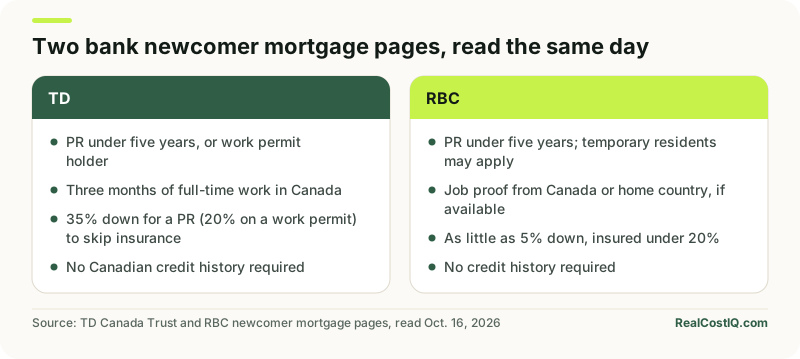
Look at the three-month work rule at TD against the 'if available' wording at RBC. A newcomer who has not started a job yet may fit one page and not the other. Both pages say home-country records can be used. Neither says you must buy a home from them. A broker can compare more lenders, but that is a choice for you.
How your income is counted
A lender decides how much of your pay it will count. Income from a new job, a job offer, a foreign employer and self-employment can each be treated differently. Our post on how Canadian lenders count income covers the usual rules. For a newcomer, the main point is the one from the insurer sheets above: debts you hold abroad count against you, and rental income from a property abroad is left out.
Check your own debt list before you apply. A car loan or credit card balance at home is still a debt in the ratio. If you owe money abroad, a lender may ask for the statements. Paying it down before you apply can raise the price you qualify for.
The cash you need on top of the down payment
The down payment is not the only cash you need. Land transfer tax, legal fees, a home inspection, adjustments for taxes and utilities, and title insurance all come due near closing. The amounts depend on the province. Toronto adds its own municipal land transfer tax, and in Quebec each municipality charges the transfer duty, with higher top rates in Montréal. The CMHC premium is added to your loan in most provinces. In Ontario, Quebec and Saskatchewan, the provincial sales tax on it is paid in cash.
The site's CMHC insurance calculator shows the premium and the provincial sales tax on it for your price and down payment. To total the cash for your price and province in one place, use the first-home buyer total cost calculator. Two provinces also tax foreign buyers: Ontario's Non-Resident Speculation Tax applies across the province, and British Columbia's additional tax applies in five regional districts, including Metro Vancouver. It can reach a work permit holder the federal ban allows. Our foreign buyer post explains where that line falls.
One last savings point, and no more than that. The First Home Savings Account (FHSA) is a registered savings account for first-time buyers. The Canada Revenue Agency says you must be a resident of Canada to open one. The test for first-time buyer looks back at the current year and the four years before. It also counts a home you owned outside Canada if it would qualify were it in Canada. So a newcomer who owned a home abroad may not pass. The savings maths belongs to a personal finance site, not here.
Questions to ask a lender before you apply
- Do you accept my status? Show your PR card or work permit, and tell them the end date.
- How many months of work in Canada do you need? Does a signed job offer count?
- Which insurer do you use for my file? Does it have a newcomer programme?
- Will you take a foreign credit report? Which countries? If not, which Canadian records do you need, and for how many months?
- Can my down payment come from savings abroad? What proof do you need, and how long do transfers take?
- Will you count my foreign income? What about debts I still owe at home?
- At my down payment, what is the premium, and is any sales tax due in cash?
- How long will you hold my rate, and what do you check again before closing?
What this post does not cover
It does not give immigration advice. It uses IRCC's wording for a permanent resident and the Justice Laws text for the ban, and nothing more. It does not recommend a lender. It does not cover refugee claimants, students or other groups beyond what the sources say. And it does not cover how to save a down payment, or the tax side of an FHSA or the RRSP Home Buyers' Plan. For those, ask a licensed professional.