Before you buy a resale condominium, the corporation must give you, or your lawyer, a document. The corporation is the owners' body that runs the building. In BC it is called the strata corporation, and in Quebec it is the syndicate. The document says what the building owes, what the unit owes and what is coming. Its name and rules differ in each province. In Ontario it is a status certificate. In British Columbia it is a Form B information certificate. In Alberta it is an estoppel certificate. In Quebec it is a certificate of the syndicate attesting to the state of the immovable, which is the property. The names are the visible part. The part that decides your timeline and your budget is underneath. That part is who issues the document and how many days the issuer has. It is also the most it may charge, and what it is legally required to say.
This post is about the document workflow. It does not explain how reserve funds work in each province. A reserve fund is the savings a condo keeps for big repairs. The condo fee affordability calculator already covers the provincial reserve-fund rules and the CMHC (Canada Mortgage and Housing Corporation) treatment of the fee. This post also does not explain deductible chargebacks. A chargeback is when the corporation bills an owner for an insurance deductible. The condo insurance post owns that topic. Every legal statement below comes from the statute or regulation itself, read on 2026-10-09. The consolidation date of each is given in the table below and in the source list. A consolidation is the current merged text of a law. Amounts are in Canadian dollars (CAD). This is information, not legal advice. Your lawyer reads the actual certificate against your actual offer.
The four documents at a glance
| Province | Document | Deadline for the corporation | Fee the corporation may charge (CAD) | Authority read |
|---|---|---|---|---|
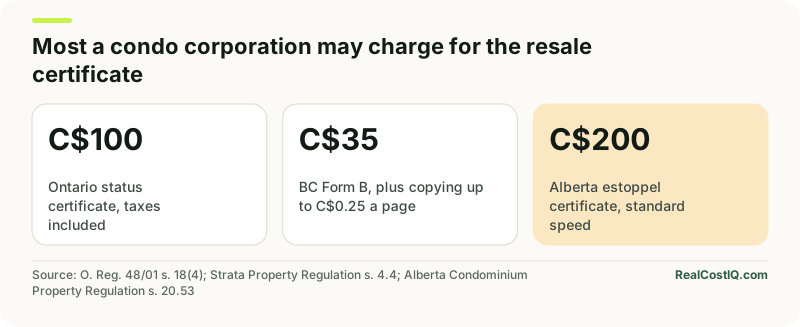
| Ontario | Status certificate | 10 days after receiving the request and the fee (Condominium Act, 1998, s. 76(3)) | Not more than C$100, taxes included, covering the certificate and everything it must contain (O. Reg. 48/01, s. 18(4)) | Act consolidated to Dec. 31, 2025; regulation consolidated from July 20, 2026; both with e-Laws currency of Oct. 6, 2026 |
| British Columbia | Information Certificate (Form B) | Within one week of a request (Strata Property Act, s. 59(1)) | C$35 plus photocopying or reproduction up to C$0.25 a page (Strata Property Regulation, s. 4.4) | Act current to Sept. 22, 2026; regulation current to Oct. 6, 2026 |
| Alberta | Estoppel certificate (Condominium Property Act, s. 43.2) and related documents (s. 44) | 10 days after the written request (ss. 43.2(1) and 44(1)) | Up to C$200 for the certificate, plus up to C$100 more if produced within 3 days (Condominium Property Regulation, s. 20.53) | Act current as of May 14, 2026; regulation current as of Feb. 15, 2026 |
| Quebec | Certificate of the syndicate on the condition of the immovable (C.c.Q., art. 1068.1); statement of common expenses (art. 1069) | 15 days (arts. 1068.1 and 1069) | No amount in the articles read; form and content set by government regulation, which was not read today | Civil Code of Québec, current to Aug. 12, 2026 |
Provinces not on this list (Manitoba, Saskatchewan, Nova Scotia, New Brunswick, Newfoundland and Labrador, Prince Edward Island, the territories) were not read today. Do not assume their rules match any row here.
Ontario: the status certificate
Section 76 of the Condominium Act, 1998 requires the corporation to give a status certificate to each person who requests one for a unit. It must be in the prescribed form, which means the form set by law. It must show the date it was made. The regulation (O. Reg. 48/01, s. 18) says the form is entitled Status Certificate (Certificat d'information in French). It is the form the Condominium Authority of Ontario specifies, as approved by the Minister. The corporation has 10 days after receiving both the request and the fee to deliver it. The fee is capped at C$100, taxes included. The regulation says the cap covers the certificate together with all material required to be included in it.
What the certificate must contain is long. That is the reason a reading is worth paying for. Under s. 76(1) it includes these items. It shows the common expenses for the unit and any default in paying them. Common expenses are the monthly fees. It shows any increase the board has declared since the current budget, and why. It shows any assessments levied since the budget to raise the reserve fund contribution. It includes the declaration, by-laws and rules. It lists outstanding judgments against the corporation and the status of its legal actions. It includes the budget for the current fiscal year, the last audited financial statements and the auditor's report. It lists current agreements. It includes the most recent reserve fund study. It also gives the reserve fund amount as at a month-end within 90 days of the certificate's date. It lists proposed substantial changes to the common elements, which are the shared parts of the building. It gives the number of units leased in the prior fiscal year. And it includes a certificate or memorandum for each insurance policy.
The regulation adds items the Act does not list. Section 18(1) requires, among others, these items. One is whether a certificate of lien has been registered against the unit. A lien is a legal claim for unpaid money. Another is a statement that the current budget is accurate, with the amount of any surplus or deficit it may produce. It requires any operating fund assessments levied since the budget. It requires what the corporation knows of circumstances that may increase the common expenses. It requires the reserve fund balance, the unit's annual contribution and whether the board expects the fund to be adequate. Where a future-funding plan notice has been sent, it requires instead a copy of it and whether the board has implemented it. It requires any outstanding warranty guarantee-fund claims. It requires whether required insurance is in place. And it requires any court-ordered inspector or administrator.
What the Ontario Act says if the certificate is late or incomplete
Section 76(5) is unusually specific. Suppose a corporation does not deliver within the required time. It is then deemed to have given a certificate, effective the day after the deadline. Deemed means the law treats it as given. That certificate is deemed to state three things. There is no default in common expenses for the unit. There is no declared increase in common expenses since the budget. There is no assessment levied to increase the reserve fund contribution. Those deemed statements cover only those three items. A deemed certificate does not tell you the reserve fund balance, the litigation, the insurance or the special assessment plans. Section 76(4) separately covers a certificate that omits material information it is required to contain. Such a certificate is deemed to say there is no such information. Section 76(6) makes the certificate binding on the corporation, as of its date, against a purchaser or mortgagee who relies on it. A mortgagee is the lender.
Two smaller rights sit in s. 76(7) and (8). Someone who has requested the certificate and paid the fee may examine the agreements listed in it. They must ask in writing and give reasonable notice. The corporation must supply copies within a reasonable time if the person asks and pays a reasonable fee for labour and copying. That copying fee is not part of the C$100 cap. So a request for copies of management or shared-facility agreements can add a charge of its own.
British Columbia: the Form B Information Certificate
Under s. 59 of the Strata Property Act, the strata corporation must give an Information Certificate in the prescribed form within one week of a request. The request can come from an owner, a purchaser or a person authorized by one of them. The prescribed form is Form B in the Strata Property Regulation. The regulation (s. 4.4) caps the corporation's fee at C$35 plus copying costs of up to C$0.25 a page. The cap includes the required attachments.
The certificate must disclose the following, as of its date. It shows the monthly strata fees. It shows any amount the owner owes the corporation. It lists agreements under which the owner takes responsibility for alterations expenses. It shows any approved special levy and its due date. A special levy is an extra charge on owners for a big cost. It shows any expected overspend against the current budget. It shows the contingency reserve fund balance, net of approved but unspent expenditures. It lists unfiled bylaw amendments and unfiled three-quarters-vote resolutions. It lists any winding-up resolution. It lists notices of pending resolutions that need a three-quarters, 80% or unanimous vote or that deal with bylaws. It lists court, arbitration and tribunal proceedings and judgments against the corporation. It lists outstanding notices or work orders. It says which parking stalls and storage lockers are allocated to the lot. And it gives a summary of the corporation's insurance coverage.
Copies of the rules, the current budget and the most recent depreciation report, if there is one, must be attached. A depreciation report is a long-term plan for building repairs. Under s. 59(5), the disclosed information binds the corporation in its dealings with someone who relied on the certificate and acted reasonably. Subsection (5.1) carves out the insurance summary. It does not bind the corporation if it was obtained from the corporation's insurer or insurance agent. So the summary is a pointer to the policy, not a substitute for reading it. Section 59(6) lets the Supreme Court make any order it considers just. The order can give effect to the consequences of an inaccurate certificate, or relieve the corporation from them.
Here is the arithmetic on the BC fee. A certificate with 120 pages of attachments at the maximum copying rate would cost C$35 plus C$30, or C$65. A certificate delivered electronically, with no copying cost, is capped at C$35. Other records, such as meeting minutes, are requested under a different part of the Act. They have their own maximum fees. Those were not read today beyond noting that they exist.
Alberta: the estoppel certificate
Section 43.2 of the Condominium Property Act requires the corporation to provide a certificate within 10 days. The request must be in writing from an owner, purchaser or mortgagee, or their solicitor or authorized person. The certificate states the amount of any contribution payable by the owner and how often contributions are payable. It states any arrears and any interest owing. Arrears are unpaid amounts that are overdue. It also includes anything else the regulations require. Subsection (2) makes the certificate conclusive proof of what it certifies, in favour of the person who requested it, as of its date. In plain words, the corporation cannot later deny what the certificate says. That is what estoppel means. The regulation (s. 73.93) adds that an estoppel certificate must include information on any proposed chargeback to the unit's owner under s. 39.01 where the notice has been served.
The estoppel certificate is narrower than the Ontario and BC certificates. It is a statement about money owed by the unit. The wider picture comes from section 44. Under it, the corporation must provide the information or documents prescribed by regulation, within 10 days of a written request from the same class of persons. Section 20.52 of the Condominium Property Regulation lists them. They include the bylaws, minutes of general and board meetings, leases of common property, copies of professional reports, insurance certificates and policies, the standard insurable unit description, and reserve fund plans, reports and annual reports. A purchaser who asks only for the estoppel certificate gets the arrears picture and little else.
| Item | Standard maximum | If produced within 3 days (excluding holidays) | Maximum when expedited |
|---|---|---|---|
| Certificate under s. 43.2 of the Act | C$200 | up to C$100 more | C$300 |
| Information statement with the s. 20.52(1)(a) particulars | C$100 | up to C$50 more | C$150 |
| Other document | C$10 (electronic, or hard copy of 40 pages or less); C$0.25 a page if hard copy exceeds 40 pages | up to C$20 more | C$30 for an electronic or short document |
Source: Condominium Property Regulation, AR 168/2000, as consolidated to February 15, 2026 and read 2026-10-09. A later amendment would not appear in that consolidation; confirm against the King's Printer before relying on a figure.
The Alberta cap is the highest of the three provinces with a stated number. Suppose a buyer wants the certificate, the information statement and three more documents in a hurry. The corporation could charge C$300 plus C$150 plus C$90, or C$540, at the caps. Standard-speed requests for the certificate and the statement would cost at most C$300. These totals are statutory ceilings, not typical charges. The regulation does not say what corporations actually charge.
Quebec: the syndicate's certificate and the promise to purchase
Quebec's rules sit in the Civil Code rather than a condominium statute. Article 1068.1 requires a person selling a fraction to give the promisor, in due time, a certificate from the syndicate. A fraction is a condo unit. The promisor is the person who has promised to buy. The certificate attests to the condition of the immovable. Its form and content are set by government regulation. The syndicate must give the certificate to a co-owner who asks for it within 15 days. Those obligations apply from the appointment of a new board after the developer loses control of the syndicate. The Code does not state a fee for the certificate in the article.
Article 1068.2 gives a person who promises to buy a fraction the right to ask the syndicate for documents and information that allow informed consent. The syndicate must provide them with diligence, at the promisor's expense, subject to privacy rules. Article 1069 deals with arrears. Anyone acquiring a fraction is bound to pay the common expenses due on it at acquisition, with interest. A person considering buying can request a statement of those expenses. The prospective acquirer is bound to pay them only if the statement is provided within 15 days of the request. Article 1070 lists what the syndicate's register must hold, including the maintenance log and the contingency fund study. Article 1070.1 gives co-owners the right to a copy for a reasonable cost.
What the Quebec certificate must contain is in a regulation under the Code, which was not read today. So a buyer should ask the notary or lawyer to confirm the current certificate form and the 1068.2 document list against the building. Do not rely on any summary, including this one.
The clock: deadlines against your own offer
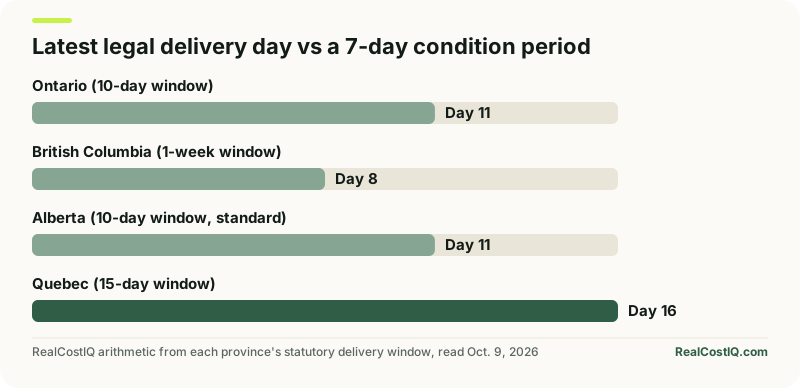
The most useful comparison across provinces is not the fee. It is how the statutory delivery window sits against the conditions period in your agreement. A conditions period is the set time after your offer is accepted when you can still back out if a condition is not met. The statutes read set a window for the corporation. None of them sets the length of your conditions period. That is negotiated. A hypothetical makes the mismatch visible. Say an offer is accepted and a seven-day condition period begins. In Ontario, a request made on day one can legally take until day eleven (10 days after receiving the request and fee). In Alberta it is the same. BC's one-week window ends on day eight. Quebec's 15-day window ends on day sixteen.
| Province | Statutory window | Latest delivery (counting from day 1) | Falls inside a 7-day condition period? |
|---|---|---|---|
| Ontario | 10 days | Day 11 | No. Four days after the period ends. |
| British Columbia | 1 week | Day 8 | No. One day after the period ends. |
| Alberta | 10 days; a corporation that produces within 3 days may add the expedite charge | Day 11, or day 4 if produced expedited | Only if produced expedited. |
| Quebec | 15 days | Day 16 | No. Nine days after the period ends. |
Illustrative arithmetic: the windows come from the statutes and regulations read today; the 7-day condition period is invented for the example. Business-day counting rules and how a day is counted were not read and may differ. Ask your lawyer how the days run in your offer.
This is why the order of operations matters. In every province, the request starts the clock. In Ontario the clock also waits on the fee. The sooner a buyer's side requests the document, the more of the statutory window falls inside the conditions period. Who requests it, who pays the corporation and whether the seller orders it at listing are matters of practice. They are also matters for the agreement of purchase and sale. The statutes read here do not decide them. If the corporation misses its deadline, Ontario's deemed certificate gives you a legal position on three items only. For BC, Alberta and Quebec, the sections read here do not state a deemed-certificate consequence for lateness. The one exception is Quebec's art. 1069 rule. Under it, the purchaser is bound by the unpaid common expenses only when the syndicate provides the statement within 15 days. Whether lateness gives you a right to extend or walk away depends on the conditions written into your offer. Your lawyer should draft them with the delivery window in mind.
What to read, in the order that costs you money
The disclosure lists are long. Reading them in the order of how directly each item turns into a bill makes the review manageable. The items below appear in at least one province's list. The columns in the table show where.
| What to look for | Ontario status certificate | BC Form B | Alberta estoppel and documents | Quebec |
|---|---|---|---|---|
| Arrears or amounts owed by the unit | Yes: s. 76(1)(a), lien statement in reg. s. 18(1)(c) | Yes: s. 59(3)(b) | Yes: s. 43.2(1)(c), (d) | Statement under art. 1069 |
| Approved special levy | Assessments since the budget: s. 76(1)(c); reg. 18(1)(e) | Yes: s. 59(3)(d) | Not in s. 43.2 as read; proposed chargeback is (reg. s. 73.93) | Check the certificate form (regulation not read) |
| Fee increase or budget deficit | Yes: s. 76(1)(b); reg. 18(1)(d), (f) | Yes: s. 59(3)(a), (e) | Contribution amount: s. 43.2(1)(a) | Check the certificate form |
| Legal proceedings | Yes: s. 76(1)(h) | Yes: s. 59(3)(j) | Via the s. 44 information statement (reg. s. 20.52(1)(a)(i)): actions served on the corporation with the amount claimed, unsatisfied judgments or orders, and written demands over C$5,000 that could lead to an action | Check the certificate form |
| Insurance | Certificate or memorandum of each policy: s. 76(1)(p) | Summary only: s. 59(3)(l.2); not binding if sourced from insurer | Insurance certificates and policies in reg. s. 20.52 | Check the certificate form |
| Parking and storage | Not in the list read | Yes: s. 59(3)(l.1) | Leases of common property in reg. s. 20.52(1)(j) | Declaration and register |
| Reserve or depreciation study | Most recent study and fund balance: s. 76(1)(m) | Depreciation report attached: s. 59(4)(d) | Reserve fund plans and reports in reg. s. 20.52(1)(q) | Contingency fund study in the register: art. 1070 |
Section references are to the statute or regulation read on 2026-10-09. Cells that say 'check the certificate form' mean the content is set by a Quebec regulation that was not read.
Three habits turn this table into a decision. First, line up the arrears and special levy items against the closing statement. An approved levy is a known future cost of the unit, so ask who bears it under the agreement. Second, read the reserve-fund item as a question, not an answer. In Ontario, whether the fund is adequate is the board's view, and the study is the evidence. The affordability calculator linked earlier explains why that gap matters. Third, ask what the certificate does not say. The Ontario deemed-certificate rule, the BC insurance carve-out and Alberta's narrow estoppel all mean that silence is not a clean bill of health.
A certificate also gives you inputs for your own numbers. The monthly fee, any approved levy and the insurance summary feed directly into the condo versus house calculator, which compares ownership costs. They also feed into the fee field of the affordability calculator. For the closing day cash, the Ontario closing costs calculator puts the certificate line next to land transfer tax and legal fees.
The lawyer's review: what to ask before paying
No statute or regulation read today sets the fee for a lawyer's or notary's review of a condominium document. No regulator figure for it was found. Any range you see online is an estimate. The reliable approach is to ask for a written quote that states what is included. That means the review of the certificate itself, the review of the attachments and agreements, and the call or letter that explains the findings. It also means whether the quote changes if the certificate raises problems that need further requests to the corporation.
- Scope. Does the quote cover the certificate only? Or does it also cover the bylaws, rules, budget, financial statements, reserve study and insurance documents?
- Turnaround. Can the review be done inside your conditions period, given the corporation's statutory delivery window?
- Follow-up requests. If the certificate is incomplete, who writes to the corporation? Is that billed on top?
- Findings. Will you receive a short written summary of the items that cost money or limit use of the unit? Examples are rental limits, parking allocation and levies.
- Government fees. The statutory cap on the corporation's fee is separate from the lawyer's fee. So the quote should list them separately.
If the certificate comes back adverse
An adverse finding is bad news in the certificate. Examples are a large unpaid levy and a recent fee jump. Others are a reserve study that shows a deep shortfall, active litigation against the corporation, or an insurance gap. The statutes read here give the buyer information and bind the corporation to what it said. But none of the sections read creates a general right to cancel a purchase because of an adverse certificate. That right, where it exists, comes from the conditions written into the agreement. There are several practical routes. You can negotiate the price. You can ask the seller to pay or credit a known levy. You can ask for a holdback, which is money kept back from the seller until a problem is settled. You can extend the condition period. Or you can walk away under the condition if the agreement allows it. The lawyer who reviews the certificate is the person to say which of those your offer permits.
Sometimes the certificate is accurate and the building is simply expensive. Then the adjustment belongs in the budget rather than the negotiation. A higher monthly fee reduces the mortgage you can qualify for under the CMHC 50% rule, which the affordability calculator models. So check that your pre-approval still works at the certificate's fee before you remove conditions.
A pre-offer checklist
- Ask for the existing certificate before you make an offer. Some listings include one. Check its date, because the Ontario reserve fund figure must be within 90 days of the certificate's date.
- Decide who will order the current certificate and who will pay the fee. Put it in the agreement, with the cap in mind. The caps are C$100 in Ontario, C$35 plus copying in BC, and up to C$200 in Alberta.
- Write the conditions period around the statutory window. The windows are 10 days, one week, 10 days and 15 days in the four provinces covered above.
- Get a written lawyer quote for the review. Ask what is included.
- Compare the certificate to your numbers. Re-run the monthly fee through the affordability and ownership-cost calculators before you give up the condition.
- Ask about the insurance deductible and chargeback exposure. The insurance post linked earlier summarizes it. A deductible is the part of an insurance claim you pay yourself.