Selling a home in Canada does not give you one closing-cost line the way buying does. The costs come from four directions. The first is the brokerage you hire. The second is the tax on that brokerage's fee. The third is the lender you are paying off. The fourth is the lawyer or notary who completes the sale. Each has its own rules, and the province you sell in changes those rules. Many sellers work out their profit by taking a round-number commission off the sale price. They then find the other three costs at the lawyer's office, after the offer is signed and the conditions are gone.
This explainer takes the costs in the order a seller meets them. It covers how commission is set and why no provincial regulator publishes a rate. It shows how GST or HST attaches to the commission. GST is the federal goods and services tax, and HST is a combined federal and provincial version of it. It also shows what that tax is in each province. It explains what a mortgage payout costs on a sale and who handles the discharge, which is the step that removes the lender's claim from the title. It covers what the buyer pays instead of you, and the extra step a non-resident seller faces. It does not repeat the capital gains rules, which have their own explainer on selling a home and the principal residence exemption. It also does not work out how a prepayment penalty is calculated. The mortgage penalty calculator does that for your own balance and rate.
Every source was opened and read on 2026-10-08, and the end of the post lists them with that date. We tried to read two regulators and could not. These were the Real Estate Council of Alberta (RECA) and Quebec's OACIQ. The RECA page we tried failed to load and then returned a 404 on a retry. OACIQ returned a bot-check wall. So nothing here is attributed to them. Where a number below is an input we made up to show the arithmetic, it says hypothetical next to it. This is information about how the costs work. It is not legal, tax or mortgage advice.
The costs, in the order a seller meets them
The BC Financial Services Authority (BCFSA), British Columbia's financial regulator, publishes the plainest checklist of a seller's costs. First comes the commission you agreed to pay your agent's brokerage. Next are the legal fees to discharge any existing mortgage and the legal or notary fees for the title transfer. Then comes the GST on the commission and on your legal fees. You may also owe a prepayment penalty, if the lender charges one for early pay-out. Last, you may owe your share of the property taxes for the year, if this year's taxes have not yet been paid. We read that list on BCFSA's page "What Costs Come with Selling a Home" on 2026-10-08. It holds in outline across the country, even though the details differ.
| Cost | Who sets it | Seller or buyer | What to get in writing |
|---|---|---|---|
| Brokerage commission | You and the brokerage, in the listing agreement | Seller (a share may go to the buyer's brokerage) | The rate or flat amount, the split with the buyer's side, the term and the holdover clause |
| GST or HST on the commission | Federal and provincial law | Seller | The tax line on the brokerage's invoice or statement of adjustments |
| Mortgage prepayment penalty | Your mortgage contract | Seller | A payout statement from the lender with the penalty shown separately |
| Mortgage discharge fee | The lender (capped in some provinces) | Seller | The fee on the payout statement |
| Lawyer or notary fees, disbursements and tax | The professional, by quote | Seller (the buyer pays separately for their own) | A written quote covering the sale, the discharge and disbursements |
| Property tax adjustment | The municipality's bill and the closing date | Seller for their share of the year | The adjustment line on the statement of adjustments |
| Land transfer tax or property transfer tax | The province (and some cities) | Buyer | Nothing for you to pay, but it affects what buyers can offer |
Compiled from the sources listed at the end, all read 2026-10-08. The property tax and statement-of-adjustments items follow the BCFSA list; the amounts depend on your municipality and closing date.
The rest of this post takes each line in turn. The last row matters more than it looks. Land transfer tax is the buyer's, so it never appears on your side of the ledger. But the buyer must find it in cash on top of the price. We say more about it in a section further down.
Commission: negotiated, and no regulator publishes a rate
The first thing a seller should know is that commission is not a fixed fee set by law. Ontario's regulator is the Real Estate Council of Ontario (RECO). On its page about signing a contract with a brokerage, RECO says you and the brokerage decide the amount you will pay. It says the amount is not fixed or approved by RECO, any government authority, or any real estate board. BCFSA answers the question directly in its Consumer Guide to Remuneration (remuneration means pay). Asked if there is a standard commission to pay when you list, it says no. Some brokerages have a commission all their professionals charge. Even so, any commission amount can be negotiated between you, your real estate professional and the brokerage.
Both regulators also describe the shape the fee can take. RECO says you can agree to pay a fixed dollar amount, a percentage of the sale price, or a mix of both. BCFSA says many listing contracts set the commission as a percentage of the sale price. That means the higher the sale price, the more the brokerage earns. When an offer arrives, your agent will give you a Disclosure to Seller of Expected Remuneration. This turns the percentage into a dollar figure. BCFSA adds a warning that is easy to miss. That dollar figure does not include other fees you may owe, such as lawyer or notary fees.
What a commission cannot be based on
A seller cannot agree to a deal in which the agent keeps whatever the home sells for above a set list price. RECO says a representation agreement cannot set an amount based on the difference between the listing price and the sale price. (A representation agreement is the contract you sign with a brokerage.) BCFSA says the same and gives the reason. The ban removes the perception that an agent recommends listing below market value so the agent can earn more. Suppose a listing contract rewards the gap between list price and sale price. That is a reason to stop and ask the regulator or a lawyer.
Renegotiating, cancelling and the holdover clause
BCFSA says the commission can be renegotiated in the middle of a listing if the services change or both sides agree to change them. Neither side has to accept a change the other proposes. If nothing is agreed, the original terms continue. On cancelling, BCFSA says the terms of your contract decide whether you owe commission after you end it. That is why the termination clause deserves a read before you sign, not after you are unhappy.
RECO flags the clause sellers most often overlook. Most representation agreements in Ontario include a holdover clause. This clause can require you to pay the brokerage's fee for a sale that happens after the agreement ends. RECO says the clause is designed to protect the brokerage. It says there is no minimum or set holdover period, and that you should make sure you agree to its length before you sign. A holdover that is longer than you expected is a cost that only shows up if you change agents.
The buyer's side of the commission
Who pays the buyer's brokerage is part of the same negotiation, and it is not automatic. In its guidance to buyers, RECO warns that a seller might not offer any amount to cover the fees the buyer owes to the buyer's own brokerage. So ask what the listing agreement says about offering a share to the buyer's brokerage. An offer of nothing, a fixed amount or a percentage will each change who is willing to bring a buyer. Get the answer in the listing agreement, not by phone.
GST or HST on the commission
A brokerage's commission is a taxable service, so the seller pays GST or HST on it. BCFSA lists the GST on the real estate commission and on your legal fees among the seller's costs. The rate depends on the province. The Canada Revenue Agency (CRA) publishes a table of rates in effect on or after April 1, 2025. We read it on 2026-10-08. It shows 5% GST alone in Alberta, British Columbia, Manitoba, Quebec, Saskatchewan, the Northwest Territories, Nunavut and Yukon. It shows 13% HST in Ontario and 14% HST in Nova Scotia, which fell from 15% on April 1, 2025. It shows 15% HST in New Brunswick, Newfoundland and Labrador and Prince Edward Island.
Which province's rate applies to a service tied to a house is set by place-of-supply rules. These rules decide which province a sale counts as made in. The CRA's page on GST/HST rates and place-of-supply rules is dated 2026-07-15. It says the general place-of-supply rules for services do not apply to services in relation to real property. It says the place of supply is the participating province (one that uses HST) where the largest proportion of the real property is located. The page does not mention real estate commissions by name. So we cannot tell you from the CRA's page alone how a particular brokerage treats a particular sale. The practical test is simple. The statement of adjustments or the brokerage's invoice will show a tax line. (The statement of adjustments is the closing-day sheet that shows what buyer and seller owe each other.) You can check that line against the table above for the province where the home stands.
| Province where the home is | GST/HST rate (CRA, from 2025-04-01) | Tax on C$40,000 | Commission plus tax |
|---|---|---|---|
| Alberta, British Columbia, Saskatchewan, Manitoba | 5% GST | C$2,000 | C$42,000 |
| Ontario | 13% HST | C$5,200 | C$45,200 |
| Nova Scotia | 14% HST | C$5,600 | C$45,600 |
| New Brunswick, Newfoundland and Labrador, Prince Edward Island | 15% HST | C$6,000 | C$46,000 |
Hypothetical: a C$800,000 sale price at a 5% commission rate that we chose for the arithmetic, not a market rate. Tax = commission x rate; recomputed 2026-10-08. Quebec is left out of the table because the CRA's rate table lists Quebec's separate 9.975% provincial tax in its provincial-tax column and we did not read Revenu Quebec's rules on whether it applies to a brokerage commission.
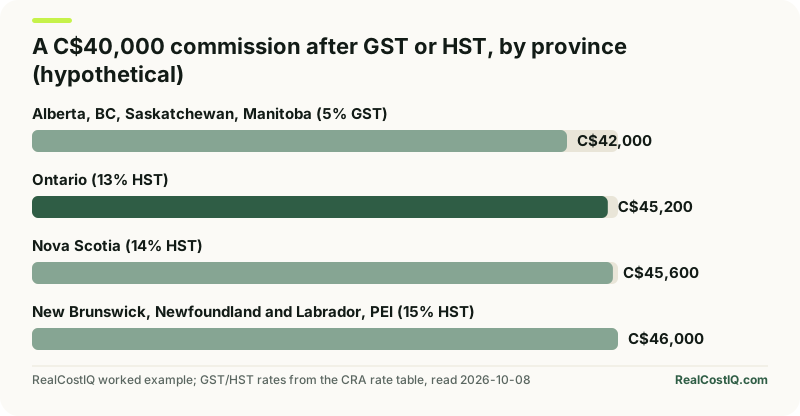
The table makes a point that percentages hide. The same commission costs C$3,200 more in tax in Ontario than in Alberta on this example, purely because of where the house stands. You control the commission rate you negotiate. The tax rate sits on top of it. If you compare two quotes, compare them after tax, in dollars, on the sale price you expect.
The mortgage payout: penalty, discharge fee and professional fees
If you have a mortgage, the lender is paid from your proceeds on closing. What the lender is owed that day is not just the remaining balance. The Financial Consumer Agency of Canada (FCAC) has a prepayment penalties page, dated 2025-10-15. It says a penalty can apply when you repay the whole mortgage early, including when you sell your home. It adds that if you have an open mortgage, you can prepay without a penalty. An open mortgage is one you can pay off at any time.
FCAC says the penalty is usually the higher of two amounts. One is three months' interest on the balance. The other is the interest rate differential (IRD), which is based on the gap between your rate and current rates for the time left in your term. The term is the length of your current rate contract. The mortgage penalty calculator works through both methods on your own balance, rate and remaining term. Your lender's payout statement is the only figure that counts.
Ways to avoid or shrink the penalty
FCAC's pages describe the main options. First, you may be able to port the mortgage, if your lender allows it. Porting means taking your existing interest rate, terms and conditions to your next home. This can avoid breaking the contract. Second, closed mortgages, which limit early repayment, come with prepayment privileges. These let you pay down a set amount each year without penalty. Most lenders limit prepayments per year, and unused amounts usually do not carry over. Third, a blend-and-extend blends your old rate with the rate for a new term. It generally avoids the penalty but may carry administrative fees. It is an early-renewal tool rather than a sale tool. FCAC's page on breaking your mortgage contract gives a worked example. The balance is C$200,000, with 24 months left at 5.5%. The new five-year rate is 4%, which gives a blended 4.6%. Timing can matter as well. In FCAC's example, the IRD is driven by the number of months left in the term. So the same balance and rate gap produces a smaller IRD with fewer months remaining. Ask the lender to quote the penalty at more than one closing date.
The discharge fee and the professional fees
Paying off the mortgage is not the same as removing the lender's claim from the title. (The title is the official record of who owns the property.) FCAC's page on discharging a mortgage is dated 2025-09-25. It says you must get a mortgage discharge when you sell your property. In most cases you work with a lawyer, a notary or a commissioner of oaths. The lender typically provides confirmation of full payment, but most lenders do not send it unless you ask. The land registry office then removes the lender's rights and updates the title. FCAC gives two cost ranges. Where a province or territory does not regulate the lender's discharge fee, the fee typically ranges from no charge up to C$400. Federally regulated lenders must disclose that fee in your mortgage contract. The professional fees for the lawyer, notary or commissioner who does the discharge work are typically between C$400 and C$2,500. FCAC says some provinces and territories cap the lender's fee. It lists no provincial caps itself.
Add the two FCAC ranges, and the discharge step alone sits between C$400 and C$2,900. The low end is no lender fee plus the low end of professional fees. The high end is a C$400 lender fee plus C$2,500 in professional fees. That is the discharge paperwork only. FCAC's page does not say what a lawyer charges for the sale itself, so neither do we. For the sale, ask for a written quote that names the professional fee, the disbursements and the tax on both. Disbursements are out-of-pocket costs the lawyer pays for you, such as registration fees.
In Quebec the discharge runs through the notary or lawyer in the same way, with Quebec's own vocabulary. The Government of Quebec has a page on ending a mortgage, updated 2025-11-21. It defines the quittance as the document in which the creditor confirms it has received everything owed. It says only notaries and lawyers may prepare it. It says the professional fees and registration costs are usually the borrower's responsibility. It adds that a fee is payable to publish the discharge deed at the land register, set out in a government tariff. We did not read that tariff, so we quote no amount.
A worked example, with every input labelled
The example below puts the pieces together for a hypothetical Ontario sale. Every input is made up for the arithmetic, except where it is marked as an FCAC range. It shows the order of subtraction and the size of the swing between a cheap and an expensive payout. It does not show what you will pay.
| Line | Low case | High case | Where the number comes from |
|---|---|---|---|
| Sale price | C$800,000 | C$800,000 | Hypothetical |
| Commission at 5% | C$40,000 | C$40,000 | Hypothetical rate |
| HST on commission at 13% | C$5,200 | C$5,200 | CRA rate for Ontario |
| Mortgage balance repaid | C$350,000 | C$350,000 | Hypothetical |
| Prepayment penalty | C$4,200 | C$13,125 | Three months' interest at 4.8%, or a simplified IRD (our hypotheticals) |
| Discharge fee and discharge professional fees | C$400 | C$2,900 | FCAC ranges: no fee to C$400, plus C$400 to C$2,500 |
| Total of these lines | C$399,800 | C$411,225 | Sum of the lines above, excluding the sale price |
| Left before sale legal fees, other adjustments and tax questions | C$400,200 | C$388,775 | Sale price minus the total |
Low case = 800,000 - (40,000 + 5,200 + 350,000 + 4,200 + 400) = 400,200. High case = 800,000 - (40,000 + 5,200 + 350,000 + 13,125 + 2,900) = 388,775. Recomputed 2026-10-08. The penalty low case uses three months' interest; a lender whose IRD is lower than three months' interest would charge the three-month figure, which is why the low case is not zero. Penalty derivations (our hypotheticals): low case = 350,000 x 4.8% / 4 = 4,200; high case = 350,000 x 1.5% x 2.5 years = 13,125 as a simplified IRD, since lenders compare posted rates and adjust for your original discount. Legal fees for the sale itself, the property tax adjustment and any capital gains are not in the table.
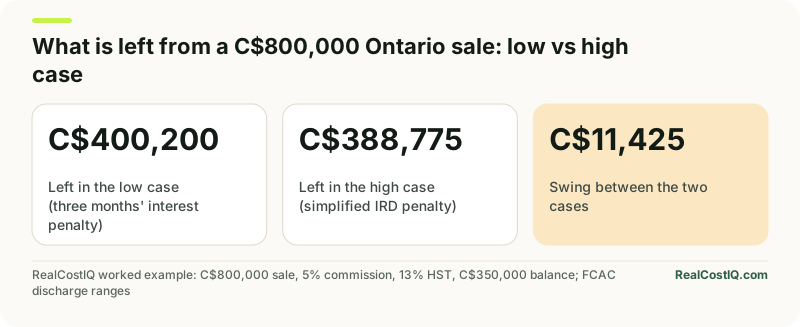
The swing between the two cases is C$11,425. None of it comes from a decision the seller makes at the listing appointment. It comes from two lines that move between the cases: the penalty terms in the mortgage contract and the discharge professional fees. So the most useful step before listing is not a call to an agent. It is a call to the lender for a payout quote at your intended closing date. Ask for a second quote for a date a few months later if the term ends then.
What the buyer pays instead of you
Land transfer tax is a one-time tax on buying property. Sellers are often asked whether it comes out of the sale price. It does not. Ontario's Ministry of Finance has a page on land transfer tax, updated 2026-01-02. It says that when you acquire land or a beneficial interest in land, you pay land transfer tax to the province when the transaction closes. It says the tax is payable when the transfer is registered. The same page says that if you buy property in the City of Toronto, you may also pay the City of Toronto's own municipal land transfer tax. So a buyer in Toronto faces two taxes, and a buyer elsewhere in Ontario faces one.
British Columbia works the same way under a different name. The province's page on property transfer tax was last updated 2025-12-03. It says the purchaser, or anyone who gains an interest in registered property, must pay the tax unless an exemption applies. It says the tax is based on the property's fair market value on the day it was registered with the Land Title Office. We do not quote either province's rates here. The point for a seller is who writes the cheque, and in both provinces it is the buyer. BC's page adds one item that can reach a seller. It says that if you plan to sell your property after December 31, 2024, you may also have to pay the BC home flipping tax. The page does not say which sales are covered or at what rate. So check the province's home flipping tax page before you list a home you recently bought.
This matters to a seller indirectly. A buyer's cash for closing costs competes with the cash available for the deposit and the price. First-time buyer refunds and exemptions differ by province, so the same house can be affordable to more buyers in one province than another. We do not model those here, because this post is about the seller's side of the ledger.
Quebec: the notary, and no seller closing-cost shortcut
Quebec closings run through a notary. We could not read a province-wide schedule of notary fees today. The Quebec government page on ending a mortgage, above, confirms the key facts for a seller who has a mortgage. Only a notary or lawyer can prepare the quittance. The fees are usually the borrower's. A registration fee applies. The Chambre des notaires' invoicing pages returned a bot wall when we tried to read them. So we quote nothing from them, including who pays the notary on the sale. In Quebec, the safest practice for a seller is the same as everywhere else. Ask for a written quote for the whole seller side, including the discharge, before you sign.
A related caution: do not carry an Ontario or British Columbia checklist into Quebec. The legal tools differ. Quebec uses a quittance rather than a discharge of charge, and a notary or lawyer must prepare it. The tax on a brokerage commission is also a Quebec question we did not research. The CRA's rate table lists Quebec at 5% GST with a separate 9.975% provincial tax. It does not say how that provincial tax applies to a commission.
Selling as a non-resident: the section 116 step
A seller who is not a resident of Canada faces an extra step under section 116 of the Income Tax Act. The CRA's circular IC72-17R6 says the vendor must notify the CRA of the sale. It also says a buyer who has no certificate of compliance may have to hold back part of the price. That holdback is a cash-flow item on closing day, so tell your lawyer before you list. The rates, deadlines and a worked holdback are in our capital gains explainer, which we do not repeat here.
A checklist for comparing two ways to sell
Commission is negotiated and the other costs are quoted. So the best use of this information is a side-by-side comparison. Before you sign a listing agreement, or when you compare two brokerages, ask each of them for the same list in writing.
- The commission as a rate or a flat dollar amount, and the dollar figure it gives at the price you expect, with GST or HST added as a separate line.
- What, if anything, is offered to the buyer's brokerage, and whether that comes out of your commission or on top of it.
- The length of the agreement and of any holdover period, and what happens to the fee if you cancel.
- Any fee for services beyond listing, such as staging (dressing the home for showings), photography or marketing, and whether the commission covers them or they are billed separately.
- Your lender's payout figure at the intended closing date, with the penalty, the discharge fee and any administration fee shown as separate lines.
- A written quote from your lawyer or notary that covers the sale, the discharge and the disbursements, with tax.
- Your share of the year's property taxes, from the municipality's bill and your closing date.
The list is deliberately short on percentages, because the answers that matter are the dollar figures on your own sale. A listing agent who will not put the commission, the term and the holdover in the document is telling you something. It says how the rest of the relationship may go.
What this post did not read
- The Real Estate Council of Alberta's commission page failed to load and then returned a 404 on a retry. Quebec's OACIQ returned a bot wall. So we do not describe Alberta and Quebec commission rules from their regulators. We use the BCFSA and RECO pages for the principles, which each regulator frames in its own words.
- No survey or statistic on typical commission rates was read, so none is quoted.
- We did not read Revenu Quebec's treatment of Quebec's provincial sales tax on a brokerage commission, or the Chambre des notaires' fee guidance.
- Provincial caps on lender discharge fees. FCAC says some exist and names none, so check your provincial land registry.
- We did not read the sale-side lawyer's fee, the land registry's discharge registration fee in each province, or rate tables for land transfer tax and property transfer tax.
- Income tax on the sale. See the capital gains explainer linked above.