When you sign a mortgage in Canada, the bank often asks if you want insurance on it. The pitch is short. If you die, the mortgage is paid off. Your family keeps the house. That sounds like a good deal, and for some people it is. For many others, a different product does the same job, pays out more and costs less.
This post compares the two in Canadian dollars (CAD). One is mortgage life insurance, which banks also call creditor insurance. The other is term life insurance that you buy on your own. We read the Financial Consumer Agency of Canada (FCAC), TD, CIBC and two insurers. Their numbers are examples, not quotes for you. Your age, health and mortgage change the price.
In plain English
- Mortgage life insurance is sold by your lender. If you die, it pays your lender. It does not pay your family. FCAC says the lender is the beneficiary.
- The payout shrinks. The benefit is your mortgage balance at the time of death. As you pay the loan down, the cover falls. The premium usually does not.
- Term life insurance is a policy you own. You name who gets paid. The amount stays fixed for the whole term, such as 20 or 25 years.
- Price. In the examples we found, term cost about one-third to one-half as much as the bank plan at the same age and amount. Those examples come from sellers of term insurance, so check them yourself.
- Health. Bank plans ask few health questions. That makes them easier to get. Term life asks more, which is why it can cost less for healthy people.
- Nobody can force you to buy it. FCAC says a lender cannot make mortgage insurance a condition of the mortgage.
What each product is
Mortgage life insurance (creditor insurance)
FCAC describes it this way. The lender is the beneficiary and receives the death benefit. The money must be used to pay off the mortgage. The benefit equals what you still owe, so it shrinks as you pay the loan down. FCAC adds that premiums generally stay the same even though you owe less. Its page was last modified on October 15, 2025.
TD's page shows how one big bank sets it up. You can insure a share of your balance, with total cover between C$300,000 and C$1,000,000. A claim pays that share of the balance at the time of loss. No beneficiary is named. TD says approved benefits go to The Toronto-Dominion Bank to pay off or reduce your mortgage. CIBC's page is similar. It says cover pays toward your balance, up to C$1,000,000, and ends at age 70.
Term life insurance
Term life is a separate policy from an insurance company. You choose the amount, the length and who is paid. FCAC says the death benefit of term or permanent life insurance stays fixed, and the person you name can spend it on anything. That could be the mortgage. It could also be child care, tuition or a year off work. FCAC says term or permanent insurance may offer better value than mortgage life insurance.
Do not confuse either product with CMHC mortgage loan insurance. That one is required when your down payment is under 20%. Your lender arranges it, and you pay the premium. It protects the lender if you stop paying. It pays your family nothing. Our post on 20% down or CMHC insurance covers it. The two products have similar names and do different jobs.
What you pay: the numbers we found
Prices vary by age, health, province and bank. We found three sets of examples. Two come from insurers that sell term life, so they have a reason to make the bank plan look costly. We say so each time. The TD figures come from TD's own page.
TD's own examples
TD lists example premiums for its mortgage life insurance in Ontario. They include sales tax. At age 35, a C$350,000 balance costs C$48.38 a month. A C$500,000 balance costs C$67.66. A C$650,000 balance costs C$82.40. The same C$500,000 balance costs C$144.99 at age 45 and C$251.32 at age 55. TD says the premium depends on your age at application, the type of cover and your balance at application, less any discounts.
A term insurer's comparison at C$500,000
PolicyMe is a term insurer. On April 7, 2026 it published a table for C$500,000 of cover over 20 years for a non-smoking woman of average health. It used TD as the example for the mortgage plan. The term figures are PolicyMe's average starting rates.
| Age | Mortgage life (TD example) | 20-year term | Gap per month | Gap over 20 years |
|---|---|---|---|---|
| 30 | C$48.33 | C$20.68 | C$27.65 | C$6,636 |
| 35 | C$67.66 | C$22.93 | C$44.73 | C$10,735 |
| 40 | C$106.33 | C$33.27 | C$73.06 | C$17,534 |
| 45 | C$144.99 | C$51.25 | C$93.74 | C$22,498 |
Source: PolicyMe, April 7, 2026, for both columns. The last two columns are our arithmetic: the monthly gap times 240 months. PolicyMe sells term life.
Look at how the gap grows with age. At 30 the bank plan costs 2.3 times the term policy. At 45 it costs 2.8 times. Bank plans are priced by age bands for a mixed group. Term life is priced for you, after a health check. The older you are and the healthier you are, the more that matters.
A 25-year check against five banks
Empire Life, another term insurer, ran a survey in March 2026. It priced mortgage life insurance at five big banks for a healthy, non-smoking woman aged 36 with a C$400,000 mortgage and a 25-year amortization. The prices include 8% Ontario sales tax. It compared them with its own 25-year term policy, which has a fixed premium for 25 years.
| Provider | Monthly premium |
|---|---|
| RBC | C$60.48 |
| TD Canada Trust | C$86.13 |
| BMO | C$90.72 |
| CIBC | C$90.72 |
| Scotiabank | C$103.95 |
| Average of the five banks | C$86.40 |
| Empire Life 25-year term | C$32.58 |
Source: Empire Life, 'Why pay more?' (INS-SF-693-EN-03/26). Empire Life sells the term policy. Its survey is a marketing document, not an independent study.
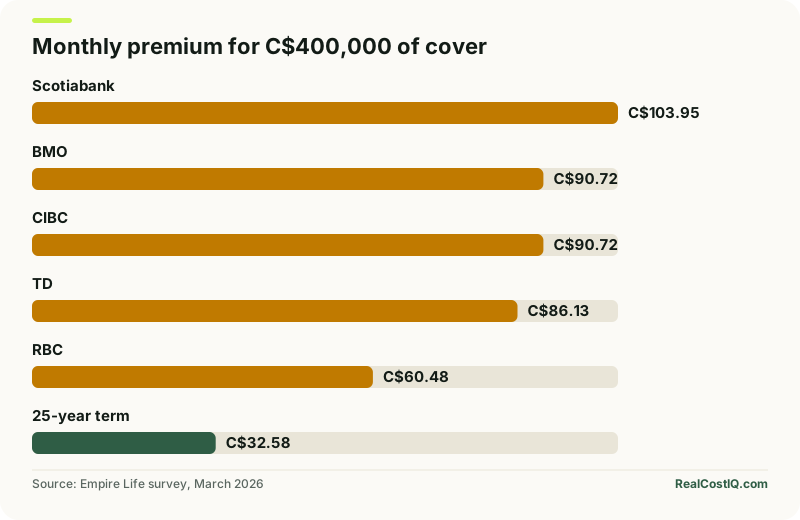
On those numbers, the average bank premium is C$53.82 a month higher than the term quote. Over 300 months that is C$16,146. Against TD's own price of C$86.13, the gap is C$16,065. Treat both as the high end of what you might save. Empire chose the example, and a smoker or a person with a health condition would see different prices. But the direction matches PolicyMe's table.
What your family gets
Price is only half of it. The other half is what the money does when it arrives. Take a C$500,000 mortgage with a 25-year amortization at an assumed 4.59%, compounded twice a year as Canadian fixed-rate mortgages are. That rate is an example, not an offer. The balance falls like this.
| Years in | Balance owed | Bank plan pays the lender | 20-year term pays your family |
|---|---|---|---|
| 0 | C$500,000 | C$500,000 | C$500,000 |
| 5 | C$439,633 | C$439,633 | C$500,000 |
| 10 | C$363,891 | C$363,891 | C$500,000 |
| 15 | C$268,856 | C$268,856 | C$500,000 |
| 20 | C$149,614 | C$149,614 | C$500,000 |
| 25 | C$0 | C$0 | Term ended at year 20 |
Balances are our calculation: monthly payments of C$2,792.44, with the interest rate compounded semi-annually. The bank plan pays the balance at the time of death, as FCAC and TD describe. A claim in year 10 would pay C$363,891 to the lender, and nothing is left for your family.
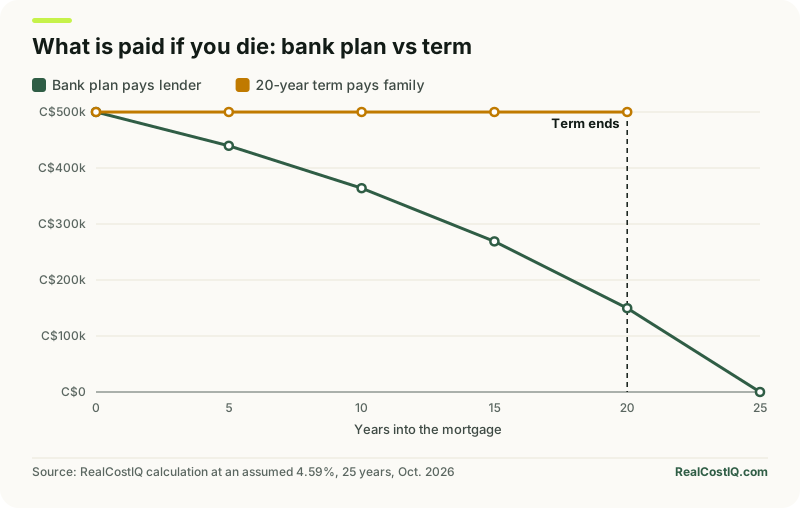
Two things follow. First, if you die in year 10, the bank plan clears C$363,891 of debt. The family keeps the house but gets no cash. The term policy pays C$500,000. A family could use it to clear the mortgage and still have C$136,109 left. Second, the premium you pay in year 10 is not lower because the cover is lower. FCAC says premiums generally stay the same.
A longer mortgage than policy is a real risk for term life. In our table the term ends at year 20 and the mortgage runs to year 25. Pick a term that covers your full amortization if you can. Empire's Solution 25 policy, for example, fixes the premium for 25 years. Empire says its policy renews on its own at the end of the term, with the premium rising each year after that. Read the policy for the renewal price.
When the bank plan can still make sense
Bank plans are not a trick. They solve one problem well: they are easy to get. TD says coverage starts on your application date if your total insured cover is C$500,000 or less and you answer no to four health questions. Otherwise there is a short health form, with a decision in about two to three business days. CIBC says if you answer no to all the health questions and the mortgage is approved, cover starts when the bank gets your signed application.
That matters if you have a health condition. A term insurer may charge more or decline you. A bank plan may still accept you. If you are in that group, a bank plan can be worth the extra cost. Even then, ask whether a different insurer offers a guaranteed-issue policy, and compare it with the bank's price.
- You have a health issue. Term quotes may be high or refused. Apply for term first. If you are declined, the bank plan is a fallback, and you know why you are buying it.
- You want no paperwork. The bank plan adds the premium to your mortgage payment. TD says the premium is calculated on your payment schedule and added to your payment.
- The debt is small. If the balance is low and the premium is a few dollars, the saving from switching is small too.
The claim risk: when is the health check done?
This is the point that decides some cases. With term life, the insurer checks your health when you apply. Once it accepts you, the check is done. With a bank plan, practice can differ. TD's page says health questions are asked at application. It does not describe a check at the time of claim. PolicyMe, though, says mortgage life insurance is "often underwritten after a claim is made." Ratehub, a mortgage site, says the same: the lender can look for reasons to deny the claim.
These two statements do not agree, so we do not claim either as a fact for every plan. What we can say is that it is worth asking. Ask the bank in writing: "Is my eligibility confirmed now, or can it be reviewed when a claim is made?" Then read the certificate of insurance. FCAC tells borrowers to read the certificate and notes there are important limits on cover.
There is a real case on record. In 2014, Canadian Mortgage Professional reported that Scotiabank declined a claim on a C$289,000 mortgage after the borrower died of lung cancer. The bank said he was not eligible for cover because of his health, and that he had filled in the health questionnaire incorrectly. A Toronto Star report cited in the article said the bank paid the widow C$5,000 instead. That is one old case, not a measure of how often it happens. It shows why the questions you answer on the form matter. Answer every one fully and keep a copy.
Other differences that cost money later
Switching lenders
A mortgage has a term, often five years, and an amortization, often 25. At the end of a term you can renew or move to a new lender. A term life policy is yours, so it moves with you. A bank plan is tied to the mortgage. TD says cover can end if you are no longer a borrower or guarantor. Ratehub says you may have to reapply when you switch, and the price can rise with your age. If you plan to shop your mortgage at renewal, that is a cost. Our mortgage calculator shows how a lower rate at renewal changes your payment, and the amortization calculator shows how fast the balance falls.
Cancelling
Both banks we read let you cancel. TD says you can cancel at any time, with no lock-in period. If you cancel in the first 30 days, TD refunds all premiums, unless a claim was made. CIBC gives 30 days from receiving the certificate for a full refund. After that, you stop paying and the cover ends. So taking the bank plan on closing day is not a trap. You can compare it with a term quote within the first month and cancel the bank plan if the term quote is better. Do not cancel until the term policy is in force.
Joint cover and discounts
Couples often buy on one mortgage. TD gives a 20% discount to each person when more than one person is insured on the same cover. CIBC gives 15% off when two people are insured. TD's own couple example, ages 30 and 32 on C$500,000 at full cover, is C$92.79 a month. At 60% cover on C$300,000 it is C$57.55. These discounts narrow the gap with a term policy. They do not erase it in the examples we found, but compare a joint quote, not a single one, if you are a couple.
What the bank plan does not cover
Mortgage life insurance covers death. FCAC lists other optional products that banks sell with mortgages, such as disability and critical illness cover. It says pre-existing medical conditions are usually not covered for those. Do not assume a life plan covers job loss or illness. It does not. Term life pays on death only, unless you add a rider. If your real worry is losing income while alive, that is a different product and a different decision.
A simple way to decide
- Write down the need. How much would your family need if you died? Include the mortgage, but also income they would lose, child costs and other debts. The mortgage balance is only part.
- Get a term quote first. Ask for a quote for the amount and the length of your amortization. Use an online quote or an advisor. Compare it with the bank's premium for the same age and amount.
- Ask the bank two questions. What is the premium for my age and balance? Is my eligibility confirmed now, or can it be reviewed at claim time?
- Check the term. If the mortgage has 25 years left, does the policy run as long? If not, how much does renewal cost?
- Decide on health. If you may be declined for term, take the bank plan and tell yourself why. If you are healthy, term usually wins on both price and payout.
- Re-check at renewal. When your mortgage term ends, the balance is lower. You may need less cover. The amortization calculator above shows your balance at renewal.
A worked example makes it concrete. Anna is 35 and borrows C$500,000. TD's example is C$67.66 a month. PolicyMe's 20-year term quote is C$22.93. The gap is C$44.73 a month, or C$536.76 a year. If Anna put that C$536.76 a year toward the mortgage principal instead, it would not change her cover, and it would lower her balance faster. That is one way to use the saving. Whether it is the best way is a personal choice, and we do not give advice on investing here.
Mistakes to avoid
- Treating the bank offer as a condition. FCAC says the lender cannot require it. If a banker implies it is needed for approval, say you want it in writing.
- Skimming the health form. A wrong answer can give the insurer a reason to deny a claim. Answer every question fully.
- Buying term that ends before the mortgage. A 20-year policy on a 25-year mortgage leaves five years open.
- Cancelling the old plan first. Never cancel one cover until the new one is in force.
- Confusing it with CMHC insurance. That product protects the lender. It has nothing to do with your family's cover.
- Using the payout as your whole plan. A mortgage balance is not the same as a family's need. Count income too.
What this post did not read
We did not get quotes for a smoker, for a man, for ages above 45 outside TD's table, or for joint term cover. We did not read Scotiabank's, BMO's or RBC's certificates of insurance, so the five-bank survey relies on Empire Life's figures. Both insurers whose prices we use sell term life. We also could not read a forum thread from the last 12 months. Reddit would not load for us, and a search for Canadian forum threads on RedFlagDeals returned none. We give no advice on which policy to buy. This post is general information. A licensed life insurance advisor can quote you.