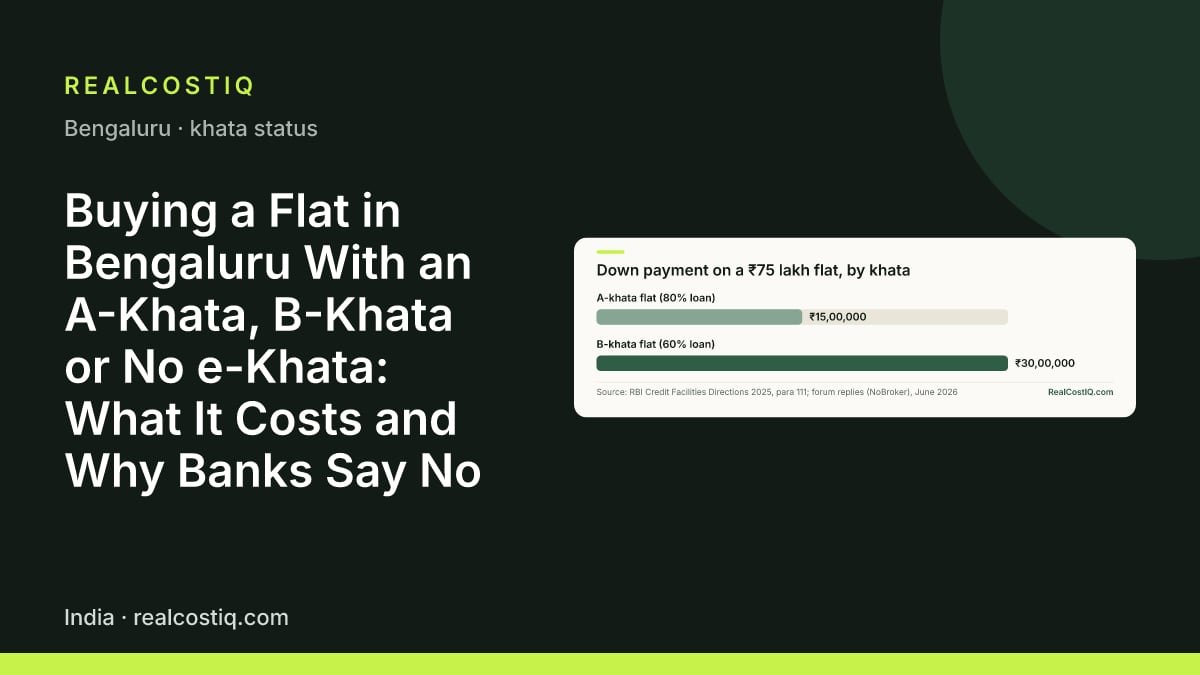
A buyer finds a 2BHK in Whitefield for ₹75 lakh. It is ₹8 lakh cheaper than the flat next door. The agent says, "It is a B-khata. Same flat, same building, just a different paper." The buyer asks his bank. The bank says no. A private lender says yes, but wants ₹30,00,000 down and a higher rate. This is the pattern in many forum threads on this topic. This post explains why it happens and what it costs.
We keep to the flat buyer. We do not repeat the stamp duty slabs, because our Karnataka stamp duty calculator already works those out. We also do not cover the khata transfer fee after registration, which that page explains. For how mutation works across Karnataka, Telangana, Uttar Pradesh and Delhi, read mutation after you buy property. This post is about the thing that comes before: what kind of khata the flat has, and what that does to your loan and your cash. Civic records in Bengaluru are now run by the Greater Bengaluru Authority (GBA), which took over from the BBMP in 2025. Older papers still say BBMP. The two names mean the same office for your purposes.
A-khata, B-khata and e-khata in plain terms
The word khata means account. The civic body keeps one for each property. It records who owns the property and who pays property tax. Three terms matter to a buyer.
- A-khata. Given to a property that follows the building rules, layout approval and tax rules. A report in Deccan Herald on 17 October 2025 says an A-khata can be used to get building permits, trade licences and bank loans.
- B-khata. Given to a property that does not meet the rules. The same report names revenue sites cut from farm land, sites in unapproved layouts, and flats built without a sanctioned plan. It says B-khata properties pay tax, but their buildings are treated as unauthorised, and most banks refuse loans on them.
- e-khata. The digital form of either khata, started in 2024. It is not a third type. A flat can have an A e-khata or a B e-khata. The civic body said in October 2024 that it had published draft e-khatas for both A and B properties.
A draft e-khata is not a final one. The civic body told owners in October 2024 that the final e-khata needs electronic IDs of the sale deed, Aadhaar e-KYC, the BESCOM number, GPS photos of the property and an encumbrance certificate. An encumbrance certificate (EC) is a record that shows whether the property has loans or claims against it. So a seller who only shows a draft e-khata has not finished the job.
Why a final e-khata matters at registration
The BBMP made e-khata compulsory for property registrations from 30 September 2024, as Deccan Herald reported on 1 September 2025. On 12 March 2025 the Inspector General of Registration told all sub-registrars in a circular to register properties only through the e-Aasthi and e-khata software. He warned that action under the civil service rules would follow if they did not. The circular applies to properties under city corporations, town corporations and gram panchayats.
Read that carefully. The circular talks about the e-khata. We did not find a rule that bars the registration of a B-khata flat. We found the opposite: the civic body issues e-khatas for both letters. So the first block is usually not the sub-registrar. It is the bank, and sometimes the builder.
There is a new-flat rule too. Under a rule that started on 1 July 2025, a builder must first register the e-khata for each flat in the builder's own name. Only then can the flat be transferred to you. The civic body said in March 2025 that it would give a provisional khata the moment a builder files, and a final khata within 60 days after a site check. It also said that a building that does not follow the rules, including one with no occupancy certificate, will get a B-khata.
That last point matters most. When a new flat gets a B-khata, the fault is usually in the building, not in your flat alone. The Cabinet said in July 2025 that a multi-storey building must secure its occupancy certificate before the property and the building can be given an A-khata. You cannot fix that from your side of the table.
Why banks say no
It is tempting to think banks are being picky. In fact the Reserve Bank of India writes the rules they follow. The RBI's Commercial Banks (Credit Facilities) Directions, 2025, updated as on 15 July 2026, has a paragraph numbered 92. It was written after observations of the Delhi High Court on unauthorised construction. Four of its lines matter here.
- Paragraph 92(4). When a person asks for a loan to buy a built-up house or flat, the person must sign an affidavit that the building was built as per the sanctioned plan or building bye-laws, and "as far as possible" has a completion certificate.
- Paragraph 92(5). An architect chosen by the bank must certify, before the loan is paid out, that the building is strictly as per the sanctioned plan or bye-laws.
- Paragraph 92(6). No loan should be given on properties in the category of unauthorised colonies, until they are regularised and development and other charges are paid.
- Paragraph 113. The bank must not count stamp duty, registration or document charges in the cost of the property it finances. You pay these from your own cash.
The RBI does not use the word "khata" in these lines. Banks use the khata as their quick test. A flat in a building with no sanctioned plan or OC cannot give the affidavit in paragraph 92(4). The bank's architect cannot sign paragraph 92(5). A B-khata is a sign that one of these is missing. That is why most banks stop at the first check. A bank may still lend on a B-khata flat if its own lawyer and valuer are satisfied, but that is the bank's choice, not a right.
Housing finance companies and some private banks have more room. The forum replies we read say they sometimes lend. A NoBroker forum thread asked on 29 January 2026, "Is it possible to get an HDFC home loan for a B-khata property?" One reply the next day called it very challenging. Another said HDFC generally does not approve, but it may be possible with updated tax receipts or a sale deed, a good credit score and two to three years of tax returns. In a longer thread, replies dated 17 March and 28 June 2026 name lenders such as Axis, HDFC, ICICI, LIC Housing, PNB Housing and Bajaj Housing. They say lenders usually finance only 55% to 70% of the value, at rates of about 9.5% to 14%. These are forum posts, not lender notices. Treat them as leads. Ask each lender in writing.
What it costs: ₹75 lakh flat, two khatas
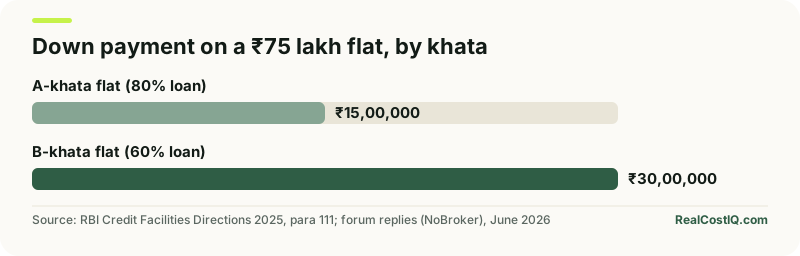
Let us put numbers on it. Take a ₹75,00,000 flat. RBI paragraph 111 sets the most a bank may lend as a share of the property's value. The limit depends on the size of the loan. For a loan above ₹30 lakh and up to ₹75 lakh it is 80%. For a loan above ₹75 lakh it is 75%. On a ₹75 lakh flat, an 80% loan of ₹60,00,000 falls inside the 80% band.
We assume an A-khata buyer borrows the full 80%, which is ₹60,00,000. That leaves ₹15,00,000 as down payment. For the B-khata we assume a housing finance company lends 60% of the value, in the 55% to 70% range the forum replies give. That is ₹45,00,000. The down payment is then ₹30,00,000. We assume 9% a year for the A-khata loan and 12% for the B-khata loan, both over 20 years. These rates are examples for comparison, not quotes.
| Item | A-khata flat | B-khata flat |
|---|---|---|
| Loan share of value | 80% (RBI ceiling, paragraph 111) | 60% (assumed, lender's choice) |
| Loan amount | ₹60,00,000 | ₹45,00,000 |
| Down payment | ₹15,00,000 | ₹30,00,000 |
| Interest rate (assumed) | 9% | 12% |
| EMI, 20 years | ₹53,984 | ₹49,549 |
| Total interest paid | ₹69,56,054 | ₹73,91,730 |
Stamp duty, registration and khata charges are extra on both, as RBI paragraph 113 bars banks from financing them. EMI uses the standard monthly formula. The B-khata buyer borrows ₹15,00,000 less, so a lower EMI does not mean a cheaper deal.
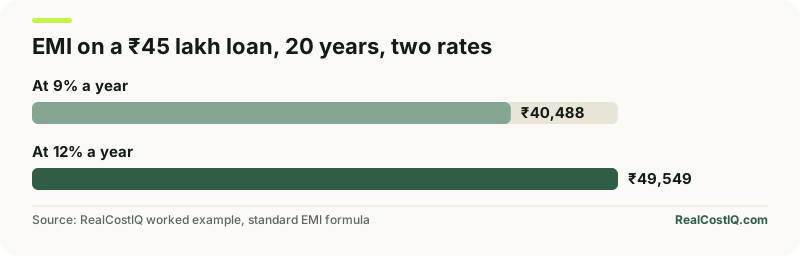
Now compare the same loan at two rates. Suppose a buyer manages a ₹45,00,000 loan on both flats. At 9% over 20 years the EMI is ₹40,488 and the interest is ₹52,17,040. At 12% the EMI is ₹49,549 and the interest is ₹73,91,730. The higher rate costs ₹21,74,690 more over the loan. Our home loan eligibility calculator lets you test your own income against a loan at the rate a lender quotes.
A price cut of ₹8 lakh looks large. Set it against the extra ₹15,00,000 of cash and the higher rate. A cheap B-khata flat can cost more than the A-khata flat next door once you add the finance. If you plan to sell later, the next buyer will face the same bank wall. That cuts your pool of buyers and your price.
Why the 5% conversion scheme does not rescue a flat
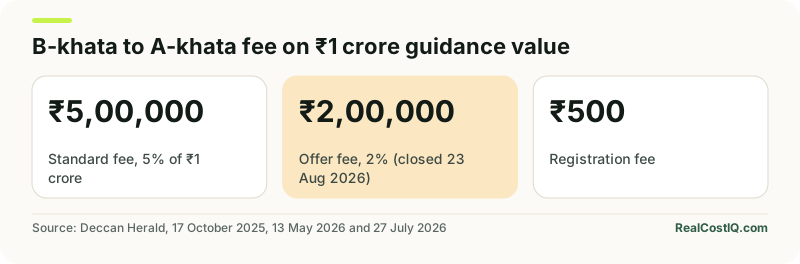
The state has run a scheme to turn B-khatas into A-khatas. It sounds like the fix. For flats it mostly is not. Deccan Herald explained the scheme on 17 October 2025. The fee was 5% of the property's guidance value, plus ₹500. The scheme applied to vacant plots and plots with a single-unit building. The report says in plain words that it does not benefit individual flat owners who hold a B-khata, or those living in multi-storey apartment units.
A 100-day discount followed. On 13 May 2026, Deputy Chief Minister D K Shivakumar announced a one-time cut to 2% of the guidance value for owners who applied in the next 100 days, starting 15 May. He said a property worth ₹1 crore would pay ₹2,00,000 instead of ₹5,00,000. A Deccan Herald report on 27 July 2026 said a state government order dated 24 July 2026 (the report does not give its number) cut the levy for new A-khatas under single-plot approval to 2% until 23 August, and that after that date the original 5% would apply.
What is the position now? The 23 August date is also in the Deccan Herald report of 27 July. The exact closing time, 11.59 p.m. on 23 August, and the statement that no order restoring or extending the 2% had been notified by 26 August, rest only on one NammaWard analysis posted on 26 August 2026. We could not check them against a government notice. Applications made between 15 May and 23 August keep the 2% rate, even if approval comes later. We searched Deccan Herald coverage up to 19 October 2026 and found no report of a new window. We could not reach the Karnataka government portals from our network, so this rests on press reports of official decisions. Check the e-Aasthi 2.0 portal before you rely on any rate.
For a flat, the route is different and it is out of your hands. The analysis says an A-khata for a flat needs approval for the whole building and an occupancy certificate. If those do not exist, the flat may get only a B-khata, and only if electricity records show the building stood on or before 30 September 2024. After that date, the Greater Bengaluru Governance Act, 2024, bars the issue of a B-khata for new unauthorised property, as the Cabinet told reporters in July 2025. So you cannot count on a B-khata flat becoming an A-khata by paying a fee.
What happens with a draft or missing e-khata
The third case is the flat with no final e-khata. This is common in two situations. One is a new flat where the builder has not finished the bulk khata. The other is a resale where the owner never completed the online steps.
In March 2025 the civic body admitted that khata work for builders had been on hold for six months, and small builders could not register flats they had sold. It then opened a bulk-khata form for builders. A builder who gets a provisional khata cannot transact on it, the civic officer said. Only the final khata can be used to transfer the flat. If a seller shows you only a provisional or draft record, you cannot yet complete a clean transfer.
The system also has bugs. A report on 19 October 2026 said the GBA's new e-khata system, launched in September 2026 as e-Aasthi 2.0, would not let some owners upload their encumbrance certificates. This affected properties registered after 1 April 2004. A senior GBA official said the problem would be fixed in a day or two. Ask the seller to show the final e-khata on the portal on the day you sign. Do not accept a promise that it is in process.
| Status | What it usually means | Bank loan | What you should do |
|---|---|---|---|
| A-khata, final e-khata | Building follows the plan and has an OC. Seller has finished the online steps | Possible. Ask for an architect and legal check as RBI paragraph 92 requires | Check the OC, sanctioned plan and EC. Then go ahead |
| B-khata | Something is missing: plan, layout approval or OC | Most banks refuse. Some housing finance companies lend less, at a higher rate | Get the lender's yes in writing before any token money. Do not count on conversion |
| No final e-khata (draft or provisional only) | Seller or builder has not completed the record | Banks will not close on a record that cannot be transferred | Make the final e-khata a condition of payment |
Sources: Deccan Herald reports of 5 October 2024, 26 March 2025, 17 October 2025 and 19 October 2026; RBI Credit Facilities Directions 2025, paragraph 92. A bank can still decide a case on its own legal advice.
Property tax: B-khata is not tax-free
One myth is that a B-khata flat means no property tax. The opposite is true. The Deccan Herald explainer says the 7.5 lakh B-khatas were issued so the civic body could collect tax. A Cabinet report in July 2025 said about 6 lakh B-khata properties would come under the tax net of the Greater Bengaluru Authority. So you pay the tax. What you lack is the standing that an A-khata gives you for loans and permits. Our property tax calculator shows how Bengaluru's tax is worked out.
How to check a flat before you pay a token
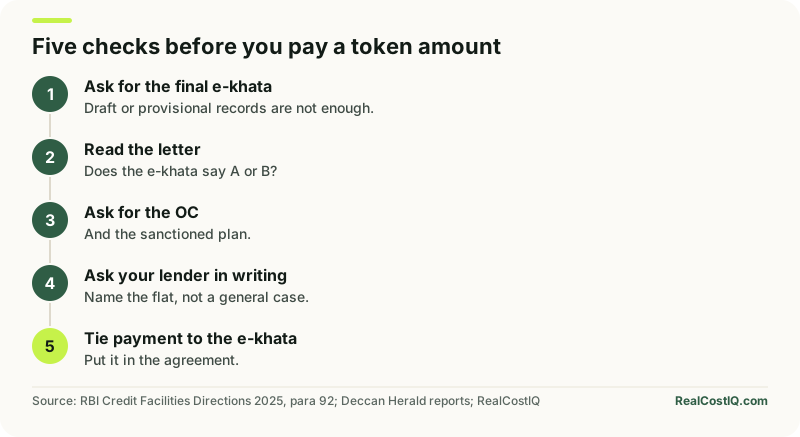
- Ask the seller for the final e-khata, not a draft. Look at it on the e-Aasthi portal yourself.
- Read whether it says A or B. If it says B, stop and read the next steps before you pay anything.
- Ask for the occupancy certificate and the sanctioned plan. RBI paragraph 92 makes the bank look at both.
- Give your lender the exact address and ask in writing whether it will lend. Ask what share of the value it will fund.
- Check the encumbrance certificate for liens. If the seller says there is a loan on it, ask for the lender's no-objection letter.
- Put the final e-khata, and the loan approval, in the agreement as conditions of payment. Add a clause on what happens to your token money if they fail.
- Check your own paper trail. Keep copies of every circular, receipt and portal screen.
Think about the cost of a mistake. A buyer who pays ₹5,00,000 in token money, then finds out the bank will not lend, can lose the token or fight to get it back. A written bank reply costs nothing and takes a few days. It is the best protection you have.
What this post does not cover
- Karnataka stamp duty. Use the Karnataka stamp duty calculator. We did not find a rule that makes the stamp duty rate depend on the khata letter, so we make no claim about one.
- Title and legal disputes. A clear khata does not prove clear title. Get a lawyer's opinion on the chain of papers.
- Other cities. Khata is a Karnataka term. Other states use different records, such as the property card in Maharashtra.
- Government sources. We could not open the Karnataka portals. The rates and dates for the conversion scheme come from news reports of official statements and orders. The bank rules come straight from the RBI directions.
The rules here have moved four times in two years. The e-khata mandate, the builder rule, the 2% window and the new portal each changed the picture. Expect more change. Before you pay, read the portal's notice board and ask your lender what it will accept on that day.