After the sale deed is registered, most buyers believe the paperwork is finished. It is not. The deed moves the title between you and the seller. But it does not by itself change two other things. One is the name in the register that the revenue office keeps of who holds the land. The other is the name in the register that the municipal corporation keeps of who pays the property tax. Mutation is the entry that changes those names. A buyer who skips it can end up with a clean registered deed, while the land record or property-tax register still shows the seller.
This post sets out what mutation is and how it differs from registration. It then covers what the law and the official pages of four places say about the steps, the office, the fee and the time. The four are Karnataka, Telangana, Uttar Pradesh and Delhi. We read all four on 8 October 2026. Three are statutes. They are the Karnataka Land Revenue Act, 1964 with its appended amendments. Next is the Telangana Bhu Bharati (Record of Rights in Land) Act, 2025. The last is the Uttar Pradesh Revenue Code, 2006 as published in 2012. We read each through a PRS Legislative Research copy, because the state websites refused our connections. For Telangana and Uttar Pradesh these are scans of the gazettes. For Karnataka it is the consolidated text with the amending Acts' gazettes appended. We read Delhi from the Delhi government's district services page and from the Municipal Corporation of Delhi's own policy order and citizen charter. Sometimes a statute leaves the fee or the time to rules that we could not read. Then we say “prescribed” and give no number. This is general information, not legal advice.
What mutation is, and what it is not
The Telangana Bhu Bharati Act defines mutation as a change in the entries in the record of rights. The change follows a transfer of a person's right in a holding, or part of it. The transfer can be by sale, gift, mortgage, exchange, partition of the holding, will, or inheritance or succession, intestate or testamentary. (Intestate means without a will.) The Municipal Corporation of Delhi's policy order states the limit in plain words. Land or a building may be transferred by an instrument or by inheritance on death. In that case the name change is allowed in the records of the Assessment and Collection Department. It is for realising property tax only. The power comes from section 128 of the Delhi Municipal Corporation Act, 1957. It does not confer any legal title or ownership rights.
Two points follow. First, mutation is evidence of possession and liability. It is not a substitute for a registered deed, and a mutation entry cannot cure a defective title. Second, there are two kinds of record, kept by two different offices. A revenue record of rights is kept by the Tahsildar (the local revenue officer) or the village officer. It is mostly for farm and village land. A municipal property-tax record is kept by the corporation or municipality, for urban buildings. A flat in a city is mutated in the second record. A farm or a village plot is mutated in the first. A buyer of a converted plot may have to deal with both.
| Revenue record of rights | Municipal property-tax record | |
|---|---|---|
| Kept by | Tahsildar, Revenue Inspector or village officer | Municipal corporation or municipality |
| Typical property | Agricultural land, village land, farm plots | Urban flats, houses, shops |
| Names in practice | Record of rights, khatauni, pattadar pass book, RTC | Khata, property-tax assessment, e-change of name |
| Who is paid | Revenue department | Municipal body |
| What a missing entry costs | Rights shown against the old holder; in UP a bar on suits until you report | Property-tax register stays in the old owner's name |
The names of the records vary by state and we read only the four jurisdictions below. The last row is drawn from section 37 of the Uttar Pradesh Revenue Code and the Delhi policy order; for the other states we state no consequence we did not read.
Karnataka: report within three months, or pay the fee at registration
Sections 128 and 129 of the Karnataka Land Revenue Act, 1964 are the mutation provisions. The consolidated copy we read has amending Acts appended up to Karnataka Act 41 of 2026, published in the gazette on 4 September 2026. We found only one appended Act that touches section 128. It is Karnataka Act 3 of 2022, which amended the third proviso, on the sketch for a partition. We found none that touches section 129. But PRS warns that its copies may not carry every amendment. So confirm with the Tahsildar's office. Bengaluru flat buyers have a second step, because the city keeps its own khata record. We cover that step in A-khata, B-khata and e-khata: cost and loan effects.
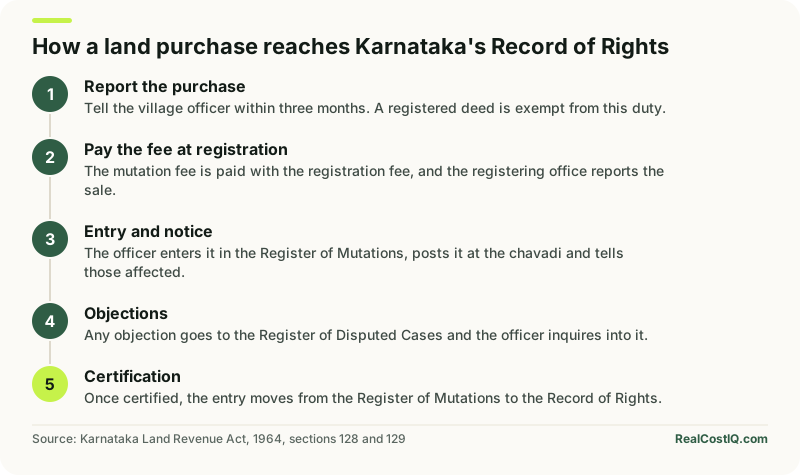
- The duty to report. Anyone who acquires a right in land must report it to the prescribed village officer within three months. This covers succession, survivorship, inheritance, partition, purchase, mortgage, gift, lease or otherwise. The report can be oral or in writing. The officer must at once give a written acknowledgment. A person who acquires the right by a registered document is exempt from the duty to report.
- Fees at registration. Section 128(4) says that a document by which a person acquires a right in land cannot be registered until a fee is paid. The person liable to pay the registration fee must also pay the fees prescribed for making the necessary entries in the record of rights and the register of mutations. The registering authority then reports the acquisition to the prescribed officer. For a buyer this is the main route. The mutation fee is collected with the registration, and the report follows.
- The entry and the notice. The officer enters the report in the Register of Mutations. He posts a copy of the entry in a conspicuous place in the chavadi (the village office). He also gives written intimation to everyone shown in the record or register as interested. This is section 129(2).
- Objections. Any objection, oral or written, is entered in the Register of Disputed Cases. The prescribed officer inquires into it. He has the powers of a Revenue Officer in a formal or summary inquiry.
- Certification and transfer. The prescribed officer tests and certifies the entries. An entry is not moved from the Register of Mutations to the Record of Rights until it has been certified. See section 129(6) and (7).
Late reporting carries a small penalty written into the section. It is ₹2 if the report is made after three months but within a year. After a year it is between ₹2 and ₹10, as ordered by the Tahsildar. Those amounts are printed in the consolidated text. They are tiny, and the real cost of delay is the unrecorded name. Section 129A adds that every holder of agricultural land is to be given a patta book containing a copy of the record of rights. Rules decide the fee for the mutation entries, the time the officer has and the form of the report. We did not read those rules. So this post gives no figure and no number of days for Karnataka.
A caution on scope. These sections speak of land in the revenue record. In Bengaluru, the khata is the municipal property record. Moving it after a sale is a separate municipal step, which our Karnataka stamp duty calculator explains.
Telangana: mutation is built into the registration of agricultural land
The Telangana Bhu Bharati (Record of Rights in Land) Act, 2025 gives the most detailed procedure of the four. It is Act 1 of 2025, assented to on 3 January 2025 and published in the Telangana Gazette on 4 January 2025. It comes into force in the areas and on the dates the Government notifies. A Suryapet district notice lists Government Orders 36 and 39, both dated 14 April 2025, as the Bhu Bharati guidelines. We could not read their content as text. So we do not state the fees and time limits that they presumably set.
Sale, gift, mortgage, exchange and partition of agricultural land
Section 5 covers a person who plans to transfer or obtain an interest in farmland by one of these modes under a registered document. That person first applies on the prescribed website to the Registrar for a date and time. On that date the parties present the transfer document, the prescribed affidavits and the Pattadar Pass Book-cum-Title Deed, with a survey or sub-division map from a prescribed date. The Registrar registers the document on payment of stamp duty, the registration fee and the “mutation charges prescribed”. This holds where the pattadar (the landholder in the record) and property details match the Record of Rights and the transfer is not otherwise prohibited. Immediately after registration, the Tahsildar amends the Record of Rights. He deletes the land from the transferor's account and adds it to the transferee's. The Recording Authority then issues a new or updated pass book and an extract of the changes, which is appended to the registered document. The buyer does not file a separate mutation application. The Act contemplates no waiting period between registration and mutation.
Will, inheritance and other modes
A person who acquires rights through a will or by succession applies to the Tahsildar. The application is in the prescribed format, on the prescribed website, with the prescribed fees. Legal heirs file a joint statement in an intestate succession. The Tahsildar decides within the prescribed time. He must give notice to everyone entered in the record who may be affected. He must consider objections. He must also give the applicant a chance to make a representation before refusing. If no order is passed within the prescribed period, the Record of Rights is deemed amended. Mutation under a court order or decree, or by any other means the Government notifies, goes to the Revenue Divisional Officer on a similar procedure (section 8). An order of the Tahsildar can be appealed to the Revenue Divisional Officer within sixty days. A second appeal goes to the District Collector within thirty days (section 15). Section 6 separately lets the Government regularise certain unregistered transactions made before 2 June 2014 by small and marginal farmers. The Act fixes the application window as 12 October to 10 November 2020. So it is no route for a buyer today.
Urban plots and flats are outside this Act
Abadi land is built-up village land. For abadi land and other non-farm land, sections 5(9) and 7(5) send mutation to other laws. These are the Telangana Panchayat Raj Act, 2018, the Telangana Municipalities Act, 2019 and the Greater Hyderabad Municipal Corporation Act, 1955. So a flat in Hyderabad is mutated in the city's property-tax record. It is not mutated under the Bhu Bharati process. We did not read the city's procedure. Section 9 also gives every parcel of land a Bhudhaar number and an online Bhudhaar card, on a date the Government notifies.
Uttar Pradesh: dakhil-kharij before the Tahsildar
Mutation in Uttar Pradesh is known as dakhil-kharij. Chapter IV of the Uttar Pradesh Revenue Code, 2006 (U.P. Act 8 of 2012) governs it. We read the PRS copy of the 2012 gazette. The scan is partly illegible, and we cannot quote a few lines of section 34. Uttar Pradesh has also amended the Code since 2012. So what follows is the structure, not the current text. The Uttar Pradesh bhulekh portal loaded for us but showed only its title. So we do not state the portal's own procedure and fees.
- Succession (section 33). A person who gets possession of land by succession must submit a report to the Revenue Inspector of the circle in the prescribed form. If the case is not disputed, the Revenue Inspector records the succession in the record of rights, the khatauni. If it is disputed, he inquires and reports to the Tahsildar.
- Transfer (section 34). Section 34 puts the same duty on a person who gets possession by transfer. The explanation to the section covers transfer by a family settlement. We cannot quote the wording of the rest of it from the scan.
- Inquiry and order (section 35). The Tahsildar makes the prescribed inquiry on a report, or on facts otherwise coming to his knowledge. If the case is not disputed, he directs the khatauni to be amended. If it is disputed, he settles it by conciliation or decides the dispute. An aggrieved person may appeal to the Sub-Divisional Officer within thirty days. A second appeal lies to the Commissioner within thirty days, and his decision is final. The Third Schedule lists mutation cases (section 35) as going to the Tahsildar first.
- Registration feeds mutation (section 36). Say a document is registered under the Registration Act, 1908. Then the registering authority sends a notice to the Tahsildar. The notice follows the prescribed form and time. No order recording succession or amending the record of rights is passed unless the land revenue due up to date has been deposited.
- A bar on suits (section 37). A person who got possession by succession or transfer cannot bring a suit in a revenue court. He must first make the report under section 33 or section 34.
The Code leaves the form, the fee and the time to the rules, and we did not read them. Section 37 is the practical point. A buyer who has not reported cannot go to the revenue court to enforce a claim about that land. To price the deed, use our own stamp duty page for Uttar Pradesh. This post covers only what comes after.
Delhi: a Tahsildar record and a separate MCD record
Delhi has the two records side by side. For the land record, the District Magistrate (South) services page describes mutation as a service of the Tahsildar's office. The applicant files an application to the Tahsildar with proof of residence and proof of ownership, such as a sale deed. Where the property passes on a death, the applicant also files affidavits from all surviving members. The page says the application is made at the Tahsildar's office on working days between 10:00 AM and 1:00 PM. It gives 30 days as the time required. It states no fee. The page carries a last-updated date of 10 July 2020, so treat the details as indicative.
For a building in a city, the record that matters to most owners is the Municipal Corporation of Delhi's property-tax record, and the MCD publishes the rules. The policy order says the name change is allowed under section 128 of the DMC Act, 1957 for the purpose of realising property tax only. For a registered sale deed, registered agreement to sell, conveyance deed by a land-owning agency or registered gift deed from 1 April 2019, no separate application is needed. The e-change of name certificate is auto-triggered. The same policy says the certificate is valid like one generated by application. It needs no stamp or signature from an MCD official, and the Circle Officer updates the register. In exceptional cases where the auto-trigger does not happen, you can apply on the portal. The citizen charter says you can download the certificate for a registered sale deed from the portal the day after registration. It gives 30 days as the maximum time for other deeds.
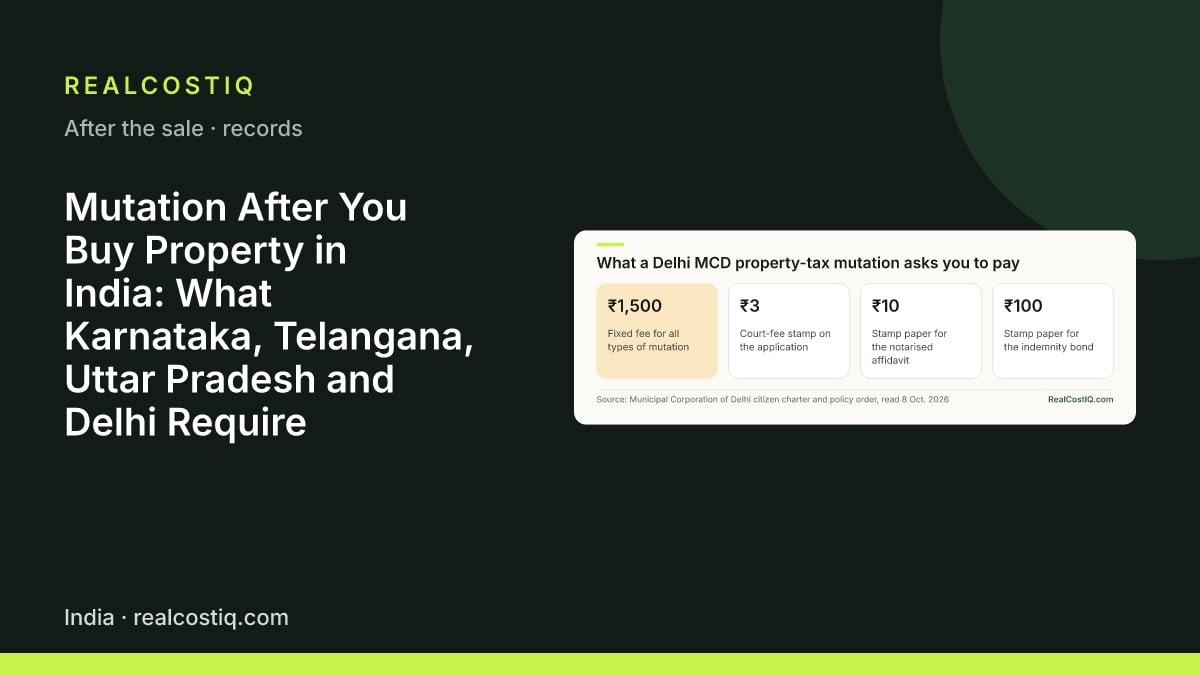
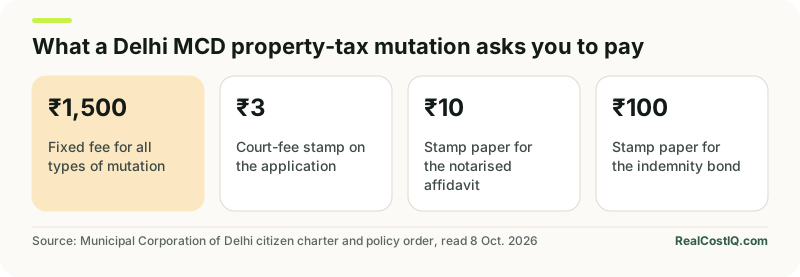
The citizen charter lists a fixed fee of ₹1,500 for all types of mutation. It does not say whether an auto-triggered certificate attracts it. The application carries a ₹3 court-fee stamp. The general documents are an affidavit of the applicant on ₹10 stamp paper, duly notarised. They also include an indemnity bond on ₹100 stamp paper, duly notarised, and the death certificate of the previous owner, if applicable. You also need receipts of up-to-date property tax and the complete chain of ownership documents. The charter is undated and sits beside licence fee tables for 2023 to 2025. So confirm the fee on the MCD portal before you pay. For deaths, the policy sets out cases by whether there is a registered will, an unregistered will or none, and by how many legal heirs apply. A Surviving Member Certificate is required in most of them. Where there is no will and only one of several legal heirs applies, a succession certificate or letter of administration is needed. Release and exchange deeds are mutated only after transfer duty is paid. A partition or family settlement without consideration can be mutated without transfer duty. So can a relinquishment without consideration on a death. The Delhi stamp duty position is on our Delhi stamp duty page. A family transfer that follows a will is covered in our gift deed, will and release deed post.
Side by side
| Karnataka (revenue record) | Telangana (agricultural land) | Uttar Pradesh (khatauni) | Delhi (MCD tax record) | |
|---|---|---|---|---|
| Who files | Buyer reports; if the deed is registered the registering authority reports | No separate filing for a registered sale; Tahsildar amends after registration | Buyer reports; registering authority sends intimation | Nobody for registered sale or gift deeds since 1 April 2019; otherwise buyer on the MCD portal |
| Office | Prescribed village officer, then Tahsildar | Registrar, then Tahsildar | Revenue Inspector or Tahsildar | Zone office of MCD Assessment and Collection |
| Deadline for the buyer | 3 months, unless the document is registered | None stated for a registered sale | Report required before a revenue-court suit | None stated |
| Fee | Prescribed; paid with registration | “Mutation charges prescribed” | Prescribed | ₹1,500 fixed per the citizen charter, plus a ₹3 court-fee stamp |
| Time | Prescribed | Immediately after registration for a sale; prescribed period for a will | Prescribed; appeals 30 days | Day after registration for a sale deed; 30 days maximum for others |
| Appeal | Objections inquired into by the prescribed officer | RDO within 60 days of the Tahsildar's order; Collector within 30 days (section 15) | SDO within 30 days, Commissioner within 30 days | Not stated in what we read |
“Prescribed” means the statute leaves the number to rules that we did not read; it does not mean there is no fee. Maharashtra, Tamil Nadu, Gujarat and every other state are not covered.
The municipal record is a second mutation
Whatever the revenue record shows, the property-tax record needs its own change if you own a building in a city. In Ahmedabad, it is the corporation's name-transfer fee. In Delhi, it is the MCD e-change of name above. The municipal record decides whose name the property-tax bill is issued in. Our property tax calculator shows what that bill is likely to be in the cities it covers. The Department of Land Resources home page lists two programmes: the National Generic Document Registration System, and the integration of e-Courts with land-record and registration databases. But the page gives no detail on mutation. So we cannot say in which states a registered deed already triggers mutation by itself, beyond those we read. These are Telangana for agricultural land and Delhi for the MCD record.
If you skip it
- Uttar Pradesh. Until you report, you cannot sue in a revenue court on the strength of the land (section 37). The Tahsildar will not amend the khatauni if land revenue is in arrears (section 36(2)).
- Karnataka. The report is due within three months unless the document is registered. If you buy by registered deed, the fee is collected at registration. Still, check that the village officer received the report, and ask for the acknowledgment. The entry goes through notice, objection and certification before it reaches the Record of Rights.
- Telangana. For farmland, you should receive an updated pass book at the registration. If you do not, ask the Tahsildar's office why. For a flat, ask for the municipal assessment in your name.
- Delhi. The MCD continues to bill the name on its register. For a registered sale or gift deed since 1 April 2019, the e-change of name certificate should appear on the portal the next day. If it does not, apply on the portal.
- Inheritance anywhere. The will or the death certificate does not change the record. Our gift deed and will post covers what the person who inherits must file.
What this post did not read
We set one rule for this post. We had to read at least three states' mutation rules at primary level on the day. We did that for Karnataka, Telangana, Uttar Pradesh and Delhi. We did not read the following today. We name them so you do not assume them.
Maharashtra: the 7/12 extract, the property card and the register of mutations (ferfar) under the Land Revenue Code. The Mahabhumi and IGR websites did not give us a page we could read. Our copy of the Code could not be read as text. Tamil Nadu: patta transfer. The websites were unreachable. Gujarat: the 7/12 and the Village Form 6 entry. West Bengal, Kerala and every other state.
Also not read: the Karnataka rules on the mutation fee and the time for the officer. The Telangana rules and Government Orders of 14 April 2025. The Uttar Pradesh rules and the current amended Code. The Hyderabad and Bengaluru municipal procedures. The current Delhi land-record fee.
If your property is in one of these, ask the office named in your state's revenue department for the written procedure. Do not rely on what is common elsewhere.