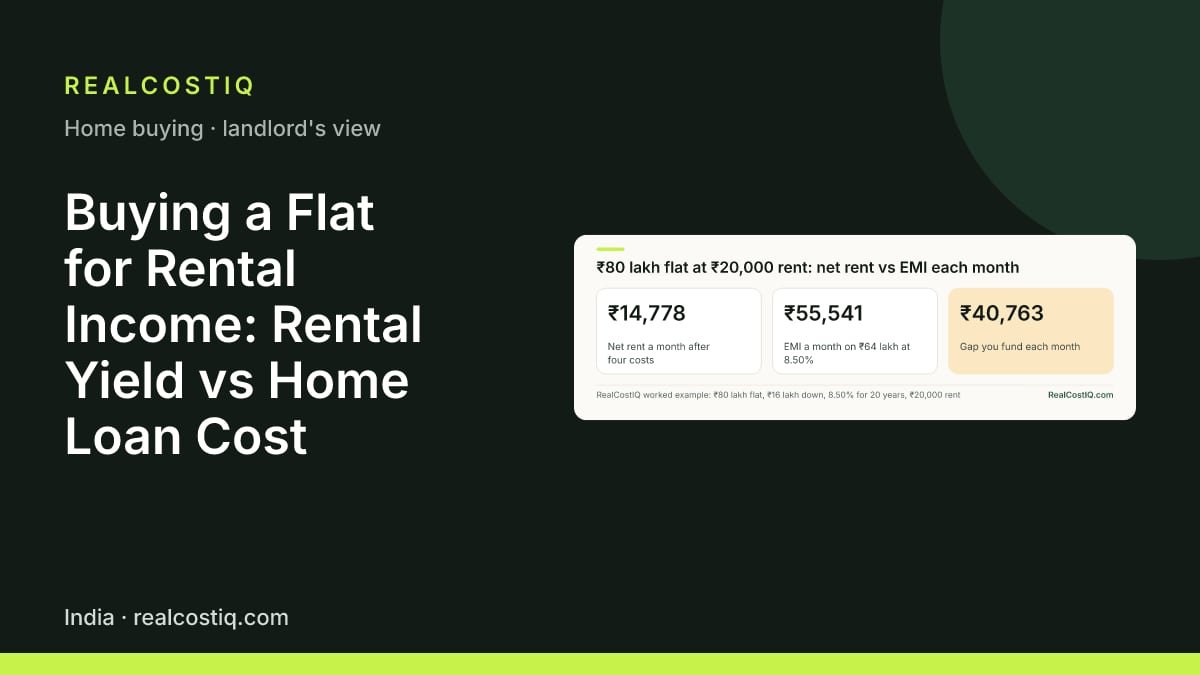
Many buyers see a flat as a way to earn rent. The idea is simple. You buy, a tenant pays you every month, and the rent helps with the loan. Whether it helps enough is a sum, and the sum is easy to do before you pay a booking amount. This post does it for one flat, and then shows how the answer moves with the rent and the loan rate.
We read every source named here on 18 October 2026. Our rental yield calculator gives the yield on your own flat, and the rental property calculator models a full holding period. This post asks one narrow question: how big is the monthly gap between net rent and the loan payment? If you plan to live in the flat, our post on renting vs buying looks at the same sort of flat from a resident's side.
A worked example first: an ₹80 lakh flat that rents for ₹20,000
Take an ₹80 lakh flat. A tenant pays ₹20,000 a month, which is ₹2,40,000 a year. Gross rental yield is the year's rent divided by the price. Here that is ₹2,40,000 divided by ₹80,00,000, which is 3.00%.
Gross yield ignores every cost of owning. Net rental yield takes costs off the rent first. We use four costs. All four are our own assumptions, because no Indian public source publishes them as a benchmark. We write them out so you can swap in your own.
| Line | Per year | Our assumption |
|---|---|---|
| Rent received at ₹20,000 a month | ₹2,40,000 | 12 months of rent |
| Vacancy | −₹20,000 | One month empty each year |
| Society maintenance paid by the owner | −₹30,000 | ₹2,500 a month; lease terms vary |
| Property tax | −₹6,000 | A placeholder for your own bill, not a rate for any city |
| Brokerage to find a tenant | −₹6,667 | One month's rent every three years |
| Net rent | ₹1,77,333 | |
| Net rental yield | 2.22% | ₹1,77,333 divided by ₹80,00,000 |
Our sums. The costs are assumptions, not market data. Property tax differs by city and state, so we use a round placeholder and do not cite any rate. Repairs, the deposit you hold, tax on the rent and the cost of any gap between tenants beyond one month are not modelled.
So a flat that looks like a 3% earner is a 2.2% earner once the owner pays the bills. Now set that against the loan.
The loan side: ₹64 lakh at 8.50%
Say you pay 20% down, which is ₹16 lakh, and borrow ₹64 lakh for 20 years. For the rate we use the 8.50% shown on HDFC Bank's home loan page on 18 October 2026. The page ties that example rate to a credit score of 800 or above and says it is “as on today”. It shows no effective date, so treat it as the rate on the day we read it. Our EMI engine gives an EMI, the fixed monthly payment, of ₹55,541.
In the first year you pay ₹6,66,488 in EMIs. Of that, ₹5,39,114 is interest and ₹1,27,375 reduces the loan. Interest is 81% of what you pay in year one. That is the usual shape of a long loan: early payments are mostly interest.
| Item | Per year | Per month |
|---|---|---|
| Net rent after our four costs | ₹1,77,333 | ₹14,778 |
| EMIs paid | ₹6,66,488 | ₹55,541 |
| Gap you fund from your own pocket | ₹4,89,155 | ₹40,763 |
| Of the EMIs, interest | ₹5,39,114 | ₹44,926 |
| Of the EMIs, principal repaid | ₹1,27,375 | ₹10,615 |
EMI and the year-one split are from the home loan EMI calculator's engine: price ₹80,00,000, down payment ₹16,00,000, 8.50%, 20 years. Net rent is from the table above. The principal is not lost: it lowers your loan. But it still leaves your bank account every month.
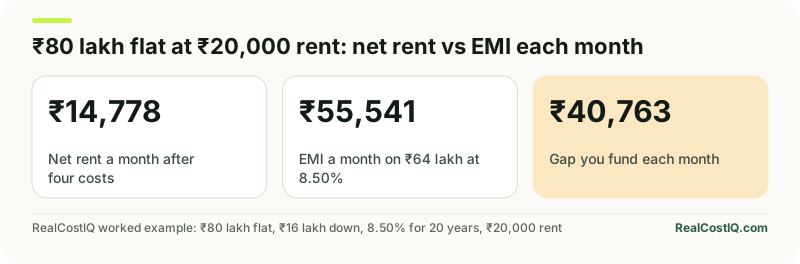
The owner puts in about ₹40,763 every month, on top of the ₹16 lakh down payment. Stamp duty and registration are extra, and they depend on the state. We leave them out here so that every figure in the post is clear. You can find them for your state in our stamp duty calculator.
Compare the two rates. The flat earns 2.22% net and the loan costs 8.50%. On ₹64 lakh, that 6.3 point difference is the heart of the gap. Rent is a small earner set against a loan of this size.
What if the rent is the market average?
The ₹20,000 rent in our example is a weak case. Anarock Research, a private property consultancy, put the average rental yield in Bengaluru at 4.6% in Q2 2026. On an ₹80 lakh flat that is about ₹30,667 a month. We use ₹30,000, which is 4.5% gross. The same costs apply, except vacancy and brokerage rise with the rent.
| Rent ₹20,000 | Rent ₹30,000 | |
|---|---|---|
| Gross yield | 3.00% | 4.50% |
| Costs (vacancy, maintenance, property tax, brokerage) | ₹62,667 | ₹76,000 |
| Net rent per year | ₹1,77,333 | ₹2,84,000 |
| Net yield | 2.22% | 3.55% |
| EMIs per year | ₹6,66,488 | ₹6,66,488 |
| Gap per year | ₹4,89,155 | ₹3,82,488 |
| Gap per month | ₹40,763 | ₹31,874 |
Our sums. Both columns use the same four cost assumptions as the first table, with vacancy at one month's rent and brokerage at one month's rent every three years.
A rent that is 50% higher cuts the monthly gap by about ₹8,900. It does not close it. At a market-average rent, the owner still puts in ₹31,874 a month.
How yields look across cities, and how the loan rate compares
Anarock's study covered 11 residential markets from 2019 to Q2 2026. It was reported by Business Today and Outlook Money in early August 2026. We could not find an official series for residential rental yield by city. The RBI's house price index tracks prices, not rents, and we did not find a city-by-city rent dataset from the RBI, NHB, CREDAI or MoSPI. So these are private averages. The press coverage does not explain how Anarock counts rent and price, so we call them gross yields as a reading, not as a stated definition.
| City | Average yield (Anarock, Q2 2026) | Rent a month on ₹80 lakh | Gap to an 8.50% loan rate |
|---|---|---|---|
| Delhi | 3.2% | ₹21,333 | 5.3 points |
| Hyderabad | 3.6% | ₹24,000 | 4.9 points |
| Noida | 3.9% | ₹26,000 | 4.6 points |
| Gurugram | 4.3% | ₹28,667 | 4.2 points |
| Mumbai | 4.3% | ₹28,667 | 4.2 points |
| Bengaluru | 4.6% | ₹30,667 | 3.9 points |
Yields: ANAROCK Research, 2019 to Q2 2026, as reported by Business Today (4 August 2026) and Outlook Money. Rent and gap are our sums on an ₹80 lakh flat, which is not an average price in any of these cities. The gap compares a gross yield with a loan rate, so it understates the real gap after costs.
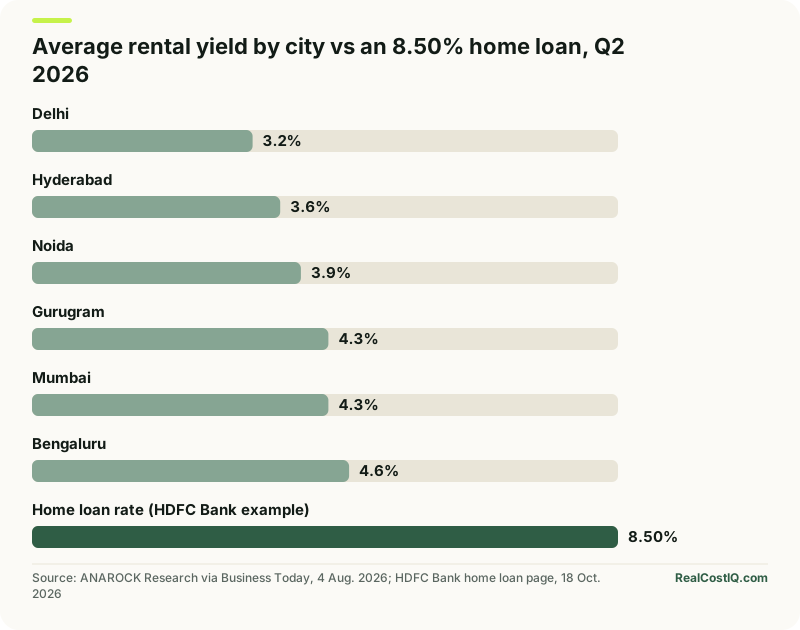
The yields are in a narrow band, from 3.2% to 4.6%. Even the best of them is 3.9 points below the loan rate. The reports also note that yields improved between 2019 and Q2 2026, by 100 basis points in Bengaluru, Hyderabad and Delhi. A basis point is one hundredth of a percentage point. Better yields help, but the gap to the loan rate stays wide.
How the loan rate moves the gap
The rate is the part you can shop for. On 18 October 2026, SBI's home loan page showed “7.50% p.a. onwards”, with the note “w.e.f. 15.10.2026” and terms and conditions. It is a starting rate, not a rate for every borrower. HDFC Bank's example card showed 8.50%. The RBI raised its repo rate by 25 basis points to 5.50% on 7 October 2026, and changed its stance to calibrated tightening. The repo rate is the rate at which the RBI lends to banks. The RBI said rate cuts are off the table in the near term, so we do not assume a fall. We add a third row, 9.50%, as a plain one-point rise and not as a forecast.
| Rate | EMI | Gap per year | Gap per month |
|---|---|---|---|
| 7.50% (SBI, 'onwards', from 15 October 2026) | ₹51,558 | ₹4,41,363 | ₹36,780 |
| 8.50% (HDFC Bank example, score 800 and above) | ₹55,541 | ₹4,89,155 | ₹40,763 |
| 9.50% (our one-point test) | ₹59,656 | ₹5,38,544 | ₹44,879 |
EMI from the home loan EMI calculator's engine. Gap is EMIs for the year minus net rent of ₹1,77,333. The 9.50% row is a test and not a quote from any bank.
A full percentage point moves the monthly gap by about ₹4,000. That is useful, but it is small next to the ₹40,000 base. Shopping for the lowest rate matters. It does not turn a 2% earner into a break-even flat. Use our home loan EMI calculator to test the rate you are offered.
What rent would cover the loan?
Turn the question around. Instead of asking what the gap is, ask what rent would make it zero. Net rent in our model is 12 months of rent, less one month of vacancy, less brokerage of one month every three years, less ₹36,000 a year of maintenance and property tax. That works out to 10.67 months of rent less ₹36,000. Set it equal to the year's EMIs, or to the year's interest, and solve for the rent.
| Rate | To cover the full EMI | As gross yield | To cover year-one interest only | As gross yield |
|---|---|---|---|---|
| 7.50% | ₹61,378 | 9.21% | ₹47,919 | 7.19% |
| 8.50% | ₹65,858 | 9.88% | ₹53,918 | 8.09% |
| 9.50% | ₹70,488 | 10.57% | ₹59,923 | 8.99% |
Our sums with the same four cost assumptions. A rent of ₹65,858 on an ₹80 lakh flat is 9.88% a year of the price. Anarock's city averages in the table above run from 3.2% to 4.6%.
At 8.50%, the flat would need to rent for about ₹65,900 a month to pay its own EMI. That is 3.3 times our example rent and 2.2 times the ₹30,000 rent. Even covering only the interest takes about ₹53,900. No city average in Anarock's study comes close to either figure. That is why a financed flat is usually held for its price growth, not its rent.
How long would rent growth take to close the gap?
Rents rise over time and the EMI does not, on a standard fixed-EMI loan. So the gap shrinks. How fast? Say rent rises 5% a year. That is our assumption, and a round one. To keep the test simple, we hold the owner's costs flat, which helps the owner. At 8.50%, the rent must reach ₹65,858 to cover the full EMI.
- Starting at ₹20,000: 5% a year takes about 24.4 years to reach ₹65,858. That is longer than the 20-year loan. The EMI never gets covered by net rent while the loan runs.
- Starting at ₹30,000: 5% a year takes about 16.1 years. Net rent covers the EMI only in the last three or four years of the loan.
In both cases, the owner puts in cash for most of the loan. Add up ₹40,763 a month in year one. It falls each year as rent rises, but it is still large for a long time. You should be sure you can fund it for years, including a year with a gap between tenants.
The other part of the return: what the price does
Rent is only one source of gain from a flat. The other is a rise in its price. The RBI's All-India House Price Index, which covers 18 cities, rose 3.6% in the year to Q1 2026-27, according to its release of 24 August 2026. On an ₹80 lakh flat, 3.6% is ₹2,88,000. That is a national index, not a figure for your city. A city or a project can do better or worse, and a past year is not a forecast.
Set that against the year-one gap in our example. A rise of ₹2,88,000 would cover about 59% of the ₹4,89,155 you top up. The ₹1,27,375 of principal you repay also reduces your loan. These two together are what you hope to gain in return for the cash you put in. They are not guaranteed, and selling a flat has its own costs that we have not modelled. The real question for you is whether the price gain you expect is worth the monthly top-up you must pay for it.
Tax on the rent
Rent from a let-out flat is taxed under the head income from house property in the Income-tax Act, 2025. The Act lets you deduct a set share of the annual value, and the interest on a loan used to buy the property. We have not modelled tax. It depends on your slab and on how the Act applies to you. Ask a tax adviser before you rely on any saving.
How to test your own flat in six steps
- Get a real rent. Find what similar flats in the same building or society rent for. Do not use a city average as your rent.
- Work out gross yield. A year of rent divided by the price. Compare it with the 3.2% to 4.6% range in the Anarock study.
- List your costs. Maintenance the owner pays, property tax from your own municipal bill, vacancy, brokerage and repairs. Subtract them to get net rent.
- Price the loan. Use the rate your bank actually offers you. Read its sanction letter, and get the EMI from the EMI calculator.
- Find the gap. EMIs for the year minus net rent. Divide by 12. That is the monthly cash you must be ready to add.
- Ask if you can fund it. Check that you can pay the gap for at least two years, including an empty month or two and a possible rate rise.
Steps two to five are quick in the rental yield calculator. If you want the full hold, with rent growth, price growth and the sale, use the rental property calculator.
What this post cannot tell you
- Your flat's rent. Our ₹20,000 and ₹30,000 are examples. The Anarock yields are private averages for whole cities, and the press reports do not explain the method behind them.
- Your costs. Maintenance, vacancy, property tax and brokerage are our assumptions. Property tax in particular differs by city and state, so we used a placeholder and cite no rate.
- Your loan rate. The 8.50% is HDFC Bank's example card on 18 October 2026 for a score of 800 and above. SBI's 7.50% is a starting rate with conditions. Your rate depends on your profile and your lender.
- Stamp duty and registration. They add to the cash you put in and depend on your state. We left them out.
- Tax on rent and on a sale. We did not model either.
- Whether to buy. This post shows the monthly gap and the rent that would close it. It does not say whether the price gain you expect is worth the cost.