A flat can be finished, painted and handed over, and still have no occupancy certificate. For the buyer that gap is not a paperwork detail. It decides whether a bank will lend, whether the builder can legally give you possession, and who pays when the municipality charges more for a building without the certificate. This post puts rupee figures on each of those, using one example flat: ₹80 lakh, a 20% self-funded share, and a bank loan of up to ₹60 lakh.
Every legal and lender rule below was read on 30 October 2026 from the source named next to it. Where a figure is our own arithmetic, we say so. Where we could not read a source, we leave the figure out rather than guess. That matters most for municipal penalties: they differ by city, and we did not read a municipal portal today, so we quote no city's penalty.
OC and CC: what each one certifies
Two papers get mixed up. The completion certificate (CC) says the building was built as per the sanctioned plan. The occupancy certificate (OC) is issued by the local authority after that check and says the building is fit to be lived in, with the basic services in place. One loan-aggregator explainer puts the order plainly: the CC comes first, the OC after final compliance checks. The same explainer says the local body usually issues an OC within about 30 days of the application, which is a typical figure, not a legal deadline (BankBazaar, occupancy certificate explainer, 2026).
The Real Estate (Regulation and Development) Act, 2016 puts the job of getting these papers on the builder, called the promoter in the Act. Section 17(1) says the promoter must execute a registered conveyance deed and hand over possession. If no local law sets a period, that must be done within three months of the date the occupancy certificate is issued. Section 17(2) adds that where no local law applies, the promoter hands the documents and plans for the common areas to the association within thirty days of the completion certificate (RERA 2016, section 17, Court Book text). Read that carefully: the Act ties your title paperwork to the OC. A flat with no OC has not reached the point where the Act expects your conveyance.
Partial certificates exist. A large project built in phases can get an OC for one tower while the rest is still going up. That is normal and not a red flag by itself. The check is whether the tower and floor you are buying are named in the certificate. A loan-aggregator explainer notes a partial OC covers a completed phase or block and should be replaced by a final OC when the whole project is done (BankBazaar, above).
Will a bank lend on a flat with no OC?
Start with what the regulator says, because it is narrower than most buyers think. The Reserve Bank of India's credit-facilities Directions deal with a built-up flat in paragraph 92. The buyer must give an affidavit-cum-undertaking that the property is built as per the sanctioned plan or building bye-laws and, in the RBI's words, "as far as possible" has a completion certificate. A bank-empanelled architect must certify before disbursement that the property is as per the sanctioned plan or bye-laws (RBI Master Direction RBI/DOR/2025-26/154, para 92(4)-(5), updated as on 1 October 2026). So the RBI text does not say "no OC, no loan" in so many words. It leaves room, and it puts the burden of checking on the bank.
Banks then add their own rule on top of that room. The loan-aggregator explainer we read says an OC is one of the mandatory documents for a housing loan and that a buyer "cannot apply for a housing loan" without it (BankBazaar, above). Another lender's page says a completion certificate "may be required" in due diligence and lists difficulty with loan processing and resale as consequences of not having one (L&T Finance, completion certificate page, published 18 June 2026, updated 20 July 2026). Those are lender-side explainers, not a bank's written sanction conditions, and no bank's product page was readable for us today. Treat them as the usual practice and ask your own bank for its checklist in writing before you pay a token.
What a refusal costs: the loan band on an ₹80 lakh flat
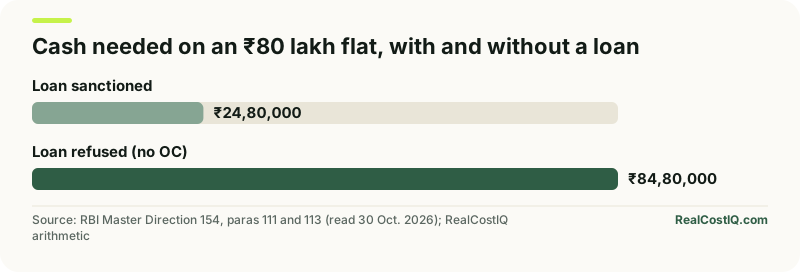
RBI paragraph 111 sets the most a bank may lend as a share of the property value. For an individual housing loan up to ₹30 lakh it is 80%, with a higher 90% band at a higher risk weight. Above ₹30 lakh and up to ₹75 lakh it is 80%. Above ₹75 lakh it is 75% (RBI Master Direction, para 111). An ₹80 lakh flat sits in the last band. The most a bank may lend is therefore 75% of ₹80 lakh, which is ₹60,00,000, and the minimum you bring is ₹20,00,000. If no bank will lend because the OC is missing, you bring all ₹80,00,000.
Stamp duty and registration come on top of either number. They are state-specific, differ by buyer type and city, and the RBI says banks must not count them in the property cost when working out the loan, except where the flat costs ₹10 lakh or less (RBI Master Direction, para 113). To keep the table simple we assume combined duty and registration of 6% of the price. That is an example, not any state's rate. Use the stamp duty comparison for your state, city and buyer type.
| Line | Loan sanctioned | Loan refused (no OC) |
|---|---|---|
| Flat price | ₹80,00,000 | ₹80,00,000 |
| Bank loan (75% band above ₹75 lakh) | ₹60,00,000 | ₹0 |
| Own money towards the price | ₹20,00,000 | ₹80,00,000 |
| Duty and registration at an assumed 6% | ₹4,80,000 | ₹4,80,000 |
| Total cash needed | ₹24,80,000 | ₹84,80,000 |
| Extra cash because of the refusal | — | ₹60,00,000 |
Our arithmetic. The 75% band is RBI para 111; the 6% is an assumed example, not a state's rate. The loan is also subject to income and credit checks, so the sanctioned amount can be lower than the cap.
There is a second, quieter loan problem. If the flat is under construction and the builder says the OC will come later, the bank pays the builder in stages. The RBI warns about schemes where the loan is paid out upfront to the builder without linking it to the stages of construction, because a dispute or a delay then leaves the borrower exposed, and a builder's late payments of interest can reach the credit bureau under the borrower's name (RBI Master Direction, paras 114-115). If a developer offers you a scheme where the builder pays your EMI until possession, read those two paragraphs first. A missing OC at the end of the build leaves you with a loan, a flat you may not legally occupy, and a credit record you did not control.
The extra charges: property tax and water
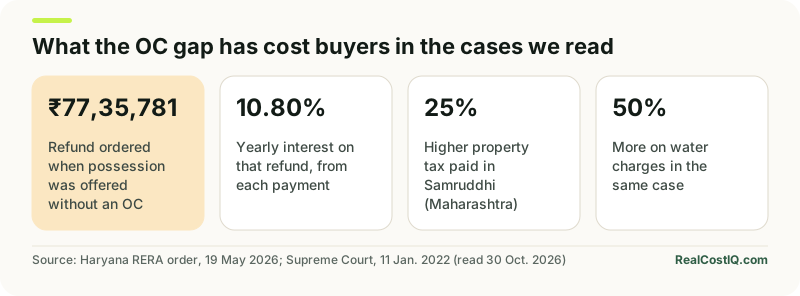
The clearest rupee evidence on OC-less living comes from the Supreme Court. In Samruddhi Co-operative Housing Society v. Mumbai Mahalaxmi Construction (decided 11 January 2022), flat owners in a building without an OC paid 25% higher property tax and 50% more on water charges than a building with one. The builder had never obtained the OC. The court held that failing to get it was a deficiency in service, that the flat owners were consumers entitled to be compensated for the extra tax and water charges, and that the builder's continuing failure was a continuing breach, so the complaint was not out of time (LiveLaw, Samruddhi Co-operative Housing Society v. Mumbai Mahalaxmi Construction, 2022).
Two cautions. First, the case came under the Maharashtra Ownership Flats Act, sections 3 and 6, which make the builder liable for outgoings such as municipal taxes and water until the property is transferred. The percentages are what that municipality charged in that case, not a national rule. Your city may charge differently, or nothing extra, and we did not read any municipal portal today. Ask the municipal office what it charges an OC-less building and get the answer in writing. Second, the court's remedy is against the builder. You still have to claim it.
To see what 25% and 50% mean in rupees, take two example bills. These are assumed amounts to show the arithmetic, not a city's rates. If your yearly property tax would normally be ₹24,000, 25% more is ₹6,000 a year. If your yearly water charge would normally be ₹30,000, 50% more is ₹15,000 a year. Together that is ₹21,000 a year, or ₹2,10,000 over ten years. Use the property tax calculator to set your city's normal bill, then add the surcharge your municipal office confirms.
| Item | Normal bill a year | Extra without OC | Extra over 10 years |
|---|---|---|---|
| Property tax (+25%) | ₹24,000 | ₹6,000 | ₹60,000 |
| Water charges (+50%) | ₹30,000 | ₹15,000 | ₹1,50,000 |
| Total | ₹54,000 | ₹21,000 | ₹2,10,000 |
Our arithmetic on assumed bills. The 25% and 50% are the figures in the Supreme Court's Samruddhi judgment (Maharashtra, 2022), not rates for every city.
GST: the completion certificate decides whether you pay it
GST is where the CC, not the OC, matters. A reading of the GST law that tax professionals commonly give is this: if the entire payment is received only after the completion certificate is issued, or after first occupation, whichever is earlier, the sale is outside GST, because it falls under Schedule III of the CGST Act. A 2022 TaxGuru note also points to FAQ 29 of the CBIC Tax Research Unit (7 May 2019), which treats first occupation as effectively the completion certificate date (TaxGuru, GST on construction-related activities, 27 June 2022). That is a commentary, not the notification, so confirm the position with a chartered accountant for your deal.
The practical reading for a buyer is simple. Ask the builder for the date of the completion certificate and the date of each payment you have made. A payment made before that date is a payment for an under-construction flat. If the flat was sold before the certificate, the builder may charge GST on the under-construction rate we explain in the true cost of buying a flat post. On an ₹80 lakh flat, 5% is ₹4,00,000. If the builder has the CC but not the OC, the GST position is usually not what is in doubt. The lender, the tax bill and your possession are.
Possession: why an offer before the OC can fail
A builder can send a possession letter on a Friday and a fit-out schedule for Monday. That does not make the possession valid. In a recent order, Haryana RERA held that a valid offer of possession can be made only after the OC is obtained. The builder had offered possession for fit-outs in October 2024 without an OC, almost ten years after the due date it had agreed (which the report puts at 7 November 2015, grace period included). The authority called the offer premature and invalid, let the buyers withdraw, and ordered a refund of ₹77,35,781 with interest at 10.80% a year from the date of each payment, within 90 days (LiveLaw Biz, Haryana RERA order on Ansal Housing, Estella, Sector 103 Gurugram, order of 19 May 2026, reported 8 June 2026).
Know the limits of that case. It is one authority's order on one project in Haryana, and the delay was close to ten years. It does not mean every buyer who takes possession without an OC can walk away and recover everything. It does show that the missing OC is a ground a regulator will act on. The 10.80% in that order is the rate Haryana RERA applied; our RERA delay compensation calculator defaults to a different, more recent rate, so enter the rate your state's rules prescribe.
RERA gives two routes when a promoter misses the agreed date. Under section 18(1), a buyer who wants to withdraw gets the amount paid back with interest at the prescribed rate, plus compensation. A buyer who stays in gets interest for every month of delay until possession is handed over (RERA 2016, section 18, Court Book text). Section 18(2) separately covers loss caused by a defective title to the land, and says that claim is not barred by limitation under other laws. As an illustration of the stay-in route, an ₹80 lakh flat delayed twelve months at 10.80% simple interest would carry ₹8,64,000 of monthly-delay interest. That is our arithmetic on the rate in the order, not a quote, and the rate each state prescribes can differ.
Four situations, four different risks
| Builder holds | What it means for you | Rupee exposure on an ₹80 lakh flat |
|---|---|---|
| Neither CC nor OC | Flat may be unfinished or unauthorised. Loan unlikely. Possession offer can be held invalid. | Up to the full ₹80,00,000 at risk until the papers arrive |
| CC but no OC | Built to plan, awaiting final clearance. Banks may still refuse. Tax and water surcharge may apply. | ₹60,00,000 of loan in doubt; ₹21,000 a year extra in our example |
| Partial OC (other tower) | Your tower is not covered. Treat as no OC for your flat. | Same as no OC until your tower is named |
| Full OC | Papers complete. Loan, possession and conveyance follow the normal route. | Normal costs only |
Our summary of the sources above. Whether a bank lends on a CC-only flat is the bank's policy; the RBI text leaves room (para 92(4)).
What to ask for before you pay
You cannot fix the missing OC yourself, but you can decide how much money goes in before it arrives. The list below follows from the rules above.
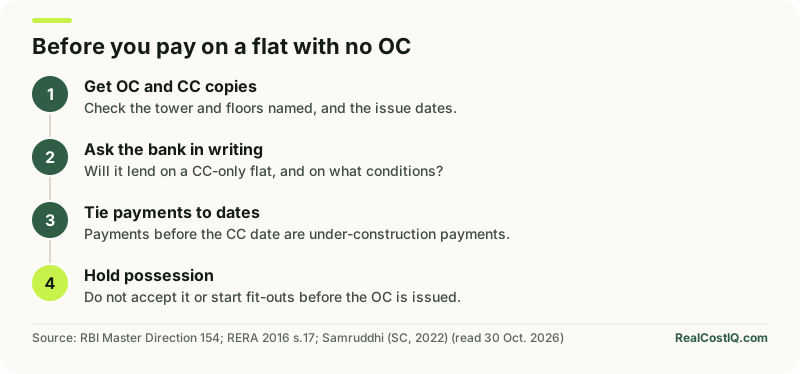
- Ask for the OC and CC copies, with the date, the tower and the floors covered. If the certificate names another tower, treat your flat as having none.
- Get your bank's written position on a flat with a CC but no OC. Ask in writing, before the token, and note the date. The RBI text leaves room; the bank's own policy decides.
- Tie payments to dates. Each rupee paid before the CC date is a payment for an under-construction flat, which matters for GST. Keep every receipt.
- Ask the municipal office what it charges an OC-less building for property tax and water. The Samruddhi percentages are from one Maharashtra case. Get your city's figure in writing.
- Do not accept possession, or sign for fit-outs, until the OC is in hand. The Haryana RERA order shows a possession offer before the OC can be held invalid. Taking possession early can muddy that argument.
- Write the builder's liability into the agreement. The Samruddhi court held the builder liable for the extra tax and water charges. A clause saying so, and saying who pays after handover, avoids a fight.
When a flat without an OC can still make sense
Some buyers knowingly take a flat with no OC, usually at a discount and usually with cash. The sums above show what that discount must cover. For the ₹80 lakh example, the buyer who cannot borrow brings ₹60,00,000 more than the one who can. The tax and water extras run to ₹21,000 a year in our example, and a resale later is harder because the next buyer faces the same loan refusal. A discount only makes sense if it exceeds the cost of your lost financing, the yearly extras and the resale difficulty together. A flat that has the CC and whose builder has applied for the OC is a different risk from one with no approved plan at all.
A lender's explainer lists the consequences of missing papers as trouble with resale, ownership transfer and loan processing, and possible legal exposure if construction deviates from the approved plan, with authorities able to start proceedings in some cases (L&T Finance, above). The page names no fixed penalty. That is why we quote none: municipal penalties are set locally, and we did not read a municipal portal today.
What this post does not tell you
- No city's municipal penalty. We did not read a municipal portal today, so the only surcharge figures here are the 25% and 50% from the Supreme Court case.
- No bank's own conditions. The RBI text, a loan-aggregator explainer and a lender's explainer are the sources. A bank's sanction letter is the real test.
- No state's stamp duty rate. The 6% in the examples is an assumption. Duty depends on the state, the city, the buyer's gender in some states, and whether the area is urban.
- No legal advice. If you are about to sign, a property lawyer in your state should read the agreement and the certificates.
For the other charges on a flat purchase, see the true cost of buying a flat, which lists each one with its source. For the delay interest if the builder misses the date, the RERA delay compensation calculator works it out from your payments.