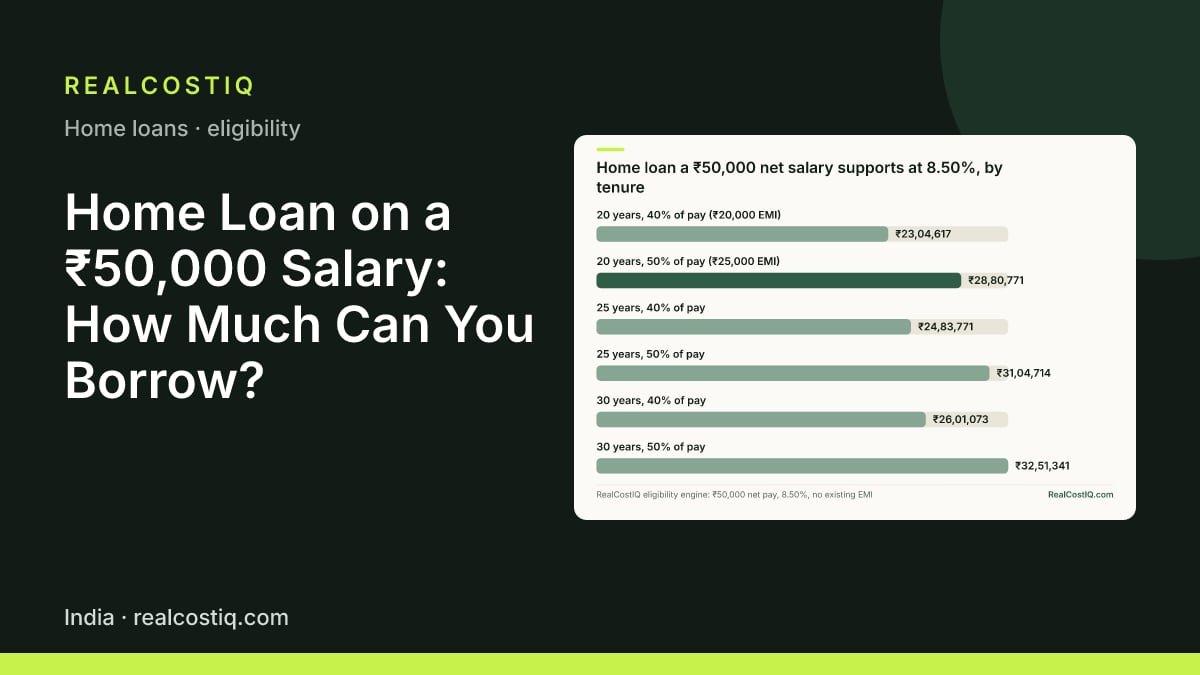
Many people ask the same thing: I earn ₹50,000 a month, so what home loan can I get? There is no single answer, because three different limits act on you at once. One is your pay. One is the bank's own rule on how much of that pay can go to loans. One is an RBI rule on how much of the flat's price a bank may finance. This post takes each in turn, with the arithmetic shown, and ends with a table you can match to your own case.
We read every lender page and RBI document named here on 15 October 2026. The sources are listed at the end. Where a lender does not publish a number, we say so instead of guessing. The loan amounts come from the same engine as our home loan eligibility calculator, run at the inputs written under each table.
A worked example first: ₹50,000 a month, nothing else owed
Start with a round number, before any formula. Suppose a bank charges 8.50% a year and you repay over 20 years. An EMI is the fixed amount you pay each month, part interest and part repayment of the loan. For every ₹1 lakh you borrow on those terms, the EMI is about ₹868. That is the only number you need to turn a monthly payment into a loan size.
Now take your pay. Say the bank lets you give 50% of ₹50,000 to loan payments. That is ₹25,000 a month. Divide ₹25,000 by ₹868 and you get about 28.8. So the bank can lend about ₹28.8 lakh. Our engine gives ₹28,80,771. The two answers match, because the rule of thumb and the engine use the same maths.
The formula behind it runs backward from the usual EMI sum. If the monthly rate is r and the number of months is n, the loan is the EMI times ((1 + r) to the power n, minus 1), divided by r times (1 + r) to the power n. You do not need to work it out by hand. The home loan EMI calculator does it, and the eligibility calculator does the reverse.
Here is the full set for ₹50,000 of net monthly pay. Net pay means the money that reaches your bank account after tax and deductions, also called take-home pay. The rate is 8.50% a year, with no other EMIs.
| Tenure | Share of pay allowed | Top monthly EMI | Loan the EMI supports | Flat price that loan supports | Your own money for the flat |
|---|---|---|---|---|---|
| 20 years | 40% | ₹20,000 | ₹23,04,617 | ₹25,60,685 | ₹2,56,069 |
| 20 years | 50% | ₹25,000 | ₹28,80,771 | ₹32,00,857 | ₹3,20,086 |
| 25 years | 40% | ₹20,000 | ₹24,83,771 | ₹27,59,746 | ₹2,75,975 |
| 25 years | 50% | ₹25,000 | ₹31,04,714 | ₹38,80,893 | ₹7,76,179 |
| 30 years | 40% | ₹20,000 | ₹26,01,073 | ₹28,90,081 | ₹2,89,008 |
| 30 years | 50% | ₹25,000 | ₹32,51,341 | ₹40,64,176 | ₹8,12,835 |
Computed with the RealCostIQ eligibility engine on ₹50,000 net monthly income, no existing EMI, 8.50% a year. The flat price uses the RBI loan-to-value limit that applies at each loan size (see the section on the RBI rule). Stamp duty and registration are extra and are not in the last column. Your bank's actual limit, rate and valuation can differ.
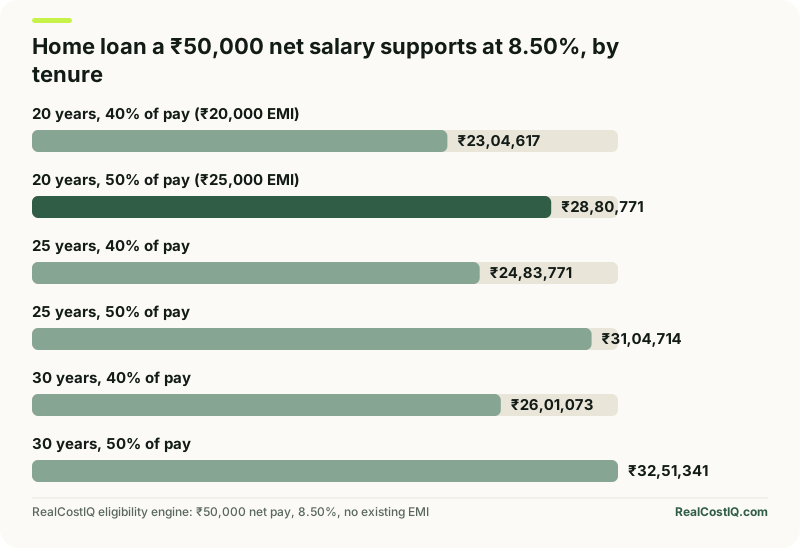
Read the table from the top. Even in the best case, you cannot borrow much more than about ₹32.5 lakh. In the cautious case you are near ₹23 lakh. The flat you can buy ranges from about ₹25.6 lakh to about ₹40.6 lakh. In many large cities that is a small flat, a flat far from the centre, or a plot of land. In many smaller towns it is a full flat. Price depends on where you buy, and no loan table can fix that.
Why the share of pay is 40% or 50%: what lenders publish
The share of your pay that goes to loan payments has a name. It is the FOIR, short for Fixed Obligation to Income Ratio. Add up all your fixed monthly payments, including the new EMI. Divide by your monthly income. If the answer is 50%, then half your income is already promised to loans.
The RBI does not set a FOIR. Each lender picks its own. We looked at what lenders say in public. They do not agree, and the page you read decides the number you expect.
| Lender | What the page says | Income it uses |
|---|---|---|
| Axis Bank, home loan page | Banks generally allow EMIs of up to 40% of net monthly income. | Net monthly income |
| Axis Bank, FOIR guide (a personal-loan article; says views are personal, not the bank's) | Most lenders prefer a FOIR of 40% to 50%. Above 50% hurts your chances. | Gross monthly income, before tax |
| Godrej Capital, ₹60,000 salary guide (published 16 May 2026) | Lenders prefer total payments, including the new EMI, within 40% to 50% of income. | Net (take-home) income |
| Bajaj Housing Finance, FOIR page | A FOIR between 40% and 55% is generally considered favourable for a home loan. | Not stated |
| SBI, HDFC Bank, Bank of Baroda (home loan pages) | No FOIR or EMI-to-income limit is published on the pages we read. | Not stated |
Godrej Capital and Bajaj Housing Finance are housing finance companies, not banks. The Godrej guide's own sample table for a ₹60,000 salary shows an EMI of ₹42,000 over 15 years. That is 70% of ₹60,000, above the 40% to 50% it describes, so treat single-page examples with care.
Three things follow. First, 40% to 50% is the common zone. Second, the base matters. If a lender applies the same percentage to gross pay, which is pay before tax, the answer for the same person is larger. If it uses take-home pay, it is smaller. Third, three of the biggest names do not publish a figure at all. So the only way to learn your exact limit is to ask the bank, or to run its own eligibility tool.
Our calculator uses 50% by default and lets you change it. We call it a convention, not a rule. The tables here show 40% and 50% side by side so you can see both ends.
The second limit: how much of the flat's price a bank may lend
Getting a loan amount is half the job. The other half is the flat. The RBI limits how much of a flat's price a bank may lend. The limit is called the LTV, short for loan to value. An LTV of 80% means the bank may lend up to 80% of the price, and you pay the other 20%.
We read the RBI Commercial Banks (Credit Facilities) Directions, 2025 (RBI/DOR/2025-26/154, paragraph 111) on 16 October 2026. Their paragraph 451 repeals earlier credit-facility instructions for commercial banks, and they carry the same bands as the old Master Circular on Housing Finance. It sets risk weights, and in effect the top LTV, by loan size. The steps are:
| Loan size | Highest LTV | What it means for you |
|---|---|---|
| Up to ₹30 lakh | 90% | You can put in as little as 10% of the price. |
| Above ₹30 lakh and up to ₹75 lakh | 80% | You put in at least 20%. |
| Above ₹75 lakh | 75% | You put in at least 25%. |
Source: Reserve Bank of India, Commercial Banks (Credit Facilities) Directions, 2025, paragraph 111, read 16 October 2026. The Directions state the LTV bands through risk weights: 80% or less for loans up to ₹75 lakh, between 80% and 90% for loans up to ₹30 lakh, and 75% or less above ₹75 lakh. Banks can set tighter limits.
Look at the 25-year row in the first table. At 50% of pay, the loan comes to ₹31.05 lakh. That is above ₹30 lakh, so the 80% limit applies, not 90%. The flat the loan supports is ₹38.81 lakh, and you must bring ₹7.76 lakh yourself. For the 20-year case the loan is ₹28.81 lakh, under the line, and you need only ₹3.20 lakh. So a loan that is only ₹2.24 lakh bigger asks for ₹4.56 lakh more of your own money. Crossing ₹30 lakh is not a free upgrade. Plan your savings for the step.
The circular also says banks should not add stamp duty, registration and other paper charges to the cost of the property they finance. There is one exception. If the home costs ₹10 lakh or less, a bank may include them. For every flat in the tables above, that exception does not apply. So the last column is not your whole cash need. Stamp duty and registration come on top, and they differ by state and city. Use the stamp duty calculator for your state, and check the rate on your state registration portal before you book.
Which rate to use: what a bank page shows today
A lower rate gives a bigger loan for the same EMI. The rate you get depends on your credit score, the bank and the week. We used 8.50% because that is the rate HDFC Bank's home loan page showed on 15 October 2026 for borrowers with a credit score of 800 or more, for 15, 20 and 30 years. The page gave no effective date for it.
The same page shows a repo-linked range. A repo-linked rate is a floating rate tied to the RBI's repo rate, which is the rate at which the RBI lends to banks. The page lists the repo rate at 5.50% and adds a bank spread of 2.50 to 7.95 percentage points. That gives 8.00% to 13.45%. The RBI home page showed the policy repo rate at 5.50% on 15 October 2026, after the 7 October 2026 policy announcement. Your own rate can be higher than 8.50% if your credit score is lower. When the repo rate moves, floating loans move with it. Our post on the repo rate rise shows how much an EMI changes.
| Interest rate | Loan the ₹25,000 EMI supports | Change from 8.50% |
|---|---|---|
| 8.00% | ₹29,88,857 | ₹1,08,086 more |
| 8.50% | ₹28,80,771 | Base case |
| 9.00% | ₹27,78,624 | ₹1,02,147 less |
| 9.50% | ₹26,82,026 | ₹1,98,745 less |
Computed with the RealCostIQ eligibility engine. A rate of 8.00% is the lowest end of HDFC Bank's published repo-linked range as read on 15 October 2026. The other rates are illustrations.
Each half-point on the rate moves the loan by about ₹1 lakh to ₹2 lakh here. That is real money, but it matters less than the tenure or the FOIR. Still, a better credit score is the cheapest way to raise your number, because it can lower the rate you are offered.
Tenure: a longer loan lends more and costs far more
The tenure is the number of years you take to repay. A longer tenure lowers the EMI for each lakh, so the same ₹25,000 supports a bigger loan. Axis Bank and Bank of Baroda both show a maximum of 30 years on their home loan pages. Both also say the loan should end by about age 65. So if you are 40, your real limit is 25 years, not 30.
A longer tenure also costs far more in interest. Here is what you pay in total at a ₹25,000 EMI, 8.50%:
| Tenure | Loan | Total you repay | Interest you pay |
|---|---|---|---|
| 20 years | ₹28,80,771 | ₹60,00,000 | ₹31,19,229 |
| 25 years | ₹31,04,714 | ₹75,00,000 | ₹43,95,286 |
| 30 years | ₹32,51,341 | ₹90,00,000 | ₹57,48,659 |
Total repaid is the EMI times the number of months. Interest is the total repaid minus the loan. Computed from the eligibility engine's loan amounts.
Going from 20 to 30 years lifts your loan by only ₹3.7 lakh. It adds ₹26 lakh of interest. In plain words, ten extra years buys you a flat that costs about ₹8.6 lakh more and charges you about ₹26 lakh more for the favour. Paying part of the loan early can cut that interest, but plan for the full cost first.
What an existing EMI does to the number
Existing payments count in the FOIR. A car loan, a personal loan, or in many cases a credit card minimum all use up part of your limit. Take a ₹10,000 EMI on top of the ₹50,000 salary. With the 50% limit, the room for a home loan EMI shrinks from ₹25,000 to ₹15,000. That is a cut of 40%, and the loan shrinks with it.
| Tenure | No other EMI: loan | With ₹10,000 EMI: loan | Flat price with ₹10,000 EMI | Loan lost |
|---|---|---|---|---|
| 20 years | ₹28,80,771 | ₹17,28,463 | ₹19,20,514 | ₹11,52,308 |
| 25 years | ₹31,04,714 | ₹18,62,829 | ₹20,69,809 | ₹12,41,885 |
| 30 years | ₹32,51,341 | ₹19,50,805 | ₹21,67,561 | ₹13,00,536 |
Computed with the RealCostIQ eligibility engine. The flat price uses the 90% LTV that applies to loans up to ₹30 lakh.
A ₹10,000 EMI costs you more than ₹11 lakh of home loan. The cheapest fix is often to clear that loan, or to pay it down, before you apply. If a small personal loan has a few months left, waiting for it to end can raise your eligibility by lakhs. We cannot say what a given bank counts as an obligation. Some ignore loans with fewer than 12 months to run. The eligibility tool on Axis Bank's page has a field labelled "Other Obligations (If residual tenor is more than 12 months)", which hints at exactly that. Ask your bank.
What a co-applicant adds
A co-applicant is a second person who applies with you and shares the loan. It is often a spouse, a parent or a sibling. The bank adds their income to yours and looks at both of you. Axis Bank's page suggests a joint loan with a family member if your own income does not reach the amount you want. Its eligibility calculator also has a box for co-applicant details.
Suppose the co-applicant takes home ₹30,000. Together you earn ₹80,000. At the 50% limit the EMI room is ₹40,000.
| Tenure | Loan | Flat price (80% LTV) | Your own money |
|---|---|---|---|
| 20 years | ₹46,09,234 | ₹57,61,542 | ₹11,52,308 |
| 25 years | ₹49,67,543 | ₹62,09,428 | ₹12,41,886 |
| 30 years | ₹52,02,146 | ₹65,02,682 | ₹13,00,536 |
Computed with the RealCostIQ eligibility engine. Joint-owner rules, tax treatment and ownership share are matters to settle with your bank and adviser. This post does not cover them.
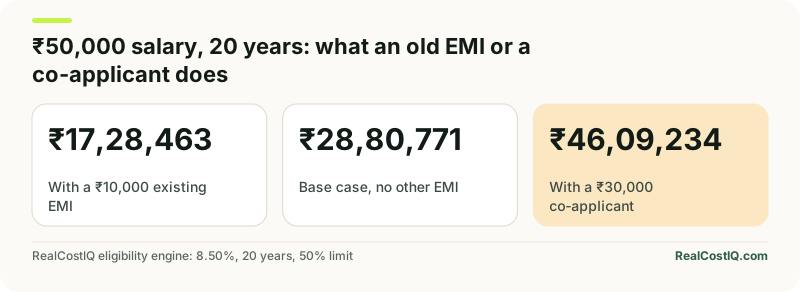
A ₹30,000 co-applicant raises the loan by about 60%, from ₹28.8 lakh to ₹46.1 lakh in the 20-year case. The flat you can target rises from about ₹32 lakh to about ₹57.6 lakh. A co-applicant also shares the risk. If one of you stops paying, the bank can ask the other. Make sure both of you can live with that before you sign.
Six ways to raise your number before you apply
- Clear small loans. A ₹10,000 EMI removes over ₹11 lakh of eligibility in the table above. Paying one off is the largest single move.
- Add a co-applicant with income. It is the biggest lever after clearing debt. Check the bank counts their income in full.
- Pick the tenure for your age. Banks end the loan near 65. A 30-year loan is not open to everyone.
- Raise your credit score. HDFC Bank's page ties its 8.50% to a score of 800 or more. A lower score can mean a higher rate and a smaller loan.
- Ask each bank which income it uses. One may take net pay, another gross. Ask which one, and ask for the bank's own eligibility tool.
- Save more for the down payment. The loan is capped by your pay, but the flat price you can pay is capped by your pay and your savings together.
What this post cannot tell you
A few limits are worth stating plainly. The 40% and 50% figures are what lenders say in public, not what any one bank will approve for you. Banks also look at your job type, years in the job, credit history and the property itself. They value the property and may lend on their valuation, which can be below the price. A builder-linked project, a plot or a resale in an older building may be treated differently.
We use 8.50% from one bank page that carried no effective date, so check today's rate. We do not cover tax relief on home loans, because that is a personal-finance topic outside this site. We do not cover NRI loans or loans for self-employed borrowers, whose income is judged by other rules. Last, the engine shows a ceiling, not an offer. Treat it as the top of a range and start your search below it.
If a bank offers you much less than these tables, ask why. The usual reasons are a higher FOIR rule, a lower rate of income counted, an existing EMI you forgot, or a low credit score. If a bank offers you much more, read the EMI. A loan that takes 70% of your pay leaves little for rent, food, school fees and surprises, even if the bank is willing to sign.