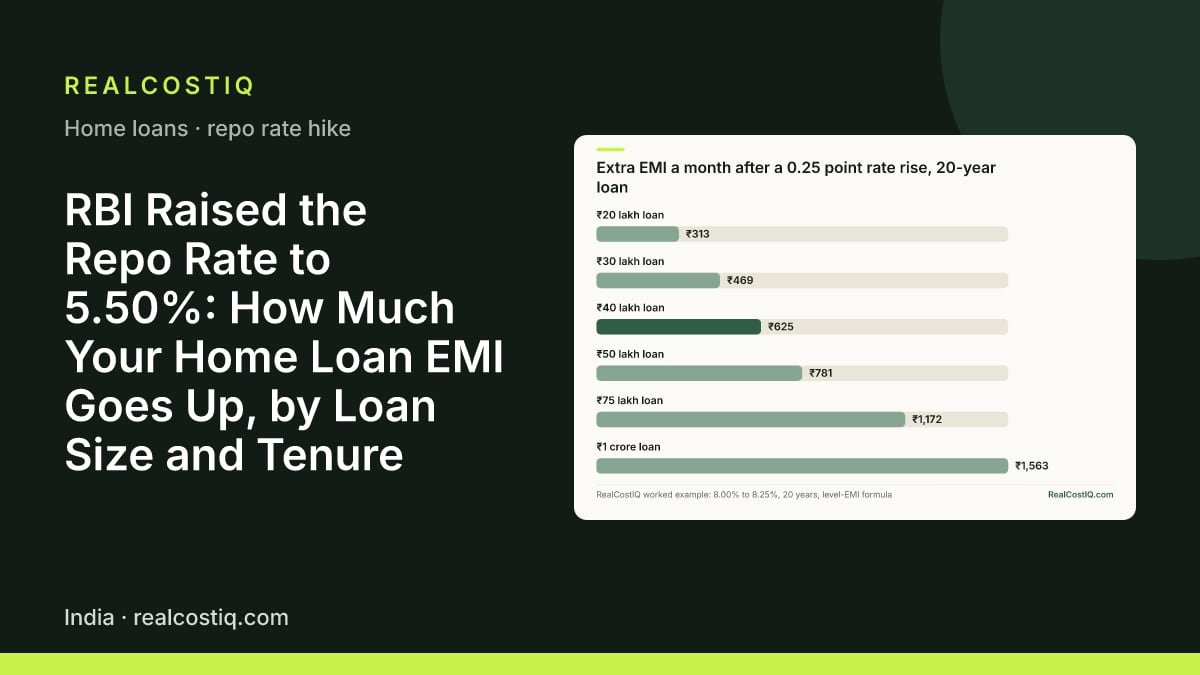
What the RBI decided on 7 October 2026
The Reserve Bank of India (RBI) is the country's central bank. Its Monetary Policy Committee, or MPC, meets several times a year to set the main interest rate. That rate is called the repo rate. It is the rate at which the RBI lends money to banks for the short term.
The MPC met from 5 to 7 October 2026. RBI's published resolution says the committee voted unanimously to raise the policy repo rate by 25 basis points, to 5.50 per cent. A basis point is one hundredth of a percentage point. So 25 basis points is 0.25 percentage point. That puts the rate before the meeting at 5.25 per cent, which is 5.50 minus 0.25.
RBI's home page showed a policy repo rate of 5.50 per cent when we opened it on 14 October 2026. The same page listed the standing deposit facility rate at 5.25 per cent and the marginal standing facility rate and the Bank Rate at 5.75 per cent. You do not need those three. They are other rates the RBI sets around the repo rate. Only the repo rate matters for most floating home loans.
The MPC also changed its stance to calibrated tightening. The stance is a signal about what comes next. RBI's own wording is plain. It says rate cuts are off the table in the near term, and the next move can only be a rise or a pause. That matters for you. It means the 0.25 point rise may not be the last one.
The RBI gave its reasons. It said consumer price inflation, the yearly rise in what households pay for goods, was 4.8 per cent in August 2026, up from 4.5 per cent in July. It projected inflation of 5.2 per cent for the whole of 2026-27. Two of the six members preferred to keep the stance neutral. The next meeting is scheduled for 2 to 4 December 2026, and the minutes of this meeting are due on 21 October 2026.
A worked example first: ₹40 lakh over 20 years
Let us start with round numbers. Say you borrowed ₹40 lakh. The amount you borrow is called the principal. You agreed to repay it over 20 years. That period is the tenure. Your lender charges 8.00 per cent a year on a floating rate. We picked 8.00 per cent only to keep the sums simple. Your own rate will differ.
Your EMI, short for equated monthly instalment, is the fixed amount you pay each month. It covers both interest and part of the principal. At 8.00 per cent for 20 years, the EMI on ₹40 lakh is ₹33,458.
Now the lender raises your rate by 0.25 point, to 8.25 per cent. The EMI becomes ₹34,083. That is ₹625 more each month. Over the 240 months of a 20-year loan, ₹625 adds up to about ₹1,50,006 of extra interest. The loan is the same size and the tenure is the same. Only the rate changed.
If a second 0.25 point hike follows and your rate reaches 8.50 per cent, the EMI is ₹34,713. That is ₹1,255 a month above where you started. Two small hikes made the monthly bill almost ₹1,300 bigger.
| Rate | EMI | Change from 8.00% | Extra interest over 20 years |
|---|---|---|---|
| 8.00% | ₹33,458 | none | none |
| 8.25% (one hike of 0.25 point) | ₹34,083 | +₹625 a month | about ₹1,50,006 |
| 8.50% (two hikes) | ₹34,713 | +₹1,255 a month | about ₹3,01,279 |
Computed with the same level-EMI formula as our home loan EMI calculator. The extra interest is the EMI rise multiplied by 240 months. It assumes the new rate applies from the first month and never changes again. Real loans reset in steps, so your own number will differ.
Why a small rate rise moves the EMI by this much
A 0.25 point rise sounds tiny. It is not tiny on a large, long loan. Interest is charged every month on what you still owe. In the early years you owe almost the full amount. So the rise bites on a very large number for a very long time.
The sum behind the EMI looks scary but is only a formula. EMI = P × r × (1 + r)^n ÷ ((1 + r)^n − 1). Here P is the principal. The letter r is the monthly rate, which is the yearly rate divided by 12 and by 100. The letter n is the number of months. You never need to do this by hand. Our home loan EMI calculator does it, and every figure in this post was checked against it.
Two things drive the size of the rise. The first is how much you owe. Double the loan and the rise doubles. The second is how long you take to repay. A longer tenure means more months of interest on the higher rate, so the monthly rise is larger. Each extra five years adds a little.
The EMI today, by loan size and tenure
This first table shows the starting point. These are EMIs for a new loan at an illustrative 8.00 per cent, before any pass-through of the hike. Find your loan size on the left and your tenure along the top. If your balance is not on the list, use the nearest row, or use the per-lakh table further down.
| Loan amount | 15 years | 20 years | 25 years | 30 years |
|---|---|---|---|---|
| ₹20 lakh | ₹19,113 | ₹16,729 | ₹15,436 | ₹14,675 |
| ₹30 lakh | ₹28,670 | ₹25,093 | ₹23,154 | ₹22,013 |
| ₹40 lakh | ₹38,226 | ₹33,458 | ₹30,873 | ₹29,351 |
| ₹50 lakh | ₹47,783 | ₹41,822 | ₹38,591 | ₹36,688 |
| ₹75 lakh | ₹71,674 | ₹62,733 | ₹57,886 | ₹55,032 |
| ₹1 crore | ₹95,565 | ₹83,644 | ₹77,182 | ₹73,376 |
Illustrative 8.00% a year on a new loan, monthly reducing balance. Not a quote from any lender. Rounded to the nearest rupee.
How much more you pay after a 0.25 point rise
This is the table most readers came for. Each cell is the extra rupees you pay every month when the rate goes from 8.00 per cent to 8.25 per cent. Read across your row. The rise grows as the tenure grows, and it grows in step with the loan size.
| Loan amount | 15 years | 20 years | 25 years | 30 years |
|---|---|---|---|---|
| ₹20 lakh | +₹290 | +₹313 | +₹333 | +₹350 |
| ₹30 lakh | +₹435 | +₹469 | +₹499 | +₹525 |
| ₹40 lakh | +₹580 | +₹625 | +₹665 | +₹700 |
| ₹50 lakh | +₹724 | +₹781 | +₹832 | +₹875 |
| ₹75 lakh | +₹1,087 | +₹1,172 | +₹1,248 | +₹1,313 |
| ₹1 crore | +₹1,449 | +₹1,563 | +₹1,663 | +₹1,750 |
Computed from the level-EMI formula and checked against the site's EMI engine for several cells. Differences of ₹1 against a lender's schedule come from rounding.
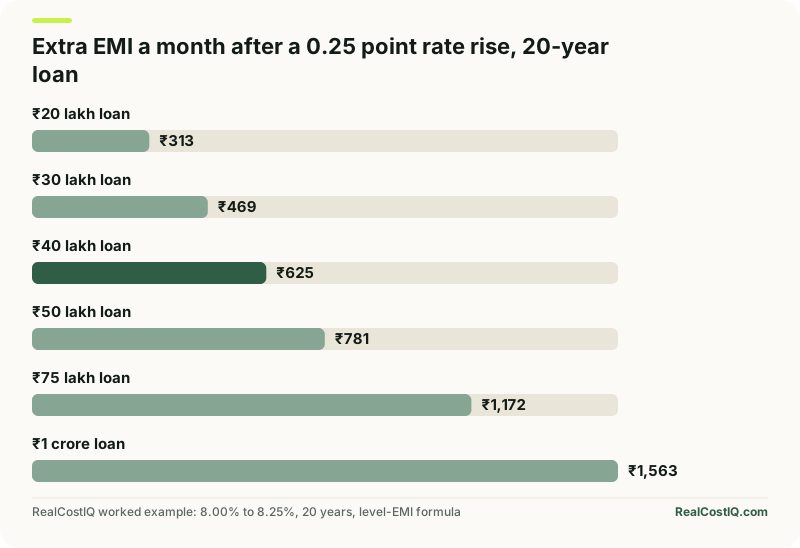
Look at the ₹1 crore row. A buyer who took 30 years pays ₹1,750 more every month. A buyer who took 15 years pays ₹1,449 more. The longer loan feels cheaper each month, but it is hit harder by the same rate rise.
The rise in percentage terms is about the same for every loan of one tenure. On a 20-year loan, a 0.25 point rise lifts the EMI by about 1.9 per cent. If your EMI is ₹50,000 today, expect roughly ₹900 more on a 20-year loan.
If a second hike follows: the 0.50 point column
RBI said the next move can only be a rise or a pause. It did not promise another rise. But planning for one is cheap, and it stops a bad surprise. This table shows the extra EMI if your rate climbs 0.50 point in total, from 8.00 per cent to 8.50 per cent.
| Loan amount | 15 years | 20 years | 25 years | 30 years |
|---|---|---|---|---|
| ₹20 lakh | +₹582 | +₹628 | +₹668 | +₹703 |
| ₹30 lakh | +₹873 | +₹941 | +₹1,002 | +₹1,054 |
| ₹40 lakh | +₹1,163 | +₹1,255 | +₹1,336 | +₹1,406 |
| ₹50 lakh | +₹1,454 | +₹1,569 | +₹1,671 | +₹1,757 |
| ₹75 lakh | +₹2,182 | +₹2,354 | +₹2,506 | +₹2,636 |
| ₹1 crore | +₹2,909 | +₹3,138 | +₹3,341 | +₹3,515 |
Same method as the table above. The total is slightly more than double the single-hike figure because each step rises on a higher base.
The next MPC meeting is on 2 to 4 December 2026. Until then, nothing in RBI's text says the repo rate will move. Treat the 0.50 point column as a stress test, not a forecast.
The total extra interest if the rise lasts the whole loan
The monthly rise looks small next to the loan. The total over the years looks bigger. This table multiplies the 0.25 point monthly rise by the number of months. It shows the cost of leaving your EMI to rise and doing nothing else.
| Loan amount | 15 years | 20 years | 25 years | 30 years |
|---|---|---|---|---|
| ₹20 lakh | ₹52,158 | ₹75,003 | ₹99,803 | ₹1,26,015 |
| ₹30 lakh | ₹78,237 | ₹1,12,504 | ₹1,49,705 | ₹1,89,022 |
| ₹40 lakh | ₹1,04,316 | ₹1,50,006 | ₹1,99,607 | ₹2,52,029 |
| ₹50 lakh | ₹1,30,394 | ₹1,87,507 | ₹2,49,509 | ₹3,15,037 |
| ₹75 lakh | ₹1,95,592 | ₹2,81,260 | ₹3,74,263 | ₹4,72,555 |
| ₹1 crore | ₹2,60,789 | ₹3,75,014 | ₹4,99,017 | ₹6,30,073 |
Monthly rise from the table above multiplied by the number of months. Assumes the rate stays at 8.25% from the first month. An upper bound for a loan that is not yet repaid, because most borrowers repay early or refinance.
A 30-year loan of ₹1 crore costs about ₹6.3 lakh more over its life after a single hike. The same hike on a ₹20 lakh, 15-year loan costs about ₹52,000 more. The gap shows why borrowers with the biggest and longest loans should pay the most attention.
A quick rule: the rise per ₹1 lakh you owe
If your balance is not on the table, use this shortcut. Find the number for your tenure, then multiply by the number of lakhs you owe. For example, you owe ₹36 lakh with 20 years left. Multiply 15.6 by 36 and you get about ₹562 a month more.
| Tenure | EMI per ₹1 lakh | Extra after +0.25 point | Extra after +0.50 point |
|---|---|---|---|
| 15 years | ₹956 | +₹14.5 | +₹29.1 |
| 20 years | ₹836 | +₹15.6 | +₹31.4 |
| 25 years | ₹772 | +₹16.6 | +₹33.4 |
| 30 years | ₹734 | +₹17.5 | +₹35.1 |
Computed from the level-EMI formula at an illustrative 8.00%. If your current rate is higher, the rise is a little bigger. At 9.00%, the ₹40 lakh, 20-year loan rises ₹646 for a 0.25 point step, against ₹625 at 8.00%.
If you are already years into the loan
The tables above treat the loan as new. Most readers are partway through one. Your balance has shrunk, and fewer years remain. Both facts make the rise smaller than the table shows.
Take the same ₹40 lakh, 20-year loan at 8.00 per cent. After five years of EMIs (60 payments), about ₹35,01,023 is still owed, with 15 years to go. A 0.25 point rise lifts the EMI by about ₹507, not ₹625. After ten years, about ₹27,57,625 is owed with ten years left. The rise is about ₹365. After fifteen years, about ₹16,50,077 is owed. The rise is about ₹198.
| Loan age | Balance owed | Years left | Extra EMI per month |
|---|---|---|---|
| New loan | ₹40,00,000 | 20 | +₹625 |
| After 5 years | ₹35,01,023 | 15 | +₹507 |
| After 10 years | ₹27,57,625 | 10 | +₹365 |
| After 15 years | ₹16,50,077 | 5 | +₹198 |
Assumes the lender keeps the original tenure and raises the EMI. Balance is calculated from standard monthly reducing-balance repayment. Your lender's statement is the authority on your own balance.
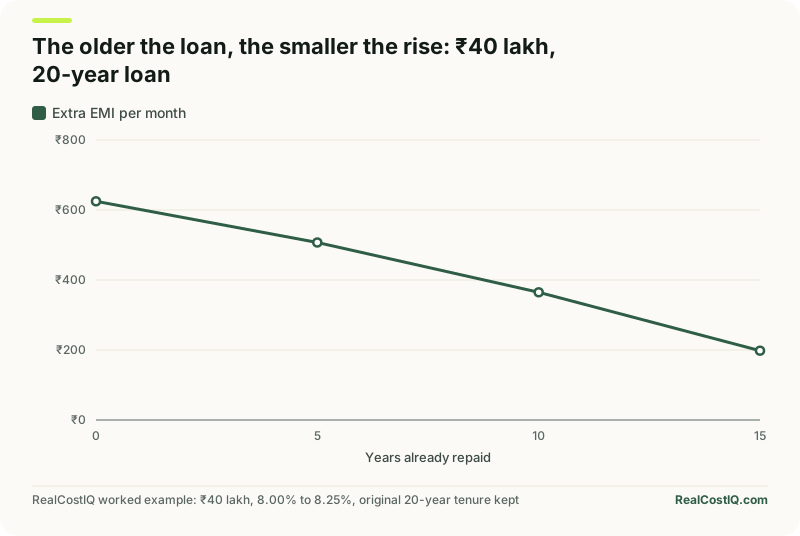
So the older your loan, the smaller the sting. But note one more point. Some lenders keep your EMI the same and stretch the tenure instead. Then the monthly payment does not move. The loan simply lasts longer. For how that choice works and what RBI lets you ask for, read our post on resets, EMI and tenure.
When does the hike actually reach your loan?
The repo rate moves on one day. Your loan rate moves later. How much later depends on the type of loan you hold.
Loans linked to the repo rate (EBLR)
Many home loans are linked to an external benchmark. That is a rate set outside the bank. RBI's Interest Rates on Advances Directions, 2025 list the allowed benchmarks (paragraph 5(4)). They are the RBI policy repo rate, the 3-month and 6-month Government of India Treasury Bill yields published by the Financial Benchmarks India Private Limited (FBIL), and any other market rate published by FBIL. New floating home loans and other retail loans must use one of them (paragraph 25).
A loan linked to the repo rate is called an EBLR loan, short for external benchmark linked lending rate. Your rate is the repo rate plus a fixed margin called the spread. If the repo rate rises 0.25 point and the spread stays the same, your rate rises 0.25 point. The Directions say banks are free to set the spread. They also say the credit risk part of the spread may change only when your credit assessment changes substantially, as agreed in the loan contract. The other parts of the spread can be altered once in three years.
The Directions also set a rule on timing. The interest rate under an external benchmark must be reset at least once in three months. So your lender must review an EBLR loan's rate at least every quarter. A bank may reset more often. Your sanction letter names your reset date and your benchmark. Look there for the exact day.
The State Bank of India's home loan page says the same thing in plain words. When the repo rate changes, the interest rate on a home loan changes. An upward revision in the repo rate results in an increase in the home loan rate. We read this on 14 October 2026. HDFC Bank's plot loan page, opened the same day, also prices its loans as the policy repo rate plus a spread. It showed the repo rate at 5.50 per cent and a range of 8% to 13.45% a year. So the 8.00 per cent we use in the tables is the low end of that range, which makes our rises a fair guide for borrowers on cheaper loans. We did not read a different bank's reset date, and we do not claim one here.
Older loans linked to the lender's own rate (MCLR)
Older loans, taken before October 2019, may still sit on the MCLR, or marginal cost of funds based lending rate. That is a rate the bank works out itself. RBI's Directions say a bank may set the reset date either at the date of first disbursement or at the date of its MCLR review. These loans move when the bank next resets, and the repo hike reaches them only through the bank's own costs. RBI's home page listed the overnight MCLR range at 7.80 to 8.00 per cent on 14 October 2026.
If your loan is on the older system, do not assume the EBLR timing applies to you. Check the statement for the words MCLR or base rate. Moving to a repo-linked loan is possible, and our balance transfer calculator shows what a move would cost.
Fixed-rate loans
A fixed-rate loan keeps the same rate for the period stated in the contract. The repo hike does not change it during that period. Many loans that are called fixed switch to floating after a set number of years. Read your agreement.
What to check in your own loan this week
- Find your latest loan statement and your sanction letter.
- Write down three things: your balance, your current rate, and the benchmark name. If it says repo rate, you are on an EBLR loan.
- Find the reset date. It tells you when the hike will reach you.
- Use the table above, or the per-lakh rule, to estimate your new EMI.
- Run the exact figure in the EMI calculator, using your balance and the years left.
- Decide whether the extra amount fits your budget. If it does not, the choices (a bigger EMI, a longer tenure, or a part-prepayment) are laid out in the earlier post.
If you can spare a lump sum, our prepayment calculator shows how much interest a part-payment saves. It is the quickest way to cancel out a rate rise on a loan you are partway through.
What this post did not verify
- We did not read any lender's current home loan rate card. The 8.00 per cent in the tables is an illustration chosen for round numbers. It is not a quote.
- We did not confirm when any single bank will pass the hike on. The only timing rule we read is RBI's: external benchmark loans must reset at least once in three months.
- We did not model loans with a moratorium, step-up EMI or part-disbursed loans. Those have different EMI patterns. Our EMI calculator has modes for them.
- The RBI stance and future rate path come from RBI's own text. We make no forecast of our own.
If you are still deciding how large a loan you can take at all, read our post on what a ₹50,000 salary can borrow before you read these EMI tables.