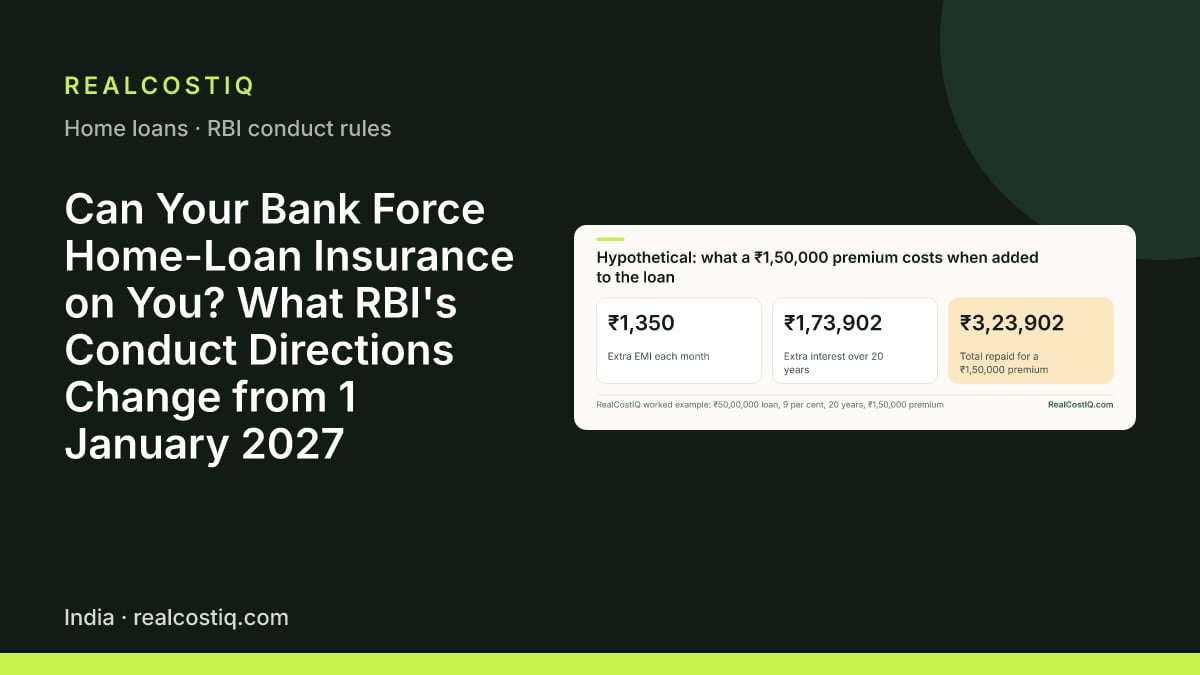
Many home-loan borrowers have been told, at sanction or disbursement, that a loan protection or credit-life policy is part of the package. They are told that the loan will not move without it. Often the premium is a single payment. Often it is added to the loan, so that you never see it leave your account. It simply becomes part of the principal that your EMI repays. The Reserve Bank of India has now written rules that address exactly this pattern. On 15 June 2026, it issued a set of Responsible Business Conduct amendment directions. They do three things. They define compulsory bundling. They require explicit and recorded consent for every product a lender sells. And they list default-added loan protection insurance as an example of a prohibited dark pattern. A dark pattern is a screen design that tricks you into a choice. The rules take effect on 1 January 2027.
How this was checked. We read every direction cited below on 10 October 2026 on the RBI's own notification pages. They are:
the commercial banks amendment (RBI/2026-27/115); the small finance banks amendment (116); the payments banks amendment (117); the local area banks, regional rural banks, urban co-operative banks, rural co-operative banks and all India financial institutions amendments (118 to 122); the NBFC amendment (123); and the housing finance companies amendment (124). We also read the RBI press release of 15 June 2026 and the Key Facts Statement circular of 15 April 2024.
We paraphrase. We do not reproduce the text. The EMI arithmetic is our own. We ran it on the site's home loan EMI calculator engine at stated, illustrative inputs. Nothing here is advice about which insurance to buy.
What the directions define as compulsory bundling
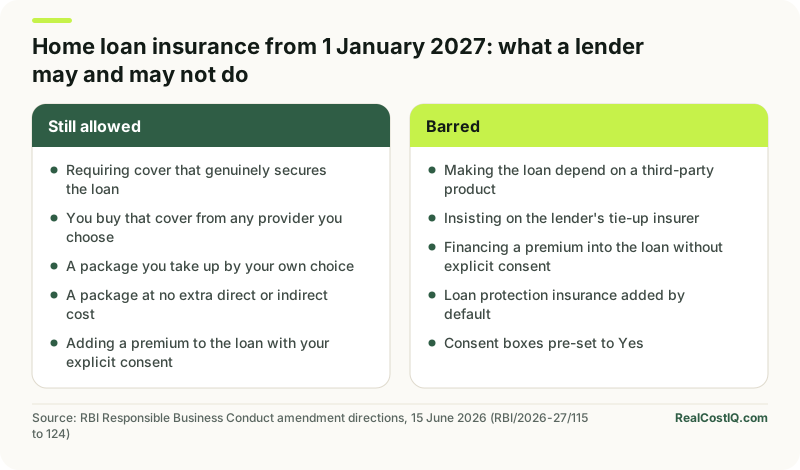
The commercial banks amendment adds a definition of compulsory bundling at paragraph 4(6A). It describes a bank making a customer's purchase of one product or service conditional on the customer also buying another. It does not matter whether the second product is the bank's own or a third party's. The definition is about conditionality. A lender that offers you a policy and lets you say no is not bundling. A lender that says the loan is only available if you take the policy is.
The operative prohibition sits in paragraph 85V of the commercial banks text. A bank may not compulsorily bundle any third-party product or service with its own product. The same paragraph carries the exception that matters most to a home loan. Suppose the bank's own product depends on a third-party product as a risk mitigant. Then the customer must be free to buy that product from any provider. In plain terms, a bank can still insist that a property or a life be protected where that protection genuinely secures the loan. But it cannot insist that you buy the protection from the insurer it has a tie-up with.
Two further carve-outs narrow the rule. A package offered on the customer's voluntary consent is not compulsory bundling. Neither is a package offered at no additional direct or indirect cost to the customer. The second one deserves attention. Say a lender calls a policy complimentary. The test the directions apply is whether you bear any extra cost for it, directly or indirectly. A premium recovered through a higher rate, a higher fee or a larger loan balance is not obviously free.
The directions also classify compulsory bundling as a form of mis-selling. The commercial banks and small finance banks texts list it at paragraph 4(20A)(iv). The payments banks text lists it at 4(10A)(iv). This matters, because mis-selling is what triggers the refund remedy described further down.
Who is covered: banks, small finance banks, NBFCs and housing finance companies
Home loans in India come from several kinds of lender, and the RBI has issued a separate amendment for each. They were all dated 15 June 2026, and they all take effect on 1 January 2027. The RBI press release of the same date covers the advertising, marketing and sale amendments. It says they reach commercial banks, small finance banks, payments banks, local area banks, regional rural banks, urban and rural co-operative banks, all India financial institutions, NBFCs and housing finance companies. The table sets out what we read for each.
| Lender type | RBI circular | What we confirmed on the notification page |
|---|---|---|
| Commercial banks (not SFBs, payments banks, RRBs, LABs) | RBI/2026-27/115 | Definition 4(6A); bundling bar 85V; explicit consent 85G; default "No" 85I; no loan-funded purchase without consent 85W; mis-selling remedy 85Z; Annex IIA lists default-added loan protection insurance |
| Small finance banks | RBI/2026-27/116 | Same bundling bar, risk-mitigant exception, consent and refund provisions |
| Payments banks | RBI/2026-27/117 | Bundling bar at 42V; mis-selling definition includes bundling; the same default-insurance example |
| Local area banks, regional rural banks, urban and rural co-operative banks, AIFIs | RBI/2026-27/118 to 122 | Each repeats the bundling bar, consent rules and loan protection insurance example for its own category |
| NBFCs | RBI/2026-27/123 | Bundling bar at 101V; consent 101G; default "No" 101I; no loan-funded purchase without consent 101W; remedy 101Z; Annex III example |
| Housing finance companies | RBI/2026-27/124 | Made under section 30A of the National Housing Bank Act, 1987; a new section A.11A requires an HFC to comply with paragraphs 101A to 101ZA of the NBFC directions |
Read on rbi.org.in notification pages on 10 October 2026. The NBFC direction excludes core investment companies, NBFC account aggregators, non-operative financial holding companies and NBFCs with no customer interface.
The housing finance company route is worth spelling out, because housing finance companies are the lenders many buyers deal with. The HFC amendment does not repeat the bundling text. It replaces the earlier advertising and sales-agent conduct sections of the Fair Practices Code chapter with a new section. That section points to paragraphs 101A to 101ZA of the NBFC Responsible Business Conduct Directions. Those are the paragraphs the NBFC amendment (123) rewrites, including the bundling bar at 101V. So an HFC borrower is covered by the same bundling and consent rules through that cross-reference. We did not read the consolidated, updated text of paragraphs 101A to 101ZA as they will stand on 1 January 2027. We read the amendment instruments. If your lender is an HFC, treat the cross-reference as the basis. Confirm paragraph numbers against the consolidated directions once the RBI publishes them.
Consent: what a lender must do before it sells you anything
The consent paragraphs are the part that changes the experience on the branch or app. Paragraph 85G of the commercial banks text says a lender may sell a product, its own or a third party's, only with the customer's explicit consent. Consent can take several forms. It can be a signed declaration, an OTP approval, a digitally recorded confirmation, or a clearly demarcated section of the agreement. Where one form covers several products, each must be listed. The customer must be able to select only the ones they want. The lender keeps the consent record for one year after the contract ends.
Paragraph 85I covers the interface. A consent flow must not allow consent without the customer going through the applicable terms and conditions. The default option must be the negative one: no, or I do not agree. An app that arrives with an insurance box already ticked is the situation this paragraph is aimed at. The NBFC text repeats the point at 101I, and the other categories carry equivalent paragraphs.
Paragraph 85W deals with the way a premium usually reaches a home-loan borrower. A bank may not use the customer's loan facility to fund the purchase of any product or service without the customer's explicit consent. That is the financed single premium. Under the directions, the lender needs your explicit consent to add it to the loan. This is separate from your consent to buy the product. The NBFC text carries the same rule at 101W.
Dark patterns: why default-added loan insurance is named
Annex IIA of the commercial banks amendment lists eleven illustrative dark patterns. Two bear on a home loan. The first is basket sneaking. It means adding extra products, services or donations without consent. The illustration the RBI chose is loan protection insurance added by default during a loan application. Necessary fees that were disclosed, and free services, are excluded from the pattern. The second is interface interference. It highlights the lender's preferred option while hiding the alternatives, and pre-set Yes consent defaults illustrate it. A third pattern, drip pricing, reveals charges late. Undisclosed processing fees illustrate it.
The annex is illustrative. It is not a separate source of penalties. Its use is that it tells you, in the regulator's own words, which conduct the RBI regards as a problem. A loan screen that adds a protection policy to the basket before you have chosen it is the example given. The NBFC direction carries the same illustration in its Annex III. The local area, regional rural, urban and rural co-operative, and all India financial institution directions carry it in their own annexes.
If you were mis-sold: the 30-day window and the refund
Paragraph 85Z sets the remedy. A mis-selling complaint must be lodged within the timeline set by the relevant financial sector regulator. Where no timeline exists, the period is 30 days from the date the customer receives the signed terms and conditions or agreement. If mis-selling is established, the bank must do three things. It must refund the full amount the customer paid for the product. It must tell the customer about the cancellation where applicable. And it must compensate for any loss under its Board-approved policy. The NBFC text puts this at 101Z, and the other categories carry the same wording.
Two practical points follow from this wording. First, the clock can run from the date you receive the signed agreement, not from the date you notice the charge. Say you took the loan and only later saw a premium in the statement. The 30 days may already be running or gone, unless the insurance regulator sets a longer timeline for that product. We could not find an insurance-regulator timeline for a loan-linked policy, so we state none. Second, the compensation is measured under the lender's own policy, which the directions require lenders to adopt. Ask for it in writing.
What a financed premium costs: a worked example
Suppose a buyer takes a ₹50,00,000 loan for 20 years at 9 per cent. These inputs are illustrative. The rate is not a quote. The premium below is an assumed round figure, not the price of any policy. We ran both cases through the site's EMI engine with the same rate and tenure.
| No premium financed | ₹1,50,000 premium financed | |
|---|---|---|
| Loan amount | ₹50,00,000 | ₹51,50,000 |
| Monthly EMI | ₹44,986 | ₹46,336 |
| Total interest over 20 years | ₹57,96,711 | ₹59,70,613 |
| Total paid to the lender | ₹1,07,96,711 | ₹1,11,20,613 |
Computed with the home-loan EMI engine behind the site's calculator, monthly reducing balance. The extra ₹1,73,902 of interest is what the financed premium costs on top of its own ₹1,50,000. Illustrative, not an offer.
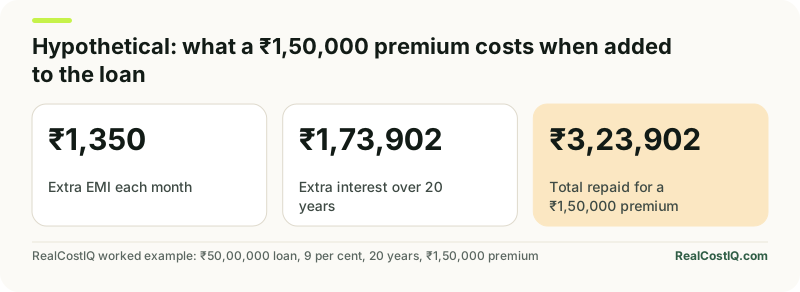
The monthly difference is ₹1,350. That is small enough not to be noticed on a statement. Over the full term, the borrower repays ₹3,23,902 against a ₹1,50,000 premium. So the financing adds ₹1,73,902 of interest. That is more than the premium itself. The point of the example is not that insurance is a bad idea. It is that the financing is a separate decision with its own cost. Under paragraph 85W, the lender has to ask you about it separately. If you do want the cover, paying the premium from your own funds avoids the interest. You can compare the two paths in the home loan comparison calculator, which models the loan on the amount you enter.
A financed premium also interacts with prepayment. If you later prepay, the extra principal is part of the balance you are reducing. So a part-prepayment does not target the premium separately. For how a lump sum changes the schedule, see the home loan prepayment calculator.
Closing or moving the loan: do you get the unused premium back?
This is the question borrowers ask most, and the honest answer is that we found no rule that guarantees it. On 21 October 2026 we read the IRDAI Master Circular on Life Insurance Products (ref. IRDAI/ACTL/MSTCIR/MISC/89/6/2024, 12 June 2024) on the regulator's own site. It says two things that bear on a loan-linked policy. First, paragraph 5 gives a free-look period of 30 days from the date you receive the policy document, in which you can cancel if you are not satisfied with the terms. Second, paragraph 7.16 says that for credit life products, the cover term at the start must not be longer than the outstanding loan tenure, and the sum assured must match the original loan amount or the loan schedule.
What we did not find in that circular is any rule that returns the unused part of a single premium when you prepay, foreclose the loan or move it to another lender. So the policy's own terms decide it. Do not assume the cover ends when the loan ends, or that money comes back. Ask the insurer, in writing, for four things: the date you received the policy document, so you know whether the 30-day free look is still open; whether the policy continues, lapses or can be cancelled when the loan closes; the surrender or refund value, if any, on that date; and the name of the insurer to which the bank sent your premium.
| No premium financed | ₹1,50,000 premium financed | Difference | |
|---|---|---|---|
| Interest paid in the first 5 years | ₹21,34,530 | ₹21,98,566 | ₹64,036 |
| Balance owed after 5 years | ₹44,35,352 | ₹45,68,413 | ₹1,33,061 |
Same illustrative loan as the table above, computed with the engine behind the site's home loan EMI calculator. After 5 years you would still owe ₹1,33,061 of the ₹1,50,000 premium, and you would have paid ₹64,036 of interest on it. If you close the loan then, you repay that balance with everything else. Whether any of the premium comes back is a matter for the policy terms.
The mis-selling remedy is different. From 1 January 2027, paragraph 85Z gives a 30-day window from receipt of the signed agreement where the insurance regulator sets no timeline. If mis-selling is established, the bank must refund the full amount the customer paid for the product. That is a remedy for a sale that was forced or not consented to. It is not a right to a refund when you simply repay early.
Property insurance and loan-cover life insurance are different things
A lender may ask for two kinds of cover. Property insurance protects the flat against damage, such as fire. Loan-cover (credit life) insurance pays the outstanding loan if the borrower dies. They protect different risks and end for different reasons. The RBI's rule that takes effect on 1 January 2027 does not ban either. Where the bank's loan depends on a cover as a genuine risk mitigant, you must be free to buy it from any provider, as the section above on paragraph 85V explains. So if a lender asks for either cover, ask which one it requires, whether you may buy it from your own insurer, and whether the premium is to be financed.
What the directions do not do
- They do not ban insurance on a home loan. The risk-mitigant exception expressly contemplates a lender requiring cover. What changes is who you may buy it from, and whether you are asked.
- They do not say which products count as a risk mitigant. We found no list, so the boundary will be tested in practice. A lender saying a particular policy is a mitigant is not the end of the question. The customer must still be free to choose the provider.
- They do not set a premium, a cap on premium or a cap on commission. This post does not compare products, and we are not recommending term cover or credit-life.
- They do not apply before 1 January 2027. A loan sanctioned in 2026 is not protected by these paragraphs on the date of sanction. We did not verify whether the new conduct rules reach loans already on the books after that date. So we do not state it.
- They are not the only protection. The Key Facts Statement circular of 15 April 2024 applies to retail and MSME term loans sanctioned on or after 1 October 2024. It already requires lenders to count charges collected on behalf of third parties, such as insurance, in the annual percentage rate. It also requires them to disclose these separately. It says a lender cannot charge a fee absent from the statement without explicit consent.
What you can already do: use the Key Facts Statement
The Key Facts Statement is the document in which a lender must put the cost of the loan in front of you before you sign. Under the 15 April 2024 circular, the lender counts charges it collects on behalf of third parties, such as insurance or legal fees, in the annual percentage rate. It shows them separately and must give receipts for what it collects. The borrower has at least three working days to accept the statement for a loan of seven days or more. The practical use is simple. Read the statement for an insurance line. Check whether the amount has been added to the loan amount. Ask who the insurer is and whether you may choose another. Our post on what RBI rules let you do when your home loan rate resets covers the wider rights around rate resets.
A checklist for the sanction conversation
- Ask for the Key Facts Statement and find any insurance line. Note the amount, the insurer and whether it is in the annual percentage rate.
- Ask in writing whether the policy is a condition of sanction. If the lender says it is a risk mitigant, ask whether you may buy equivalent cover from another provider.
- Check whether the premium has been added to the loan. If it has, ask for the loan amount without it and compare the EMI.
- Look for pre-ticked boxes on any digital form. From 1 January 2027, the default must be no.
- Keep the signed agreement date. Where no regulator timeline applies, the 30 days for a mis-selling complaint is counted from it.
- Escalate in writing to the lender's grievance channel first. Keep a copy of every reply.
What we did not verify
- We read the amendment directions as published on 15 June 2026. We have not seen the consolidated, updated versions of the parent directions that will carry the final paragraph numbers. So paragraph references could be renumbered.
- For housing finance companies, we read the amendment that points to the NBFC paragraphs. We did not read the HFC consolidated directions as they will stand after 1 January 2027.
- On 21 October 2026 we read one insurance-regulator document, IRDAI's Master Circular on Life Insurance Products. We did not read IRDAI's Protection of Policyholders' Interests Regulations, 2024 or any rule on property (general) insurance. So we state no insurance-side refund or timeline beyond paragraphs 5 and 7.16 of that circular.
- We have not tested how any particular lender will implement the rules. Several months remain before the effective date.
The short version for a buyer is this. From 1 January 2027, a loan cannot be made conditional on a third-party product. A risk-mitigant requirement leaves the choice of provider with you. A premium cannot be put into your loan without your explicit consent. Until that date, the best protection is the Key Facts Statement. Add the habit of asking the three questions above. If a tied premium makes a lender's offer more expensive than it looks, the home loan EMI calculator will show you by how much.