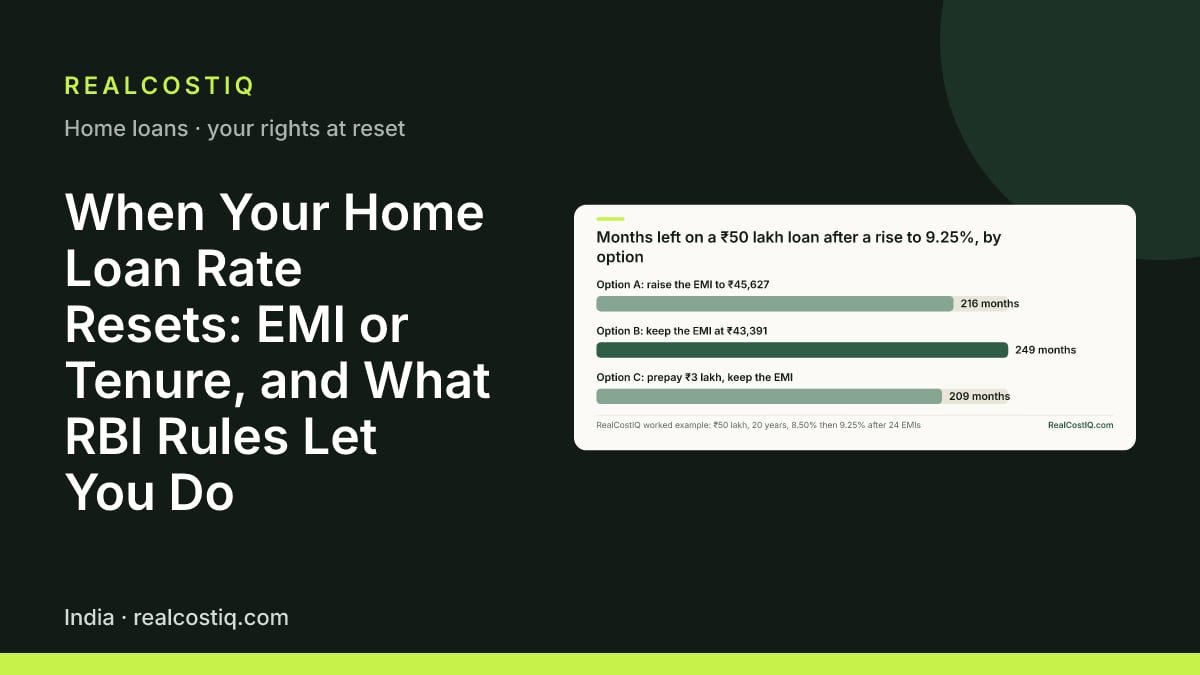
A floating-rate home loan does not stay at the rate on your sanction letter. When the benchmark moves, your lender resets the rate. That lands on you as a higher EMI, a longer loan, or both. Most borrowers meet this as a letter or an SMS, and pick whatever the lender's default is. The default is not always the cheapest option. It is also not the only one you are entitled to. This post sets out what the Reserve Bank of India's own circulars and directions require lenders to offer, disclose and not charge at the point your rate changes. It then works one ₹50 lakh loan through the three choices. That way you can see what each costs in rupees.
How this was checked. We first read these rules on 9 October 2026 from the RBI's own website. On 18 October 2026 we checked them again. Several of the circulars below were withdrawn on 28 November 2025, when the RBI folded its instructions into consolidated Directions (circular RBI/2025-26/100). The reset, Key Facts Statement, penal-charge, pre-payment and property-document rules now sit in paragraphs 348 to 360 of the Reserve Bank of India (Commercial Banks - Responsible Business Conduct) Directions, 2025, in the version updated as on 1 October 2026. We quote that text where it matters. Those Directions bind commercial banks. We did not read the equivalent text for housing finance companies. The original circulars and directions we first read are:
the 18 August 2023 circular on reset of floating interest rates and its FAQs (updated 1 October 2025); the Reserve Bank of India (Commercial Banks - Interest Rates on Advances) Directions, 2025 of 28 November 2025, which replaced the 2016 Master Direction; the Monetary Policy Statement resolution of 7 October 2026; the Pre-payment Charges on Loans Directions of 2 July 2025; the Key Facts Statement circular of 15 April 2024; the penal-charges circular of 18 August 2023; and the 13 September 2023 circular on releasing property documents. The RBI's list of withdrawn circulars names all of these except the Interest Rates on Advances Directions and the Monetary Policy resolution.
The worked example is our own arithmetic on stated, illustrative inputs. It is not a lender's offer, and no rate in it is a quote. For your own EMI, use the home loan EMI calculator, which takes your loan amount, rate and tenure.
Why your rate resets at all
New floating-rate personal or retail loans from banks, housing loans included, have to be benchmarked to an external rate (paragraph 25 of the Interest Rates on Advances Directions, 2025). Paragraph 5(4) lists the permitted benchmarks. These are the RBI policy repo rate, the 3-month or 6-month Treasury Bill yield published by the Financial Benchmarks India Private Ltd, or another market rate that FBIL publishes. (The repo rate is the rate at which the RBI lends to banks.) A bank must use one benchmark within a loan category (paragraph 27). So two home-loan borrowers of the same bank are tied to the same external rate. The lender then adds a spread, which is its own margin on top. For external-benchmark loans, paragraph 38 says the interest rate must be reset at least once in three months.
The Monetary Policy Committee, in its resolution of 5 to 7 October 2026, voted unanimously to raise the policy repo rate by 25 basis points to 5.50 per cent. By a majority, it changed its stance to calibrated tightening. So a repo-linked home loan is exactly the kind of loan that is about to reset. What that means for your loan depends on your lender's spread. It also depends on whether your loan is benchmarked to the repo rate at all. That is why the sanction letter matters more than any headline. Older loans can sit on the internal Marginal Cost of Funds based Lending Rate (MCLR). For those, paragraph 34 lets the bank tie the reset date to the date of first disbursement or to its MCLR review. Paragraph 36 requires the reset periodicity to be one year or lower, and says the exact periodicity must be in the loan contract. Suppose you took a loan before the external-benchmark rule. Find out which of the two systems you are on, because it decides how often a change reaches you.
Two limits protect you from the lender quietly widening its margin. Under the external-benchmark system, the credit risk premium may change only when your credit assessment undergoes a substantial change, as agreed in the loan contract. The other spread components, including operating cost, may be altered once in three years (paragraph 33). A proviso to that paragraph lets a bank reduce those other components earlier than three years for customer retention. It must do so on justifiable grounds, in a non-discriminatory manner and under its policy. Under the MCLR system, paragraph 31 says the spread charged to an existing borrower shall not be increased except on account of deterioration in the credit risk profile of the customer, supported by a full risk profile review. Both of these are rules about the spread. They do not stop the benchmark moving.
What the August 2023 reset circular requires
On 18 August 2023, the RBI issued a circular to banks, regional rural banks, co-operative banks and non-banking financial companies including housing finance companies. Its title is Reset of Floating Interest Rate on Equated Monthly Instalments (EMI) based Personal Loans. It was a response to complaints that lenders had changed tenor and EMI without proper communication or the borrower's consent. The scope matters. The FAQs say it applies to all equated periodic instalment based personal loans only, and they use a home loan as their own example of a loan category. It covers loans linked to an external benchmark and loans linked to an internal one. It applies to existing borrowers as well as new ones. Lenders had to extend it to existing and new loans by 31 December 2023. They also had to send existing borrowers a communication about the options.
Read as a checklist from your side, the circular gives you six things. The RBI withdrew the circular on 28 November 2025 and moved the same instructions into paragraph 349 of its Responsible Business Conduct Directions for commercial banks, where the wording on options, prepayment and notice is the same. The six points below follow that text.
- Disclosure at sanction. The lender must tell you clearly that a change in the benchmark can change your EMI, your tenor or both. The FAQs add that the annualised rate, or APR, goes in the Key Facts Statement and the loan agreement.
- Prompt notice of a change. The lender must tell you immediately, through appropriate channels, about any increase in EMI, tenor or both because of a benchmark change.
- A choice, not a default. You must be given the choice of a higher EMI, a longer tenor keeping the EMI unchanged, or a combination of both.
- The right to prepay. You can prepay in part or in full at any point in the tenor of the loan. The prepayment rules in the next section decide whether a charge applies.
- No negative amortisation. When the lender stretches the tenor on a floating-rate loan, the longer schedule must not leave your balance growing. In plain terms, the EMI must at least cover the interest.
- A quarterly statement. At the end of each quarter you should receive a statement. At the minimum, it shows principal and interest recovered to date, the EMI, the number of EMIs left and the annualised rate of interest or APR for the entire tenor.
The fixed-rate switch is now optional
The circular also talks about switching to a fixed rate at the time of reset. Here the wording changed. The original circular said the lender shall give the borrower the option to switch. A set of amendment directions dated 29 September 2025, effective 1 October 2025, replaced that. The new wording says the lender may, at its option, provide a choice to switch over to a fixed rate as per its Board-approved policy. The updated FAQs say the same thing from the borrower's side. You can switch to a fixed rate for the remaining portion of the loan where the lender provides such an option. So a fixed-rate switch is no longer something you can demand. To see what a fixed rate costs in rupees, read our post on fixed vs floating home loans. Some sources written before October 2025 still describe it as mandatory. The text to trust is paragraph 349(2) of the consolidated Directions, which says a bank “may, at its option, provide a choice to the borrowers to switch over to a fixed rate”.
If your lender does offer it, there is a price. The circular and FAQ allow charges for switching from floating to fixed or the reverse, plus other service charges and administrative costs incidental to the switch. The lender must disclose them transparently in the sanction letter, and again when it revises them. The FAQ adds that the charges are as approved by the lender's board and displayed on its website. The policy may also cap how many times you can switch during the loan. We did not find, and do not state, any figure for the switching fee, because the RBI leaves it to each lender.
EMI or tenure: a ₹50 lakh loan after a rate rise
The circular gives you the choice. It does not tell you which to take. To show what the choice costs, we used illustrative inputs, not a quote from any lender. The loan is ₹50,00,000 for 20 years (240 months) at 8.50% a year, repaid by EMI. After 24 EMIs the benchmark rises, and the lender raises your rate to 9.25% for the rest of the loan. Both rates are made up for the example. We chose them because a 0.75 percentage point rise is the sort of move a borrower can plan around. The arithmetic is the standard reducing-balance EMI formula, computed month by month.
| Step | What it is | Amount |
|---|---|---|
| Starting EMI | ₹50,00,000, 240 months, 8.50% | ₹43,391 |
| Balance after 24 EMIs | Principal still owed at the reset | ₹47,92,181 |
| Option A: raise the EMI | Same 216 months left, 9.25% | EMI ₹45,627 (up ₹2,236 a month) |
| Option B: keep the EMI | EMI stays ₹43,391, 9.25% | Loan runs 249 more months (248 full EMIs and a last instalment of about ₹9,166), 33 more than 216 |
| Extra interest on B versus A | Total paid from the reset, B minus A | About ₹9.15 lakh (₹9,14,684) |
| Option C: prepay ₹3,00,000 at reset, keep the EMI | Balance ₹44,92,181, EMI ₹43,391, 9.25% | Loan runs 209 more months, 7 fewer than 216 |
| Option D: prepay ₹3,00,000, keep the tenor | Same 216 months | EMI ₹42,771 (₹620 below the starting EMI) |
All inputs are illustrative and monthly compounding on the reducing balance is assumed. The rates are not lender quotes. Real loans differ by day-count, EMI rounding and the lender's reset date. Run your own numbers in the home loan EMI and prepayment calculators.
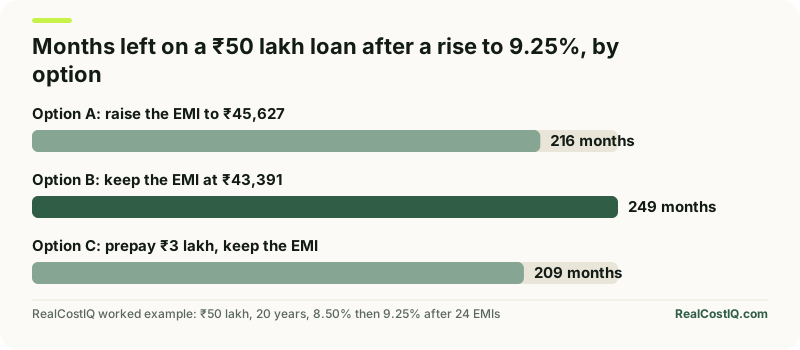
The table makes one point that surprises many borrowers. Keeping the EMI feels free, but it is the most expensive choice here. A 0.75 point rate rise on a loan this early in its life leaves very little of each EMI going to principal. So a modest EMI cut produces a long extension. Option B costs about ₹9.15 lakh more over the rest of the loan than Option A, to save ₹2,236 a month. Whether that trade is right depends on your cash flow. Say the ₹2,236 is the difference between servicing the loan comfortably and not. Then take the longer tenor now, and plan to shorten it later with prepayments. If it is not, raising the EMI is the cheaper route.
Options C and D show what a part-prepayment does at the moment of reset. Say you pay ₹3 lakh at the reset and leave the EMI alone. The loan then runs 209 more months. That is 7 fewer than the 216 you had before the rise, and 40 months fewer than Option B. Apply the same ₹3 lakh to the EMI instead, and the instalment falls to ₹42,771, below where you started. So prepaying is the lever that most efficiently undoes a rate rise. The next section is about whether the lender can charge you for pulling it. To test your own prepayment amount and see the interest saved, use the home loan prepayment calculator.
Can the lender charge you to prepay?
For most borrowers of a bank, no. But the date your loan was sanctioned matters. The RBI issued Pre-payment Charges on Loans Directions on 2 July 2025. It withdrew them on 28 November 2025 and moved the rules into Part E of the Responsible Business Conduct Directions for commercial banks, paragraphs 352 and 353. Paragraph 353 applies to loans sanctioned or renewed on or after 1 January 2026. The rule that matters to a home-loan borrower is paragraph 353(1). For all floating-rate loans granted for purposes other than business to individuals, with or without co-obligants, “a bank shall not levy pre-payment charges”. A joint loan with your spouse is covered.
- Any source of funds. The bar applies irrespective of the source of funds used to prepay, in part or in full. Moving the loan to another lender is not a prepayment loophole in the lender's favour. A lump sum from savings is treated the same way.
- No lock-in. It applies without any minimum lock-in period. So there is no waiting year before you can prepay free of charge.
- Dual-rate loans. Some loans combine a fixed and a floating period. For these, applicability depends on whether the loan is on a floating rate at the time of pre-payment.
- Disclosure. The lender must disclose whether any pre-payment charge applies. It goes in the sanction letter and loan agreement and, where a Key Facts Statement is required, in that statement (paragraph 353(8)). A charge that was not disclosed cannot be levied. A charge waived earlier cannot be levied retrospectively at the time of prepayment (paragraph 353(9)).
- Lender-initiated closure. The lender shall not levy any charge where the pre-payment is at its own instance (paragraph 353(7)).
Fixed-rate loans and loans sanctioned before 2026
The bar covers floating-rate loans. For cases outside paragraphs 353(1) and 353(2), paragraph 353(5) applies. It says pre-payment charges, if any, shall be as per the approved policy of the bank. For term loans, any charge must be based on the amount being prepaid. So on a fixed-rate home loan a charge can exist. It is a number you should read in the Key Facts Statement before you sign. Older loans have their own paragraph. Paragraph 352 says: “In case of existing floating rate term loans sanctioned before December 31, 2025 for purposes other than business to individual borrowers with or without co-obligant(s), a bank shall not charge pre-payment charges.” So a floating-rate home loan from a commercial bank that was sanctioned before the 2026 cut-off cannot carry a prepayment charge either. Two cautions. First, the two paragraphs use two dates: “before December 31, 2025” in paragraph 352 and “on or after January 01, 2026” in paragraph 353. A loan sanctioned on 31 December 2025 itself is not named by either. Ask your bank in writing if that is your date. Second, we read the text for commercial banks only. We did not read the matching text for housing finance companies and other lenders. Where your lender is not a bank, ask it in writing whether it levies any charge on prepayment of your account, and keep the reply. We said the same thing before 28 November 2025 in other words: the RBI had told banks in a 7 May 2014 circular not to charge foreclosure or pre-payment penalties on floating-rate term loans to individuals. That circular was not named in the withdrawn list we read, so we do not rely on it. The 2025 paragraphs above are the rule.
Different paragraphs cover business-purpose loans. They bar charges for most lenders on business loans to individuals and micro and small enterprises. They bar them below ₹50 lakh for smaller lender categories. A home loan taken for a self-occupied or rented residential property is not a business purpose loan. So paragraph 5(i) is the one that applies to you.
Moving to a lower rate: balance transfer and the benchmark switch
If the reset leaves you paying more than a new borrower would, two routes are open. The first is staying with your lender and asking for a rate switch. Paragraph 41 of the Interest Rates on Advances Directions, 2025 gives a specific right here for older loans. Floating-rate term loans sanctioned to borrowers who are eligible to prepay without pre-payment charges are eligible for switchover to an external benchmark. This must be without any charges or fees, except reasonable administrative and legal costs. After the switchover, the final rate charged to such borrowers must be the same as the rate charged for a new loan of the same category, type, tenor and amount at the time of origination of the loan. The switchover is not treated as a foreclosure of the existing facility. Other existing borrowers have the option to move to an external benchmark on mutually acceptable terms. This direction binds banks. Housing finance companies and other NBFCs are subject to the reset circular. But do not assume this specific benchmark-switch right applies to them without checking their own directions.
The second route is moving the loan to another lender. That is a new loan with new processing costs, and a new Key Facts Statement to read before you accept. The next section covers it. The 2025 directions bar prepayment charges on the old loan for borrowers within their scope. So the exit cost on your side is often the new lender's fees, not a penalty on the old one. The home loan balance transfer calculator puts the old and new loans side by side. That way you can weigh the saving in interest against the fees on the new one. For the first route, our post on switching from MCLR to EBLR sets out the fee three banks list and what it takes to recover it.
The Key Facts Statement is your price tag
The RBI issued its Key Facts Statement circular on 15 April 2024 and withdrew it on 28 November 2025. For commercial banks the rules now sit in paragraph 348 of the Responsible Business Conduct Directions, and the text we quote below is from there. The statement applies to all new retail and MSME term loans sanctioned on or after 1 October 2024, including fresh loans to existing customers. Credit card receivables are exempt. The statement is a standardised summary of the loan's key facts in simple language, in the format of Annex XIII to the Directions. The lender must explain it to you in a language you understand, with an acknowledgement that you understood it (paragraph 348(1)). For a home loan, four of its rules do real work.
- It binds the lender for a window. The statement carries a unique proposal number. It is valid for at least three working days for loans of seven days or more. The lender is bound by the terms in it if you agree during that period (paragraph 348(2)). Use the days to compare, not to sign on the first.
- It carries an APR and a schedule. The statement includes a computation sheet of the annual percentage rate and the amortisation schedule over the tenor. (An amortisation schedule lists every instalment and how it splits between interest and principal.) The APR includes all charges the lender levies. So it is the figure to compare across lenders, not the headline interest rate.
- Third-party charges are separate and receipted. Insurance, legal and similar charges recovered on an actual basis for third parties form part of the APR. The lender discloses them separately and gives receipts and related documents for each payment.
- Unlisted fees cannot be added later. The lender cannot charge any fees or charges not mentioned in the statement at any stage during the term of the loan without the borrower's explicit consent (paragraph 348(5)).
The last of these is the one to remember at reset. Suppose a lender proposes a switching fee, a conversion charge or an administrative fee that is not in your statement or sanction letter. You can ask where it was disclosed. The reset circular itself requires switching charges to be disclosed in the sanction letter. The statement also tells you what happens if you stop paying on time. That brings us to penal charges.
Late payment: penal charges are not extra interest
A rate reset can strain a budget, and an EMI that bounces is expensive. A separate post sets out how a missed EMI moves through SMA-0, SMA-1, SMA-2 and NPA. The RBI's 18 August 2023 circular on penal charges changed how that cost is built. The RBI withdrew the circular on 28 November 2025 and moved it into paragraph 351 of the Responsible Business Conduct Directions. Under that paragraph, a penalty for breaching a material term of the loan contract is a penal charge. The lender must not levy it as penal interest added to the rate of interest. There must be no capitalisation of penal charges. That means no interest is computed on them. The lender must have a Board-approved policy. The amount must be reasonable and commensurate with the breach, without being discriminatory within a product category. For loans to individuals for purposes other than business, the penal charge must not be higher than that for non-individual borrowers for a similar non-compliance. The lender must disclose the quantum and the reason in the loan agreement and the Key Facts Statement, as applicable, and on its website. Reminders you receive should state the applicable penal charge.
Paragraph 351 says the penal-charge rules apply to fresh loans availed from 1 April 2024. For existing loans, the switchover to the new penal charges regime applies from 30 June 2024. Those are the dates in the consolidated text. For an account you are managing today, the practical point is this. A penal charge should appear as a fixed charge with a stated reason. It should not be compounding on your outstanding. If a statement shows interest-on-penalty, that is worth a written query.
Closing the loan: 30 days and ₹5,000 a day
A reset is not the end of the loan, and the end has its own RBI rule. The RBI circular of 13 September 2023 covered release of movable and immovable property documents. The RBI withdrew it on 28 November 2025, and the same rules are now paragraphs 354 to 360 of the Responsible Business Conduct Directions. It requires lenders to release all original documents and remove charges registered with any registry within 30 days of full repayment or settlement of the loan. You can collect the documents from the branch where the loan was serviced, or any other office of the lender where they are held. Sanction letters issued on or after the effective date must state the timeline and place of return. The lender must also have a procedure for returning the documents to legal heirs if the sole borrower or joint borrowers die. It must display that procedure on its website.
Suppose the lender is late, either in releasing the documents or in filing the charge satisfaction form with the relevant registry. It must tell you the reasons. Where the delay is attributable to the lender, it must compensate you at ₹5,000 for each day of delay. Suppose the original documents are lost or damaged. The lender must help you obtain duplicate or certified copies at its cost. It gets an additional 30 days for that before the daily compensation runs, a total of 60 days. The compensation is without prejudice to your right to other compensation under any applicable law. The rule applies where release of documents falls due on or after 1 December 2023 (paragraph 360). For a property you plan to sell, this matters, because a buyer's lender will not complete without clear title.
A sequence to follow when your rate changes
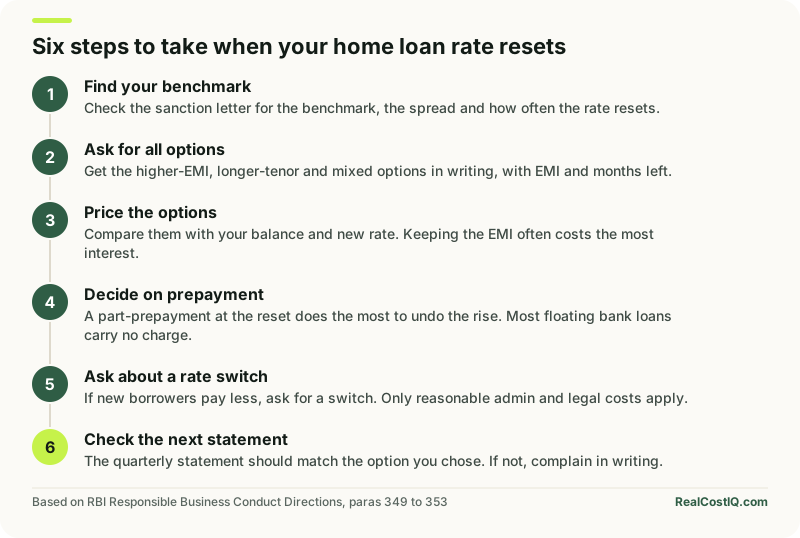
- Find your benchmark and reset date. Look in the sanction letter for the benchmark (repo-linked, T-Bill-linked or MCLR-linked), the spread and the reset periodicity. On an external-benchmark loan, the rate resets at least every three months.
- Wait for the lender's notice, then ask for all options. Request the higher-EMI, longer-tenor and mixed options in writing. For each one, ask for the new EMI, balance and months remaining. The circular says you must be given the choice.
- Price the options yourself. Take the new rate and your outstanding balance, and compare. In our example, keeping the EMI added about ₹9.15 lakh of interest. Use the EMI and prepayment calculators with your own figures.
- Decide on prepayment. If you hold surplus cash, a part-prepayment at the reset does the most to undo the rise. On a floating-rate loan to an individual sanctioned or renewed from 1 January 2026, no pre-payment charge may be levied. For a bank loan sanctioned before 31 December 2025, paragraph 352 also bars the charge. For any other lender, ask in writing what it charges.
- Ask about a rate switch. Say your rate is above what a new borrower is offered. Ask the lender for a switch. Where the benchmark-switch right applies, the rate must match a new loan of the same category, type, tenor and amount. The only costs are reasonable administrative and legal costs.
- Check the next quarterly statement. It should show the EMI, the number of EMIs left and the annualised rate. If any of those do not match the option you chose, raise it with the lender's grievance channel in writing.
To see how much a quarter-point rise adds to an EMI at other loan sizes and tenures, use the rupee tables in our post on the October 2026 repo rate hike.
To see what SBI, HDFC Bank and ICICI Bank publish on their own pages after the hike, with the date on each rate, read our home loan interest rates for October 2026.
What this post did not verify
- Any lender's current rate, spread or switching fee. We read RBI directions, not lender price lists. Your lender's spread and fee are in your own sanction letter and on its website.
- A loan sanctioned on 31 December 2025. Paragraph 352 says “before December 31, 2025” and paragraph 353 says “on or after January 01, 2026”. Neither names that day.
- Housing finance companies' own directions. The old reset and KFS circulars named them. The consolidated Responsible Business Conduct Directions and the Interest Rates on Advances Directions, 2025 that we quote bind commercial banks. We did not read the housing finance directions.
- How a court or the Banking Ombudsman will treat a particular dispute. The RBI texts say what lenders must do. Remedies for a breach are a separate subject, and we have not covered them here.
- Tax on home-loan interest and principal. That is outside this post.