Most lists of home loan charges are copied from each other and have no date. A few mix the fee a bank advertises with the fee a customer pays. Others quote a range that no bank page shows. We took a narrower path. On 17 October 2026 we opened the fee pages of SBI, HDFC Bank and ICICI Bank, wrote down what each says, and noted what each leaves out.
This post covers what the lender charges. It does not cover what the buyer pays to the state, such as stamp duty, registration and GST on a flat. Those are in our post on the true cost of buying a flat in India.
A ₹50 lakh loan: what the three banks' pages list
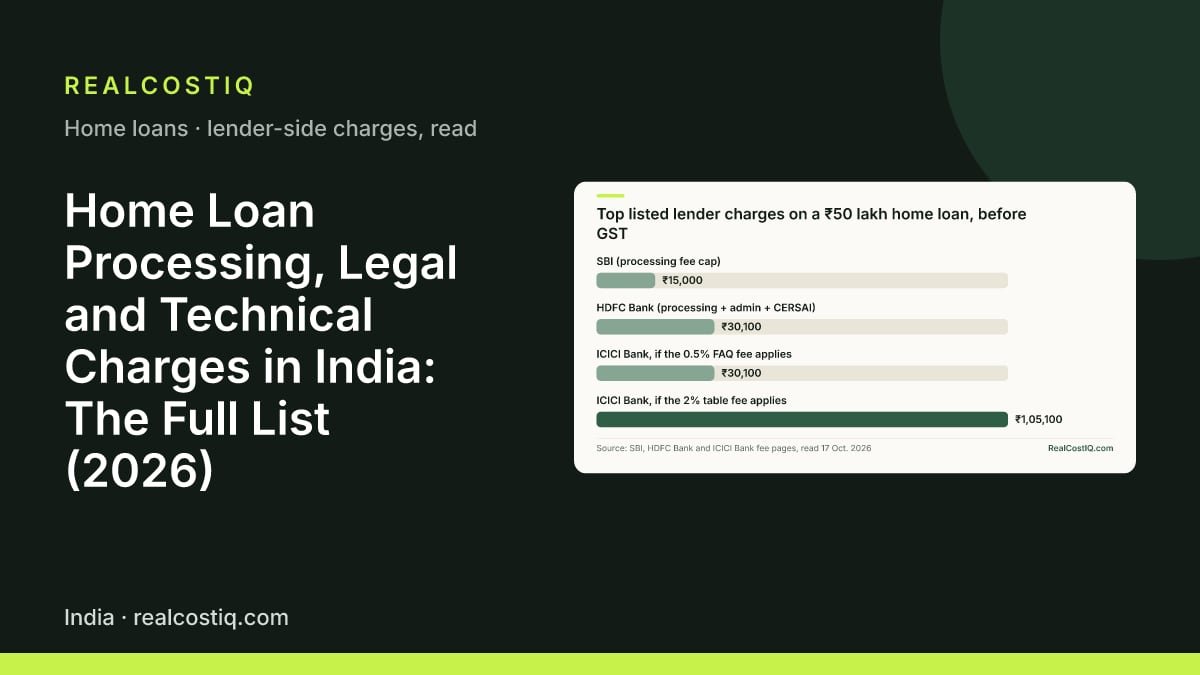
Take a loan of ₹50,00,000 (₹50 lakh) for a salaried borrower. Here is each bank's line for it. Where a page gives a range, we show the top of the range. A fee shown as a percentage is that percentage of ₹50 lakh.
| Charge | SBI | HDFC Bank | ICICI Bank |
|---|---|---|---|
| Processing fee | 0.35% of the loan, minimum ₹5,000, maximum ₹15,000, plus GST. On ₹50 lakh that is capped at ₹15,000. | Up to 0.50% of the loan or ₹4,000, whichever is higher, plus taxes. On ₹50 lakh: up to ₹25,000. | Table says up to 2% of the loan: up to ₹1,00,000. The FAQ on the same page says 0.5% plus taxes: ₹25,000. |
| Valuation and legal checks | No separate fee shown on the pages we read. | No separate valuation fee shown. Administrative charges: up to ₹5,000 plus taxes. | Administrative charges: 0.25% of the loan or ₹5,000, whichever is lower. On ₹50 lakh: ₹5,000. The page says this covers valuation and legal verification of the property. |
| CERSAI charge | Not shown on the pages we read. | At actual, up to ₹100. | ₹100 for a loan above ₹5 lakh. |
| Stamp duty and registration on loan papers | Not shown. | At actual. | Not shown as a bank fee. The FAQ says it depends on the state. |
| Part-prepayment | SBI's home loan page says no prepayment penalty. | Nil on variable-rate loans. | Nil. |
| Total of the lines above, before GST and taxes | ₹15,000 | Up to ₹30,100 (₹25,000 + ₹5,000 + ₹100) | ₹30,100 if the 0.5% FAQ figure applies; ₹1,05,100 if the 2% table figure applies |
Sources: SBI Processing Fee Card Rates (PDF, no printed date; its file properties show it was created on 1 April 2026) and SBI processing fee page (last updated 12 October 2026); HDFC Bank home loan page, Home Loan Charges section (no effective date shown); ICICI Bank home loan service charges page (no effective date shown). The total row is our addition. GST and tax rates are not stated on these pages, so we show every fee before them.
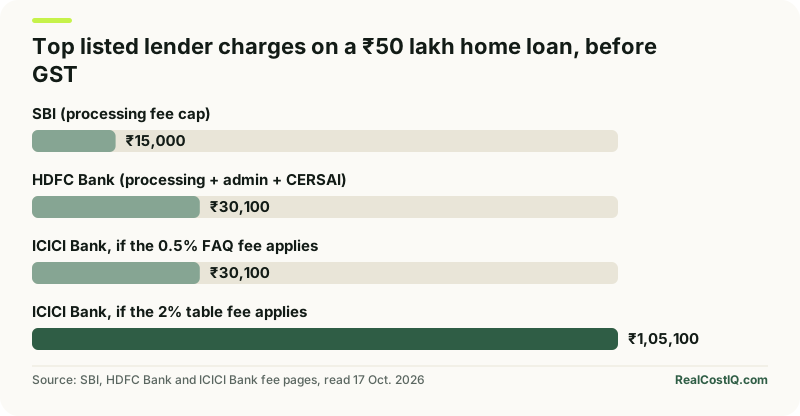
Read the table with care. The gap between banks looks large, but a card rate is not what every customer pays. SBI's own processing fee page says there is a 50% concession on the card rate and a 100% waiver in selected cases, with terms and conditions. HDFC Bank and ICICI Bank print the word up to. So these are the top of what is listed. The fee on your sanction letter may be lower. It can also be higher if you are in a category the card treats differently, such as a self-employed borrower or an NRI.
What the fee does to your EMI
You can pay these fees from savings, or, where a lender allows it, add them to the loan. If so, you pay interest on them for years. We worked that out for the same ₹50 lakh loan at 8.50% over 20 years, using the method in our home loan EMI calculator. The 8.50% is an illustration. It is not a quote.
| Loan amount | Monthly EMI | Extra EMI per month | Total interest over 20 years |
|---|---|---|---|
| ₹50,00,000 (fee paid in cash) | ₹43,391 | ₹0 | ₹54.14 lakh |
| ₹50,15,000 (SBI's ₹15,000 fee added) | ₹43,521 | ₹130 | ₹54.30 lakh |
| ₹50,25,000 (a ₹25,000 fee added) | ₹43,608 | ₹217 | ₹54.41 lakh |
| ₹51,00,000 (a ₹1,00,000 fee added) | ₹44,259 | ₹868 | ₹55.22 lakh |
Loan ₹50,00,000 plus the fee shown, 20 years, 8.50%, monthly repayment. EMI and interest come from the site's EMI engine at these inputs. Fees are shown before GST. Extra interest is the total at that loan size minus ₹54.14 lakh.
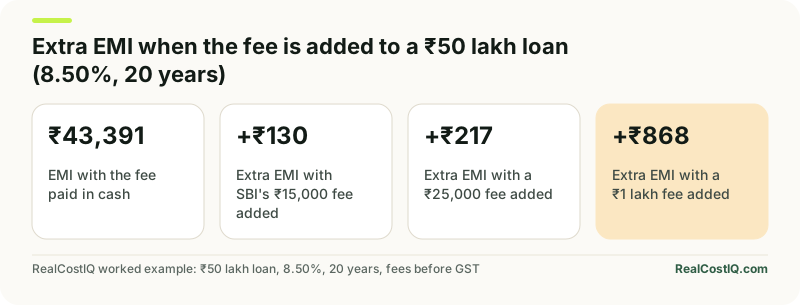
A fee of ₹1 lakh adds ₹868 to every EMI and about ₹1.08 lakh to the interest you pay over 20 years. So the fee costs you more than its face value when it is financed. A ₹15,000 fee adds ₹130 a month. The sums show why the percentage matters. The same loan can carry a fee of ₹15,000 or ₹1 lakh, depending on the bank and the category you fall in. To test your own numbers, use the home loan EMI calculator.
Seven terms, in plain words
- Processing fee. A one-time fee for the bank's work in looking at your application. ICICI Bank's page calls it non-refundable and says it is charged whatever the result of the appraisal. HDFC Bank's page also calls it non-refundable.
- Valuation. A check of what the flat is worth. A bank's valuer visits the property or reviews papers. The bank lends against its own valuation, which can differ from the price you agreed.
- Legal verification. A lawyer, chosen by the bank, checks the seller's title and papers to see that the flat can be mortgaged.
- CERSAI. The Central Registry of Securitisation Asset Reconstruction and Security Interest of India. It is a national record of loans that are secured on property. The bank files an entry so others can see the flat is already mortgaged.
- MODT. Memorandum of Deposit of Title Deeds. In some states, the bank records its hold on your flat by taking your title deeds and signing this memorandum. The state may charge stamp duty on it. The rate depends on the state.
- Key Facts Statement. A summary of the loan terms in a standard format that RBI requires. It must show the cost of the loan in a figure called the annual percentage rate.
- Sanction letter. The bank's letter that says it has approved your loan and on what terms. The fee, rate and other charges should be in it.
What the pages say about legal and technical costs
The word technical, in a home loan, means the bank's check of the flat's build and value. Banks use it for the valuation visit. Only one of the three banks prints a figure for these checks. ICICI Bank's page lists an administrative charge of 0.25% of the loan or ₹5,000, whichever is lower. It says this is a one-time, non-refundable charge for appraising the valuation and legal verification of the property. It is payable when the loan is paid out, not at application. On ₹50 lakh, 0.25% is ₹12,500, so the ₹5,000 cap applies.
HDFC Bank's page lists administrative charges of up to ₹5,000 plus taxes. It lists no line named valuation or legal fee. It does list incidental charges at actual, which means whatever the bank pays out on your behalf. It also lists stamp duty and statutory and regulatory charges at actual, and mortgage guarantee at actual. The page does not say what the incidental charges are. So the legal and valuation cost may sit inside those lines. Ask the bank to name them.
SBI's pages show a processing fee and a fee to revalidate a loan, and no legal or valuation line. We cannot say that SBI charges nothing for these checks. We can only say that the pages we read did not show a figure. If your sanction letter lists a valuation or legal fee, ask what it covers and who is paid.
RBI has a rule that bears on this. Its Key Facts Statement circular of 15 April 2024 (withdrawn and folded into consolidated Directions in November 2025, as explained below) says charges that a lender recovers on behalf of third parties, such as legal charges and insurance, form part of the annual percentage rate and must be shown separately. The lender must also give you the receipts. So a valuer's or lawyer's fee collected through the bank should appear in the statement and have a receipt. If it does not, ask why.
The charge that is not the bank's: the mortgage deed
Some states charge stamp duty and registration on the paper that creates the bank's claim on your flat. That is not a bank fee. It goes to the state, and the rate varies by state and by the kind of document. We did not read a state registration department's rate for this on 17 October 2026, so we give no figure. If your bank asks for stamp duty on a mortgage document, ask which state rate it applies and ask for the receipt. For the stamp duty on the purchase itself, use the stamp duty calculator.
Other lines you may meet later
The fee pages list charges that come up after the loan starts. They matter if you plan to change the loan, miss a payment or close it. We list them so that nothing is a surprise. We do not repeat the RBI rules on prepayment and late payment, which we cover in other posts.
| Charge | HDFC Bank | ICICI Bank |
|---|---|---|
| Failed payment (bounced instalment) | ₹450 payment return charge | ₹500 per bounce |
| Change of repayment mode | Up to ₹500 | ₹500 |
| Duplicate document or certificate | Up to ₹500 for a duplicate list of documents | ₹250 for a duplicate no-dues certificate |
| Property papers not collected after closure | ₹1,000 a month, after 2 months from closure | ₹1,000 a month, after 60 days from closure |
| Review of the loan six months after sanction | Up to ₹3,300 for a salaried borrower | Not shown |
| Switch of rate or benchmark | Up to 0.50% of principal or ₹3,000, whichever is lower, for a switch to a lower rate | ₹3,000 |
Sources: HDFC Bank home loan page and ICICI Bank home loan service charges page, read 17 October 2026. SBI's pages did not list these lines in the places we read. For SBI's switch fee and the rules, see our post on EBLR and MCLR, linked under the table.
A rate switch is the one that can save money. We worked through it in our post on switching from MCLR to EBLR, where SBI lists ₹5,000 plus GST and the other two list ₹3,000. If you are comparing lenders rather than changing your own loan, our home loan comparison calculator puts two offers side by side.
Three things the pages disagree on or leave out
- ICICI Bank shows two processing fees. The charges table says up to 2% of the loan. A question and answer lower on the same page says 0.5% plus taxes. Both are on the live page. On ₹50 lakh the gap is ₹75,000. We show both. Ask which one your sanction letter uses.
- No page gives an effective date for the fee lines. SBI's processing fee page shows a last-updated date of 12 October 2026. The others show none. A date on the page you read matters if a dispute arises, so save a copy or a screenshot.
- Taxes are not itemised. SBI says plus GST. HDFC Bank says plus applicable taxes. None of the pages states the rate. So every total in this post is before tax. Ask for the tax in rupees.
How to get the true cost in writing
RBI gives you a tool for this. Under the Key Facts Statement circular of 15 April 2024, a lender must give you the statement before you sign. It must stay valid for at least three working days for a loan of this kind. It must show the annual percentage rate, which includes all the charges the lender levies, and a repayment schedule. The circular also says a fee not mentioned in the statement cannot be charged at any stage of the loan without your explicit consent. An amendment of 15 June 2026 to the Responsible Business Conduct Directions will also tell banks to use any format RBI has prescribed, such as this statement, from 1 January 2027.
We could not read the Key Facts Statement text inside RBI's 2025 consolidated Directions, because RBI serves those files only to browsers. So we cite the 2024 circular. It still loads on RBI's site, but RBI's list of withdrawn circulars shows it was withdrawn on 28 November 2025, when RBI folded its instructions into new consolidated Directions. We have not confirmed the consolidated wording, so treat the points above as the 2024 rule and check the current Direction for any change.
- Ask for the Key Facts Statement before you pay any fee. Use the three working days to compare it with other banks.
- Find the annual percentage rate. It is higher than the interest rate because it includes the fees.
- Find each fee: processing, administrative, valuation, legal, CERSAI, stamp duty on loan papers. Ask for each in rupees, with tax.
- Ask which fees are paid at application and which at disbursement, and which are refundable if the loan is not sanctioned.
- Check the same figures in the sanction letter. They should match.
- Keep the receipts. The circular says the lender must give a receipt for each third-party charge it collects.
What this post cannot tell you
- Your fee. The amounts are the lenders' published maximums or card rates. Your sanction letter is the only figure that counts.
- Which bank is cheaper. A low fee can go with a higher rate. Compare the rate and the fee together.
- Banks we did not read. We read three banks. Other banks and housing finance companies publish their own charges.
- State charges. We give no figure for stamp duty on a mortgage document, as we read no state source.
- CERSAI's own fee. CERSAI's website did not load for us on 17 October 2026. The CERSAI amounts here come from the banks' pages.