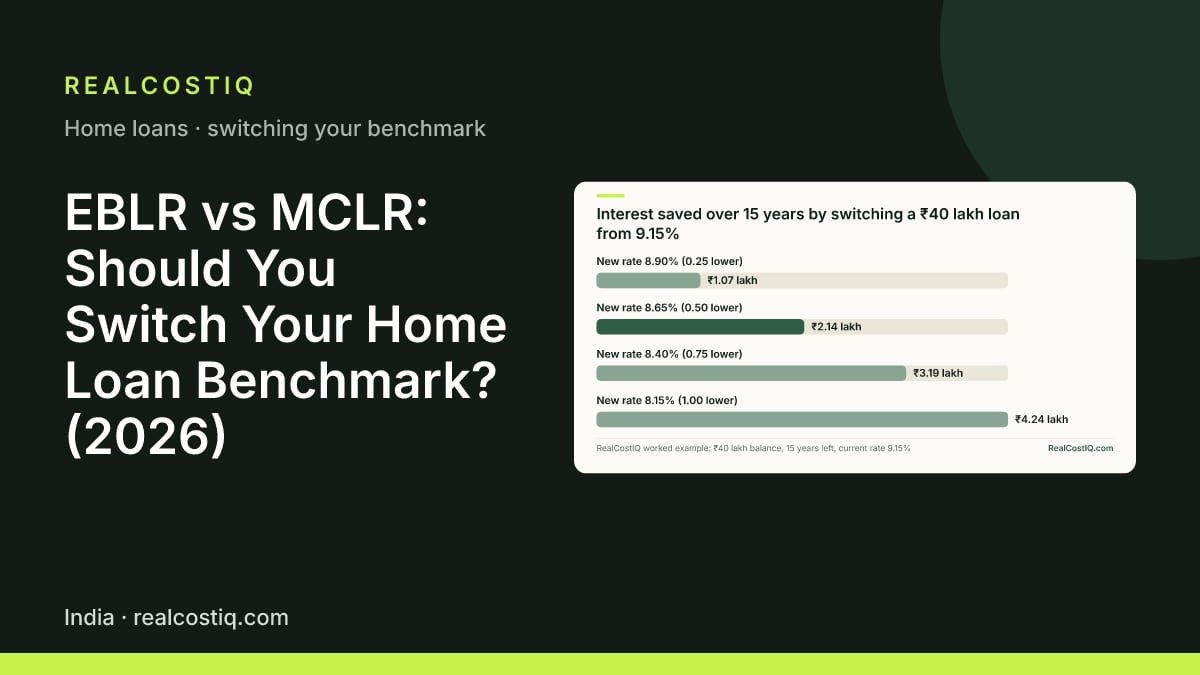
Most guides on this topic repeat one line: EBLR is better. That is not always true, and it hides the part that matters. The switch has a price, the new rate is a quote you must get in writing, and the benchmark you leave may be the cheaper one next year. We start with the rupees.
A ₹40 lakh loan, 15 years left: what a switch is worth
Take a home loan with ₹40,00,000 (₹40 lakh) still to repay and 15 years left. You pay 9.15% a year on an MCLR-linked loan. The 9.15% is made up for this example. It is SBI's one-year MCLR of 8.85% plus a spread of 0.30 points, and the spread is our guess, not an SBI figure. Your bank then offers you an EBLR-linked rate. We do not know what that rate would be for you, so the table tries four. The EMI and interest come from the same method as our home loan EMI calculator.
| New rate | Monthly EMI | EMI saved each month | Interest saved over 15 years | Months to recover a ₹5,000 fee | Months to recover a ₹3,000 fee |
|---|---|---|---|---|---|
| 9.15% (no change) | ₹40,928 | ₹0 | ₹0 | Never | Never |
| 8.90% (0.25 lower) | ₹40,333 | ₹595 | ₹1.07 lakh | 8.4 | 5.0 |
| 8.65% (0.50 lower) | ₹39,742 | ₹1,186 | ₹2.14 lakh | 4.2 | 2.5 |
| 8.40% (0.75 lower) | ₹39,155 | ₹1,773 | ₹3.19 lakh | 2.8 | 1.7 |
| 8.15% (1.00 lower) | ₹38,573 | ₹2,355 | ₹4.24 lakh | 2.1 | 1.3 |
Loan ₹40,00,000, 15 years, monthly repayment. EMI and interest come from the site's EMI engine at these inputs. The rates are illustrations, not offers. The fee columns use ₹5,000 and ₹3,000 before GST and ignore any legal cost. They are the fees SBI, and HDFC Bank and ICICI Bank, list on their own pages (see the fee section). Interest saved is the 15-year total at 9.15% minus the total at the new rate.
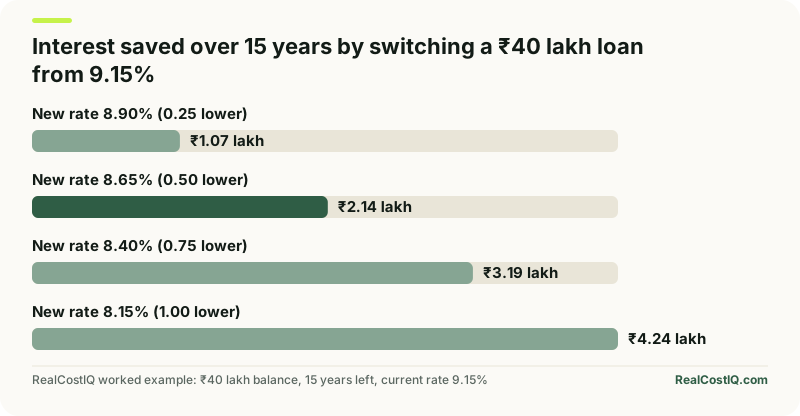
Two things stand out. First, the fee is small next to the saving once the gap is half a point or more. At 0.50 points lower, a ₹5,000 fee is back in about four months. Second, the saving falls fast as the gap shrinks. At 0.25 points it takes over eight months, and at zero the switch can never pay for itself. So the question is never EBLR or MCLR in general. It is: what exact rate will my bank put in writing, and how does it compare with what I pay today?
The table also hides something. We kept the tenure at 15 years. A bank may reset your loan so that the EMI falls or the tenure falls. Ask which one it does. If you want to keep paying your old EMI after the switch, the loan will end sooner, and you can test that with the home loan EMI calculator by shortening the years until the EMI is close to your old one.
Five terms you need
- Benchmark. The base rate that your loan rate starts from. Your lender adds a margin to it.
- MCLR. The Marginal Cost of Funds based Lending Rate. A bank works it out from its own cost of raising money, and publishes it for different periods, such as one month or one year. Loans linked to it are reset by the bank's own schedule.
- EBLR. The External Benchmark Lending Rate. It is based on a rate the bank does not control. For most banks the base is the RBI repo rate. (The repo rate is the rate at which the RBI lends to banks.)
- Spread. The margin the bank adds to the benchmark. It covers the bank's costs, its profit and the risk of lending to you.
- Reset period. How often the benchmark change reaches your loan. For MCLR it is as agreed in your contract, and never longer than one year. For EBLR it is at least once in three months.
If you want the longer story of what happens after a rate rise, including whether to raise the EMI or lengthen the tenure, we cover that in our post on what to do when your home loan rate resets. We do not repeat it here.
What RBI's rules say, and which text now counts
Many guides still quote the RBI Master Direction on Interest Rate on Advances, 2016. We checked RBI's list of Master Directions and its list of withdrawn circulars on 17 October 2026. For commercial banks, that text has been replaced by the Reserve Bank of India (Commercial Banks - Interest Rates on Advances) Directions, 2025, issued on 28 November 2025 (RBI/DOR/2025-26/161). It repeals the earlier instructions on the subject. So the rules below are from the 2025 Directions. They apply to commercial banks such as SBI, HDFC Bank and ICICI Bank.
They do not cover housing finance companies such as LIC Housing Finance, which have their own Directions. We did not read those, so nothing here describes them.
| Paragraph | What it says | What it means for you |
|---|---|---|
| 25 | All floating-rate personal or retail loans, housing included, must be benchmarked to an external benchmark. | A bank cannot sell you a new floating home loan on MCLR. |
| 27 | A bank must use one external benchmark within a loan category. | All new home loans at one bank sit on the same base rate. |
| 33 | The bank sets the spread. The credit risk part can change only if your credit assessment changes a lot, as agreed in the contract. Other parts can change once in three years. | On an EBLR loan, the bank cannot quietly widen its margin every quarter. |
| 36 | On MCLR loans, the reset period is one year or lower, and it must be written in the contract. | Look for your reset date in your sanction letter. |
| 38 | The rate on an external-benchmark loan is reset at least once in three months. | A repo change reaches an EBLR loan within about a quarter. |
| 41 | Existing MCLR loans continue until repayment or renewal. Floating-rate term loans that can be prepaid without charge can switch to an external benchmark without charges or fees, except reasonable administrative and legal costs, at the rate charged on a new loan of the same type, tenor and amount. Other borrowers can move on mutually agreed terms. | The right to switch is the key line. It carries a condition (see below). |
Source: Reserve Bank of India (Commercial Banks - Interest Rates on Advances) Directions, 2025, read 17 October 2026. The wording in the right-hand column is ours.
The condition inside paragraph 41
The free-switch right in paragraph 41 is for loans that can be prepaid without a charge. For most home loans taken by individuals, that points to the RBI rule on prepayment charges. The Reserve Bank of India (Pre-payment Charges on Loans) Directions, 2025, which apply to loans sanctioned or renewed on or after 1 January 2026, said a lender shall not levy prepayment charges on floating-rate loans to individuals for non-business purposes. A home loan for your own flat fits that description. RBI's list of withdrawn circulars shows that text, too, was withdrawn on 28 November 2025 and folded into consolidated Directions; we have not confirmed the consolidated wording, so check it with your bank. What that means for a loan sanctioned before 1 January 2026 is a point we cannot settle for you from the text we read. The paragraph 41 wording talks about borrowers eligible to prepay without charges under the rules in force. Your bank decides who falls in that group. So ask in writing: is my loan eligible for the paragraph 41 switch?
Two more things in paragraph 41 are worth a note. The new rate must equal the rate for a new loan of the same type, tenor and amount, at the time of origination of the loan. That is the wording. It does not say a new borrower today. The date is unclear to us, so ask the bank which date it uses. The text also says the switch is not treated as foreclosure of the loan. So your loan is not closed and reopened, and your original disbursement date stays.
What banks publish as a switch fee
The Directions allow reasonable administrative and legal costs. They set no number. So we opened the three big banks' own fee pages on 17 October 2026.
| Bank | What the page lists | On a ₹40 lakh balance |
|---|---|---|
| SBI | Processing fee for switch-over from MCLR, SBAR or Base Rate to the EBLR regime: ₹5,000 plus GST. | ₹5,000 plus GST |
| HDFC Bank | For a home loan, a switch to a lower rate on a variable-rate loan: up to 0.50% of the principal outstanding, or ₹3,000, whichever is lower, for the first conversion. Later conversions: up to 0.50% or ₹2,000, whichever is lower. | ₹3,000 (0.50% would be ₹20,000, so the lower figure applies) |
| ICICI Bank | Conversion charges for all floating-rate term loans to fixed or floating: ₹3,000. | ₹3,000 |
Sources: SBI Processing Fee Card Rates (PDF on homeloans.sbi.bank.in; it carries no printed date, and its file properties show it was created on 1 April 2026); HDFC Bank home loan page, charges section (no effective date shown); ICICI Bank home loan service charges page (no effective date shown). GST rate is not stated on SBI's card, so we show the fee before GST.
Three cautions apply. First, the HDFC Bank line is worded as a switch to a lower rate in a variable-rate loan. It does not say MCLR to EBLR. The ICICI Bank line says floating to fixed or floating. Neither page names the MCLR to EBLR move in so many words, while SBI's does. So for HDFC Bank and ICICI Bank, ask whether the line applies to your switch. Second, a fee is not the same as the reasonable administrative and legal costs in paragraph 41. A bank may charge one, the other or both. Ask for the total in writing. Third, none of the three pages carries an effective date for these lines, so treat them as a guide and not as a quote.
There is also a question the pages do not answer. Paragraph 41 says an eligible borrower can switch without charges or fees, except reasonable administrative and legal costs. SBI lists a flat processing fee for the switch. Whether that flat fee counts as a reasonable administrative cost is for the bank and, if you disagree, for RBI's complaint route to say. We do not take a side. We only note that the fee exists on the page, and that you can ask the bank to explain it.
How the two benchmarks moved on 15 October 2026
The case for one benchmark over the other changes with the rate cycle. On 7 October 2026 the RBI's Monetary Policy Committee raised the repo rate by 25 basis points to 5.50%. (A basis point is one-hundredth of a percentage point, so 25 basis points is 0.25 points.) It also changed its stance to calibrated tightening. SBI's own pages, read on 17 October 2026, show what followed on 15 October.
| Benchmark | Before | After | Change |
|---|---|---|---|
| EBLR (repo-linked), base before premiums | 7.90% | 8.15% | Up 0.25 points |
| One-year MCLR | 8.70% | 8.85% | Up 0.15 points |
| Six-month MCLR | 8.60% | 8.75% | Up 0.15 points |
| Three-month MCLR | 8.25% | 8.40% | Up 0.15 points |
| Overnight and one-month MCLR | 7.85% | 7.85% | No change |
Sources: SBI External Benchmark based Lending Rate page (last updated 14 October 2026) and SBI MCLR page (last updated 15 October 2026), read 17 October 2026. SBI's EBLR line reads 8.15% plus CRP plus BSP. SBI's page does not spell out CRP or BSP or give the size of either; they are premiums added on top of the EBLR.
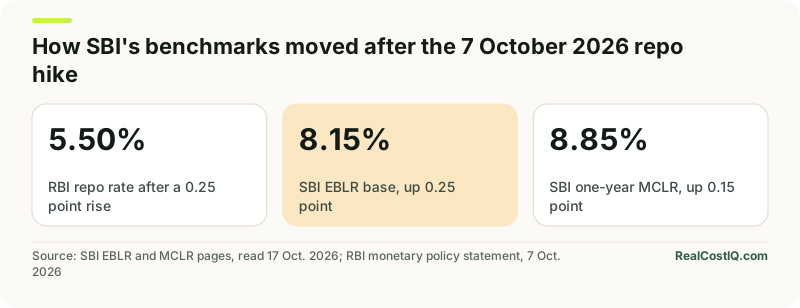
Look at the timing, not just the size. The EBLR moved by the full 0.25 points on 15 October, and an EBLR loan resets at least every three months. An MCLR loan took a smaller rise in the one-year rate, and a borrower on a one-year MCLR reset feels it only on the next reset date. In a rising cycle, an MCLR loan can feel cheaper for a while, because the full rise reaches you later. In a falling cycle, it works the other way round. A cut in the repo rate reaches an EBLR loan within three months, but an MCLR loan holds its old rate until the reset date. That is a feature of the structure, and not a forecast. Nobody can say which way rates go next.
A short sum shows the size of it. On our ₹40 lakh example, a loan at 9.15% has an EMI of ₹40,928. If the rate goes to 9.30% the EMI is ₹41,288, which is ₹360 a month more, and the total interest over 15 years rises from about ₹33.67 lakh to about ₹34.32 lakh. That is the kind of difference that a delayed or fast reset makes, month after month. For how a repo move works through loans of different sizes, see our post on what a 0.25 point repo hike does to EMIs.
What the benchmark does not fix: the spread
A switch moves your benchmark. It does not move your spread unless the bank says so. Compare the two rule sets. Under the MCLR rules in the 2025 Directions (paragraph 31), the spread charged to an existing borrower cannot rise except when the borrower's credit risk has got worse, backed by a full review. Under the external benchmark rules (paragraph 33), the credit risk part can change only when your credit assessment changes a lot, as agreed in the contract, and the other parts can change once in three years. They look alike, and in both cases the bank cannot just widen its margin because it feels like it.
There is one difference. Under the external benchmark rule, a bank may lower the other spread parts sooner than three years to keep a customer, if it does so on justifiable grounds and without discrimination, under its policy. This is the line a borrower can lean on when asking for a better spread. It gives you a reason to ask. It does not give you a right to get it.
So when a bank quotes you an EBLR rate, ask it to split the rate. You want the benchmark, the spread, and any premium for your credit score. Then compare the spread to the one you pay now. If the benchmark on the new loan is lower than your old one by 0.40 points but the spread is higher by 0.40 points, you gain nothing. The rate card is a range, and your place in it depends on your credit score and job type. Our post on home loan rates in October 2026 shows the ranges the three banks publish, with the date on each figure.
Switching within your bank, or moving to another bank
This post is about the first route: staying with your lender and changing the benchmark. The second route is moving the loan to a new lender. That route has its own costs, such as a new processing fee, legal checks and stamp duty on fresh papers in some cases. Our home loan balance transfer calculator works through that comparison. A simple order is to ask your own bank first, and to use its written quote as the yardstick for any transfer offer.
What to ask your bank, in writing
- Is my loan on MCLR, a base rate or an external benchmark today? What is my reset date?
- Is my loan eligible for the paragraph 41 switch to the external benchmark? If not, on what grounds?
- What exact rate will I pay after the switch, and what is the benchmark and spread in it?
- On what date is that rate fixed? Is it the rate a new borrower gets today, or the rate on the date my loan began?
- What is the total I pay to switch: the fee, GST, and any legal or administrative cost?
- After the switch, does my EMI change, or my tenor? Which one?
- Will you send a Key Facts Statement for the switched loan?
- How often will the rate reset, and on what date?
Keep the replies. If the bank says no, or quotes a figure that does not match the rules above, the RBI complaint route is open to you. Start with the bank's grievance officer. If the reply does not settle it, the RBI Integrated Ombudsman Scheme is the next step. We have not tested that route for this topic, so check the steps on RBI's own pages.
What this post cannot tell you
- Your rate. The rates in the example are illustrations. We use SBI's published MCLR and EBLR as context, and our own spread guess. No bank has quoted anyone a rate through this post.
- Whether you should switch. That depends on your rate gap, your fee, your plan to prepay and how long you will hold the loan. We show the sums. The choice is yours.
- Housing finance companies. The RBI text we read covers commercial banks. We did not read the rules for housing finance companies.
- The state of the rate cycle. We report what the RBI did on 7 October 2026. We do not predict the next move.
- Tax. This post is about the loan rate. It says nothing on tax relief on interest.