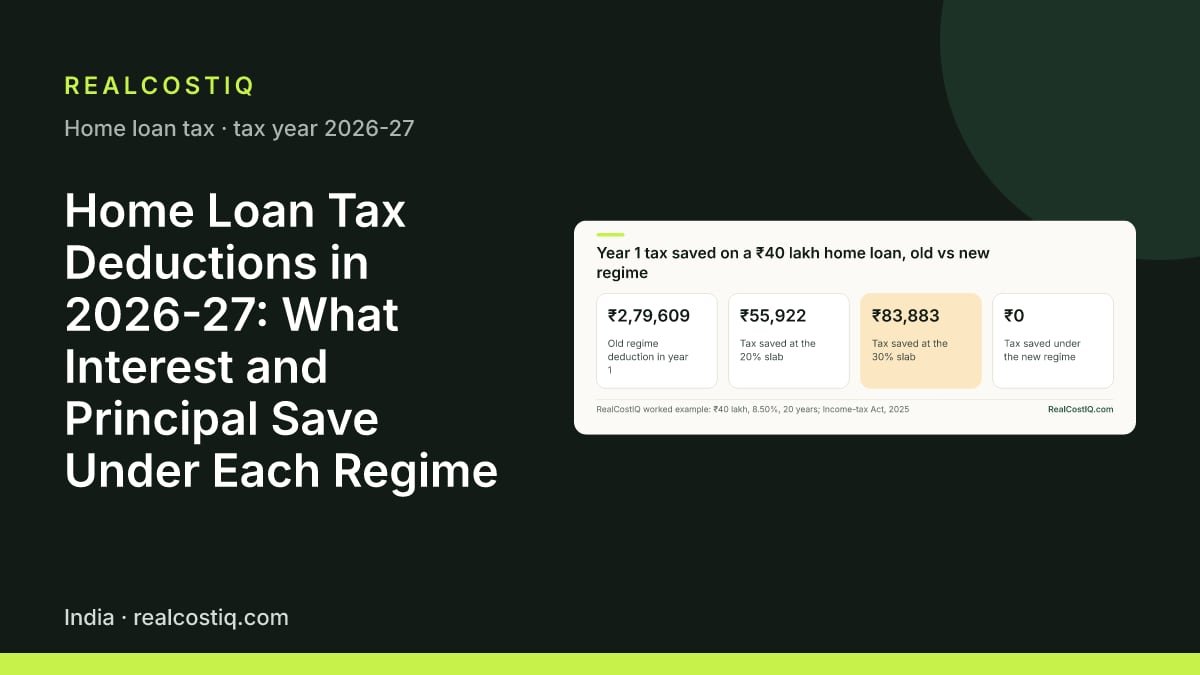
Most home loan tax advice online was written for the old law. It uses the old section numbers, and some of it is out of date. This post sticks to what the Income-tax Act, 2025, the Income Tax Department and the Finance Act 2026 say.
A few terms first. EMI is the equated monthly instalment you pay the bank. Each EMI has two parts: interest, which is the bank's charge for the loan, and principal, which is the part that reduces what you owe. A deduction is an amount you subtract from your income before tax is worked out. A slab rate is the tax rate on a band of income, such as 20% on income between ₹5 lakh and ₹10 lakh under the old regime. Self-occupied means you live in the home yourself, or cannot actually live in it for any reason (section 21(6) of the 2025 Act). This post covers only a self-occupied home bought with a loan.
A ₹40 lakh example first: what the deductions are worth in year 1
Take a loan of ₹40,00,000 (₹40 lakh) at 8.50% a year for 20 years. The EMI is ₹34,713. In the first year you pay ₹3,36,946 in interest and repay ₹79,609 of principal. Those two numbers add up to your 12 EMIs of ₹34,713 (₹4,16,555 in the year).
Now apply the old-regime limits. The interest limit is ₹2,00,000 for a self-occupied home, so only ₹2,00,000 of your ₹3,36,946 counts. The principal limit is ₹1,50,000 in a combined pool, so your ₹79,609 counts in full, if nothing else has used the pool. The total deduction is ₹2,79,609.
| Item | Amount paid | Amount you can deduct | Tax saved at 20% | Tax saved at 30% |
|---|---|---|---|---|
| Interest | ₹3,36,946 | ₹2,00,000 (capped) | ₹40,000 | ₹60,000 |
| Principal | ₹79,609 | ₹79,609 (under the ₹1,50,000 limit) | ₹15,922 | ₹23,883 |
| Total | ₹4,16,555 | ₹2,79,609 | ₹55,922 | ₹83,883 |
| New regime | ₹4,16,555 | ₹0 | ₹0 | ₹0 |
Interest and principal come from the site's loan schedule at ₹40,00,000, 8.50% and 20 years. Tax saved is the deduction times the slab rate, our arithmetic. Health and education cess of 4% on the tax is extra: it would make the saving ₹58,159 at 20% and ₹87,238 at 30%. The slab rate is the rate on your top rupee of income, not on all of it.
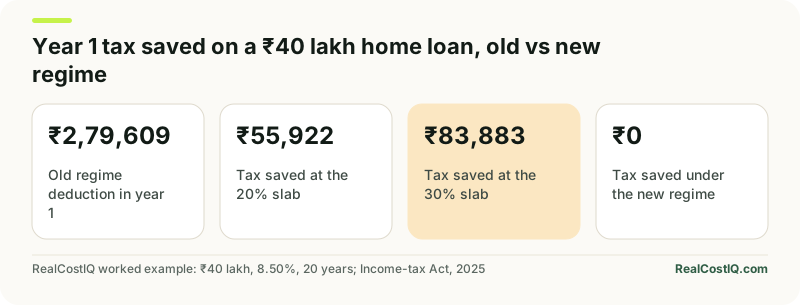
The method has three steps. Step one: find the interest and principal paid in the year. Step two: apply the cap to each. Step three: multiply the total deduction by your top slab rate. In symbols, tax saved = (min(interest, ₹2,00,000) + min(principal, ₹1,50,000)) × slab rate. For year 1 at 30%, that is (₹2,00,000 + ₹79,609) × 0.30 = ₹83,883.
Our home loan tax benefit calculator runs the same steps for your own loan. It also covers the first-time-buyer extra deduction (old Section 80EEA), which applies only to loans sanctioned before 1 April 2022, so we leave it out here.
Which law applies to income in 2026-27
The Income-tax Act, 2025 came into force on 1 April 2026. The Income Tax Department's page on the new Act says the 1961 Act stands repealed from that date. It also says a "tax year" is a period of twelve months within a financial year. This replaces the old words "previous year" and "assessment year". Income earned from 1 April 2026 to 31 March 2027 falls in tax year 2026-27 and is under the new Act. (Source: incometax.gov.in, Objective and scope of the New Act, FAQs 2, 9 and 21, read 16 October 2026.)
This matters for your reading. Returns filed in July 2026 were for assessment year 2026-27, which is income of the 2025-26 financial year. Those returns still use the 1961 Act and its old section numbers. The same page says advance tax for tax year 2026-27 follows the new Act. So when you read a guide, check which year it is about. A guide that talks of "Section 24(b)" and "Section 80C" is about the old law.
The new regime also carries over. The department's FAQ 22 says the new tax regime continues under Section 202 of the 2025 Act, and that it is the default, with an option to opt out. FAQ 23 says you do not need to opt again, because an earlier choice is treated as made under the equivalent provision of the new Act. (Source: same page, read 16 October 2026.)
Old section numbers and what they became
| What it does | 1961 Act (up to 2025-26) | 2025 Act (from 2026-27) | How we know |
|---|---|---|---|
| Interest on a home loan, including the ₹2 lakh cap on a self-occupied home | Section 24(b) | Section 22 | The Finance Bill 2026 memo and the Finance Act 2026 both name section 22 of the 2025 Act for house property deductions; section 22 of the Act itself |
| Principal repaid on a home loan (₹1.5 lakh pool) | Section 80C | Section 123 (with Schedule XV, item 1(r)) | The Income-tax Act, 2025 as amended by the Finance Act 2026 (Income Tax Department PDF): section 123 caps the pool at ₹1,50,000. The department's AY 2026-27 pages still use 80C for the old law |
| The new tax regime | Section 115BAC | Section 202 | Department FAQ 22 on the new Act |
Sources read 16 October 2026: incometax.gov.in (Objective and scope of the New Act); Finance Bill 2026 explanatory memorandum, clause 30; Finance Act 2026, section 38 (amending section 22(2)); incometax.gov.in AY 2026-27 pages.
Where these numbers come from: we read the Income-tax Act, 2025 itself, in the Income Tax Department's PDF of the Act as amended by the Finance Act 2026. Section 22 holds the interest deduction and its ₹2 lakh cap. Section 123, with Schedule XV, holds the ₹1.5 lakh pool that includes home loan principal. The Finance Bill 2026's explanatory memorandum and the Finance Act 2026 explain the 2026 change to section 22.
Interest: the ₹2 lakh cap and what changed in the Finance Act 2026
The Finance Bill 2026's explanatory memorandum describes section 22 of the Income-tax Act, 2025 as the section on deductions from income from house property. It says sub-section (2) of that section limits the total deduction for a self-occupied property to ₹2 lakh, where the property was bought or built with borrowed money. The old-law version of this limit is on the department's AY 2026-27 page: for a self-occupied property, the upper limit for interest on a housing loan is ₹2 lakh. (Sources: Finance Bill 2026, explanatory memorandum, clause 30; incometax.gov.in AY 2026-27 page, last reviewed 9 July 2026; both read 16 October 2026.)
One change in 2026 is easy to miss. The memorandum says the ₹2 lakh ceiling "has not included" the deduction for prior-period interest, which is interest payable before the property was bought or built. The Bill proposed to change this, so that the total deduction for interest includes prior-period interest. The change takes effect from 1 April 2026. The Finance Act 2026, which became law on 30 March 2026, amends section 22(2) in line with the Bill: its section 38 widens the reference in sub-section (2) from clause (1)(b) to clauses (1)(b) and (c). (Sources: Finance Bill 2026 memorandum, clause 30; Finance Act 2026 (No. 4 of 2026), section 38, egazette, read 16 October 2026.)
In plain terms: the ₹2 lakh is now one pot for all the interest you claim on a self-occupied home. That includes interest from the years before you got possession.
Interest paid before you get the keys
If you buy a flat that is still being built, you may pay interest for years before you move in. This is called pre-construction interest. The Finance Bill's memorandum calls it prior-period interest. Section 22(1)(c) of the 2025 Act lets you claim it in five equal yearly parts, starting with the tax year in which the home is bought or its construction is completed.
Here is what the 2026 change does to an example. Say you paid ₹5,00,000 of pre-construction interest. That is ₹1,00,000 a year for five years. Say your current-year interest in each of those five years is above ₹2 lakh, as it is in our ₹40 lakh example (₹3,36,946 in year 1 and ₹3,04,842 in year 5). The cap of ₹2 lakh covers everything together. So on the memorandum's reading, the ₹1,00,000 slices add nothing extra in those years. The cap is already full.
A borrower with a smaller loan sees it differently. If your current-year interest is only ₹1,20,000, the ₹1,00,000 slice can add to it, up to the ₹2 lakh total. The size of your loan decides how much of the pre-construction interest ever gets used. For how to treat the months before possession in your EMI, see our home loan EMI calculator, which has a moratorium option.
The ₹30,000 limit and the completion condition
The ₹2 lakh limit applies where the home was bought or built with borrowed money. The law has long set a lower limit of ₹30,000 for a home that is not completed within a set period. Section 22(2) of the 2025 Act keeps this rule: the ₹2 lakh limit needs construction completed within five years from the end of the tax year in which you borrowed, and a certificate from the lender; otherwise the limit is ₹30,000. If your flat is delayed, ask a tax professional how the limit applies to you.
Principal: the ₹1.5 lakh pool
The department's AY 2026-27 page lists housing loan principal among the payments that count under Section 80C, under the old regime. The pool has a combined limit of ₹1,50,000. "Combined" is the key word. Your provident fund, life insurance premiums, tuition fees and other listed items share the same ₹1.5 lakh. If they already fill it, your loan principal earns no extra deduction. (Source: incometax.gov.in, Salaried Individuals for AY 2026-27, last reviewed 9 July 2026, read 16 October 2026.)
Stamp duty and registration charges on the purchase count in this same pool in the year you pay them (Schedule XV, paragraph 3(a)(iv) of the 2025 Act). Keep the receipts.
The pool also changes the picture across the years of a loan. In the early years, interest is the big number and principal is small. Later, it flips. The next section shows this.
How the deduction changes across 20 years
The same ₹40 lakh loan gives a different deduction each year. Interest falls as the balance falls. Principal rises. Here are five snapshots.
| Loan year | Interest paid | Principal repaid | Interest you can deduct (cap ₹2,00,000) | Principal you can deduct (cap ₹1,50,000) | Total deduction | Tax saved at 20% | Tax saved at 30% |
|---|---|---|---|---|---|---|---|
| 1 | ₹3,36,946 | ₹79,609 | ₹2,00,000 | ₹79,609 | ₹2,79,609 | ₹55,922 | ₹83,883 |
| 5 | ₹3,04,842 | ₹1,11,713 | ₹2,00,000 | ₹1,11,713 | ₹3,11,713 | ₹62,343 | ₹93,514 |
| 10 | ₹2,45,936 | ₹1,70,619 | ₹2,00,000 | ₹1,50,000 | ₹3,50,000 | ₹70,000 | ₹1,05,000 |
| 15 | ₹1,55,969 | ₹2,60,586 | ₹1,55,969 | ₹1,50,000 | ₹3,05,969 | ₹61,194 | ₹91,791 |
| 20 | ₹18,561 | ₹3,97,994 | ₹18,561 | ₹1,50,000 | ₹1,68,561 | ₹33,712 | ₹50,568 |
Interest and principal come from the site's loan schedule at ₹40,00,000, 8.50% and 20 years (EMI ₹34,713). Principal is counted as if nothing else uses the ₹1,50,000 pool. Tax saved is the total deduction times the slab rate before the 4% cess, our arithmetic. This is an illustration, not your tax.
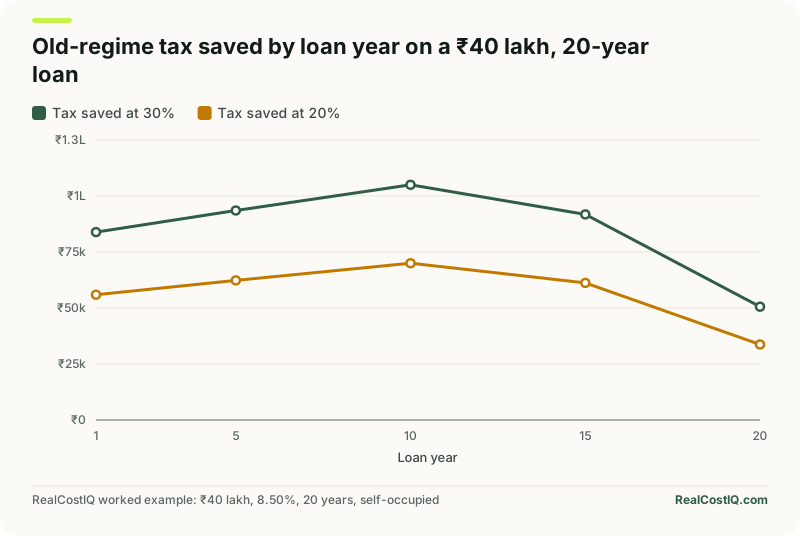
Three things stand out. The interest deduction is capped at ₹2,00,000 for the first twelve years, because your actual interest is above the cap. This means that in those years, extra interest you pay earns you nothing. Your interest drops below the cap in year 13. The principal reaches the ₹1,50,000 limit in year 9. By year 20 the loan is nearly repaid, and the deduction is smaller.
You can test other loan sizes and rates in the home loan tax benefit calculator. Keep in mind its own note: it models the old regime numbers, and a new-regime filer on a self-occupied home would see ₹0.
The new regime: what the department's pages say
The CBDT validation rules for the ITR-1 return for AY 2026-27 say that when the old regime is chosen, a self-occupied property cannot carry interest on borrowed capital of more than ₹2,00,000. They also say that when the new regime is chosen and the property is self-occupied, the interest on borrowed capital must not be more than "0". (Source: CBDT e-Filing, ITR-1 Validation Rules for AY 2026-27, version 1.0 of 15 May 2026, rule 48 and rule 162, read 16 October 2026.)
The department's AY 2026-27 page lists the same split. Under the new regime, interest under Section 24(b) is allowed only for let-out property. Of the Chapter VI-A deductions, only Section 80CCD(2) and Section 80CCH remain. Housing loan principal sits under Section 80C and is an old-regime item. (Source: incometax.gov.in, Salaried Individuals for AY 2026-27, read 16 October 2026.)
A let-out property is a different case. We cover it in a section below. Our home loan tax benefit calculator page says what it does and does not cover.
Joint home loan: two co-owners, two sets of limits
Many flats are bought by two people on one loan, a couple or a parent and a child. Each person's tax return stands alone. So the useful question is how the interest and principal split between the two returns, and what limits apply to each.
Each co-owner files a return of their own, so each has their own limits. Principal first: the ₹1.5 lakh limit in section 123 applies to one taxpayer's deduction, so each co-owner who pays principal has a pool of their own. Interest: under section 24(1) to (2) and section 22(2) of the 2025 Act, the ₹2 lakh limit applies to each co-owner on their own share of the interest. So two co-owners can each claim up to ₹2 lakh. Confirm the position for your own return with a CA before you rely on it.
| Loan | Year-1 interest | Each owner's half | Deduction in all, ₹2 lakh cap per owner |
|---|---|---|---|
| ₹40,00,000 | ₹3,36,946 | ₹1,68,473 | ₹3,36,946 (both halves under ₹2 lakh) |
| ₹80,00,000 | ₹6,73,892 | ₹3,36,946 | ₹4,00,000 (₹2 lakh each) |
Interest comes from the site's loan schedule at 8.50% over 20 years, shares 50:50; the ₹80 lakh row is double the ₹40 lakh row. Principal in year 1 on ₹40 lakh is ₹79,609, about ₹39,800 each, well under each person's ₹1.5 lakh pool.
On a ₹40 lakh loan split equally, each owner's half of the year-1 interest is ₹1,68,473, under ₹2 lakh, so both claim their half in full, ₹3,36,946 in all. On an ₹80 lakh loan each half is ₹3,36,946, so each is capped at ₹2 lakh and the pair deduct ₹4,00,000. Two practical points: the deduction follows who owns and who pays, so keep both names on the sale deed and the loan and keep each person's payment proof. And confirm with a CA. For how a co-applicant changes the loan you can get, see home loan eligibility on a ₹50,000 salary.
Let-out flat under the new regime
If you rent the flat out, interest on the loan is a cost against the rent. The department's AY 2026-27 page for salaried individuals (page last reviewed 9 July 2026, under the 1961 Act) sets out the difference between the regimes for a let-out property. Under both regimes, interest on a housing loan is deductible as the actual amount, without the ₹2 lakh limit that applies to a self-occupied home. The split comes when interest is more than the rent and the property shows a loss. Under the old regime, a loss can be set off against other heads of income up to ₹2,00,000 in the year, and the balance is carried forward for up to 8 years. Under the new regime, the page says the loss cannot be set off against other heads or carried forward. The 2025 Act says the same: section 109(1)(b) caps the set-off at ₹2 lakh and section 110 allows the carry-forward under the old regime, while section 202(2)(b)(ii) and 202(3) bar both the set-off and the carry-forward under the new regime.
| Step | Old regime | New regime |
|---|---|---|
| Loss on the flat for the year | ₹3,00,000 | ₹3,00,000 |
| Set off against salary or other income | ₹2,00,000 (the yearly limit) | ₹0 |
| Carried forward | ₹1,00,000, for up to 8 years | ₹0 (not carried forward: s.202(2)(b)(ii) and s.202(3)) |
The ₹3,00,000 is an illustrative loss, not a computed figure. The set-off and carry-forward rules and the new-regime statement are from the department's AY 2026-27 page (incometax.gov.in, last reviewed 9 July 2026, 1961 Act) and, for the 2025 Act, from sections 109(1)(b), 110, 202(2)(b)(ii) and 202(3) (Gazette text, read 2026-10-21). The department's FAQ on set-off says house property losses from before 1 April 2026 continue under the new Act in the manner of the old section 71B. Confirm your own position with a CA.
In plain terms: under the new regime the department's page says a let-out flat's loss cannot shelter other income. The old regime lets up to ₹2 lakh of it do so. Under the new regime it cannot be carried forward either. Whether the old regime wins for you is a question about your whole return, and this post does not answer it. If rent is above the interest, there is no loss and the question does not arise.
The tax rates behind the saving
To turn a deduction into a saving, you need your top slab rate. The Finance Act 2026 sets out the rates for tax year 2026-27 under the 2025 Act in its First Schedule. For an individual under 60 who is outside the section 202 regime, income up to ₹2,50,000 is nil. The next ₹2,50,000 (to ₹5,00,000) is taxed at 5%. The band from ₹5,00,000 to ₹10,00,000 is taxed at 20%. Income above ₹10,00,000 is taxed at 30%. The Finance Act adds a 4% health and education cess on the tax. (Source: Finance Act 2026 (No. 4 of 2026), First Schedule, Part I-B, Paragraph A(I), and the cess provision, egazette, read 16 October 2026.)
This is why the table shows 20% and 30%. A taxpayer whose top rupee falls in the 20% band saves 20 paise on each rupee deducted, before cess. A taxpayer in the 30% band saves 30 paise. Someone with income below ₹5,00,000 saves less, or nothing, because only the lower bands apply to the top of their income. We do not give the new-regime rate bands here, because we did not read them today and we are not comparing regimes.
Documents that support a claim
Your bank issues a provisional or final interest certificate each year. Keep it. It splits your EMIs into interest and principal, so you do not have to work it out. If the numbers on your certificate differ from your own sums, trust the certificate and ask the bank to explain.
- The bank's annual interest and principal certificate for the loan.
- The sanction letter and the loan account number.
- Receipts for stamp duty and registration, if you plan to claim them.
- The possession letter or completion date, for pre-construction interest.
- Your other 80C-type payments, so you know how much of the ₹1.5 lakh pool is left.
What this post leaves out, on purpose
We do not say which regime is better for you. That depends on your whole income and all your other deductions, and it is a tax-planning question, not a home-loan one. We do not cover capital gains on sale, and our coverage of joint loans and let-out flats is limited to what we could read at source. We also do not cover the extra interest deduction for first-time buyers, because it applied only to loans sanctioned before 1 April 2022. To plan the loan itself, start with the home loan EMI calculator. To see how much a bank may lend you, read home loan eligibility on a ₹50,000 salary.