Most guides say "add a parent and you can borrow more". That is half true. It is true when the parent is young and earning. It can be false when the parent is near retirement, because the tenure shrinks. We could find no lender page that says exactly how it treats a parent's age, so we did the sums for the cases that matter. The method for sizing a loan from pay, the FOIR (the share of your pay that may go to loan payments), is in our post on a home loan on a ₹50,000 salary. We use it here and do not repeat it.
What SBI, HDFC Bank and ICICI Bank publish on age
We opened each bank's own home loan pages on 28 October 2026 and wrote down the age and tenure lines. They are not written the same way, so the table shows exactly what each page says.
| Bank and product | Age line on the page | Tenure line on the page | Co-applicant line |
|---|---|---|---|
| SBI, general home loan | Minimum age 18 years, maximum age 70 years. Resident Indian. | Up to 30 years | The document list covers applicant, co-applicant and guarantor. |
| SBI, balance transfer (takeover) | Minimum age 18 years, maximum age 70 years. | "Extended loan tenure"; no number shown | Same document list. |
| SBI Privilege (government employees) | Minimum age 18 years, maximum age 75 years. Includes people with pensionable service. | Up to 30 years | Not stated on the page. |
| HDFC Bank, home loan | Age 18 to 70 years. The page also lists age at loan maturity as a factor. | Up to 30 years. The FAQ says 30 years or until the age of retirement, whichever is lower. | All co-owners must be co-applicants. Co-applicants need not be co-owners. Up to 8 co-applicants. |
| ICICI Bank, home loan | Salaried 20 to 65 years. Self-employed 21 to 70 years. | Calculator allows up to 30 years | A co-applicant can be a spouse, parent or sibling; the co-applicant's income and credit history are taken into account. |
Sources: SBI general home loan, balance transfer and Privilege product pages; HDFC Bank home loans page (eligibility table and FAQ); ICICI Bank home loan page (eligibility criteria and FAQ). The pages do not say whether an age limit applies to the oldest co-applicant, to the main earner, or at the start or end of the loan.
Three things matter in that table. First, the limits run from 65 to 75, and which one applies depends on the bank and on the job. Second, no page says that the limit is checked at the end of the loan, except that HDFC Bank lists "age at loan maturity" as a factor. Third, no page says whose age counts when there are two applicants. So you cannot tell from the web which rule your bank will use. You can only plan for the strict case and ask for the real one. We use the strict case below, and we say so every time.
The sums: you on ₹70,000, a parent on ₹30,000
Take a buyer who brings home ₹70,000 a month, with no other EMIs. A parent brings home ₹30,000 a month. We use an 8.50% rate, which is our illustration and not a quote (SBI shows rates from 7.50% and HDFC Bank from 8.00% on their pages today). We use a FOIR of 50%, a common lender habit that RBI does not set. So the buyer alone can pay an EMI of ₹35,000, and together the two can pay ₹50,000.
Alone, over the longest tenure of 30 years, the buyer can borrow about ₹45.52 lakh. Now add the parent. The strict case says the loan must end when the parent reaches 70. The table shows what tenure and loan that gives for five parent ages. The last column shows the stricter case of a salaried parent and a cap of 65, like ICICI Bank's salaried limit.
| Parent's age today | Tenure if the loan ends at 70 | Loan if it ends at 70 | Tenure if it ends at 65 | Loan if it ends at 65 |
|---|---|---|---|---|
| Buyer alone (no parent) | 30 years | ₹45,51,878 | 30 years | ₹45,51,878 |
| 45 | 25 years | ₹62,09,428 | 20 years | ₹57,61,542 |
| 50 | 20 years | ₹57,61,542 | 15 years | ₹50,77,485 |
| 55 | 15 years | ₹50,77,485 | 10 years | ₹40,32,723 |
| 58 | 12 years | ₹45,04,279 | 7 years | ₹31,57,266 |
| 60 | 10 years | ₹40,32,723 | 5 years | ₹24,37,059 |
| 65 | 5 years | ₹24,37,059 | None left | Not possible |
Combined take-home pay ₹1,00,000 (buyer ₹70,000, parent ₹30,000), no other EMIs, FOIR 50%, rate 8.50%, monthly repayment, tenure capped at 30 years. Loan = the largest loan whose EMI is ₹50,000 over that tenure, from the same reverse-EMI formula as the site's eligibility calculator. The age-70 and age-65 tenures are our worst-case reading, not a rule printed by any bank.
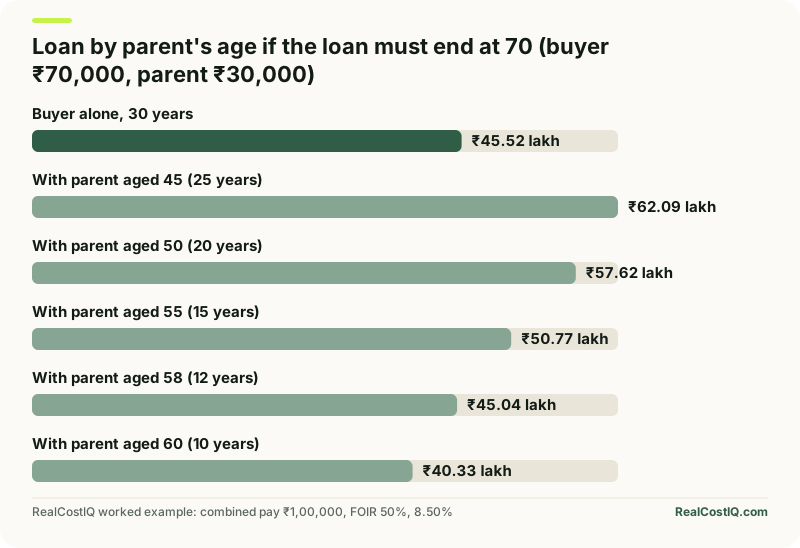
In lakh, the pair can borrow about ₹62.09 lakh with a parent aged 45, ₹57.62 lakh at 50, ₹50.77 lakh at 55, ₹45.04 lakh at 58 and ₹40.33 lakh at 60. This is the result most guides miss. With a parent aged 58 on ₹30,000, the pair can borrow about ₹45.04 lakh. The buyer alone could borrow about ₹45.52 lakh. The parent has added ₹30,000 of pay and still the loan is slightly smaller, because the bank has cut the tenure from 30 years to 12. At 60, the parent makes the loan smaller by about ₹5.2 lakh. At 65, if the strict rule applies, it falls to about ₹24.37 lakh. The extra income only helps if the parent is young enough.
Be careful with what this does not show. If a bank looks only at the main earner's age, the tenure stays at 30 years and the pair can borrow ₹1,00,000 × 50% = ₹50,000 of EMI over 30 years, which is about ₹65.03 lakh. If a bank looks at the parent's age, you get the table above. The truth for your bank is somewhere between them. That range is the reason to ask the bank before you choose a flat.
How much must the parent earn to be worth adding?
Turn the question round. To match the ₹45.52 lakh that the buyer can get alone over 30 years, how much does an older parent need to bring home, if the shorter tenure applies? We solve for the EMI that repays ₹45.52 lakh in that time, double it to get the pay, and take away the buyer's ₹70,000.
| Parent's age | Tenure if the loan ends at 70 | EMI needed to repay ₹45.52 lakh | Combined pay needed | Parent's pay needed |
|---|---|---|---|---|
| 55 | 15 years | ₹44,824 | ₹89,648 | ₹19,648 |
| 58 | 12 years | ₹50,528 | ₹1,01,057 | ₹31,057 |
| 60 | 10 years | ₹56,437 | ₹1,12,874 | ₹42,874 |
| 65 | 5 years | ₹93,389 | ₹1,86,777 | ₹1,16,777 |
Same method as the first table. A parent below the pay shown makes the pair's loan smaller than the buyer's loan alone, if the lender ends the loan at the parent's age 70. Rounded to the rupee.
A parent aged 55 needs to bring in only about ₹19,648 to break even, so almost any income helps. At 58 the figure is about ₹31,057, which is more than the ₹30,000 in our example. At 60, a parent has to bring home about ₹42,874. At 65, over ₹1.16 lakh. So the older the parent, the more the parent has to earn before the loan grows at all.
A shorter loan is not a loss
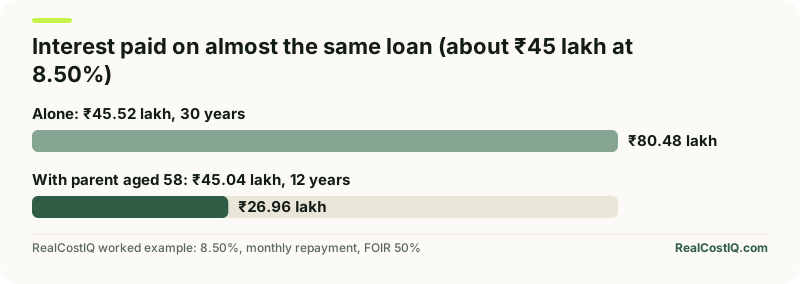
The tables count only the size of the loan. They leave out the interest, and there the shorter tenure wins by a wide margin. The buyer alone borrows about ₹45.52 lakh over 30 years at ₹35,000 a month, and pays about ₹80.48 lakh in interest. The pair with a parent aged 58 borrow about ₹45.04 lakh over 12 years at ₹50,000 a month, and pay about ₹26.96 lakh in interest. That is about ₹53.5 lakh less interest for almost the same loan.
| Tenure | Monthly EMI | Total interest over the loan |
|---|---|---|
| 30 years | ₹30,757 | ₹70.72 lakh |
| 20 years | ₹34,713 | ₹43.31 lakh |
| 15 years | ₹39,390 | ₹30.90 lakh |
| 12 years | ₹44,402 | ₹23.94 lakh |
| 10 years | ₹49,594 | ₹19.51 lakh |
Loan ₹40,00,000, 8.50%, monthly repayment. EMI and interest from the standard EMI formula the site's calculator uses.
So the question is not only how big a loan you can get. It is whether you can pay the higher EMI. In the 58-year-old case the EMI is ₹50,000 against ₹35,000, so ₹15,000 more each month. If the pair can carry it, the shorter tenure saves a great deal. If the buyer has to carry it alone when the parent stops earning, it is a risk. A parent's pay can stop at retirement, and a joint loan does not stop with it. Ask yourself who pays the EMI at 60, and write the answer down before you sign.
Co-applicant, co-owner and guarantor are different jobs
Banks use three words that sound alike. Each has a different effect, and a parent can hold any of them.
- Co-applicant. Signs the loan with you. The bank counts the person's income and credit history (ICICI Bank's FAQ says so for a spouse, parent or sibling). HDFC Bank allows up to 8. A co-applicant who is not a co-owner is allowed. This is the role that raises your eligibility.
- Co-owner. Has a name on the property papers. HDFC Bank says all co-owners must be co-applicants. So if your parent goes on the title, your parent must also sign the loan, and the parent's age and credit will count.
- Guarantor. SBI's document list names applicant, co-applicant and guarantor, so SBI accepts a guarantor. The pages we read do not explain how a guarantor is treated. Ask the branch what a guarantor adds, and what the guarantor owes if you stop paying.
The rule that decides most cases is the HDFC Bank line. A co-applicant need not be a co-owner, but a co-owner must be a co-applicant. If you want your parent's income to count, the parent can sign the loan without being on the title. If you want your parent on the title, the parent must sign the loan. So putting a parent's name on the flat is never free. It brings the parent's age and credit record into the bank's file.
Think also about what a signature means. A co-applicant signs the same loan agreement as you. Ask your bank in writing whether each signer owes the full EMI, and what the bank does if one stops paying. Do not assume that a parent who signs for "support" carries only a share. That is a question for the bank and, if you wish, a lawyer. The law of who inherits a share of a flat, and how, is outside what we can say here.
Adding a mother: PMAY and the state's concessions
A mother, sister or wife on the title can matter for two reasons. The first is the central housing subsidy; you can test your own case in the PMAY subsidy calculator. SBI's PMAY-U 2.0 page, read today, says the scheme is an interest subsidy for EWS, LIG and MIG families buying or building a house in notified urban areas. The page lists these terms: a woman must be the sole owner or a co-owner of the property; the family must not own a pucca house anywhere in India; household income must be up to ₹9 lakh a year; the loan can be up to ₹25 lakh and the project cost up to ₹35 lakh; the carpet area can be up to 120 sq m; and the largest interest subsidy is ₹1.80 lakh. Applications go through the scheme's own portal, pmaymis.gov.in.
Look at the second term again: the family must not own a pucca house anywhere in India. If your parent already owns a house, adding the parent as a co-owner may remove the family from the scheme. The page does not say how it treats a parent's house. Ask the bank before you add anyone, and ask it for an answer in writing. At ₹70,000 plus ₹30,000 of monthly pay, our example family takes home ₹12 lakh a year, so it earns more than the ₹9 lakh limit on gross household income, and PMAY would not apply in our example at all.
The second reason is the state's stamp duty. Some states charge a lower rate when a woman is the buyer. We did not check other concessions, such as for the elderly or for joint owners. Rates differ by state and sometimes by city. We could not read a state portal today, so we give no rate. Check your state's current rate on the state registration department's site, and the date on which it was set. Our home loan eligibility calculator sizes the loan; the state decides the duty on top.
What the loan size means for the flat you can buy
A bigger loan buys a dearer flat, but not rupee for rupee. The bank lends only a share of the property's value, called the loan-to-value ratio, or LTV. HDFC Bank's page, read today, lists the share it funds as 90% of the property cost up to ₹30 lakh, 80% for loans from ₹30.01 lakh to ₹75 lakh, and 75% above ₹75 lakh. You pay the rest from your own money. The stamp duty and registration are extra, and the state sets them.
| Case | Loan | Flat price at 80% LTV | Own money for the flat |
|---|---|---|---|
| Buyer alone, 30 years | ₹45,51,878 | ₹56,89,847 | ₹11,37,969 |
| With parent aged 58 (12 years) | ₹45,04,279 | ₹56,30,349 | ₹11,26,070 |
| With parent aged 55 (15 years) | ₹50,77,485 | ₹63,46,856 | ₹12,69,371 |
| With parent aged 50 (20 years) | ₹57,61,542 | ₹72,01,927 | ₹14,40,385 |
| With parent aged 45 (25 years) | ₹62,09,428 | ₹77,61,786 | ₹15,52,357 |
Flat price = loan ÷ 0.80. The 80% slab applies to loans from ₹30.01 lakh to ₹75 lakh on HDFC Bank's page (read 28 October 2026). Stamp duty and registration are not included, and the state sets them. Own money = flat price minus loan.
The young-parent case brings a real gain: a flat about ₹20.7 lakh dearer than the buyer could afford alone (₹77.62 lakh against ₹56.90 lakh). But it needs about ₹4.1 lakh more of your own money for the flat itself. So when you add a parent, check that you have the larger down payment, not only the larger loan.
When the parent is a weak link
Three cases come up often. In each, a parent can lower your chances, not raise them.
- A parent with no income. A co-owner with no pay adds nothing to the FOIR sum. The bank counts only income. Such a parent has to be a co-applicant if on the title (HDFC Bank's rule), so the parent's age still counts but the parent's pay does not.
- A parent near the age cap. At 65 or more, the strict case in the table leaves five years or none. Some people then take the loan in their own name and keep the parent off the title and off the form. The cost is a smaller loan.
- A parent with weak credit. ICICI Bank says the co-applicant's credit history is taken into account. A missed payment on a parent's old loan can follow the pair. Ask the parent to check their credit report before you apply.
There is a government route worth a look if your parent is a government employee or a pensioner. SBI's Privilege home loan page says it is for employees of Central and State government, including PSBs and PSUs, and for people with pensionable service. It lists a maximum age of 75, tenure up to 30 years, a full waiver of the processing fee and no prepayment penalty. So a parent in that group may face a more generous age line than the 70 on SBI's general loan. The page does not say whether the parent can be a co-applicant on a loan taken in your name. Ask.
Seven questions to ask before you add a parent
- Does your age limit apply to the main earner, to the oldest applicant, or to every applicant? Get the answer in writing.
- Is the age limit checked at the start of the loan or at the end?
- What is the longest tenure you will give us, with each of the two ages?
- Will you count my parent's pension or rent as income, and what proof do you need?
- If my parent signs but is not on the title, is that allowed? If my parent is on the title, must my parent also sign? (HDFC Bank says yes to the second.)
- If my parent owns a house, does that stop us from the PMAY interest subsidy?
- If one signer stops paying, who does the bank ask for the full EMI?
What we did not read
Four limits apply. No lender page says how it treats the age of a second applicant, so the age-based tenures are our worst case and not a rule. We did not read SBI's rate concession for women borrowers, because it sits in a rate-card image. We did not read any state portal, so stamp duty and women's or senior concessions have no figure. And the HDFC Bank page restates the RBI loan-to-value slabs; we did not re-read RBI's own text today. The post covers banks. Housing finance companies have their own rules. It is about the cost of a home loan. The tax treatment of a joint loan is outside it; ask a chartered accountant.