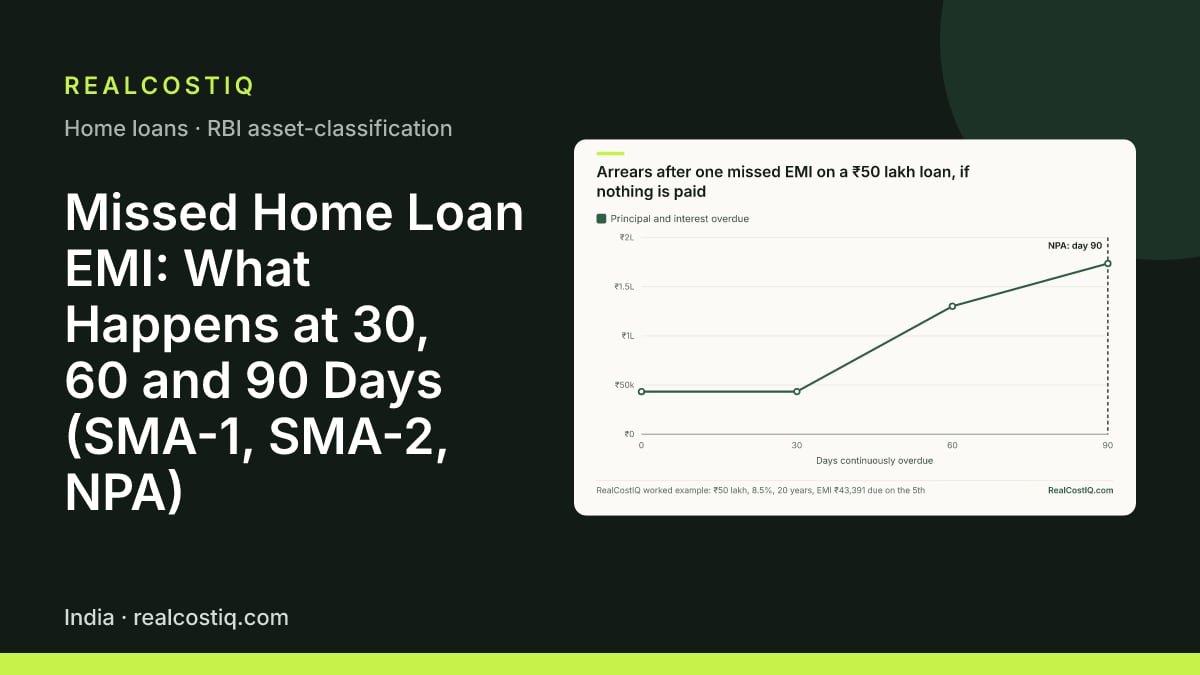
A home-loan EMI that bounces does not stay a private matter between you and your bank for long. Every regulated lender in India has to tag an overdue account on a schedule laid down by the Reserve Bank of India. The tags have names that borrowers rarely hear until a letter arrives: SMA-0, SMA-1, SMA-2 and NPA. They are not penalties. They are the lender's regulatory classification of your account. They set the clock for what happens next. This includes how the lender reports the account, and when it may begin to treat the loan as a non-performing asset. This post walks through that ladder using the RBI's own text. It includes a worked calendar for a ₹50 lakh loan. That way you can read the dates on a lender's notice against the rule they come from.
How this was checked. We read every RBI document cited below on 11 October 2026 on rbi.org.in. They are:
the Master Circular on income recognition, asset classification and provisioning dated 1 October 2021; the clarification circular of 12 November 2021 (RBI/2021-2022/125); the follow-up of 15 February 2022 (RBI/2021-2022/158); the Scale Based Regulation circular for NBFCs of 22 October 2021 (RBI/2021-22/112); the penal-charges circular of 18 August 2023 (RBI/2023-24/53); the circular on recovery agents of 12 August 2022 (RBI/2022-23/108); the Commercial Banks (Credit Facilities) Directions, 2025 (RBI/DOR/2025-26/154); the Commercial Banks (Asset Classification, Provisioning and Income Recognition) Directions, 2026 (RBI/DOR/2026-27/398, 27 April 2026); and the NBFC Resolution of Stressed Assets Directions, 2025 (RBI/DOR/2025-26/357).
We paraphrase and do not reproduce the text. The EMI figures are our own. We ran them on the engine behind the site's home loan EMI calculator at stated, illustrative inputs. Nothing here is advice on whether to pay, restructure or dispute.
What counts as overdue, and who sets the date
The master circular defines overdue in one sentence. Any amount due to the bank under a credit facility is overdue if it is not paid on the due date fixed by the bank. Two things follow. First, the clock starts on the date the lender fixed, not on the date you notice a bounce. Second, it applies to principal, interest or any other amount that is wholly or partly overdue. A part-payment does not stop the clock on the unpaid part.
In November 2021, RBI noticed that some loan agreements described due dates loosely. That left room for argument about when the clock began. RBI required four things to be written into the loan agreement. These were the exact due dates, the repayment frequency, the split between principal and interest, and examples of the SMA and NPA classification dates. The borrower must be told at sanction and again whenever the sanction terms change. For loans with a moratorium, the exact date repayment begins has to be specified. Those instructions applied to fresh loans from 31 December 2021. They applied to existing loans when they came up for renewal or review. Suppose your agreement is older and carries no such example. You can still ask the lender in writing for the date its system treats as your due date, and the dates on which it will flag each stage.
The ladder: SMA-0, SMA-1, SMA-2 and NPA
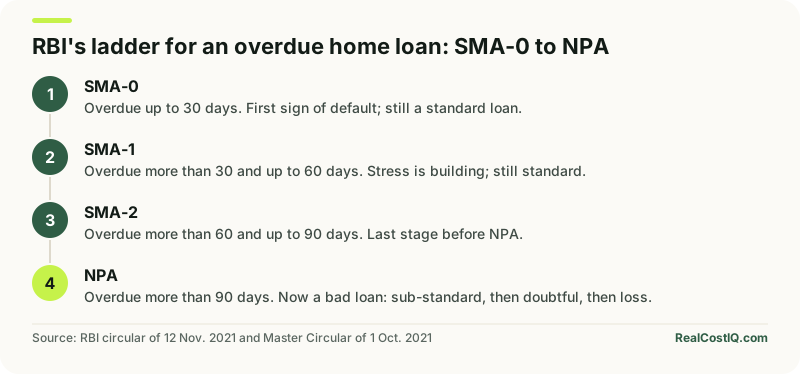
SMA stands for special mention account. RBI traces the idea to its 2019 framework for resolving stressed assets. The idea is that a lender should recognise stress at the first sign of default, rather than after 90 days. The November 2021 circular says the intervals are continuous. It sets the basis for loans other than revolving facilities like cash credit and overdraft. Home loans are term loans, so this is the row that applies to them.
| Status | Principal, interest or any other amount overdue for | What the status means |
|---|---|---|
| SMA-0 | Up to 30 days | First recognition of default; the account is still a standard asset |
| SMA-1 | More than 30 days and up to 60 days | Stress is building; still standard |
| SMA-2 | More than 60 days and up to 90 days | Last stage before NPA; still standard |
| NPA | Interest and/or instalment of principal overdue for more than 90 days | Classified as a non-performing asset: sub-standard, then doubtful, then loss |
Source: RBI circular of 12 November 2021 (SMA bands) and the Master Circular of 1 October 2021, paragraph 2.1.2 (NPA for a term loan). The same SMA rule applies to all loans, including retail loans, irrespective of the size of the lender's exposure; only agricultural advances under crop-season norms are exempt.
Notice what the table does not say. SMA is not a mark against you in the sense of a fine, and the circulars do not tie any charge to it. Its function is regulatory. It forces the lender to recognise and track the stress early. What it means for you in practice depends on the lender's own collections policy, its fees, and what it reports onward. On reporting, RBI's Credit Facilities Directions for banks observe in passing that information about the servicing of loans is passed to credit information companies on a regular basis. That is why a delay that looks small on your side can show up on a credit record. We did not read an RBI direction that sets the reporting format or the day on which a delay is reported. So we do not state one.
A worked calendar: a ₹50 lakh loan, first EMI missed
RBI's circular gives its own worked example. A loan is due on 31 March and stays unpaid. It is flagged SMA-1 on 30 April, SMA-2 on 30 May and an NPA on 29 June. Those are the 30th, 60th and 90th days of continuous overdue. Here is the same logic on a home loan, with numbers. Take a ₹50 lakh loan at 8.5% a year over 20 years. Run through the site's EMI engine, the EMI is ₹43,391. Assume the EMI falls due on the 5th of every month. Assume the 5 January 2027 instalment is missed and nothing is paid afterwards. These are hypothetical inputs chosen to show the mechanics. They are not a statement of what any lender charges.
| Day-end date | Days continuously overdue | EMIs overdue by then | Principal and interest overdue | Status flagged |
|---|---|---|---|---|
| 5 Jan 2027 | 0 (due date, unpaid) | 1 | ₹43,391 | Overdue; SMA-0 |
| 4 Feb 2027 | 30 | 1 | ₹43,391 | SMA-1 |
| 6 Mar 2027 | 60 | 3 | ₹1,30,173 | SMA-2 |
| 5 Apr 2027 | 90 | 4 | ₹1,73,565 | NPA |
EMI from the site's home loan EMI engine: price ₹62,50,000, down payment ₹12,50,000, 8.5%, 20 years gives a loan of ₹50,00,000 and an EMI of ₹43,391. Arrears are whole EMIs and exclude any penal charges, which are a separate matter. Dates follow RBI's example: SMA-1, SMA-2 and NPA are tagged at the day-end of the 30th, 60th and 90th day of continuous overdue.
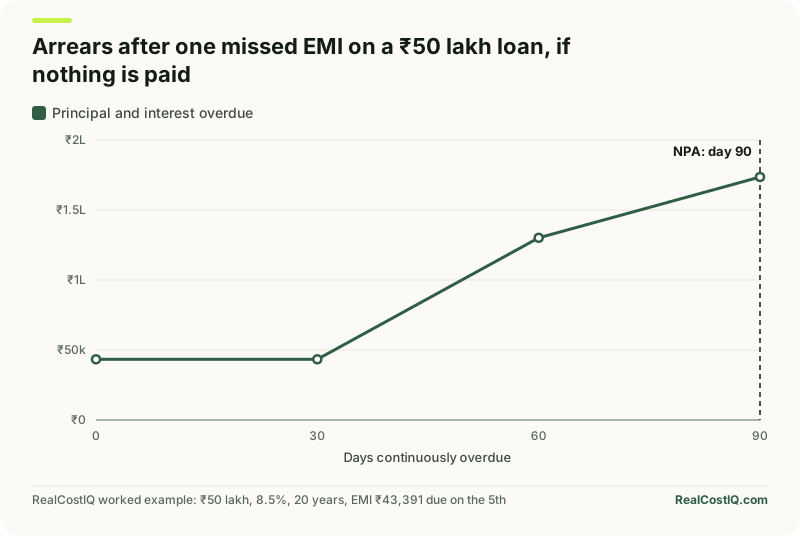
The table shows something the single-bounce story hides. A monthly loan keeps generating new due dates while the clock runs on the oldest one. By the time the first missed EMI reaches SMA-2 on 6 March, three instalments are overdue, not one. By the NPA date, four are. The ₹43,391 you missed in January has become ₹1,73,565 of arrears. That is the sum that has to be cleared to reverse the status. We come to that point below. The same arithmetic is why the first 30 days matter most. It is the stretch in which a single instalment is the whole problem.
RBI also fixed how the dates are stamped. Overdue accounts are flagged as part of the lender's day-end process for the due date, no matter what time of day that process runs. SMA and NPA classification is done as part of the day-end process for the relevant date. The classification date is the calendar date for which the process is run. In plain words, the status shows what your account looked like at the end of that calendar day. The circular's own test is whether the lender received the full dues before it runs its day-end process for that date. If it did not, that date is the date of overdue. The 2026 bank Directions repeat the day-end flagging rule (paragraphs 14 and 15). They include the point that the NPA classification date is the calendar date for which the day-end process is run.
What happens at NPA, and what clears it
For a term loan, the master circular defines a non-performing asset as interest or an instalment of principal remaining overdue for more than 90 days. A separate paragraph in the same master circular once tied the NPA test for interest to the quarter. An account was classified as NPA only if interest due and charged in a quarter was not paid within 90 days of the quarter's end. The November 2021 circular removed that cushion for term loans. From 31 March 2022, an account is an NPA if the interest applied at the specified rests stays overdue for more than 90 days. ("Rests" are the intervals at which interest is added to the loan.) This aligns it with the 90-day norm and with interest applied at monthly rests. For a monthly-EMI home loan, that is the practical test.
Within NPA, the master circular sets three grades. A sub-standard asset is one that has remained an NPA for up to 12 months. An asset is doubtful once it has stayed in the sub-standard category for 12 months. A loss asset is one that the lender, its auditors or an RBI inspection has identified as uncollectible. It need not yet be written off. The grades matter to the lender's provisioning, which is the money it sets aside against bad loans. Nothing in the texts we read turns the grade into an automatic charge on the borrower.
The route back is stricter than most borrowers expect. RBI observed that some lenders were upgrading an NPA to standard after receiving only the overdue interest, or only part of the arrears. The November 2021 circular put a stop to that. A loan classified as NPA can be upgraded to standard only if the entire arrears of interest and principal are paid. The February 2022 follow-up added a rule for borrowers with more than one credit facility with the same lender. The accounts are upgraded only when the entire arrears on all of those facilities are cleared. The circular allowed NBFCs until 30 September 2022 to build the systems for this. So for every lender the rule has applied for some time. Use the table above. Clearing the January EMI alone on 10 April would leave three instalments of arrears and the NPA tag in place. Only paying the full ₹1,73,565, plus whatever else is overdue by then, restores the standard status. The 2026 bank Directions (paragraph 8(10)) restate the same upgrade rule. They add that, for this purpose, borrower and co-borrower are treated as jointly and severally liable for repayment. In plain words, each of them can be asked to pay the whole amount.
One more consequence catches borrowers who hold other loans with the same bank. The 2021 master circular says asset classification is borrower-wise and not facility-wise. The 2026 Directions (paragraph 8(9)) are explicit. Where a bank has more than one exposure to a borrower and any one is classified as NPA, the bank considers all exposures to that borrower as NPA. So NPA classification applies at the level of the borrower. Suppose your home loan turns NPA. A car loan, personal loan or credit card with the same bank is classified NPA as well, even if you have paid those on time. The upgrade rule above then requires the arrears on all of them to be cleared. We read the 2026 text. We did not read the 2025 bank Directions. So the paragraph numbers belong to the version that takes effect on 1 April 2027.
The clarification circulars also cover two special cases. These are accounts classified as NPA because of restructuring, and accounts where a project missed its commercial-operations date. They follow the instructions specific to those cases. A restructuring of a stressed borrower falls under a separate part of the master circular, a framework for resolving stressed assets. We did not read what it allows a borrower in enough detail to describe it. If a lender proposes a restructuring or a settlement, ask for it in writing, with its effect on the classification dates.
Banks, NBFCs and housing finance companies
A home loan can come from a bank or from a housing finance company, and the circulars are addressed to both. The November 2021 circular covers commercial banks, urban and state co-operative banks, all-India financial institutions and all NBFCs (non-banking finance companies) including housing finance companies. It says its instructions apply to all lending institutions, with the references to bank circulars read as the instructions that apply to each. A footnote adds a point for NBFCs. References to 90 days for SMA-2 and NPA classification are to be read as per the applicable norms and subject to the Scale Based Regulation circular of 22 October 2021.
That Scale Based Regulation circular moved the NPA test for all categories of NBFCs to overdue for more than 90 days. It gave NBFCs in the base layer a glide path that ended on 31 March 2026. We do not rely on that glide path for a housing loan. It concerned base-layer NBFCs. Housing finance companies have their own directions, which we did not read because they are published as a PDF only. For the SMA bands, the NBFC Resolution of Stressed Assets Directions, 2025 (paragraphs 18 and 19) set the same three bands. They apply them to all loans, including retail loans, irrespective of size of exposure. If your lender is a housing finance company, ask which directions it classifies under, and ask for the NPA date in writing.
Charges you may be asked to pay on top of the EMI
A missed EMI usually brings a charge as well as a flag. The rules on penal charges are set out in our post on EMI versus tenure at a rate reset. They include that penal charges are not penal interest and are not capitalised. The amount is the lender's own and sits in your schedule of charges, so we give no figure. The credit-facilities rules now send banks to RBI's Responsible Business Conduct Directions, 2025 for penal charges and the key facts statement. We have not read that instrument.
What the circular does not do is fix an amount. The percentage or flat sum is the lender's own, set under a board-approved policy, and it will be in your schedule of charges. A figure quoted in this post would be a guess, so we give none. The EMI and arrears are the part you can work out. The home loan EMI calculator is the tool for the first. The lender's schedule of charges is the source for the second.
What a lender may not do when it chases the overdue amount
RBI's circular of 12 August 2022 on recovery agents sets conduct limits. Regulated entities must strictly ensure that they or their agents do not resort to intimidation or harassment of any kind, verbal or physical, in debt collection. The circular lists the banned acts. They are acts meant to humiliate publicly or to intrude on the privacy of the debtor's family members, referees and friends. They also include sending inappropriate messages on mobile or social media, making threatening or anonymous calls, and persistently calling the borrower. Calling before 8:00 a.m. or after 7:00 p.m. is banned, and so are false and misleading representations. The circular applies to commercial banks, all-India financial institutions, NBFCs including housing finance companies, urban and state and district co-operative banks and asset reconstruction companies. It does not apply to microfinance loans, which have their own direction. It also restates that a lender is ultimately responsible for the actions of its agents. The same circular says a violation will be viewed seriously.
Two cautions. First, the circular sets conduct limits. It does not take away the lender's right to ask for the overdue amount, to send reminders or to follow its legal remedies. Second, it is a rule on the lender. Say a call comes at 9 p.m. The instruction to follow is the lender's. The route is a written complaint to the lender and then the RBI's complaint channels. We did not verify the details of those channels today, so we do not describe them.
What we did not verify: legal recovery under the SARFAESI Act
Lenders also hold statutory remedies for a secured loan that has turned non-performing. The best known is enforcement of the security under the Securitisation and Reconstruction of Financial Assets and Enforcement of Security Interest Act, 2002 (the SARFAESI Act). It lets a lender take over and sell the property that secures the loan. We tried to read the Act's text on India Code today and the host did not respond. So we make no statement about the notices it requires, the periods it allows or what a borrower can challenge. Treat anything you see quoted about that process, including figures in forums, as unverified until you read the Act or a lawyer's advice for your loan. That is the one part of the NPA story this post deliberately does not cover.
A checklist for the first 30 days
These are steps that follow from the texts above. They are not advice about your finances. They are about information you are entitled to ask for.
- Find the due date. The clock runs from the due date fixed by the lender. Check your sanction letter and loan agreement for the exact date. Also look for the SMA and NPA examples RBI required lenders to include.
- Ask for the arrears figure in writing. Ask for the principal, interest and any charges separately. Also ask for the date of the day-end process the figure is as of.
- Know the two dates that matter. Day 30 is SMA-1. Day 90 is NPA. Count them from the first unpaid due date, not from the latest one.
- Ask how part-payments are applied. The status depends on how long an amount has been overdue. The 2026 bank Directions (paragraph 13) require the loan contract to include the schema for appropriation of repayments, from 1 April 2027. Before then, ask how the lender would apply a part-payment on your loan before you pay.
- If you are already NPA, ask what clears it. The answer in the circulars is the entire arrears of principal and interest, across all your facilities with that lender. It is not the latest EMI. For a bank, the NPA status itself applies to all your exposures to it.
- Keep contact records. Suppose calls fall outside 8 a.m. to 7 p.m., or messages are abusive. The circular of 12 August 2022 is the standard to cite in your complaint.
- Model your options. Suppose you are weighing a different lender. The balance transfer calculator and the prepayment calculator show the arithmetic. Whether a new lender will accept an account in arrears is its own policy, which we did not verify.
What the ladder does not tell you
The ladder is a classification rule. It does not tell you how a particular bank will treat a first-time delay of a few days. It does not tell you whether the bank waives a charge, how it reports to a credit bureau, or what a settlement would cost. It also does not tell you what happens to a loan that is still a standard asset but has a flag. It says nothing about the credit score or about taxes on the property. Those depend on lender policy and the specifics of the loan. Use the ladder to read the dates on a notice and to ask for the right things in writing.
The main point is the arithmetic of the calendar. Thirty days is not much time on a monthly loan, because a second EMI falls due inside it. Suppose you expect a payment to be late. The cheapest moment to act is before the next due date. Then only one instalment is outstanding and the status is still SMA-0 or SMA-1.